(preface) On March 24, 1865, Union Gen. George Stoneman led 6,000 cavalrymen from Tennessee into southwestern Virginia and western North Carolina to disrupt the Confederate supply line by destroying sections of the Virginia and . . . — — Map (db m284170) HM
Stoneman’s U.S. Cavalry occupied the town of Salisbury, Apr. 12, 1865, and destroyed the Confederate warehouses, supplies, and prison. — — Map (db m33918) HM
On May 1, 1865, cadets from the Arsenal Academy at Columbia, under Capt. John Peyre Thomas, who were en route from Greenville to Newberry to be disbanded, met a band of Stoneman's raiders near here in one of the last engagements of the war, which . . . — — Map (db m8395) HM
Union Maj. Gen. George Stoneman, seeking to destroy crucial Confederate infrastructure, led more than 5,000 cavalrymen into Southwest Virginia in Dec. 1864. Here at Marion, Stoneman’s main column encountered about 1,000 Confederate cavalry and . . . — — Map (db m300296) HM
During the Civil War, the Confederacy relied on small rural ironworks for the metals needed to manufacture cannons, swords, and firearms. The furnace here, owned by the Moratock Mining and Manufacturing Company, was typical of the charcoal blast . . . — — Map (db m34156) HM
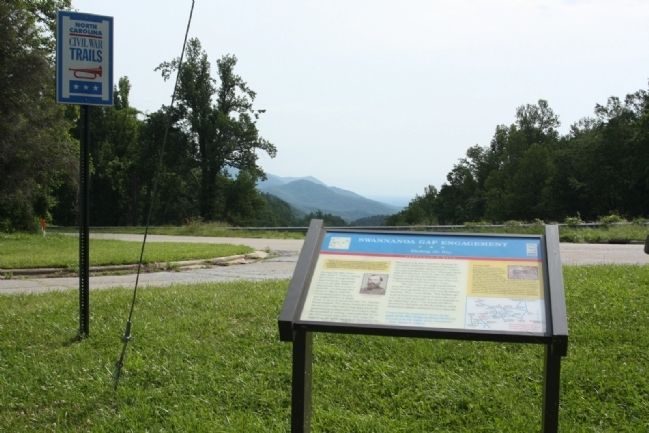
Southern troops turned back Stoneman's U.S. cavalry, raiding through western North Carolina, at Swannanoa Gap, near here, April 20, 1865. — — Map (db m55830) HM
The Battle of Brown's Mill killed or wounded about 100 of McCook's men. Wheeler's casualties probably numbered fewer than 50. "The dead lay around us on every side, singly and in groups and piles; men and horses, - in some cases, apparently . . . — — Map (db m94668) HM
On March 24, 1865, Union Gen. George Stoneman led 6,000 cavalrymen from Tennessee into southwestern Virginia and western North Carolina to disrupt the Confederate supply line by destroying sections of the Virginia and Tennessee Railroad, . . . — — Map (db m253441) HM
Southern troops turned back Stoneman's U. S. Cavalry, raiding through western North Carolina, at the Yadkin River Bridge, April 12, 1865. — — Map (db m33927) HM
On a raid through western North Carolina Gen. Stoneman’s U. S. Cavalry fought a skirmish with Southern troops near here, April 12, 1865. — — Map (db m33921) HM
Early in April 1865, Union Gen. George Stoneman’s cavalry moved from Tennessee into Virginia and then south through Danbury to destroy railroad track, warehouses, and supplies that supported Gen. Robert E. Lee’s Army of Northern Virginia. Stoneman . . . — — Map (db m77678) HM
On March 24, 1865, Union Gen. George Stoneman led 6,00 cavalrymen from Tennesse into southwestern Virginia and western North Carolina to disrupt the Confederate supply line by destroying sections of the Virginia and Tennessee Railroad, the . . . — — Map (db m299100) HM
On December 1, 1864, Union Gen. George Stoneman led 5,700 cavalrymen east from Knoxville, Tennessee, to destroy iron-, lead-, and saltworks in Virginia that were essential to the Confederate war effort. After actions at Kingsport and . . . — — Map (db m261967) HM
This was the site of ‘Los Robles’, the 400 acre estate of Governor George Stoneman. Here in 1880 President Rutherford B. Hayes was entertained. The first schoolhouse in the San Gabriel Valley, California's first tennis club, and the first municipal . . . — — Map (db m127644) HM
Sunshine Church II, built in 1880 and dedicated in 1883 by Rev. Sam Jones, replaced old Sunshine Church, two miles south of here, which General Sherman’s troops burned in 1864. A wounded northern prisoner, B.F. Morris, Shelby, Ohio, cared for by . . . — — Map (db m8897) HM
(preface)
On March 24, 1865, Union Gen. George Stoneman led 6,000 cavalrymen from Tennessee into southwestern Virginia and western North Carolina to disrupt the Confederate supply line by destroying sections of the Virginia and Tennessee . . . — — Map (db m168406) HM
On a Civil War raid through Western North Carolina by Gen. George Stoneman's U.S. Cavalry troops commanded by Col. William J. Palmer passed through Newton on April 17, 1865, burned the Confederate Commissary depot and the county jail, and shot and . . . — — Map (db m152421) HM
(preface)
On March 24, 1865, Union Gen. George Stoneman led 6,000 cavalrymen from Tennessee into southwestern Virginia and western North Carolina to disrupt the Confederate supply line by destroying sections of the Virginia and Tennessee . . . — — Map (db m208799) HM
In 1838, the Richmond, Fredericksburg & Potomac Railroad bought 462 acres bordering its tracks twelve miles north of Richmond in Hanover County. The company created a small summer retreat and passenger rest stop there. In 1858, the area was . . . — — Map (db m1991) HM
The Old Rowan County Courthouse, a visible reminder of Salisbury’s antebellum prosperity, was erected in 1855 and is one of North Carolina’s finest Greek Revival-style public buildings. It served as Rowan’s third courthouse until 1914. Salisbury . . . — — Map (db m34278) HM
On March 24, 1865, Union Gen. George Stoneman led 6,000 cavalrymen from Tennessee into southwestern Virginia and western North Carolina to disrupt the Confederate supply line by destroying sections of the Virginia and Tennessee Railroad, . . . — — Map (db m20348) HM
On March 24, 1865, Union Gen. George Stoneman led 6,000 cavalrymen from Tennessee into southwestern Virginia and western North Carolina to disrupt the Confederate supply line by destroying sections of the Virginia and Tennessee Railroad, . . . — — Map (db m301373) HM
On March 24, 1865, Union Gen. George Stoneman led 6,000 cavalrymen from Tennessee into southwestern Virginia and western North Carolina to disrupt the Confederate supply line by destroying sections of the Virginia and Tennessee Railroad, the . . . — — Map (db m12890) HM
On March 24, 1865, Union Gen. George Stoneman led 6,000 cavalrymen from Tennessee into southwestern Virginia and western North Carolina to disrupt the Confederate supply line by destroying sections of the Virginia and Tennessee Railroad, . . . — — Map (db m54615) HM
On the other side of the parapet is Quarterpath Road, a historic roadbed that for centuries linked Williamsburg to Allen’s Wharf on the James River. It runs behind the Confederate fortifications here, gaining additional importance during the Battle . . . — — Map (db m184202) HM
On this site between 1849 and 1957 stood the Union Hotel and Hall. Built by three veterans of the Mexican War, the hotel was a one-story adobe and the hall a one-story frame building. These were destroyed by fire in 1866 and replaced by two-story . . . — — Map (db m80731) HM
(Preface) On March 24, 1865, Union Gen. George Stoneman led 6,000 cavalrymen from Tennessee into southwestern Virginia and western North Carolina to disrupt the Confederate supply line by destroying sections of the Virginia and . . . — — Map (db m284171) HM
On March 24, 1865, Union Gen. George Stoneman led 6,000 cavalrymen from Tennessee into southwestern Virginia and western North Carolina to disrupt the Confederate supply line by destroying sections of the Virginia and Tennessee Railroad, the . . . — — Map (db m99609) HM
The church that stood here in 1865 became a prison for three days when Union Gen. George Stoneman, with two brigades of raiders under Gen. Alvan C. Gillem, occupied Lenoir over Easter weekend, April 15-17, 1865. The prisoners were 900 old men, boys, . . . — — Map (db m301374) HM
(Preface):
On March 24, 1865, Union Gen. George Stoneman led 6,000 cavalrymen from Tennessee into southwestern Virginia and western North Carolina to disrupt the Confederate supply line by destroying sections of the Virginia and Tennessee . . . — — Map (db m262946) HM
(Preface):
On March 24, 1865, Union Gen. George Stoneman led 6,000 cavalrymen from Tennessee into southwestern Virginia and western North Carolina to disrupt the Confederate supply line by destroying sections of the Virginia and Tennessee . . . — — Map (db m56794) HM
On March 24, 1865, Union Gen. George Stoneman led 6,000 cavalrymen from Tennessee into southwestern Virginia and western North Carolina to disrupt the Confederate supply line by destroying sections of the Virginia and Tennessee Railroad, . . . — — Map (db m270440) HM
On March 24, 1865, Union Gen. George Stoneman led 6,000 cavalrymen from Tennessee into southwestern Virginia and western North Carolina to disrupt the Confederate supply line by destroying sections of the Virginia and Tennessee Railroad, . . . — — Map (db m66013) HM
On December 1, 1864, Union Gen. George Stoneman led 5,700 cavalrymen east from Knoxville, Tennessee, to destroy iron-, lead-, and saltworks in Virginia that were essential to the Confederate war effort. After actions at Kingsport and . . . — — Map (db m67298) HM
(preface)
On March 24, 1865, Union Gen. George Stoneman led 6,000 cavalrymen from Tennessee into southwestern Virginia and western North Carolina to disrupt the Confederate supply line by destroying sections of the Virginia and Tennessee . . . — — Map (db m209727) HM
On March 24, 1865, Union Gen. George Stoneman led 6,000 cavalrymen from Tennessee into southwestern Virginia and western North Carolina to disrupt the Confederate supply line by destroying sections of the Virginia and Tennessee Railroad, . . . — — Map (db m53207) HM
After destroying the Confederate supply depot and prison at Salisbury, Union Gen.
George Stoneman led his raiders west toward Tennessee, arriving in Statesville
on the night of April 13, 1865. Here his men burned supplies, the railroad depot,
and . . . — — Map (db m262947) HM
(preface) On March 24, 1865, Union Gen. George Stoneman led 6,000 cavalrymen from Tennessee into southwestern Virginia and western North Carolina to disrupt the Confederate supply line by destroying sections of the Virginia and . . . — — Map (db m284209) HM
(Preface):
On March 24, 1865, Union Gen. George Stoneman led 6,000 cavalrymen from Tennessee into southwestern Virginia and western North Carolina to disrupt the Confederate supply line by destroying sections of the Virginia and Tennessee . . . — — Map (db m54626) HM
In July, 1864, Maj. Gen. W. T. Sherman’s army [US] closed in on Atlanta. Finding its fortifications “too strong to assault and too extensive to invest,” he sought to force its fall by sending Maj. Gen. George Stoneman, with three cavalry . . . — — Map (db m25207) HM
As part of a two-pronged Cavalry raid, on Wednesday, July 27 1864, Union Major General George Stoneman with over 2,100 troopers left the main Federal army then located near Atlanta. Stoneman's orders from Major General William T. Sherman, were to . . . — — Map (db m103205) HM
Closing in on Atlanta in July 1864, Maj. Gen. W.T. Sherman, USA, found its vast fortifications “too strong to assault and too extensive to invest.” To force an evacuation, he sent Maj. Gen. George Stoneman’s cavalry [US] (2112 men and 2 . . . — — Map (db m16165) HM
During the Civil War, White's Ford on the Potomac River was employed by Confederate troops on three separate occasions. Lee's troops crossed here in their invasion of Maryland, September 4-7, 1862. General Jubal A. Early's II Corps, after an . . . — — Map (db m10145) HM
On November 2, 1861, the Confederate government purchased about 16 acres here for a prison. The tract included an abandoned three-story cotton mill, a boiler house, six tenements, a superintendent’s house, and several smaller buildings. A stockade . . . — — Map (db m34202) HM
In 1856 Nathaniel Boyden and other investors established the North Carolina Foundry and Agricultural Machine Works. It was located on East Kerr Street on an acre lot lying between the railroad and Long Street. The property, with its three large . . . — — Map (db m238692) HM
The site of Fort Hamby is located about half a mile south of here. The two-story log house was not a military fortification. It got its name after 20 to 30 Union and Confederate deserters occupied it at the end of the war. Their leader, who gave his . . . — — Map (db m55373) HM
(Preface):
On March 24, 1865, Union Gen. George Stoneman led 6,000 cavalrymen from Tennessee into southwestern Virginia and western North Carolina to disrupt the Confederate supply line by destroying sections of the Virginia and Tennessee . . . — — Map (db m55343) HM
(Preface):
On March 24, 1865, Union Gen. George Stoneman led 6,000 cavalrymen from Tennessee into southwestern Virginia and western North Carolina to disrupt the Confederate supply line by destroying sections of the Virginia and Tennessee . . . — — Map (db m56801) HM
On January 25, 1863, Union general Joseph "Fighting Joe" Hooker replaced Gen. Ambrose E. Burnside as the fifth commander of the demoralized eastern armies in less than two years. On taking charge of the Army of the Potomac, Hooker implemented . . . — — Map (db m154485) HM
Throughout 1864, Federal raids against the Confederate infrastructure in East Tennessee and Southwest Virginia attempted to destroy iron and lead mines, salt works and railroads. The Virginia & Tennessee Railroad, the Confederate lifeline to the . . . — — Map (db m196007) HM
During the Civil War, Macon, Georgia was a thriving city, serving as a major transportation, medical, and manufacturing center. In 1864, Federal officers were being held at Camp Oglethorpe, a prisoner of war camp. Two battles were fought in Macon; . . . — — Map (db m98657) HM
In July, 1864, Maj. Gen. W.T. Sherman’s army [US] closed in on Atlanta. Finding its fortifications “too strong to assault and too extensive to invest,” he sought to force its fall by sending Maj. Gen George Stoneman, with three cavalry . . . — — Map (db m24478) HM
In July, 1864, Maj. Gen. W. T. Sherman’s army [US] closed in on Atlanta. Finding its fortifications “too strong to assault and too extensive to invest,” he sought to force its fall by sending Maj. Gen. George Stoneman, with three cavalry . . . — — Map (db m25645) HM
Closing in on Atlanta in July, 1864, Maj. Gen. W. T. Sherman, USA, found its vast fortifications “too strong to assault and too extensive to invest.” To force an evacuation, he sent Maj. Gen. George Stoneman’s cavalry [US] (2112 men and . . . — — Map (db m106731) HM
In July, 1864, Maj. Gen. W.T. Sherman’s army [US] closed in on Atlanta. Finding its fortifications “too strong to assault and too extensive to invest,” he sought to force its fall by sending Maj. Gen George Stoneman, with three cavalry . . . — — Map (db m41745) HM
From 1859 to 1873 this was the home of Jesse Root and Hannah (Simpson) Grant, parents of General Ulysses S. Grant, 18th President of the United States. Jesse served as the Postmaster of Covington from 1866 to 1872. Gen. Grant's sister, Mary, . . . — — Map (db m174671) HM
Gregg and the 8th Pennsylvania fought in the Peninsula Campaign, where he distinguished himself in the Seven Days Battles, expertly screening retreating Union Infantry. The Battle of Antietam was his next engagement, but cavalry played little . . . — — Map (db m203742) HM
This single-room cabin was constructed about six miles east of here, the home of John Janeway and his wife, Gertrude. It is typical of such dwellings in Appalachian Tennessee. During the Civil War, Janeway join the fighting late, in June 1864, . . . — — Map (db m100480) HM
[Inset]
On December 10, 1864, Union Gen. George Stoneman led 5,700 horse artillerists and cavalrymen east from Knoxville, Tennessee, to destroy iron-, lead-, and saltworks in Virginia that were essential to the Confederate war effort. . . . — — Map (db m108218) HM
On July 19, 1864, Union Major General William Tecumseh Sherman was closing in on Atlanta, Georgia. Part of his Attack Strategy was to have the supply line destroyed that might re-supply the city of Atlanta. Sherman sent a message to Union General . . . — — Map (db m313272) HM
(Preface): On March 24, 1865, Union Gen. George Stoneman led 6,000 cavalrymen from Tennessee into southwestern Virginia and western North Carolina to disrupt the Confederate supply line by destroying sections of the Virginia and Tennessee . . . — — Map (db m53199) HM
On May 10, 1864, the day after defeating Confederate forces in the bloody battle of Cloyd's Mountain, Union Gen. George Crook's Army of the Kanawha attacked and burned this railroad bridge over the New River. During the Civil War, the railroad was . . . — — Map (db m9514) HM
On May 10, 1864, the day after defeating Confederate forces in the bloody battle of Cloyd's Mountain, Union Gen. George Crook's Army of the Kanawha attacked and burned this railroad bridge over the New River. During the Civil War, the railroad . . . — — Map (db m304960) HM
The Cook brothers came to Athens to manufacture guns for the Confederate Army. Weapons produced in the water-powered Armory were heralded as some of the finest in the South.
Francis and Ferdinand Cook bought William Carr's grist and sawmill . . . — — Map (db m206375) HM
The wooded hill on the horizon to your right is the site of the Cook & Brother Gun Emplacement - one of Athens' last lines of defense against invading forces.
The only attempt to invade Athens during the Civil War was by the Union forces of . . . — — Map (db m296514) HM
Founded in 1808 Clinton was a commercial and educational center and the early seat of Jones County. It was planned with streets in a New England styled gridiron pattern and a central square. In 1820 Clinton was the fourth -largest town in Georgia. . . . — — Map (db m103208) HM
On Friday, July 22, 1864, while the Battle of Atlanta raged about 25 miles to the west, Union Brigadier General Kenner Garrard and about 3,500 cavalrymen were in Covington. They had been ordered by Major General William T. Sherman to disrupt the . . . — — Map (db m103344) HM
When the war began, more than 15 percent of Buncombe County’s residents were enslaved people. James Patton housed slaves behind his Eagle Hotel (straight ahead), where they worked as waiter, maids, grooms, cooks, and trail guides. Three blocks to . . . — — Map (db m75507) HM
Gen. Davis Tillson raised 1,700-man 1st U.S. Colored Heavy Artillery in Tennessee and North Carolina in 1864. The unit encamped nearby while garrisoned in Asheville in 1865. Assigned to Tillson's 2nd brigade, the men participated in operations in . . . — — Map (db m294918) HM
Across the road lies the grave of Elijah Wood, who served in the United States Colored Troops during the Civil War and became a community leader after the guns fell silent.
Born into slavery in 1834 in Robertsville (now Oak Ridge), Tennessee, . . . — — Map (db m293575) HM
In 1843, brick-making and construction of the stately home of Hardin and Nancy Jane Reynolds began and continued into the next decade. The bricks were likely made on the property by skilled enslaved workers. The house was built in two sections, . . . — — Map (db m304986) HM
You are standing on an old farm road where, on July 30, 1864, Union cavalrymen sweltering on tired horses were hurrying toward the Chattahoochee River. Confederate cavalrymen were hiding near the end of the road waiting for them. As the Yankees . . . — — Map (db m94659) HM
Born in Clinton, Jones County, Georgia
February 14, 1829
Died Atlanta, Georgia
March 31, 1911
He was the son of
Alfred Iverson, Sr.
United States Senator for Georgia
and
Caroline Goode Holt . . . — — Map (db m64825) HM WM
George Avery, a 19-year-old enslaved blacksmith, joined Co. D, 40th United States Colored Troops, in Greeneville, Tennessee, in 1865. According to local tradition, his master, Confederate Maj. William W. McDowell, sent Avery to enlist for a post-war . . . — — Map (db m75527) HM
On March 24, 1865, Union Gen. George Stoneman led 6,000 cavalrymen from Tennessee into southwestern Virginia and western North Carolina to disrupt the Confederate supply line by destroying sections of the Virginia and Tennessee Railroad, . . . — — Map (db m266614) HM
Since the Civil War, the thirteen-acre Old Gray Cemetery has been the final resting place for Union and Confederate
veterans. During the conflict, control of Knoxville shifted from Confederate to Union forces, so it is appropriate that both sides . . . — — Map (db m82211) HM
Saltville is named for the vast salt deposits
that exist under this valley. The commercial
salt industry began developing here in the
1780s. During the Civil War, Saltville played
a vital role in providing salt for the Confederacy, On 2 Oct. . . . — — Map (db m91056) HM
During the Civil War, most Confederate states operated furnaces or contracted with operators in Saltville to supply salt for the people of their states. Salt was vital as a preservative for food.
The Federal army's first attempt to destroy the . . . — — Map (db m258209) HM
On a raid through western North Carolina Gen. Stoneman's U.S Cavalry fought Southern Troops at Howard's Gap. 4 Mi. North, April 22, 1865. — — Map (db m11210) HM
Dedicated to the intrepid and patriotic men: the Civil War Balloonists, Union and Confederate, known and unknown who against ridicule and skepticism laid the foundation for this nation’s future in the sky.
Inscribed hereon are the names of . . . — — Map (db m24824) HM
In the early 1860s Rutledge was a community of about 200 citizens. It was named for a local family that had owned property through which the Georgia Railroad was built. Farms and plantations dotted the area around the railroad station and small . . . — — Map (db m103336) HM
Samuel Griswold (1790-1867) and his wife Louisa moved from Burlington, Connecticut, to Clinton, Georgia, in 1815. By 1825, he had advanced from store clerk to tinsmith to building cotton gins. By 1830, he owned and operated a foundry and gin . . . — — Map (db m142871) HM
Five DeKalb County courthouses have been
erected here in the center of Decatur since 1823.
The third courthouse structure, between 1847
and 1898, was where DeKalb County's two
anti-secession delegates were selected to attend
Georgia's secession . . . — — Map (db m142543) HM
Thin black lines indicate changes in relevance. Between each pair of lines entries are ordered geographically but all have the same relevance.
* Inflectional forms of words are their plurals, singulars, and possessives as well as gramatical tenses and similar variations.