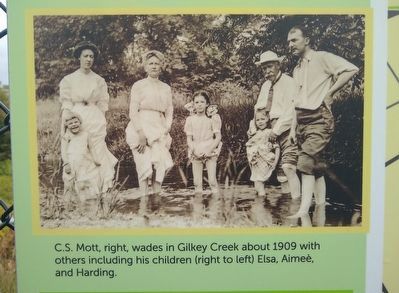
Gilkey Creek flowed through this area long before the Motts bought the surrounding land in 1915 to use as pasture for their cows. It rose and fell with the rainfall but caused few problems in those early years.
From Cows to College . . . — — Map (db m142701) HM
Flint, platted in 1836, became known as the “Vehicle City.” The production of road carts reached 150,000 annually. Due to the foresight of its vehicle manufacturers Flint has become second only to the Detroit area in production of motor vehicles. A. . . . — — Map (db m178355) HM
Labor history was made when the UAW won recognition from General Motors on
February 11, 1937 Recognition did not come easily. The 44 day Sitdown Strike took
place during a bitterly cold Flint winter. At one point, heat was turned off in . . . — — Map (db m218750) HM
This monument is to honor the unsung heroes of war:
The Corpsmen, Medics, Evac Crews, Nurses, Doctors, and Therapists,
Who tended to our wounds,
Saving untold lives.
To these lifegivers, a grateful Thank You. — — Map (db m248284) WM
They made a statement in lights and steel. In 1899, gas lamps in downtown Flint were replaced with electric lights mounted on five steel arches spanning Saginaw Street. In 1905 two more arches were added, including one with the letter "FLINT - . . . — — Map (db m179971) HM
Flint's Carriage King and
the creator of General Motors
Dedicated December 8, 1988
Derek Wernher, Sculptor
Matthew S. Collier
Mayor, City of Flint — — Map (db m182344) HM
Whaley House
The central portion of this handsome Victorian home was built in the late 1850s. Several prominent Flint families lived in it before Robert J. Whaley purchased it in 1884. Whaley a local lumberman and banker, remodeled the . . . — — Map (db m143776) HM
"Flint is in the center of the automobile industry, a progressive city, good people, with conditions for manufacturing, ideal," wrote William Crapo Durant in 1905, inviting Utica, New York axle-maker Charles Stewart Mott to move here. Durant . . . — — Map (db m182345) HM
William "Billy" Durant led Flint's incredible industrial development 18902 - 1920s. Durant co-founded the successful Durant-Dort Carriage Company, then in 1904 took control of David Buick's fledgling automobile firm. Durant built on Buick's success . . . — — Map (db m182340) HM
William C. Durant William Crapo Durant (1861-1947), one of Flint’s most important historical figures, was a pioneer in the development of the American auto industry. Durant’s vehicle ventures began in 1886, when, with a borrowed $1,500, he . . . — — Map (db m182338) HM
It began with the pine forests. Like many other Michigan communities, Flint built its economy in the 1800s on thriving lumber mills, to supply a growing nation. When demand for wood exhausted the region's forests, Flint turned to other ventures . . . — — Map (db m178471) HM
The 25 year-old French aristocrat and author of Democracy in America visited this area during his 1831-1832 tour of America
Placed by C-SPAN and the cable television industry while retracing the tour in 1997-1998 — — Map (db m305656) HM
Otis Milton Smith was an outstanding lawyer and African-American trailblazer. Born in Tennessee in 1922, he overcame poverty and prejudice to reach positions of leadership in both the public and corporate spheres. An Army Air Corps journalist . . . — — Map (db m305643) HM
Built in Davison between 1890 and 1900, the Davison Depot was a "flag stop" on the Grand Trunk Western Railroad Line. It was a gathering place for passengers and a drop off spot for the mail.
The Depot did not have scheduled stops. The train . . . — — Map (db m225260) HM
In 1896, Charles Wallace Parker (1864-1932), built his first carousel in Abilene, Kansas. In 1910 he moved his factory to Leavenworth, Kansas. Although most of Parker's carousels were small and portable, he also carved a number of large three- . . . — — Map (db m225344) HM
The Buzzell House was built on East Court Street on land that was part of the old John Smith Chippewa Indian Reservation. A professional carpenter, John Buzzell built the Greek revival-style home in 1854 for his family. As the family grew, so did . . . — — Map (db m225286) HM
Charles Stewart Mott lived for his community.
During his 60 years of service on the General Motors board of directors, he established and endowed the Mott Foundation in 1926 to improve Flint's civic welfare. Mott's generous . . . — — Map (db m234053) HM
Originally built in 1878 on Corunna Road, the Township Hall was a gift from the citizens of Clayton Township and was moved to Crossroads Village in 1976.
The Clayton Township area was originally called Miller's Settlement after the first . . . — — Map (db m225335) HM
Built in 1898, this former Cohoctah Evangelical Church initially served the religious needs of a farming community near Howell, Michigan. Since Michigan lumber was in short supply during the time this church was being built, it was constructed of . . . — — Map (db m225363) HM
William C. Durant, better known as Billy Durant, built this quaint barn behind his home on Garland Street in Flint's Carriage Town area. The barn most likely was constructed between 1890 and 1900 and was a typical outbuilding of the period.
. . . — — Map (db m226305) HM
Before automobiles were common on American roads, they were found in barns and workshops of tinkerers who explored their mechanics. Judge Charles H. Wisner and Dr. Hiram H. Bardwell, two of Flint's gentleman tinkerers, worked on . . . — — Map (db m224683) HM
This Greek-revival style building, most likely built in the 1850s, was located on Main Street in Dryden, Michigan. The building is referred to as the Manwaring Building because it was one of two mercantile buildings owned by Joseph Manwaring, a . . . — — Map (db m225463) HM
Named Stanley School for Sherman Stanley, this red brick school was built in 1883 on Bray Road, about one quarter mile from the entrance to Crossroads Village.
This brick schoolhouse saw many children pass through its doors from 1883 until . . . — — Map (db m225338) HM
Judge Charles H. Wisner, a prominent Flint citizen and tinkerer, built this Italianate carriage barn in 1878 to house a few horses and carriages at his residence on the corner of East Court and Lapeer Streets in Flint.
Wisner, the son of Moses . . . — — Map (db m225262) HM
In 1966 McCree became the first Black mayor of a major U.S. city. In 1968, McCree led the City of Flint to enact the first open housing law in the U.S. passed by a referendum.
He served Flint and Genesee County with all his heart. — — Map (db m256657) HM
In memory of
Tenth Michigan V.V. Infantry
In the United States service
Left Flint Mich April 22nd, 1862
Mustered out August 1st, 1865
Fought in the following Engagements
Farmington, Miss. May 3, 1862. •
Siege of Corinth, Miss. . . . — — Map (db m256659) HM WM
Amos Woodruff The Amos and Eliza Woodruff family migrated from Massachusetts to the Flushing area about 1845. During the next five years Woodruff purchased several parcels of land on River Road. In 1852 he acquired this land, which was part of . . . — — Map (db m180448) HM
This structure was completed and dedicated as the Brent Creek Methodist Protestant Church in the fall of 1891. There were sixteen members. The church, which was originally located slightly west of this site, was moved here in 1940. The . . . — — Map (db m180635) HM
In 1840, Flushing residents began holding religious services in James Seymour´s sawmill. In 1842 the First Methodist Episcopal Church was organized. As part of the Flint River Circuit, the Methodists were ministered to by circuit riders. In 1846, . . . — — Map (db m180633) HM
In 1835 Rufus and Sarah Harrison settled on this property, traveling by ox team from Detroit. It was said their farm was the first in Flushing Township to be cleared. Harrison died in 1856, and the farm was acquired by William Schram, his . . . — — Map (db m180632) HM
In memory of the Soldiers & Sailors who fought in the wars of our Country
1861-1865
1812-1814
1846-1848
Erected by the Township of Flushing
A.D. 1906
1898 — — Map (db m189581) WM
In the spirit of our patriot ancestors Todd Beamer, a native of
Genesee County, Michigan, with help of other passengers and crew,
stormed the cockpit of Flight 93. This brave action prevented the terrorists
from crashing the aircraft into . . . — — Map (db m189580) HM WM
Village of Gaines Between 1855 and 1858 the Detroit and Milwaukee Railway built a rail line from Detroit to Grand Haven. In 1856 Gaines Station was established as a rail stop and post office. In 1859 Henry Walker platted the town, aligning the . . . — — Map (db m178334) HM
In 1833 eleven people established the First Congregational Church of Grand Blanc. The congregation, which held its early services in homes and, later, schoolhouses built their first house of worship in 1855. They replaced it with this modest red . . . — — Map (db m179796) HM
At the close of the nineteenth century, many rural Michigan school districts were in crisis as people left farms for the city and industrial jobs. A 1903 state law authorized consolidation of districts and provided for public transportation to . . . — — Map (db m179803) HM
The first Holy Family Church rested on this rock, 1946
Knights of Columbus - Council 6742 Mother of Perpetual Help
Grand Blanc, Michigan — — Map (db m277537) HM
Simeon Perry Farmstead In 1826 Simeon Perry (1804-1880) came to this area with his father, Edmund, a cousin, Roland, and his sister, Eliza. They built a log house. Then Edmund and Eliza returned to Avon, New York, to bring the rest of the family . . . — — Map (db m179804) HM
The Buick Open
One year after Warwick Hills Golf and Country Club opened in 1957, Waldo McNaught used his unique position as club president and public relations director of the Buick Motor Division of the General Motors Corporation (GM) to . . . — — Map (db m135748) HM
In 1894, William Ray Perry built this house on the farm that was purchased by his father in 1829. The Queen Anne house displays Eastlake ornamentation. Perry’s forebearers had arrived in New England in 1650. In 1825 Edmund Perry, William’s . . . — — Map (db m179807) HM
Jonathan Davison (1795-1865), a native of Livingston County, New York, purchased 160 acres of land here in 1831. His son, John W. Davison, a farmer and carpenter, completed the rear portion of the present structure in 1855. He enlarged it to its . . . — — Map (db m179801) HM
As Americans settled the wilderness areas of Michigan, religious services were often the first community concern. Beginning in 1831, traveling preachers visited this area, holding revival and prayer meetings, and starting new congregations. One of . . . — — Map (db m179798) HM
Projected for the transportation of troops and munitions of war between the forts at Detroit and Mackinac in the Territory of Michigan. Also for an inducement to settlers.
The road from Detroit to "Saginaw River and Bay" was authorized by . . . — — Map (db m242365) HM
In 1838, Halsey Whitehead, a veteran of the War of 1812, buried his two-year-old daughter Rebecca here on land he settled in 1837. He offered burial plots for others until 1843, when he donated the land to Argentine Township. Graves located here . . . — — Map (db m178234) HM
During the 1800’s, the School House for the Linden community was located next to the Linden Mill Building on Main Street. The first grist mill, built in 1840, burned and was rebuilt about the same time the Union Block was in what is now the . . . — — Map (db m218695) HM
Linden's origins can be traced to the 1830s, when settlers began erecting mills along the Shiawassee River. Other industries soon followed, as the city became a regional center for buggy and barrel manufacturing, cement production, and foundry work. . . . — — Map (db m178166) HM
The Linden Mills were a vital source of this village’s economic growth. The first mill, located on the land granted to Consider Warner, was used to cut lumber. From 1845-50 Seth Sadler and Samuel W. Warren, local residents, erected both a saw and . . . — — Map (db m178181) HM
The First Presbyterian Society of Linden was founded under the direction of the Reverend Thomas Wright on May 8, 1860. It had eight charter members and was the first religious society to be established in the Village of Linden. The Linden . . . — — Map (db m178167) HM
Preston Bradley Water Wheel Dedicated September 6, 1971
In Commemoration of Dr. Preston Bradley
Born in Linden Michigan Aug 18, 1888
A renowned minister. A Founder of the Izaak Walton League of America, eminent author and international . . . — — Map (db m189662) HM
In 1891 the Reverend Daniel Webster Hammond and seven members chartered the Methodist Episcopal Church of Montrose. The next year a church was erected on this site; however, a growing congregation demanded a larger building. The present church was . . . — — Map (db m182293) HM
Montrose Township Cemetery
In 1859 Montrose Township bought three acres of land from John Berry to create a burying ground, which was later expanded. In August of that year, John Pickett Slade, a veteran of the War of 1812, was the first . . . — — Map (db m180510) HM
First United Methodist Church, one of the oldest congregations in Genesee County, began with services held in Lewis Buckingham’s home in 1836. The Reverend Luther D. Whitney, a Flint circuit rider, and nine other people, organized the congregation . . . — — Map (db m179823) HM
E. S. Swayze opened a drugstore on this site prior to 1870. When the store burned in 1874, Swayze built this one. Members of the Free Methodist Church used the second-floor meeting hall for services from 1887 to 1890. In 1903 Masonic Lodge #401 and . . . — — Map (db m182516) HM
This house was built in stages between the 1860s and the 1930s. In 1889 Dr. John B. Laing and his wife, Harriet, purchased the house. Raised in Vermont, Laing (1846-1908) came to Otisville in 1871 as one of the village's earliest physicians, and . . . — — Map (db m33731) HM
The brick monument before you, came from the Otisville High School, built in 1920 and opened in 1921. It was located in town at the corner of Grove St. and Center St. (formerly State Street M-15). It originally housed grades kindergarten through . . . — — Map (db m127140) HM
When Nathaniel and Sarah Smith came to the Forest area from Vermont in 1837, members of the Henry Hiester family were the only Euro-American settlers in the area. Sarah Smith died in 1848 and was the first person interred in the cemetery that bears . . . — — Map (db m179822) HM
When you lived in a rural area say before 1950, in most parts of the US, you didn't hop on the school bus and ride miles to your local town school. At first, in the early years your family had horses and a wagon to get around. Then . . . — — Map (db m120860) HM
In January 1992, a fire destroyed the building located at this location. The last business to operate at the southeast corner of St. Clair and Main Streets was Mollen's Antique Shop. The original structure was built during the 1850's and housed the . . . — — Map (db m155001) HM
The "Old Newburg" general store on the southwest corner of Main Street was originally built of logs and was the first store built for the selling of dry goods and groceries. Built in 1836, it was originally owned by Charles B. Keeler. In the fire of . . . — — Map (db m155033) HM
Graham John Terry, originally of England, was hired by Robert Thomas of Almont as a meat cutter in 1907. By 1925, he started his own business, Terry's Meat Market, in the store just to the south of this location and in 1929 he purchased land from . . . — — Map (db m155011) HM
The original wooden structure at this location served as a barber shop owned by Mr. Crippin, and was later moved to 311 Branch Street. The current building was built in 1927 when local businessmen founded the first National Bank at this location. . . . — — Map (db m155016) HM
In 1861, R.L. Rutherford started his own butcher shop where the Muir Funeral Home stands today. The original building, owned by Mrs. Dodge, also served as a millinary. The building was demolished during the devastating downtown fire later that year . . . — — Map (db m155024) HM
More than 250 men joined the
Union Army in Almont during
the Civil War, 1861-1865.
Sixteen died in action,
nineteen died of disease.
Almont is proud
of her sons and their families
who helped preserve
The United States of America.
. . . — — Map (db m155035) WM
Frederick and Mary Currier built this house around 1854, inspired by Orson Fowler's A Home for All, which promoted the octagon form as a healthy place to live. The tall windows, which admit light and air, and the five octagonal rooms reflect . . . — — Map (db m154962) HM
Henry Stephens (1823-1886), a native of Dublin, Ireland, was a merchant, lumberman and financier. One of Almont's earliest settlers, Stephens established the first mercantile business here. In 1845 he built a sawmill north of Lapeer. When the pine . . . — — Map (db m154947) HM
P. F. C. Williams was awarded the Medal of Honor posthumously
for gallantry while serving with the 1st Regt., 1st Mar. Div.
in the Republic of Vietnam. Williams was participating on a patrol
when it was ambushed by the enemy. Although severely . . . — — Map (db m211138) HM WM
St. Patrick Church began in 1879 with visits from Father Clement Krebs, pastor at St. Agatha Church in Gagetown. It later became a mission of St. Elizabeth in Reese, Sacred Heart in Brown City, and most recently, SS. Peter and Paul in North Branch. . . . — — Map (db m182675) HM
In the nineteenth century, railroads provided the prime transportation link between small villages and the rest of the country. The first Columbiaville depot was built near this site in 1872. In 1893 William Peter (1824-1899) replaced that structure . . . — — Map (db m101541) HM
Dr. Richardson practiced Osteopathic family medicine and surgery in Lapeer and Genesee counties for 33 years. He was an ardent conservationist. He arranged for the planting of a half a million trees in this area. He was a founding member of . . . — — Map (db m101545) HM
This structure, completed in 1896, was the home of William Peter (1824-1899). Peter, a prominent Columbiaville businessman, was a rags-to-riches character. Around 1847 he came to the area from Germany via New York state, a penniless immigrant. . . . — — Map (db m101547) HM
This handsome Romanesque structure was completed in 1897 for the Methodist Protestant Church of Columbiaville. Local Methodists, with the assistance of circuit riders, had organized the church some forty years earlier. In 1865 the congregation . . . — — Map (db m101546) HM
Side 1
The area now known as Dryden was settled in 1834. By 1880 it was a hamlet of about 300 people. A marketing center surrounded by rich farm land, it turned to the railroad to increase its prosperity. Its citizens, spurred by the local . . . — — Map (db m160957) HM
This Mill Dam was built in
1840
and on this site stood the first
flouring mill in Dryden Township
They were built by the Maynard
Brothers who did an Extensive
Business until the Year 1870
That year the Mill was . . . — — Map (db m179816) HM
Major General George Owen Squier (1865-1934) was a noted soldier and scientist. Graduating from West Point in 1887, he subsequently led the United States Signal Corps. He was also Chief of the Army Air Service during World War I and military attaché . . . — — Map (db m179818) HM
The Ladies Library Association was established in 1871 to provide reading material at a small cost to the community. In the beginning the association only allowed married women to be members and charged an annual fee of one dollar. The women of the . . . — — Map (db m109815) HM
The coming of the railroad in 1870 was pivotal
to Imlay City's founding and economic progression.
Imlay City's original wooden depot was built in
1870 for the Port Huron and Lake Michigan
Railroad, and contained separate waiting rooms
for men . . . — — Map (db m182976) HM
Grand Trunk Railroad Depot
The Port Huron & Lake Michigan Railroad, later the Grand Trunk Western, arrived here in 1870. The first depot burned in 1917, and makeshift quarters served for a decade. This depot was built in 1927, . . . — — Map (db m195612) HM
Grettenberger Field was constructed in 1935-1936, in the midst of the Great Depression, under the federal Works Progress Administration (WPA) jobs creation program. It originally included a grandstand, ice skating rink, and football field. Baseball . . . — — Map (db m179819) HM
Dedicated August 1, 2008
By Artists: Arla Slogar and Linda Dyball
Sponsored by the Imlay City DDA and a generous grant from Four County Community Foundation
Charles Palmer
The mural depicts Charles Palmer, founder of Imlay . . . — — Map (db m195084) HM
"Dedicated to"
The Glory of God
and in honor of
the men and women
of this community
who served and died in
"World War I and II"
Korean War
1950-1955
Lee, James F
LePard, Gerald
Wagenshutz, James
Vietnam War
1964-1975 Gregson, . . . — — Map (db m211265) WM
This building was used as the Imlay Township Hall and Library until 1985 when a new facility was built across from the township cemetery on Fairgrounds Road for township offices. The building then remained the Imlay Township Library until 1989. . . . — — Map (db m182978) HM
This ornamental iron gate graced the entrance of the Imlay Township Cemetery as early as 1850. It is the finest example of early blacksmithing with every piece hand forged and hammered into shape by the craftsman on his anvil. In 2013 the gate was . . . — — Map (db m195318) HM
Dr. David V. Yerex built this building in 1882 as a carriage
and wagon repository. It was the first door west of what was then
Dan McGillis' Bancroft Hotel.
Dr. Yerex came to this area about 1860 and for a time was
employed by his uncle, James . . . — — Map (db m182855) HM
These roses honor the legacy of the
women who made history on our
Home Front during WWII.
They are a living
memorial to inspire
future generations. — — Map (db m218090) WM
This plaque is issued by the
Historical Society of Michigan
in recognition of
Gerlach's Bowling Center
Founded in 1919
for more than 100 years of
continuous operation in service
to the people of Michigan
and for . . . — — Map (db m275317) HM
Set off by Gov. Cass in 1822, this county took its name from the French La Pierre, a translation of the Indian name for the Flint River. Settlers began to arrive in 1828. The county seat, founded in 1831, was also named Lapeer. Organization . . . — — Map (db m101532) HM
One of the 10 oldest in the United States
1846
Court sessions have been held in this
building each year since its first
owner, Lapeer pioneer judge
Alvin N. Hart, held court here in
April 1847
Presented by
the Michigan State Society . . . — — Map (db m198366) HM
Founded in 1859, the Lapeer Ladies Library Association gathered the community's first collection of books for lending. The popularity of the collection led the Carnegie Foundation to offer $10,000 to build a public library in 1916. In part through . . . — — Map (db m101536) HM
Born in 1899, Lapeer native Marguerite deAngeli was a significant author and illustrator of 20th century children's literature. In 1950, she was awarded the Newberry Medal for The Door in the Wall, and was one of the first inductees into the . . . — — Map (db m101535) HM
2258 entries matched your criteria. Entries 101 through 200 are listed above. ⊲ Previous 100 — Next 100 ⊳