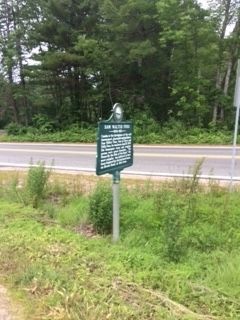
Candia is the birthplace of the well-known poet, journalist and publisher, Sam Walter Foss. Son of Dyer and Polly Foss, he was born on June 19, 1858. His homespun verse and country poems were great favorites. “The House by the Side of the Road,” . . . — — Map (db m242922) HM
Side 1:
In memory of the 155 men of Candia who served in the War of Revolution
Killed: Lieut T Dearborn, P Hills
In memory of the 5 men of Candia who served in the French and Indian War of 1756
Side 2: In honor of the 126 men of . . . — — Map (db m105524) WM
World War I Honor Roll
Row 1:
Barclay, Guy R. Brown, Bryon R. Brown, Charles E. Brown, George W. Brown, Guy Brown, Melvin Browning, George Clock, Vincent J. Cobe, Harry H. Condon, William J. Critchett, Gardiner Critchett, Edwin G. Critchett, . . . — — Map (db m105523) WM
Dedicated to the men
of Chester who served
in the war of the
American Revolution.
They served their
country well and faithfully. — — Map (db m159857) WM
In honor of our country’s defenders 1861-1865 All men of Chester who served in the War for the Union Died in the service Col. Louis Bell · Joseph Everett · Charles R. Weymouth · William M. Locke · Henry D. Davis · Pace R. Smith · Warren J. Hills . . . — — Map (db m159910) WM
Roll of Honor Erected by the Town of Chester in appreciation of those who served in the Spanish and World War. Spanish War Charles E. Cox World War Frederick C. Bartlett · Wayland J. Berry · Walter S. Brown · Bert R. Cammett · *James M. Forsaith . . . — — Map (db m159908) WM
Dedicated to the Men
of Chester
who gave their lives
in Vietnam
SP 4 Gregory A. Leighton
US Army
Sept 6 1966
PFC Gary C. Towle US Army — — Map (db m159907) WM
This graveyard, one of the oldest in the state,
was purchased from. Capt. Jonathan Blunt for
70 pounds in 1751. Signed stones. by the finest
stone sculptors in New England are found here.
Among these craftsmen are: Stephen and Abel
Webster, . . . — — Map (db m159903) HM
Isaac Blasdel, 1738-1791, son and father
of clockmakers, settled in Chester in
1762 and commenced manufacturing
one-day, striking, wall and tall-case
clocks with one weight and metal works.
He was an Association Test signer,
Revolutionary War . . . — — Map (db m159909) HM
Stevens Memorial Hall
1909
has been placed on the
National Register of
Historic Places
by the United States
Department of The Interior
September 10, 2004 — — Map (db m159911) HM
The Chester Congregational Church
Built in 1773
Entered in the National
Register of Historic Places
Washington, D.C.
June 5, 1986 — — Map (db m159916) HM
Born In Deerfield and buried in Old Center Cemetery on road west, he gained fame by the unauthorized firing of the first shot at Bunker Hill while serving as a private in Captain Dearborn's Company of Colonel Start's Regiment. Although . . . — — Map (db m115947) HM WM
1772
To Commemorate
the site of
The First Congregational Church
Doorstep in in gateway, location identical.
Ministers and term of service
1772 – Rev. Timothy Upham – 1811
1812 – Rev. Nathaniel Wells – . . . — — Map (db m115950) HM
Exeter, the Revolutionary capital of New
Hampshire, included a Black community which
was nearly 5 percent of its population in 1790.
Although enslaved Africans were forcibly
brought here in the early 1700s, after the
American Revolution several . . . — — Map (db m260703) HM
On March 3, 1860, Abraham Lincoln delivered his final of four speeches in New Hampshire at Exeter Town Hall. Lincoln had strong ties to Exeter due to the influence of Amos Tuck, of this town, who is credited with the creation of the Republican . . . — — Map (db m88050) HM
Born in Andover, Mass. June 21, 1736, Enoch Poor settled in Exeter, becoming a successful merchant and ship-builder. In 1775 he was appointed colonel in the 3rd New Hampshire Regiment. Poor was at Stillwater, Saratoga and Monmouth, and served under . . . — — Map (db m75241) HM
The Exeter Gas Works operated on this site beginning in 1862. The gas, produced from coal, supplied street lights in Exeter during the American Civil War. Local homes and businesses were supplied shortly thereafter. Manufactured gas was the . . . — — Map (db m96465) HM
In honor of John Folsom and his wife Mary Gilman, progenitors of the American Folsoms, natives of Hingham, England emigrated 1638, settled Exeter 1655. This stone erected by their descendants on land granted to Lieutenant Peter Folsom, was once the . . . — — Map (db m96467) HM
The historic Town House of Exeter stood near this site. Here on January 5, 1776, the Provincial Congress adopted and signed the first state constitution thereby establishing an independent state government, the first of the thirteen colonies. The . . . — — Map (db m75242) HM
This cannon was presented by Captain George Leonard Smith, U.S.N. (1876-1951) to honor Exeter’s veterans of World War II.
Captain Smith was a native son of Exeter, a prolific inventor, and a veteran of three wars.
This cannon incorporates . . . — — Map (db m31541) HM
Built about 1721 as one of New Hampshire’s earliest brick houses, and enlarged and clapboarded in the 1750s, this dwelling served as the state treasury during the Revolution. Here were born John Taylor Gilman (1753-1828), who was elected governor . . . — — Map (db m75243) HM
At this site on the Squamscott river stands the storehouse for the town’s powder used during the American Revolution and the War of 1812. Powder captured from the British at New Castle was stored here and later used at the Battle of Bunker Hill. — — Map (db m41157) HM
Directly across the Squamscott river stands the storehouse for the towns powder used during the American Revolution and the War of 1812. Powder captured from the British at New Castle was stored here and later used at the Battle of Bunker Hill. — — Map (db m41158) HM
Founded by Rev. John Wheelwright in 1638, Exeter was one of the four original towns in the colony. Following New Hampshire’s provisional declaration of independence on January 5, 1776, it served as the capital of the new state during the period of . . . — — Map (db m75244) HM
Second Burial Ground Est. late 1600's Here is the last resting place of some of Exeter's early settlers. Samuel Dudley, respected minister who led Exeter's residents for 33 years. Nathaniel Ladd and family, influential community members, built the . . . — — Map (db m96466) HM
A grist mill built by Thomas Wilson in 1640. The island and site were granted to him by the town which reserved the right for canoe landing and the laying of fish. Wilson’s Creek flows on the easterly side. — — Map (db m41156) HM
Occupied this site until
it was moved in 1929 to
its present location at
Spring and Water
Streets.
President George
Washington was a guest
at the Folsom Tavern in
November, 1789. — — Map (db m180170) HM
In 1928, the Exeter News-Letter printed an eye-witness account of Fremont's July 4, 1861 Civil War riot, written by 77-year-old Alden F. Sanborn. After Fremont's loyal citizens raised a 150-foot "liberty-pole" at nearby Liberty Square and had run . . . — — Map (db m115811) HM
Buried here are prominent NH Gunsmiths John & Andrew Brown; Pioneer Surgeon Laura (Fellows) Noyes; Austin Wiggin founder & father of the 1960's all-girl Shagg's Band; 1940's Baltimore Colts football player Carmen Ragonese; Politicians Stephen A. . . . — — Map (db m115817) HM
(side 1)
Historic Black Rocks Village
Settled in the 1720's this section of Poplin, (now Fremont) between Scribner Road & Rowe's Gas Station at 225 Main Street, gradually grew into a thriving settlement called "Black Rocks . . . — — Map (db m115780) HM
This old Inn/Tavern is one of the most historic landmarks in Fremont.
The first Poplin (now Fremont) Town Meeting was held here at Lovering's Inn on August 27, 1764, as were many other Town Meetings.
The towns' name was changed from Poplin . . . — — Map (db m115814) HM
Local lumbermen illegally cut Mast Trees reserved for the King's Royal Navy.
When David Dunbar, Surveyor General, visited nearby Copyhold Mill to inspect fallen lumber, local citizens assembled, discharged firearms and convinced Dunbar to . . . — — Map (db m115793) HM
Built in 1800, this steepleless structure, originally unheated, was used for both town and church meetings.
This and a similar building in Rockingham, Vt., are the only two survivors of some 70 meeting houses with twin end "porches" . . . — — Map (db m115798) HM
The Cooperage was founded here in 1874 by Jonas Spaulding, Jr. After his death in 1900 his sons, two of whom became New Hampshire governors, served as company officers; Stephen Frost, who bought into the firm in 1893, served as manager. Rebuilt . . . — — Map (db m115800) HM
In the year 1675, John Johnson was granted a tavern keeper's license. He resided and operated the tavern where the roads meet from Portsmouth, Exeter, and Hampton, at today's 480 Portsmouth Avenue. This is the house immediately in front of you. . . . — — Map (db m186250) HM
On Sept. 1, 1824, General Lafayette was received by the citizens of Greenland at a triumphal arch erected in front of the local hotel. — — Map (db m186251) HM
A Little Band of Pioneers
Under the Leadership of
Rev. Stephen Bachiler
of Southampton, England
Seeking a Larger Liberty
In October 1638
Settled in the Wilderness
Near This Spot to Plant a Free Church
In a Free Town
They . . . — — Map (db m162682) HM
Bell of Fifth Congregational Church Building 1797-1844 "Townsfolk to the Church I called."
Bell Inscription: Meneely's West Troy NY 1861 — — Map (db m155072) HM
First Public School in New Hampshire, supported by taxation, was opened in Hampton on May 31, 1649. It was presided over by John Legat for the education of both sexes. The sole qualification for admission of the pupils was that they be “capable of . . . — — Map (db m105144) HM
This memorial is dedicated by the citizens of Hampton to the firefighters, policemen, and the thousands of men and women who perished on September 11, 2001. We shall honor and respect their memory May 30,2003 — — Map (db m105143) WM
(left tablet)
Honor Roll
This tablet erected by
The Town of Hampton
in honor of
the men serving in the
1861 Civil War 1865
...
Hampton men credited elsewhere
...
* Killed in action
(right tablet)
Honor . . . — — Map (db m105145) WM
This was the roadway. from the ancient landing on Hampton River taken on October 14, 1638 by Rev. Stephen Bachiler and his small band of followers, when they made the first settlement of Hampton, originally named Winnacunnet Plantation. For the . . . — — Map (db m162681) HM
Dedicated to those of our town who served in the armed forces and Merchant Marine of the US in World War II. 6 rows of names
5 rows of 53 names each 6th row with 19 names plus 8 Starred names, indicating killed in action. — — Map (db m105147) WM
Side 1 Roll of honor 1961 1975 Roll of Honor in remembrance of those who serve in the Vietnam War 4 rows of names Row 1 47 names Row 2 48 names Row 3 46 names Row 4 46 names 7 are starred, indicating loss of life/killed in action. . . . — — Map (db m105149) HM WM
The
Proprietary School
now known as
Hampton Academy
was incorporated in 1810.
Its first building
which stood on this spot
was burned.
The building
now used by the school
was erected in 1852
and removed to
its present site . . . — — Map (db m162696) HM
Thorvald Eriksson, brother of Leif Eriksson, led an expedition to
Vinland where he was killed by Indians about 1000 years ago.
Legend states that Thorvald was wounded during an Indian
skirmish, and asked to be burned at a location that resembled . . . — — Map (db m162699) HM
On his way to Portsmouth after
entering New Hampshire on Saturday,
October 31, 1789, President Washington
accompanied by a splendid procession
of the military and state dignitaries,
halted for a short time here in
Hampton Falls. He greeted and . . . — — Map (db m260676) HM
Chartered on June 12, 1867 by the Grand Lodge of New Hampshire, Freemasons from Kingston and surrounding towns first established their lodge above the General Goods store on the Kingston plains. Through fund raising efforts this building was . . . — — Map (db m115618) HM
Distinguished participant in the founding of the Republic as signer of the Declaration of Independence and Articles of Confederation, and prominent in this State as Chief Justice of two courts and first holder of the title of Governor. An innovator . . . — — Map (db m75245) HM
(1924 plaque - left)
This Memorial
is erected
in grateful recognition
of all those who from
the settlement of Kingston
in 1694 to the present day
served the town
in its wars for freedom, union
and the rights of . . . — — Map (db m122301) WM
Stray farm animals were confined here by elected pounders or reeves until ransomed by their owners. In 1730, David Dickey kept the first pound in the West Parish. When the current boundaries of Londonderry were established in 1836, David Gilcreast . . . — — Map (db m286339) HM
In commemoration of the first victory of the American Revolution the capture on this site of Fort William and Mary 14-15 December 1774
In Admiration of the gallantry of Capt. John Langdon and Maj. John Sullivan Leaders of the . . . — — Map (db m85341) HM WM
The Frost Cemetery was a private family burying ground passed down through the Frost and Bell families for many generations. The families lived near the Piscataqua River and the cemetery was located at the end of their properties near the . . . — — Map (db m135323) HM
Portsmouth Harbor was protected by underwater mine fields during both wars. During World War II, this protection was supplemented by an anti-submarine net which stretched across the mouth of the harbor from nearby Fort Stark to Fort Foster in . . . — — Map (db m135299) HM
Replaced by the New Hampshire Daughters of the American Revolution commemorating the capture of the fort by New Hampshire Patriots December 14, 1774. — — Map (db m135324) HM
Nearby Walbach Tower is one of several built along the Atlantic coast during the War of 1812.
Its builder, John de Barth Walbach, came to America from France in 1797. He joined the U.S. Army the following year and rose in rank from a . . . — — Map (db m135298) HM
From Colonial times through World War II to the present day, Fort Point has played a strategic role in the defense of our coastline.
Walbach Tower, built in 1814 during the War of 1812, was one of Fort Point's more interesting but mostly . . . — — Map (db m135300) HM
December 14-15, 1774, several hundred
men overpowered the small British
garrison at Castle William & Mary,
now Fort Constitution, New Castle,
and removed quantities of military
supplies. These raids, set off by
Paul Revere's ride to Portsmouth . . . — — Map (db m85343) HM WM
After establishing a fishing settlement in what
is now called Dover Point, Edward Hilton, Sr.
(1596-1671) settled in the “New fields” section
of Exeter in the 1630s. Hilton's first known
residence was located near the Hilton Burying
Ground, . . . — — Map (db m260729) HM
Site of
Bloody Point Ferry
Operated By
Thomas Trickey
1640 - 1675
Zachariah Trickey
1675 - 1705
John Knight
1705 - 1725
Continued for more than a century by
Capt. Howard Henderson, Sr.
Capt. Howard Henderson, Jr.
Thomas . . . — — Map (db m224510) HM
Boundary disputes among the early river
settlements caused this area to be called
Bloody Point. By 1640 Trickey's Ferry
operated between Bloody Point and Hilton's
Point in Dover. In 1712 the meeting house was erected and the parish set off, . . . — — Map (db m224489) HM
Established by the Town of Newington in 1710
The income from timber cutting through the centuries has financed and supplied materials for building The Old 1872 Town Hall, The Stone Schoolhouse, and other town projects. — — Map (db m102636) HM
An excellent example of 19th-century commercial
architecture, the J.W. Barnard Block replaced
E.P. Pinkham's wood-framed boot and shoe shop.
The original building was relocated to the rear of
the lot, and Pinkham moved his shop into the
north . . . — — Map (db m260742) HM
Originally located on the old Main Street near the
river, this former inn was moved twice: first in the
1830s to the site of the current post office and then, in
1872, to this location to make way for the construction
of a Methodist church. . . . — — Map (db m260747) HM
Benjamin Brooks, a master mechanic in No. 1 Mill, built
the Brooks Block with shops on the ground level and his
residence upstairs. The Masonic Lodge held its first
meeting here in 1826, and the Newmarket Manufacturing
Co. moved its company . . . — — Map (db m260748) HM
Originally located on South Street near the
Engine House, this building was owned by
Wentworth Cheswell (1746-1817), a town
selectman thought to be one of the first
African Americans in the country elected to
office. Moved in 1849, the building . . . — — Map (db m260826) HM
The ground floor of this structure was
Frank H. Durgin's grocery store. Upper floors
housed the Pioneer Lodge No. 1, Knights of
Pythias and a meeting hall for the Grand Army
of the Republic, an organization for Union
veterans of the Civil War. . . . — — Map (db m260741) HM
The earliest and only surviving example of the
brick Federal-style commercial structures on
Main Street, this building stands on a lot once
owned by Edward Smith. Originally the home
of Charlotte Murray's Millinery (hatmaker's shop),
the . . . — — Map (db m260745) HM
Built against Zion's Hill, the first Newmarket
fire station is the home of Tiger No. 1, a
hand-pumped fire engine called a "handtub,"
purchased by the town in 1852. Both
Tiger No. 1 and Granite No. 2, owned by the
Newmarket Manufacturing Co., . . . — — Map (db m260814) HM
John S. Bennett moved his tin and hardware business
here in the 1840s. In 1850, his brother Edwin joined
him, and the firm employed about 50 men. The
business was later called Treadwell & Davis, and
then Treadwell & Folsom. In 1891, the building . . . — — Map (db m260737) HM
N.H.'s most successful jockey of the 20th century,
Wajda, a Newmarket native, won over 2,200 races
and achieved leading jockey honors at all major
New England tracks. In 1958, he set a world record
at Rockingham Park riding Mark Antony. . . . — — Map (db m260730) HM
One of the last surviving tavern-hotels, the A.W. Doe
House, as this building was originally called, was built
in the same year that the Newmarket Manufacturing
Co. was founded. The building became the Rundlett
Tavern and later the Washington . . . — — Map (db m260754) HM
The town's first circulating library,
the Newmarket Social Library, had no formal
building patrons gathered in private homes
for literary events. The current library was
built for the town's mill workers with a gift
from sea captain John . . . — — Map (db m260811) HM
Samuel H. Greene, who constructed this
building during the height of Newmarket's
manufacturing era, ran a drugstore on
the ground floor. The third floor housed
the Masonic Rising Star Lodge No. 47,
chartered in 1826. The drugstore was . . . — — Map (db m260746) HM
Once the site of Widow Mead's small house,
this brick and stone building at Tenney's Corner
was constructed by Benjamin Mathes. His
sisters, Maud and Mabel, opened a millinery
shop here, which was followed by a grocery and
dry goods store run . . . — — Map (db m260736) HM
No. 1 Mill | 1824
In 1823, businessmen from Salem, Mass., bought property along the Lamprey River to build Newmarket's first mill. They chose granite for its durability. The No. 1 Mill of the Newmarket Mfg. Co. was completed at a cost of . . . — — Map (db m260786) HM
The bank once housed in this building
was first chartered in 1855 as a
state bank and reorganized in 1865
as the Newmarket National Bank.
After 1879, the Newmarket Savings Bank
also moved to this site, with S. A. Haley
as cashier. On his death . . . — — Map (db m260740) HM
Erected by
Geo. A. Gay Post No. 18 G.A.R.
Newmarket N.H.
in memory of the comrades of the
1861 Civil War 1865
Soldiers and sailors who offered
their lives that this nation might be preserved
Bassett David 6th • Bates . . . — — Map (db m260817) WM
Memorial Pavilion
erected 1921
to commemorate the service
of those from
The Town of Newmarket, N.H.
who served their country in
1917 the World War 1918
The Town of Newmarket, N.H.
– 1917 – Honor Roll World War – 1918 – . . . — — Map (db m260758) WM
In 1823, businessmen from Salem, Mass., bought
property along the Lamprey River, and Ebenezer Smith's
sawmill disappeared, replaced by great blocks of granite,
rising stone by stone along the riverbank. Although the
builders considered using . . . — — Map (db m260804) HM
Built a year after No. 1 Mill, this mill building contained
over 4,000 spindles, and today still retains its original
tower and weathervane. Based on practices developed
in the early 1800s by the Boston Manufacturing Co., these
early mills used . . . — — Map (db m260805) HM
Unlike the town's first three mills, which
were built with granite blocks quarried from
Durham Point, No. 4 Mill was constructed
from local trap rock. By 1869, when the
building was completed, Newmarket's mills
were running 39,000 spindles . . . — — Map (db m260751) HM
Originally only two stories high, No. 5 Mill
started with a few looms making a soft, thin
silk called “pongee.” Silk goods production
was introduced by mill agent Ambrose Nichols
due to a depression in the cotton market and
ultimately was . . . — — Map (db m260773) HM
Built in 1842 as an elementary school and
was continually used as a school until 1965.
Unique in early American Architecture and
masonry.
On display are heirlooms, crafts and tools
of early American life in Newmarket.
Home of the New Market . . . — — Map (db m260739) HM
In the early 1800s, William M. Tenney
built a law office on this site and a
house across the street. Long known as
Tenney's Corner, both buildings were
sold to B W. Mathes, who rebuilt the
old wooden structures in stone
between 1835 and 1840. . . . — — Map (db m260731) HM
This monument honors all 290 townsmen who volunteered for
the Union cause. At the war's end, the town lost 22 men killed
in action, 9 dead from disease, 40 severely wounded, 86 disabled
and 12 POWs. This resulted in a costly toll for local . . . — — Map (db m260816) HM
One of the earliest students at Governor Dummer Academy in Massachusetts, Cheswill was among Newmarket’s best-educated and most prosperous citizens. He was entrusted with many offices, including justice of the peace, selectman, town clerk, . . . — — Map (db m113341) HM
233 entries matched your criteria. The first 100 are listed above. Next 100 ⊳