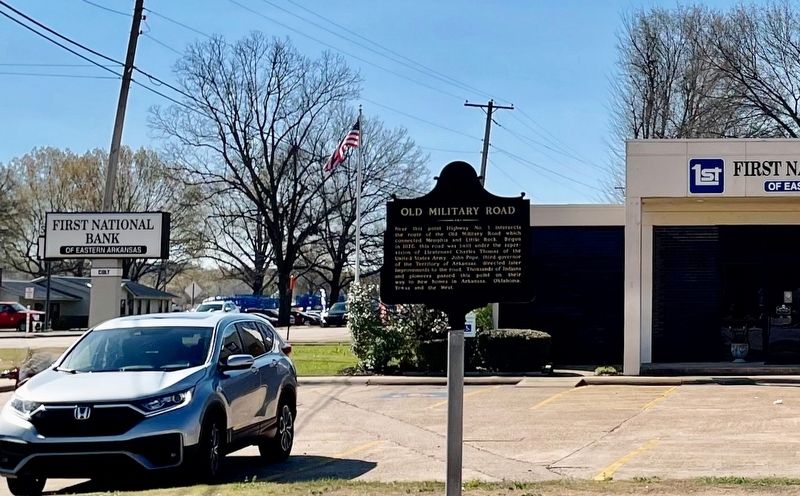
Near this point Highway No. 1 intersects
the route of the Old Military Road which
connected Memphis and Little Rock. Begun
in 1826, this road was built under the supervision of Lieutenant Charles Thomas of the
United States Army. John Pope, . . . — — Map (db m243306) HM
In early May 1863, Union troops left Helena to disrupt Confederate troops and destroy supplies and forage. Gen. John S. Marmaduke's Confederates confronted them at Taylors Creek on May 11, and after an hour-long skirmish the outnumbered Union troops . . . — — Map (db m243305) HM
Home of W. W. Campbell and Victoria Mann
Campbell. W. W. Campbell was a bank, civic,
and agricultural leader in Eastern Arkansas.
influence extended nationally as reported in
the November, 1947, issue of Readers Digest
and the November, . . . — — Map (db m243314) HM
In 1866 General Nathan Bedford Forrest, along with about 1,000 workmen, pitched camp in the vicinity of what is now Front Street on land belonging to the Izard and Prewett families. By 1868 they had succeeded in making a cut through Crowley’s Ridge . . . — — Map (db m92609) HM
Oldest active cemetery in St. Francis
County. Begun about 1854 as a family
cemetery by the Mallorys, whose
home was a short distance north.
Immediately north was the early town
of Mt. Vernon. Later other families
were permitted to use the . . . — — Map (db m243311) HM
This bell rang from the bell tower of the magnificent courthouse that graced this site for seventy-nine years before the present structure was built in 1976. The former courthouse was built in 1897 by Judge John S.R. Cowan of Hughes at a cost of . . . — — Map (db m172208) HM WM
St. Francis County was predominately sympathetic to
the Southern cause, raised five companies. The first
company, known as the Linden Dead Shots was raised by
Poindexter Dunn who also served as captain. This company
marched away from here in . . . — — Map (db m243308) HM
In God we Trust
Dedicated to veterans of St. Francis County
To the gallant men and women who served their country during Peace time and war with honor.
We shall not forget — — Map (db m172205) WM
U.S. troops from Helena came through Madison many times during the Civil War. A 5th Kansas Cavalry patrol fought here twice during a March 5-12, 1863, expedition. Iowa and Indiana troops passed through in April 1863, and detachments of men from the . . . — — Map (db m119982) HM
Benton County was established in 1870 and was formed from portions of Tippah and Marshall counties. Lewis J. McDonald donated land for Ashland, which was incorporated in 1871 and named the county seat. The Benton County Courthouse was designed by . . . — — Map (db m171379) HM
(front)
A memorial to Benton Countians who gave their lives in service for their country.
W.W.I
Homer Beasley • Chaille Ferrell • Alfred Whitten • Robert Wynn
W.W.II
Preston C. Gresham • M.B. Brown Jr. • Olice J. Vauter • . . . — — Map (db m171413) WM
As a producer, studio engineer, trumpeter and bandleader, Willie Mitchell played a central role in the rise of Memphis as a center for soul music. Mitchell, born in Ashland on March 1, 1928, made many recordings under his own name, including . . . — — Map (db m171412) HM
Here, after a successful raid on the Federal supply base at Holly Springs the day before, Confederate troops led by Maj.~Gen. Earl Van Dorn were repelled by approx. 250 Federal troops posted at Davis Mill. — — Map (db m171375) HM
On October 14, 1862, Confederate Gen. John Pemberton assumed command in Mississippi and east Louisiana. Eleven days later, Gen. Ulysses Grant became commander of Union forces in the region. Over the next 8 1/2 months, their forces fought for control . . . — — Map (db m84782) HM
Little Junior Parker, one of the most outstanding blues singers of the 1950s and ‘60s, was born on a plantation near Bobo on March 27, 1932. As a youngster Parker moved with his mother to West Memphis, and he recorded his first hit, “Feelin’ Good,” . . . — — Map (db m174029) HM
Aaron Henry (1922-1997), Clarksdale pharmacist, was a major early grassroots activist in the civil rights movement. As local NAACP president, he led the early 1960s Clarksdale boycott campaign, during which he was arrested and his home and . . . — — Map (db m170477) HM
Front
The Clarksdale area is famed for its many legendary blues artists who achieved their greatest success after moving away, such as Muddy Waters, Ike Turner, and John Lee Hooker. But there were world-renowned musicians who . . . — — Map (db m90061) HM
In 1909 steel magnate Andrew Carnegie was contacted by local women's club member Liliian Waddell about sponsoring a public library. In 1911 the Carnegie Foundation gave $10,000 to the city of Clarksdale to build and equip a public library, with the . . . — — Map (db m89927) HM
County seat of Coahoma County, was founded
in 1869 by John Clark, for whom the town was
named. Situated in one of the most fertile
regions of the world, it has grown into one
of the leading cities of the Yazoo Mississippi
Delta. It . . . — — Map (db m89749) HM
Founded 1868 at crossing of Indian trails and on possible route of De Soto's expedition. Chartered 1882. Coahoma co-county seat, 1892; sole seat since 1936. Home of Gov. Earl Leroy Brewer. — — Map (db m89925) HM
Front
The Delta Blues Museum, the world's first museum devoted to blues, was founded on January 31, 1979, by Sid Graves, director of Clarksdale's Carnegie Public Library. Originally housed in a room of the Myrtle Hall Elementary . . . — — Map (db m90046) HM
Born near Clarksdale, Aaron Henry was an
American civil rights leader, politician, and
head of the Mississippi branch of the NAACP.
He was one of the founders of the Mississippi
Freedom Democratic Party, which tried to
seat their . . . — — Map (db m170480) HM
In the late 1880s a group of African Americans established the Macedonia Missionary Baptist Church near the Sunflower River, under the leadership of their first pastor Minister A. O. Gaston. The church would be moved to this location in 1918, . . . — — Map (db m90063) HM
Harvey Brown Heidelberg was born in Shubuta, Mississippi, on March 7, 1883. Educated in the Shubuta school system and at Southern University in Greensboro, Alabama, Millsaps College in Jackson, and the University of Michigan, he began his career in . . . — — Map (db m89928) HM
Established in 1880 as Haven Memorial and
renamed Haven UMC in 1968, the church was
completed in 1923. Clarksdale's first low-income daycare was opened here in 1965
by Lilian Johnson. In 1958, Rev. Theodore
Trammel and Dr. Aaron Henry hosted . . . — — Map (db m174126) HM
The Hicks-Tarzi Memorial Grotto was built in the
early 1950s out of natural stone from Alabama
and recreates the Grotto of Lourdes, France.
The statues of the Blessed Virgin Mary and
Bernadette Soubirous were given in memory
of Johnny Tarzi and . . . — — Map (db m235164) HM
Front
Rock ‘n’ roll and rhythm & blues pioneer Ike Turner began his career playing blues and boogie woogie piano in Clarksdale. Turner was born less than a mile south-west of this site, at 304 Washington Avenue in the Riverton . . . — — Map (db m90041) HM
Built in 1916, this Italian style villa was designed by Memphis
architect Bayard Cairnes and was the home of local attorney J.W.
Cutrer and his wife Blanche Clark Cutrer, daughter of Clarksdale
founder John Clark. Named Belvoir by the Cutrer . . . — — Map (db m89922) HM
Born in Jackson in 1944, Richard Ford won critical acclaim with his
first two novels, A Piece of My Heart (1976), and The Ultimate Good Luck
(1981). While he and his wife, Kristina Ford, lived in rural
Coahoma County, Ford wrote The . . . — — Map (db m235140) HM
Front
Since 1944 the Riverside Hotel has provided lodging for traveling musicians. It was home to some, including Sonny Boy Williamson II, Ike Turner, and Robert Nighthawk. Before that, the building served African Americans of the . . . — — Map (db m90062) HM
Front
The golden voice of Sam Cooke thrilled and enchanted millions of listeners on the hit recordings “You Send Me,” “Shake,” “A Change is Gonna Come,” “Chain Gang,” and many more. . . . — — Map (db m90050) HM
Front
The Sunflower River Blues & Gospel Festival, a preeminent showcase for homegrown Mississippi talent, began in 1988 as a promotion to draw area shoppers to downtown Clarksdale. The festival's dedication to presenting authentic . . . — — Map (db m90047) HM
Originally named Kehilath Jacob, Clarksdale’s first synagogue was
built here in 1910. In celebration of the new temple, a Torah was
shipped from New York City and carried to the temple by members of
the congregation. In 1929, a larger temple was . . . — — Map (db m89923) HM
Williams famously remarked that "home is where you hang your childhood", and for the world renowned playwright, that place was the Mississippi Delta, specifically Clarksdale, where he set some of his greatest dramas, including Summer and . . . — — Map (db m154862) HM
The notion of a crossroads as a setting for
spiritual decisions is common across many
societies and religions, and in the blues it is
particularly associated with Robert Johnson
and a rumored bargain with the devil.
This intersection of former . . . — — Map (db m299931) HM
Front
This neighborhood, known since the turn of the twentieth century as the New World, was a breeding ground for ragtime, blues, and jazz music in Clarksdale's early days as a prosperous and adventurous new cotton town, when . . . — — Map (db m90060) HM
"Father of the Blues" composer and family lived at this site 1903-05. In
Clarksdale Handy was influenced by Delta blues which he collected
and later published as well as his own famous and influential music. — — Map (db m89929) HM
Front
One of Clarksdale's most talented and renowned blues musicians, Wade Walton (1923-2000) chose to pursue a career as a barber rather than as a professional entertainer. Walton never lost his love for blues, however, and often . . . — — Map (db m90049) HM
Front
WROX, Clarksdale’s first radio station, went on the air on June 5, 1944, from studios at 321 Delta Avenue. From 1945 until 1955 the station was headquartered here at 257 Delta. Legendary disc jockey Early “Soul Man” . . . — — Map (db m90033) HM
General, US Senator and
State Governor Founder
of state levee system,
which opened Delta for
cultivation. His plantation home
"Eagle's Nest" is 3 ml. E. — — Map (db m235162) HM
When first recorded, Salomon Mounds had three (possibly four) large platform mounds and as many as eight smaller mounds arranged around a central plaza. The smaller mounds have been plowed away, while one of the large mounds was destroyed in 1958 . . . — — Map (db m107621) HM
On February 3, 1863, Union forces blasted the Mississippi River levee to enable flotilla to use Moon Lake and the Yazoo Pass in a futile effort to reach Vicksburg by way of the Coldwater, Tallahatchie, and Yazoo rivers. Federal forces were stopped . . . — — Map (db m170401) HM
The Hernando de Soto expedition to explore and claim the Southeast for Spain crossed the Mississippi River on June 18, 1541, at a point in northwestern Mississippi between Sunflower Landing in Coahoma County to the south and Bass Landing in DeSoto . . . — — Map (db m107620) HM
First built in 1926 by the Elks Club of
Clarksdale, this property was sold in
1933 to William Mhoon Wilkerson,
who developed it into a popular
tourist destination. At its height, the
Moon Lake Club property included a
restaurant, hotel-style . . . — — Map (db m235158) HM
Originally facing the river, the Robinson/Marinelli house bears the mark of shelling from the Union Navy. Built ca. 1850 by Mr. and Mrs. James Dardis Robinson, it is the oldest structure in Friars Point. According to local historians, the house . . . — — Map (db m170392) HM
Side 1
Born in Friar’s Point as Harold Lloyd Jenkins, son of a ferryboat captain, Conway Twitty (1933-1993) first achieved stardom as a bluesy rockabilly singer. Beginning in the 1970s, he became one of country’s bestselling balladeers ever, with . . . — — Map (db m170382) HM
Known originally as Farrar's Point, this town was incorporated in 1852. Its name was later changed to Friars Point to honor an early settler and legislator, Robert Friar. Coahoma county seat 1850-1930. — — Map (db m170390) HM
The Friars Point Methodist Church congregation was organized in 1836 under a nearby brush arbor. The original log church, on this site, was burned by Union troops during the Civil War. A second structure was destroyed by a tornado. The present . . . — — Map (db m170394) HM
According to local tradition,
New Prospect M. B. Church was
established in the mid 1860s by
a former slave named Katherine
Armistead. New Prospect began as
Independence Church, in which
Methodists and Baptists shared
the sanctuary, each . . . — — Map (db m160395) HM
Robert Nighthawk (1909-1967) was one of the foremost blues guitarists of his era. Although he rarely stayed long in one town, he called Friars Point home at various times from the 1920s to the 1960s. In a 1940 recording, he sang of “going back to . . . — — Map (db m160406) HM
One of the major factors behind the “great migration” of African Americans from the South to northern cities was the mechanization of agriculture, which diminished the need for manual laborers. In 1944 the Hopson Planting Company produced the . . . — — Map (db m90029) HM
On this site in 1944, the Hopson Planting Co. and International Harvester, revolutionized modern cotton farming by introducing the first commercially produced mechanical cotton picker. — — Map (db m89921) HM
Front
The Lula area has been home to legendary Mississippi blues performers Charley Patton, Son House, Frank Frost, and Sam Carr. Patton immortalized Lula in the lyrics of his recordings “Dry Well Blues” (1930) and . . . — — Map (db m107619) HM
The Dunn site consists of three earthen mounds. Mound A is oval in shape and just over sixteen feet in height. Mounds B and C have ben diminished by erosion and are less than three feeet in height. Archaeological excavations in 2013 indicate that . . . — — Map (db m154827) HM
The 1951 classic Rocket “88” by Jackie Brenston and his Delta Cats has often been cited as the first rock ’n’ roll record. Waxed at Sam Phillips’ Memphis Recording Service, it was also the first No. 1 rhythm & blues hit for Chicago-based Chess . . . — — Map (db m174032) HM
Muddy Waters lived most of his first thirty years in a house on this site, part of the Stovall Plantation. In 1996 the restored house was put on display at the Delta Blues Museum in Clarksdale. Muddy Waters was first recorded here in 1941 by . . . — — Map (db m160400) HM
Front
A recording artist, disc jockey, comedian, and ambassador for Memphis music, Rufus Thomas (1917 – 2001) was born here in Cayce. As a young man Thomas toured with the Rabbit Foot Minstrels, and later worked in Memphis as an . . . — — Map (db m96779) HM
Airliewood, built in 1858 for William H. Coxe on a fifteen acre estate, is a gothic style villa. The massive iron gate and fence are attributed to Wood & Perot of Boston. At the invitation of Coxe, the house was used by Major General U.S. Grant as . . . — — Map (db m85131) HM
This Gothic villa, probably designed by
the firm of the distinguished architect
Samuel Sloan, was built in 1858 for a
reported $40,000 by wealthy planter William
Henry Coxe on a fifteen-acre tract purchased
in 1857. The massive cast iron gates . . . — — Map (db m200084) HM
At the original site of the Asbury Methodist Church, the Upper Mississippi conference was organized on February 5, 1891. Classes first held in the church led to the establishment of Rust College. — — Map (db m85132) HM
In 1964-65, the Council of Federated Organizations (COFO) came to Holly Springs, MS.
This monument is in honor and recognition of the students who came from across the country and joined with Rust College students and local citizens to register . . . — — Map (db m117499) HM
On October 14, 1862, Confederate Lieutenant General John C. Pemberton became commander of the Department of the Mississippi and East Louisiana, and two days later Union Major General Ulysses S. Grant assumed command of the Department of the . . . — — Map (db m183928) HM
Union General Ulysses S. Grant, frustrated by illegal smuggling of cotton for war materials conducted by Northern and Southern speculators, issued General Order #11 from Holly Springs. The order explicitly focused on Jews, anywhere within Tennessee, . . . — — Map (db m169021) HM
(side 1)
Although Delta blues often claims the spotlight, other styles of the blues were produced in other regions of Mississippi. In the greater Holly Springs area, musicians developed a "hill county" blues style characterized by few chord . . . — — Map (db m84875) HM
Ante-bellum cotton town and center of social and cultural life. Home of 13 generals of Confederacy. Grant's southern advance halted here by Van Dorn's raid, December, 1862. — — Map (db m121844) HM
Built in 1851 for Hugh Craft, a prominent early citizen who came to Holly Springs in 1839 in the ernploy of the American Land Company. This house is locally recognized as the first of the "big houses" during the town's initial affluence preceding . . . — — Map (db m183939) HM
Born to slave parents in Holly Springs on July 16, 1862, Wells' life
epitomized the freedom struggle for African Americans following the
Civil War. When her parents and an infant brother died in the Yellow
Fever outbreak of 1878, Wells raised her . . . — — Map (db m169992) HM
Born the eldest child to Elizabeth and James Wells, she grew up in Holly Springs, and attended Shaw University, now Rust College. She was a reformer who insisted on economic and political resistance to oppression. She became head of a household at . . . — — Map (db m136680) HM
A distinctive artist whose "cotton patch blues" had a hypnotic quality, David Kimbrough, Jr. (1930-1998) was born in Hudsonville and played actively at clubs in the Holly Springs area beginning in the 1950s. During the 1990s recordings by Kimbrough . . . — — Map (db m247554) HM
The Martyn Mission was established here
in 1825 by the Presbyterian Church as a
mission to the Chickasaw. The mission
included a school under the direction of
Rev. William Blair (1791-1873) and his
wife Susan, who taught about thirty
students. . . . — — Map (db m219956) HM
On November 7, 1862, Gen. John Pemberton reviewed his Confederate troops here. The next day, the army withdrew to a defensive position behind the Tallahatchie River. Union Gen. Grant's forces arrived on the 29th. After learning that Pemberton had . . . — — Map (db m85129) HM
Located approx. 400 yards north was the Jones-McElwain and Co. Iron Foundry, established 1859. In 1861, the firm was awarded a Confederate contract to produce rifles and muskets. Before any weapons were made, Holly Springs was threatened by Union . . . — — Map (db m85130) HM
The railroad came to Holly Springs in 1856 at the urging of Harvey W. Walter, a Holly Springs attorney. The town, located on the main route between New Orleans, Chicago, and New York, was halfway between New Orleans and St. Louis and boasted one of . . . — — Map (db m199991) HM
Elected Sheriff of Marshall County in 1979. Osborne Bell was loved by many and is remembered for his friendliness and fairness to all. His political career began in 1967, when he was elected and served three terms as County Coroner (1967-1979). The . . . — — Map (db m183935) HM
R.L. Burnside (1926-2005) reigned as North Mississippi's most celebrated blues artist in the 1990s after alternative rock audiences across the country and overseas joined traditional blues aficionados in embracing his exuberant, spirited Hill . . . — — Map (db m247524) HM
Holly Springs's first Rosenwald School was
built here ca. 1925 for the education of
African American students. Five teachers
taught students through the eighth grade.
Students attended either Rust College or
Mississippi Industrial College to . . . — — Map (db m170277) HM
Estab. 1866 as Shaw Univ. for the education of freed slaves by Miss. Methodists and the Freedman's Aid Society. Renamed 1890 to honor Richard Sutton Rust, Methodist clergymen, educator and abolitionist. — — Map (db m116157) HM
In 1960 Rust College students, under the leadership of President E. A. Smith, boycotted the segregated HollyTheater, a protest that in 1962 evolved into a Rust chapter of the NAACP. The chapter offices were installed by Medgar Evers, NAACP . . . — — Map (db m116163) HM
Home of distinguished 19th century woman writer, who pioneered in dialect stories. Served as secretary and inspiration to Henry Wadsworth Longfellow. — — Map (db m85126) HM
Grant's long and vulnerable railroad supply line to Holly Springs originated in Columbus, Kentucky, and ran outh along the Mobile & Ohio and Mississippi Central railroads. On December 19, 1862, Brigadier General Nathan B. Forrest's Confederate . . . — — Map (db m183931) HM
General Van Dorn advised Colonel Griffith of the Texas Brigade: "Take care that you do not find a hornet's nest at the square!" Griffith led his brigade westward down Depot Street (Van Dorn Avenue) to the Town Square, ushered by Rebel yells and the . . . — — Map (db m173867) HM
Near the Salem Street bridge over the Mississippi Central Railroad Van Dorn's cavalry column divided into three attacking parties. The first moved to subdue the Union cavalry at the Marshall County Fairgrounds. The second attacked the infantry . . . — — Map (db m200172) HM
The Rosenwald School and the W.T. Sims High
School were the first public schools for African
Americans in Holly Springs. The W.T. Sims
High School was built here in 1953 on land
purchased from Mississippi Industrial College.
In 1960, the school . . . — — Map (db m170279) HM
Built in 1859 by master architect Spires Boling for Harvey W.
Walter. In a combination of architectural styles, Gothic crenelated
octagonal towers flank the central Classic Greek Revival portico.
Both styles were detailed in iron cast at the . . . — — Map (db m200082) HM
Here prior to Civil War lived Edward Cary Walthall, statesman, lawyer, Confederate Brigadier General and United States Senator from 1885 to 1898. He is buried in this city. — — Map (db m84883) HM
Residence of W.J.L. Holland, who gave his quarters and his life during the yellow fever epidemic of 1878. The benevolent Holland died while chairman of the relief committee. — — Map (db m85133) HM
In November 1862, Col. Albert Lee's cavalry and Gen. Charles Hamilton's infantry division led the Union advance down the Mississippi Central R.R. Here, at Lumpkin's Mill, Lee's men met Col. William H. Jackson's Confederate cavalry. After a spirited . . . — — Map (db m102632) HM
Founded half mi. N. E., 1856; incorporated, 1872; prospered as cotton & mixed-farming center; building of Arkabutla Dam to control floods in Yazoo Basin necessitated removal of town, 1941-1942. — — Map (db m263000) HM
The Coldwater area has been home to a wide array of African American singers and musicians, including Chicago-based singer Big Time Sarah (Streeter), R. L. Burnside’s son Duwayne Burnside, soul vocalist Bill Coday, and Stonewall Mays, who often . . . — — Map (db m174094) HM
Established in 1848 when Bethesda Presbyterian Church was built here under the leadership of Rev. Andrew Harper Caldwell. Given to the town of Senatobia in 1924 by Senatobia Presbyterian Church. Many local citizens, including veterans of every war . . . — — Map (db m102663) HM
Front
One of the few female performers of country blues, Jessie Mae Hemphill (c. 1923 – 2006) was a multi-instrumentalist who performed in local fife and drum bands before gaining international recognition in the 1980s as a vocalist and . . . — — Map (db m102871) HM
Front
Country music singer and composer O. B. McClinton, born and raised here in Senatobia, found his first musical success as a songwriter for 1960s Memphis soul labels. When Stax-Volt founded the Enterprise imprint for release of his . . . — — Map (db m102890) HM
Began as R. R. station near Senatahoba Creek. Chartered 1860. Occupied and partly burned by Union Army in Civil War. Became county seat in 1873. — — Map (db m102569) HM
Sid Hemphill (1878-1961) was the most storied African-American musician in the Mississippi hills in the early decades of the 20th century, a multi-instrumentalist, singer, composer, bandleader and instrument maker whose music largely predated the . . . — — Map (db m174073) HM
To the memory of
Tate County Men
who gave their lives
to their country
in the World War
Whitten J. East
Clarence Holloway
L.W. Kitchens
S.C. Liles
Joe L. Powers
Jasper C. Patrick
Walter C. Poag
George . . . — — Map (db m103005) WM
In 1836, this church, sometimes called Palestine, stood in the thriving village of Concordia on the Randolph Road Stage Route about one mile west of Braden. Political speeches were made and voting took place here for Civil District 8. In the 1870s, . . . — — Map (db m148508) HM
The following is the Time-Line of some of the Leading Events to Grand Junction Tennessee becoming The Bird Dog & Field Trial Capital of the World
1870 (About) After the Civil war ended, West Tennessee became a mecca for quail . . . — — Map (db m186917) HM
692 entries matched your criteria. The first 100 are listed above. Next 100 ⊳