The young women all seated first, and then the young men march in. But no conversation is allowed until . . . a simple grace is chanted by the
chorus of a thousand voices. —Booker T. Washington, The Working . . . — — Map (db m101926) HM
We also felt that we must not only teach the students how to prepare their food but how to serve and eat it properly. Booker T. Washington, The Story of My Life and Work
Hospitality continues to reign in this . . . — — Map (db m100274) HM
Let our societies spend less money in taking care of the sick, and much more money in promoting the health of the race . . . . Let us make health contagious in every community rather than disease. —Booker T. Washington, Address . . . — — Map (db m101940) HM
Named for Frederick Douglass, famed runaway slave, abolitionist and statesman. Douglass came to Tuskegee in 1892 and delivered the 11th Annual Commencement address in which he "urged economy, thrift and common sense." Those words of Douglass . . . — — Map (db m101908) HM
I will be very glad to pay the bills for the library building . . .
and I am glad of this opportunity to show the interest I have
in your noble work. —Andrew Carnegie
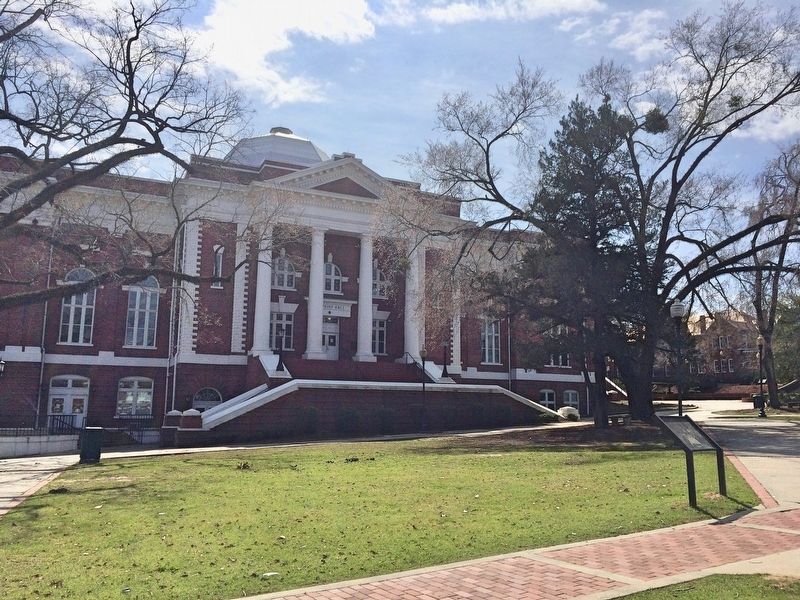
Carnegie Hall is named for Andrew Carnegie, . . . — — Map (db m101923) HM
When school is in session, the broad expanse in front of you—the university's main quadrangle—buzzes with activity just as it did in the early 1900s, but life was much more regimented then. Students received demerits if they did not obey . . . — — Map (db m101920) HM
Built as a girls dormitory with funds donated by the widow of Collis P. Huntington, philanthropist, and president of the C & O (Chesapeake & Ohio) Railroad. Huntington Hall was designed by architect, Robert R. Taylor, the first African American . . . — — Map (db m101907) HM
Jessie Parkhurst Guzman (1898-1996) was born in Savannah, Georgia, educated at Howard University (BA, 1919) and Columbia University (MA, 1924), and worked at Tuskegee University for over forty years. During Guzman's time at Tuskegee University, she . . . — — Map (db m139885) HM
Julius Rosenwald (1862-1932) was a Jewish multimillionaire merchant and one of the founders (1906) of Sears, Roebuck, and Company, then the largest department store in the United States. Rosenwald was a member of the Tuskegee University Board of . . . — — Map (db m134671) HM
In this sculpture by Charles Keck, Booker T. Washington lifts the veil of ignorance from the face of a former slave. The open book, plow, and anvil symbolize Washington's guiding principles of opening the path to education through agriculture and . . . — — Map (db m99942) HM
. . . the school is not dependent upon the presence of any one individual. The whole
executive force . . . is so organized . . . that the machinery of the school goes on day by day like clockwork.
—Booker T. Washington, . . . — — Map (db m101922) HM
Porter Hall
1883
Porter Hall was the first building erected on the Tuskegee campus. The building housed administrative offices, library reading and recitation rooms, chapel, kitchen, dining room, living quarters and laundry. It . . . — — Map (db m101915) HM
At the time we occupied the place there were standing upon it a cabin, formerly used as the dining room, an old kitchen, a stable, and an old hen-house. Within a few weeks we had all of these structures in use.
—Booker T. . . . — — Map (db m101916) HM
This plaza is dedicated to the memory of the Tuskegee Airmen, including General Daniel "Chappie" James, whose training at Tuskegee University and the Tuskegee Army Air Field enabled them to prove for all time the competence and bravery of Black . . . — — Map (db m20076) HM
The Tuskegee Institute Advancement League (TIAL) was a student-based organization started in 1963 and reorganized in 1965 during the school integration crises. It originally sought to gain a measure of academic freedom through input with the . . . — — Map (db m139886) HM
Thrasher Hall, renovated in 1983. Was built in 1893 by teachers and students using brick they made. Only the exterior walls remain from the original building. The bell above rang for class changes. It was located in the building's bell tower until . . . — — Map (db m101905) HM
More than 8,000 people, White and Colored, rich and poor, from the lowliest farm and the richest Fifth Avenue mansion crowded in and around the school chapel to pay homage [to Booker T. Washington].
—Baltimore . . . — — Map (db m99943) HM
This U.S. Air Force F-4C Phantom Jet Fighter was flown by General "Chappie" James, Tuskegee University graduate and first Black Four-Star General in the U.S. Armed Services, on his last combat mission--Operation Bold--over Southeast Asia. It flies . . . — — Map (db m101902) HM
I determined when quite a small child . . . I would in some way get enough education to enable me to read common books and newspapers.
—Booker T. Washington, Up From Slavery
Booker T. Washington changed the . . . — — Map (db m101932) HM
Named in honor of Alexander Moss White of Brooklyn, New York, with funds donated by his children. This structure opened fall 1909. The building was officially dedicated in January 1910 was a dormitory for women. A bronze tower with clock was added . . . — — Map (db m101906) HM
Located on land owned by John Gurley, pioneer settler, and named for him. His son, Capt. Frank B. Gurley, became a Confederate hero as a member of the 4th Ala. Cavalry. The settlement that developed around the water tank on Memphis and Charleston . . . — — Map (db m30574) HM
Before statehood, the Alabama Territory had only limited rights of self government. Between July 5 and August 2, 1819, forty-four delegates from across the Territory convened in Huntsville to draft a constitution for statehood. Lawyers, . . . — — Map (db m26592) HM
Dallas Mills and Village
1892-1949
Chartered in 1890 by T. B. Dallas, Dallas Mills began operation in 1892 as Alabama's largest cotton mill, manufacturing sheeting. The mill village extended from Oakwood Ave. South to O'Shaughnessy Ave., and . . . — — Map (db m154280) HM
Opened in 1944, the Fifth Avenue School became the focal point for major educational change on September 9, 1963, when Sonnie Hereford IV became the first African-American student to integrate public schools in Alabama. Following a lengthy court . . . — — Map (db m55722) HM
On January 25, 1934, Oscar Goldsmith, Lawrence B. Goldsmith, Annie Schiffman Goldsmith, Robert L. Schiffman, and Strauss Schiffman gave this property to the City of Huntsville for an athletic field. The gift was in memory of Betty Bernstein . . . — — Map (db m130148) HM
The Alabama legislature authorized the Seminary on January 15, 1831. A board of trustees
owned stock in the enterprise. It replaced the Huntsville Female Academy organized in 1830. The new teaching staff, hired by Trustee James G. Birney, were . . . — — Map (db m154269) HM
In 1918 William Lincoln Barrell of Lowell MA. purchased Abingdon Mill and transformed it into a large textile center of all concrete construction named Lincoln Mill Village. Phillip Peeler served as its superintendent from 1934-1953. Built in 1929 . . . — — Map (db m39758) HM
Merrimack Mfg. Co. & Village In 1899, construction started on Merrimack Mill and village. The mill began operation in 1900. A second mill building, added in 1903, made it one of the largest in the South. Under Joseph J. Bradley, Sr., . . . — — Map (db m38805) HM
From a small self-contained 1800s rural community Monte Sano ballooned with the Space Age. By 1958 there were approximately 100 families connected with the Space Program living on Monte Sano. Many were von Braun Rocket Team Members.
The school . . . — — Map (db m154275) HM
Monte Sano Female Seminary
founded by
The Rev. and Mrs. James Rowe
opened February, 1830
closed December, 1833
Course of Instruction included "English,
Classical, Scientific, and Ornamental
branches of Education usually . . . — — Map (db m154276) HM
Oakwood College, which began as an industrial school, was founded by the Seventh-day Adventist Church in 1896 to educate African Americans in the South. The school was erected on 380 acres purchased during the previous year for $6,700. Additional . . . — — Map (db m34953) HM
Oakwood College, which began as an industrial school, was founded by the Seventh-day Adventist Church in 1896 to educate African Americans in the South. The school was erected on 380 acres purchased during the previous year for $6,700. Additional . . . — — Map (db m34955) HM
Legislature approved 9 December 1873 "a normal school for the education of colored teachers" in Huntsville. Ex-slave William Hooper Councill founder and first president. Classes began May 1875 with sixty-one pupils and two teachers; held in rented . . . — — Map (db m85546) HM
In November 1949, following an extensive lobbying campaign by Huntsville
leaders, the University of Alabama approved the creation of an extension
center in the city. The first classes of the University of Alabama-Huntsville
Center (renamed to . . . — — Map (db m299416) HM
Organized as a Christian Church, this is the original congregation of what is now the Church of Christ in Huntsville. A gospel meeting was held in the Courthouse in 1883, conducted by James A. Harding, evangelist and founder of Harding College and . . . — — Map (db m27899) HM
Side A
Dr. Joseph Echols Lowery was born in Huntsville on Oct 6, 1921, to Dora and Leroy Lowery. He grew up in Lakeside (Methodist) church. He began his education in Huntsville, spent his middle school years in Chicago, and returned to . . . — — Map (db m85550) HM
S.R. Butler High School, originally established in
1951 at Clinton Avenue, was moved to this location in
the fall of 1967, with the first class graduating in
1968. Dr. J. Homer Crim served as principal from
1951 until 1971. By the 1970s, . . . — — Map (db m278155) HM
S.R. Butler High School. S.R. Butler High School was established by the Madison County School System in 1951 with the consolidation of five small county high schools (Rison, West Huntsville, Joe Bradley, Madison, and Lincoln). The new school . . . — — Map (db m299580) HM
Chartered in 1812. Leading educational Institution. Long prominent in training leaders of North Alabama. Occupied by Federal troops, 1862. Building burned, 1864. Site of city schools since 1882. Location used only for school purposes. Alabama . . . — — Map (db m55724) HM
Organized in 1851 under the direction of the Methodist Episcopal Church, so this institution became one of the finest of its kind in the South in the education of girls from the primary through the college level. Its aim was to "secure the . . . — — Map (db m37842) HM
The first integrated elementary education classes in the state of Alabama took place quietly and peacefully here September 3, 1963.
St. Joseph's Mission, church and school, was founded by the Society of the Divine Savior (Salvatorians) to serve . . . — — Map (db m154263) HM
The Jesup Agricultural Wagon was the first vehicle used in Tuskegee Institute’s Movable School, an outreach effort of the Tuskegee Institute (now Tuskegee University) aimed at bringing modern agricultural tools and methods to rural areas and people . . . — — Map (db m144944) HM
Tom Goodman Thrasher
August 4, 1916
December 19, 1999
-Grew up in Birmingham, Alabama
-Studied Engineering at the University of Alabama in Tuscaloosa
-Married the former Dorothy Wright of Belmont, Mississippi
-Served in the Army in North . . . — — Map (db m85611) HM
The first public school for African-Americans in the city of Huntsville was named for the founder of the Alabama A&M University. The site, selected by a committee headed by the Rev. W.E. Gaston, was donated by the Davis-Lowe family. Founded in 1867 . . . — — Map (db m36065) HM
Poplar Ridge School had its beginning in 1858 as a one-room log building. The existing late Classical Revival frame building was built circa 1875. A late Victorian façade was subsequently added. At one time the school had an enrollment of 100 . . . — — Map (db m191684) HM
Alabama Agricultural and Mechanical University
Legislature approved 9 December 1873 "a normal school for the education of colored teachers" in Huntsville. Ex-slave William Hooper Councill founder and first president. Classes began May 1875 . . . — — Map (db m39760) HM
In 1919, the first building was erected nearby with funds provided locally and supplemented with a Julius Rosenwald Foundation grant. Named for William H. Councill, Alabama A&M University founder, the three-room structure was built for black . . . — — Map (db m39761) HM
"...A tower of knowledge, of strength, of power ...Let us build..." Dr. William Hooper Councill served as President of Alabama A&M University and was the catalyst for its early development from its founding in 1875 until his death in 1909. . . . — — Map (db m39763) HM
Central High School
1917-1931
In 1916, the Superintendent of Madison County Schools met with the citizens of Ryland, Maysville, and Brownsboro to discuss plans to replace the three one-room schools serving each community. Five acres of . . . — — Map (db m113466) HM
In October, 1808, the Western Conference of the Methodist Episcopal Church sent James Gwinn, a circuit rider, to the "great bend" of the Tennessee River to formalize existing Methodist Societies. He organized the Flint Circuit to serve frontier . . . — — Map (db m39767) HM
The first public county high school for African-Americans in Madison County was located in the Toney community. The original Toney School was founded in 1896 in a log cabin on the Henderson (Tump) Crutcher place (-½ mile west of this site, at the . . . — — Map (db m201346) HM
Ulysses Simpson Jones was born in Tuscaloosa in 1872. He attended the high school division of Talladega College from 1886 to 1890. Realizing that schools were established for the perpetuation of ideas and ideals of society, he decided to build a . . . — — Map (db m286976) HM
Edd Shields was born into slavery on June 15, 1853, on the Steele plantation in Wilcox County. At age 4, his owner brought him to Marengo County where he remained enslaved until age 12. From 1867-1873, he worked as a farmer, and was educated by . . . — — Map (db m306130) HM
Following the Civil War and emancipation, newly freed African Americans, who had worshiped in the Bethel Church in McKinley while enslaved, established their own Bethel Church in a wooden house at the rear of the current church site. In the . . . — — Map (db m72969) HM
In 1910, a committee of elders of the West Alabama Primitive Baptist Association
bought two acres of land in an established African American neighborhood
to open the Thomaston Colored Institute/Thomaston Academy. Incorporated
in 1909, a . . . — — Map (db m305970) HM
The Alabama Legislature passed an act in February of 1893 calling for the construction of agricultural schools to be built in each of Alabama’s congressional districts. The city of Albertville was chosen as the site for the seventh congressional . . . — — Map (db m78709) HM
First Arab High School
In the early 1900s, students from Arab enrolled at Albertville High School because Arab didn’t have a high school. One group, called the “Brindlee Mountain Boys”, would travel to Guntersville by buggy and then by . . . — — Map (db m261862) HM
Constructed in 1937, the Florence H. Becker Recreation Hall was named in honor of Florence Hague Becker, President General of the National Society Daughters of the American Revolution from 1935 to 1938. The vertically placed pine logs used in the . . . — — Map (db m241934) HM
In 1924, the Alabama Society of the Daughters of the American Revolution (DAR) established Kate Duncan Smith School to provide a patriotic education dedicated to academic achievement and service to "God, Home, and Country" for the people of . . . — — Map (db m33308) HM
Built as a water tower in 1937 by her husband in honor of Mrs. Harper Donelson Sheppard, Pennsylvania State Regent 1935-1938, and created a Bell Tower in 1973 upon the installation of a Carillion by the Pennsylvania Daughters in honor of Mrs. Harold . . . — — Map (db m76232) HM
Claysville School was born of community pride and the tireless labor of the people. Built on five acres bought for two dollars per acre from C. W. Baird, Sarah Baird, and H. D. Walls, Claysville School was completed on February 19, 1929. Led by . . . — — Map (db m110731) HM
The building on this site has been called many names and served many functions in its long life. Originally known as the "Methodist-Episcopalian Church" and later as the "Little Church in the Pines," the structure was located a few miles from here . . . — — Map (db m146901) HM
The Grand Bay Elementary School for Colored was located on land adjacent to this building. Peter Alba donated the parcel on which the school was constructed in 1919. Soon thereafter, Black residents of Grand Bay and the Board of School . . . — — Map (db m189763) HM
Andrew N. Johnson, born 1865 in Marion, Alabama, graduated from Talladega College in 1886, and taught in rural Alabama. On this site in 1894, he established the Mobile Weekly Press, a voice for African-Americans, "A.N.", a powerful member of the . . . — — Map (db m111347) HM
Built 1835-1836. First public school in Alabama. Named for Rep. Willoughby Barton, author of Bill creating public schools of Mobile some 28 yrs. before State system. It was used as a hospital for Union soldiers in 1864. — — Map (db m86387) HM
The first public school in Alabama built in 1835-36, used continuously since that time for the purpose of education except for a brief period during the Civil War when it was a hospital. Named for State Rep. Willoughby Barton of Mobile who was the . . . — — Map (db m143517) HM
Opened in 1887 as Broad Street Academy, this was the site of Mobile's first public high school for African Americans. The building was razed in 1947, and a new elementary school was constructed and named in recognition of William Caldwell, the first . . . — — Map (db m111353) HM
Cathedral-Basilica of the Immaculate Conception
Parish established in 1703 by John-Baptiste de la Croix, Bishop of Québec, while Mobile served as capital of Louisiana. Oldest religious congregation of any denomination in Alabama and the . . . — — Map (db m286687) HM
Dunbar School was built on this site in 1924. Dr. W.A. Caldwell was its first principal. In 1947, the Old Medical College on St. Anthony Street was remodeled and became Central High School. Dr. Benjamin Baker was named principal. In 1955, the . . . — — Map (db m111386) HM
On this site stood Emerson Institute, Mobile's first school for the formal education of African-Americans and one of the few 19th-century normal schools for African-Americans in Alabama. Founded 1865 by the Freedmen's Bureau, the school was run by . . . — — Map (db m111289) HM
Organized in 1899 as St. Anthony's Mission by Creoles of African descent. By 1901, Josephite priests Revs. Joseph St. Laurent and Louis Pastorelli had established a small school. The
present church was completed in 1908 and dedicated as Most Pure . . . — — Map (db m111302) HM
Sand Town, the oldest African American neighborhood in the area of Spring Hill, in Mobile, Alabama, was established before 1845 by former enslaved and free, indigenous people of color. Sand Town residents built their own homes, school and places of . . . — — Map (db m179993) HM
The church was organized in 1853 by ten African-Americans who were former members of Stone Street Baptist Church. It is the second oldest Missionary Baptist Church in Alabama. The first three pastors were Caucasian; however, following passage of the . . . — — Map (db m86578) HM
On this site in 1884 the Sisters of Mercy established the Convent of Mercy. In 1908 the front building, the convent, was constructed and in 1927 the adjacent school building was occupied by pupils attending Convent of Mercy Academy. The school . . . — — Map (db m86584) HM
Union Baptist Church
Organized in 1869 as the Old Landmark Baptist Church by Rev. Henry McCrea and the following survivors of the slave ship, Clotilda: Pollee Allen, Rose Allen, Katie Cooper, Anna Keeby, Ossa Keeby, Josephina Lee, Peter . . . — — Map (db m307186) HM
Vernon Crawford established the first African-American law firm in Mobile. He successfully argued the Birdie Mae Davis case that desegregated Mobile schools. He stood before the Supreme Court and won the landmark case of Bolden vs. the City of . . . — — Map (db m111319) HM
Side 1
On May 30, 1965, Vivian Malone, became the first African-American to graduate from the University of Alabama. To achieve admission at the all-White university, she was forced to confront then Governor, George C. Wallace, in what has . . . — — Map (db m111392) HM
Council Traditional School was founded and opened in 1910. It is named in honor of William Hooper Councill, a former slave who was the founder of Alabama A&M University in Huntsville, Alabama. This building was erected in 1910 and underwent . . . — — Map (db m86575) HM
At the request of Rt. Rev. Michael Portier, first Bishop of Mobile, sisters, from the Visitation Monastery of Georgetown. D.C. under the direction of Mother Madeleine Augustine D'Arreger established the academy for girls. Renowned as an educational . . . — — Map (db m291876) HM
Founded in 1864 by Bishop Richard Hooker Wilmer of the Episcopal Diocese of Alabama Wilmer Hall (originally the Church Home for Orphans) was established to care for children and widows devastated by war, poverty, and disease in: Tuscaloosa. The . . . — — Map (db m310779) HM
The Monroeville Rosenwald School was built in 1927 to provide educational
opportunities for Black children in the community. The one-room school,
built by the Freedman's Bureau, offered first through sixth grades.
Funds to build the school were . . . — — Map (db m305886) HM
The Perdue Hill Industrial School was founded by Patrick J. Carmichael after he moved to this area in 1918. Carmichael acted as both the principal and teacher during the early years of the school, which was originally a one-room structure serving . . . — — Map (db m47643) HM
Captain Waller of Selma built Mt. Pleasant Methodist Church in the 1820s after he realized that no house of worship existed in the area. Captain Waller moved to the area to engage in the timber business and built the county's first sawmill on the . . . — — Map (db m247523) HM
This building was one of fourteen schools constructed in Montgomery County with funding assistance from the Julius Rosenwald Fund. Between 1912-32, Julius Rosenwald, a Jewish philanthropist and CEO of Sears, Roebuck and Company teamed up with Booker . . . — — Map (db m71427) HM
(Side A)
Air University
The Air Corps Tactical School moved to Maxwell in 1931. Brilliant young officers like Chennault, Eaker, Fairchild, Hansell, Kuter, LeMay, Quesada, and Vandenberg formulated the aerial strategies and tactics . . . — — Map (db m64437) HM
Post-Vietnam Era marked a turning point for AU. Lt Gen Furlong, AU commander, launched a three year campaign to overhaul the curriculum which became known as “Putting the ‘War’ back into War College.” Between 1975 and 1976 AU gained . . . — — Map (db m64375) HM
In 1941, before Pearl Harbour, President Franklin D. Roosevelt agreed with Prime Minister Winston S. Churchill, to provide flight training for British and Commonwealth pilots in the U.S.A. by the U.S. Army Air Corps.
Over 4,000 pilots were . . . — — Map (db m64476) HM WM
The Cessna T-41 was derived from a standard Cessna Model 172 light aviation aircraft. Between 1965 and 1969 the USAF purchased 211 T-41A variants "off the shelf" for the preliminary flight screening of pilot candidates; another 52 T-41C variants . . . — — Map (db m64482) HM
Charged with developing doctrines and concepts for the employment of air power, AU produced the first basic doctrine manuals for the Air Force. AU also gained notoriety with projects such as Corona Harvest, which studied and developed . . . — — Map (db m64374) HM
To accommodate expansion of programs, a five million dollar construction project began in 1954 to give AU a modern, integrated academic center with a collegiate atmosphere and facilities in keeping with its educational mission.
We’re . . . — — Map (db m64372) HM
The Army Air Forces school was assigned its first commander, Major General Muir S. Fairchild, in February 1946, and renamed Air University in March. The dedication ceremony occurred 3 Sep 1946. The first classes at the Air War College and the . . . — — Map (db m64370) HM
During the early 1950’s, Air Force leaders decided to consolidate and relocate professional military and continuing education activities, as well as commissioning and specialized schools to Maxwell and Gunter Air Force Bases.
”(Air . . . — — Map (db m64371) HM
Air University began new Air War College and Air Command and Staff College programs in 1987 which met newly mandated “Joint” education requirements. These programs emphasized joint war fighting.
”The basic reason for the . . . — — Map (db m64378) HM
This facility is dedicated to the memory of Senator Lister Hill who faithfully served his state and the nation for forty-five years as a member of the House of Representatives and the United States Senate. An Infantry Officer during World War I, . . . — — Map (db m79082) HM
Lt. William C. Maxwell (Side A)
William Calvin Maxwell was born Nov. 9, 1892 in Natchez, Ala. An Army ROTC student at the University of Alabama, he left in 1917 to enlist in the Army. He received his commission in April 1918, after . . . — — Map (db m64367) HM
In the mid-1950s, the USAF required a trainer with higher performance than the T-33 to better prepare student pilots for the latest tactical aircraft that were then coming into service. The aircraft chosen was the T-38A which offered high . . . — — Map (db m64433) HM
19403 entries matched your criteria. Entries 301 through 400 are listed above. ⊲ Previous 100 — Next 100 ⊳