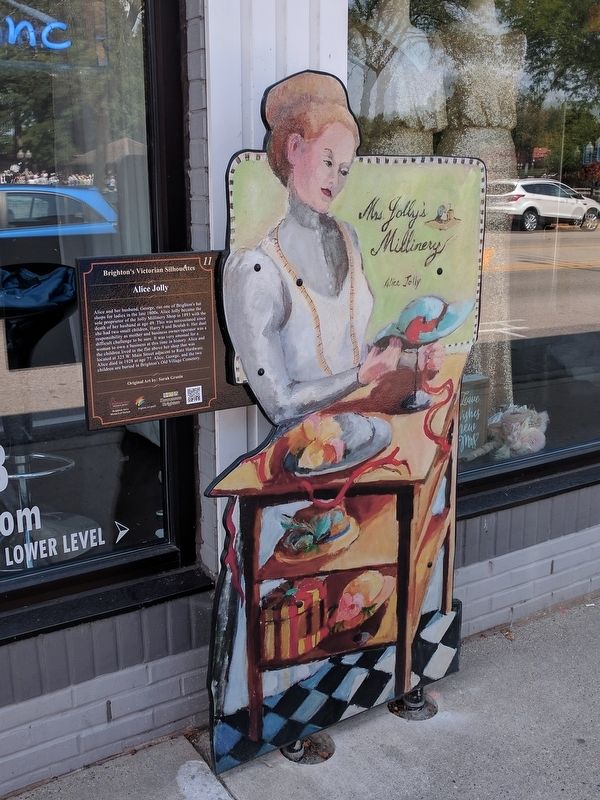
Alice and her husband, George, ran one of Brighton's hat shops for ladies in the late 1800s. Alice Jolly became the sole proprietor of the Jolly Millinery Shop in 1893 with the death of her husband at age 49. This was necessitated since she had . . . — — Map (db m107724) HM
Alvira and her husband, John, lived on Hamburg Road, south of Brighton with their two girls, Carrie and Lucy. John taught school in the Village of Brighton before being admitted to the University of Michigan Law School in the late 1850s. He . . . — — Map (db m107677) HM
Benjamin Treadwell Onderdonk Clark was an infant when his family came to Brighton in 1837 just after the tiny town of Ore Creek was renamed. His father, Reverend William A. Clark held the first regular religious services in the community and . . . — — Map (db m107649) HM
Bessie is a milk cow. Holsteins started to appear in Livingston County in the 1880s. The county became a leader in selling these cows throughout the Midwest. These black and white dairy cows can produce about 2900 gallons of milk. In the late . . . — — Map (db m107615) HM
Dedicated To
The Men and Women of the
Brighton Area
Who Honorably
Served Their Country
In War and Peace
We Cherish the Memory
Of Those Who Died That
Freedom May Live — — Map (db m182467) WM
In 1842 pioneer settler Richard Lyons donated land for the first school in Brighton Township's District No. 8. Area Methodists worshipped in the log school until 1874. In 1885 the log building was replaced with this one-room clapboard structure. . . . — — Map (db m156118) HM
The Brighton Hook and Ladder Company Number 1 was formed in 1876 to protect the village against fires. The continued growth of the community and the expansion of the village to the west of Ore Creek created a real need for men and equipment to . . . — — Map (db m107603) HM
Side 1
The Brighton Village Cemetery began as a burial ground for the family of William A. Clark, D.D., an Episcopal minister from New York City, who settled with his family in Brighton Township in 1837. Clark acquired many acres of land, . . . — — Map (db m107616) HM
Daniel Marsh was elected as the first President of the new Village of Brighton. He arrived in Brighton in 1839 and was this small town's first attorney and the first prosecuting attorney in Livingston County. He married the widow Sara Maltby who . . . — — Map (db m107694) HM
Duke was raised to provide beef. Herefords are brown and white and could be found in the 1870s. Sometimes cattle and cows were found in the Old Village Cemetery eating grass. These animals apparently left the safety of their pen in search of . . . — — Map (db m107674) HM
The sacrifices of few ensured
the freedom of many.
A grateful community
remembers those who
served in the armed forces
of the United States
during times of war and peace,
whose courage and personal
sacrifices defended and . . . — — Map (db m175047) WM
John Tanner was known as one of Brighton's most unusual people. His 10 foot long beard was always tucked under his shirt only to be seen by his wife and the paying public. His delivery operation from the train depot ran from 1871-1910 with his . . . — — Map (db m107558) HM
John McKinney arrived in Brighton in the 1850s as an escaped slave who most likely survived the dangers of hidden travel with the families who operated the Underground Railroad. The Underground Railroad helped Southern slaves escape to the North and . . . — — Map (db m108662) HM
Johnny Blessed operated a two horse stagecoach that avoided the swamps and followed the rough and bumpy Grand River Indian Trail between Detroit and Howell. Tired horses would be exchanged for fresh horses in Farmington, New Hudson and at Brighton's . . . — — Map (db m158769) HM
City of Brighton
Mill Pond Park
Dedicated October 14, 1972 to the people of the Brighton community.
A community recreation facility made possible through contributions from the citizens, service clubs, and organizations of the Brighton . . . — — Map (db m176655) HM
Settled in 1832 by Maynard Maltby, this community was originally called Ore Creek for the stream that flows through it. In 1838 its name was changed to Brighton. It was incorporated as a village in 1867 and as a city in 1928. In 1878 the village . . . — — Map (db m107605) HM
Orson Quakenbush played a key role in establishing Brighton as a viable rural community with the downtown construction of his dam and grist mill on Ore Creek in 1838. The flowing water of Ore Creek would turn a water wheel that rotated a grindstone . . . — — Map (db m108737) HM
Amelia and Benjamin Pipp lived near the Millpond. Their summer activities were swimming and fishing which was common for all kids. Placing worms on their hooks and awaiting the first hit of the "big" fish was their challenge. Their talents were . . . — — Map (db m108706) HM
The iron horse arrived in Brighton in 1871. Brighton's future growth and success was off to a good start with this new transportation service running through town. The railroad depot was built about 600 feet beyond this artwork. The push-pull . . . — — Map (db m108680) HM
St. Patrick Church
St. Patrick was the first church to serve Brighton area Catholics, many of whom were immigrants from Ireland. A simple log structure at the corner of McCabe and Silver Lake Roads built in 1838 was used by the congregation . . . — — Map (db m107557) HM
When the Reverend William A. Clark, D. D., purchased his land in Brighton Township, he set aside an acre as a church site and established a cemetery near it. In 1837 he organized an Episcopal group and conducted its first services in his orchard. . . . — — Map (db m107623) HM
Twenty-five year old Kinsley Bingham left his New York home in 1833 saying: "Give me $500 and let me go to Michigan and I'll be governor in two years." He settled here, constructing this handsome Greek Revival house in 1842. Bingham's boast was . . . — — Map (db m107539) HM
This was once the summer camp of Michigan's National Guard. Here in 1898 the five regiments which were recruited in the state during the war with Spain were organized. Ten men volunteered for every one who could be accepted. Two of the units, the . . . — — Map (db m107555) HM
Around 1855, Timothy and Lucretia Warner built this Greek Revival farmhouse. Timothy (1819-1900) migrated from Livonia, New York, to Brighton Township in 1837. He was credited with helping organize and name the township later that year. In 1841 he . . . — — Map (db m231249) HM
The Congregational Church of Tyrone, grew out of the Methodist Episcopal church that organized here in 1845. Itinerant ministers called circuit riders served what was known as the Tyrone or Cranston Class. In 1874 the class split over where to build . . . — — Map (db m178131) HM
Tyrone Township was settled in 1834, and Joseph M. Becker was elected as the first township supervisor in 1838. Township meetings were held in the homes of the townsfolk until 1887, when this hall was erected on Hartland Road at a cost of $640. . . . — — Map (db m178108) HM
The Reverend Charles G. Clarke of Washtenaw County led eleven people in organizing the First Presbyterian Church in Unadilla on February 4, 1837. It was the township’s first religious society. The congregation met in a schoolhouse until a brick . . . — — Map (db m171698) HM
The Plainfield Methodist Protestant Church formally organized on June 7, 1863. The present church building dedicated on January 27, 1907, replaced the first church, built in 1868, which burned when it was struck by lightning in 1906. In 1939 the . . . — — Map (db m192115) HM
Baseline Cemetery was established on April 14, 1837. The custom of burning the cemetery grass before Memorial Day blackened and weakened the limestone monuments and many others were destroyed during the tornado of 1914. Since no records were kept, . . . — — Map (db m171685) HM
When the town was formally organized in 1884, it was named after local farmer Philander Gregory, who had been a resident since 1837.
In the early 1870s, the Michigan Airline Railroad Company began construction in Livingston County as part of a . . . — — Map (db m273815) HM
In the early 1830s, many New England homesteaders moved west towards the Territory of Michigan in search of fertile land close to a river or stream. Many traveled by boat along the Erie Canal and then inland on existing Anishinaabe trails.
. . . — — Map (db m202037) HM
Hamburg
The year 1831 marked the arrival of Hamburg's first settlers--Felix Dunlavey, Jesse Hall, Calvin Jackson, Cornelius Miller and Herman Lake--and their families. In 1835, Ann Arbor merchant E.F. Gay and Amariah Hammond purchased thirty . . . — — Map (db m50165) HM
This building is one of the oldest Episcopal churches in Michigan. St. Stephen's parish was organized in 1844, and construction of the church began almost immediately. Hiram Raymond of Hamburg was the contractor, and building funds were solicited in . . . — — Map (db m67453) HM
Everything changed when the trains came to Hamburg in the 1880s.
The village had been connected to neighboring towns only by old Native American trails and dirt roads. Travel was slow and difficult on foot, horse or wagon, and village . . . — — Map (db m168379) HM
The Hotel brought the world to the little village of Hamburg.
Built in 1835 beside Horsehoe Creek, it sheltered many early settlers to the region and, by 1850, visitors coming to enjoy hunting and fishing in the woods and lakes. Two . . . — — Map (db m168152) HM
Hartland Township was settled in 1831. On this site distinguished early citizens Robert and Chauncey Crouse operated a general mercantile business. In 1891 this town hall was built. The hall later served as a fire station and center for community . . . — — Map (db m178052) HM
The first burial in this cemetery occurred in 1840 upon the death of Thomas Hall, a Hartland Township pioneer. Chauncey L. and Robert C. Crouse, who platted the village of Hartland in 1842, transferred approximately two acres of the original . . . — — Map (db m178056) HM
This structure was constructed in 1858 as the Hartland First Congregational Church. It was purchased in 1929 for $500 by the Hartland Consolidated School Foundation, established by John Robert Crouse, Sr. In 1932 the remodeled building became the . . . — — Map (db m178054) HM
Little is known to the living who walk above us. Yes, they come to visit a loved one or that special someone just to make themselves happy, to remember us as we once were. Oh, to always be 18 or 20 or to have lived a much longer life and choose . . . — — Map (db m211163) WM
Howell raised $20,000 in 1885 to induce the Toledo, Ann Arbor & Northern Michigan to enter town. Many believed the town, already served by one railroad, would boom with a second line. Early in 1886 a right-of-way dispute erupted in an armed brawl . . . — — Map (db m107759) HM
Albert E. French designed this two-and-a-half story brick and stone building. This edifice, completed in 1890, shows influence of Richardsonian architecture and has maintained many of its original Victorian furnishings. Peter and Maria Cowdry . . . — — Map (db m107800) HM
This “House of Seven Gables” was built in 1886-87 by the farm family of Frank J. and Ada Hecox. A plastered brick wall in the basement is inscribed with Frank Hecox’s initials and the date 1887. The Hecox family left the area by 1900, and Ada sold . . . — — Map (db m174718) HM
This c. 1846 Greek Revival house, among Howell's oldest, was home to prominent citizen George W. Lee (1812-1882). Lee moved from New York State to Michigan in 1836. A businessman and public servant, Lee helped establish the Republican Party in 1854 . . . — — Map (db m107753) HM
The Howell library association originated as the Ladies Library Association in 1875. That year, the ladies began offering books for lending. The need for spacious, permanent quarters grew, and in 1902, for three hundred dollars and railroad . . . — — Map (db m107873) HM
Waddell Woman's Relief Corps
in memory of and dedicated to Waddell Post
No. 120. G.A.R. and all Veterans of Livingston
Co. who served in the war of '61-'65
"They fought to save US a Nation" — — Map (db m182475) WM
The Livingston County Press, one of Michigan's oldest weekly newspapers, traces its roots to The Livingston Courier, The Livingston Republican and The Livingston Democrat. The Courier, established in 1843, was . . . — — Map (db m107830) HM
Honor Roll
A Tribute To The
656 Heroic Ones
Who Served Their Country
* 1914 * World War * 1919 *
In Memoriam
Floyd Howard Abrams • Leon Ellsworth Allen • John Avis • William Edward Brimley • Jesse Barton Cooley . . . — — Map (db m182476) WM
During the 1830s a number of Irish Catholic settlers migrated from New York State to Deerfield and Tyrone Townships, drawn by the prospect of purchasing inexpensive land. When they arrived there was no parish to serve them. In 1843 Father Patrick . . . — — Map (db m176612) HM
Irish immigrants founded a Catholic mission in Livingston County in 1843. The following year, two acres of land were purchased here and a log structure was erected for worship services. As the congregation grew it required a larger facility, and a . . . — — Map (db m107751) HM
Huron River: Why dam it?
Dams serve a variety of purposes. The Kent Lake Dam was built in 1947, but why? The answer comes from the "when". On the Huron River, from 1910 to 1940, power generation was the goal. From 1944 to 1970, most dams . . . — — Map (db m156415) HM
Before the existence of Kensington Metropark, Detroit journalist, poet and labor leader Jo Labadie chose this site to get away from the "noise and hurry-up of the big town." He and his wife built a house, barn, printshop, and henhouse. Because of . . . — — Map (db m185009) HM
Founded in 1884, Anderson began as a train depot along the newly built Grand Trunk Western Railroad route. A community grew around it, and, at its peak, Anderson had a post officce, cheese factory and farmers store that sold dry goods, groceries . . . — — Map (db m202579) HM
[The Village of Pinckney]...is in the midst of one of the finest and already best settled agricultural districts in the state, and is already the natural center of business for not less than two hundred or three hundred families. . . . — — Map (db m202547) HM
From 1883 to 1886, the Grand Trunk Western and Ann Arbor & Toledo Railroads laid tracks here. Soon after, the first hotels and resorts were built on the Huron River's Chain of Lakes. Throughout the early 1900s, people left the heat and industry . . . — — Map (db m202209) HM
The Humpback Bridge used to be here,
crossing the Grand Trunk Railway. The narrow wooden span was built in 1900 to carry vehicles on state route M-36 over the Grand Trunk Railway line (now the Lakeland Trail). Unsuited to . . . — — Map (db m202504) HM
The Potawatomi and Wyandot lived along the river Giwitatigweisibi, known today as the Huron River. They traveled the waterway in birchbark canoes as they caught fish, harvested wild rice or bartered with other tribes. Lightweight canoes were easy . . . — — Map (db m202076) HM
Ice harvesting was the major winter activity
in Hamburg Township for over thirty years. Until electrical refrigeration became common in the 1940s, food was best preserved during warmer months in "iceboxes" with ice blocks . . . — — Map (db m202142) HM
Train wrecks were a constant worry
in Hamburg Township, though they were not common. Accidents jolted communities around the world as trains became common in the 1800s. In fact, worldwide time zones were established, in part, . . . — — Map (db m202465) HM
Priests from Detroit served the Catholics of Kunrod's Corner, present-day Center Line, from 1852 to 1857. In 1854 Saint Clement Catholic Parish was founded, and a church was erected on land sold to the Diocese of Detroit by Hermann and Magthalina . . . — — Map (db m106224) HM
St. Clement Catholic Church served as the center of community life for the Belgian, German, Polish, French, and Irish Catholics who settled at Kunrod's Corner during the mid-nineteenth century. This cemetery originated as the parish's burying . . . — — Map (db m106225) HM
Established in 1855, the Clinton Grove Cemetery exhibits an exquisite array of funerary art in a wooded landscape. This combination of nature and monuments reflects the rural cemetery movement of the nineteenth century, which popularized park-like . . . — — Map (db m32164) HM
In 1782 marauding American militia massacred nearly one hundred Christian Delaware Indians at their village in eastern Ohio. Seeking refuge, the Delaware settled on the Clinton River two and one-half miles north of here, on land granted by the . . . — — Map (db m85632) HM
In 1844 the Reverend Jonathon Davis founded the Methodist Episcopal Church to serve the community of Davis, known then as the village of Brooklyn. In 1846 the congregation built the town's first church. The present one, which dates from 1895, is a . . . — — Map (db m87612) HM
This Memorial is
in Honor and Memory
of
Those who Served
Their Country in Time
of Peace and War
Dedicated
Nov. 11, 1959
City Of East Detroit — — Map (db m170437) WM
This school served children in Erin and Warren Townships from 1872 to 1921. Beginning in 1838, German farmer Christian Gerlach held classes in his home. During the 1840s a log building served as a classroom. In 1850 a red frame school was built. . . . — — Map (db m122963) HM
German immigrants began organizing Methodist churches in Michigan in 1846. In 1849 a small group founded the Immanuel Methodist Church in Roseville to serve Detroit's northeast side. In 1933, when the Roseville church was razed to widen Gratiot . . . — — Map (db m124524) HM
Erin Township's German immigrants first worshipped together in a log church amid an oak forest in 1846. The following year the Reverend John Friedrich Winkler helped organize St. Peter's church as a "country church" near Detroit. This is the third . . . — — Map (db m124572) HM
A native of Bavaria, John Baumgartner purchased this property in Erin Township in 1856, becoming one of Fraser's first landowners. Around 1866 he and his wife, Samantha, moved here with the first three of their seven children. In 1875 they erected . . . — — Map (db m110795) HM
The forest fire apparatus bell in America appeared in 1803 on a hose wagon owned by the Philadelphia Hose Company No. 1. A spring-operated clapper rang the bell as the wheels turned, and acted as the warning device. Fire engines to this day are . . . — — Map (db m110869) HM
Side 1
In 1864, local residents asked Pastor Herman Lemke of East Detroit to help them organize a Lutheran church in Fraser. That same year, they built a small wood frame building on land south of 14 Mile Road. Each week after Sunday service, . . . — — Map (db m111062) HM
This was the home of John & Samantha Baumgartner. John came to America from Bavaria. The beauty of this house is in its architecture, "Rundbogenstil", or "Round arched windows". The style was popular in Germany between 1840 and 1850. German . . . — — Map (db m110825) HM
This is where the Fords' boathouse stood for
many years, jutting out over the cove. Edsel
enjoyed boating of all types, and he owned
an impressive collection of boats. An avid
sailor his entire life, Edsel raced speedboats
competitively as a . . . — — Map (db m206957) HM
Edsel Ford, president of the Ford Motor Company for many years, and his wife, Eleanor Clay, completed this 87-acre estate in 1927. Architect Albert Kahn derived the design from precedents in Cotswold, England, and many of the building materials, . . . — — Map (db m143597) HM
Edsel requested Jens Jensen build a generous playground for the children-space for sports in the summer and ice skating in the winter. By the late 1930s, the Ford children had outgrown the need for the play space.
Eleanor and Edsel asked . . . — — Map (db m212257) HM
The Fords—especially Edsel—lived in the public spotlight. They considered security and privacy to be of the utmost importance. To enter the estate, you must pass through the guarded and gated opening in the monumental Gate Lodge building. . . . — — Map (db m212261) HM
Gaukler Pointe
The home of Edsel and Eleanor Ford has been designated a National Historic Landmark
The natural prairie-stye landscape of Gaukler Pointe is nationally significant as one of the fines examples of the mature work of the style's . . . — — Map (db m212247) HM
Landscape architect Jens Jensen thought about how landscapes would look over time. He commented to Edsel. It takes years to get the real beauty out of a landscape planted… Its greatest beauty is in mature age."
Here, Jensen planned a gradual . . . — — Map (db m212253) HM
The Main Residence sits on the eastern
edge of the Gaukler Pointe taking advantage
of the views of Lake St. Clair and the
surrounding landscape created by Jens Jensen.
Architecturally, the Cotswold District in
England influenced architect . . . — — Map (db m206958) HM
Eleanor's chauffeur Arthur Fauser and his family (wife Mary and three children Arthur Jr. Alice, and John) moved into the cottage in late 1928 or early 1929. They lived there until Fauser's death in 1954.
Many staff members, like Fauser, . . . — — Map (db m212263) HM
The Playhouse was a gift to Josephine on her seventh birthday (1930) from her grandmother Clara Ford. Architect Robert O. Derrick designed it to complement the other buildings on the estate. In the roof gables, you can see decorative bas-relief . . . — — Map (db m212259) HM
The Power House contained all of the
machinery and equipment for operations
across the estate. The oil-fired boilers heated
the buildings and water for the swimming pool.
Pumps operated the vacuum cleaner system in
the house. Chlorinating . . . — — Map (db m206960) HM
The Fords asked architect Albert Kahn to design a support building near the Pool for informal entertaining. The Recreation Building contains a large sitting room with original furniture and a large fireplace, a small kitchen, changing rooms, and . . . — — Map (db m212255) HM
Landscape architect Jens Jensen tried to resist designing formal gardens, but Edsel told him Eleanor wanted a not-too-large, but definitely formal, garden. The result is a circular, wagon wheel like space featuring a lotus blossom fountain at its . . . — — Map (db m212256) HM
Selfridge, Michigan's first real airport, began operations as a training base in July, 1917. It has progressed to a leading role in America's air arm. It is often called "The Home of Generals" because Selfridge has been a springboard to success in . . . — — Map (db m157867) HM
Side 1
On February 20, 1882, thirty founders signed the charter of the Evangelical Lutheran St. Peter Church. They laid the cornerstone of their first church on May 29, 1882, across from the school built by their former congregation in . . . — — Map (db m233462) HM
Revolutionary War veteran John Crawford and his wife, Ann, founded this cemetery in 1837. Ornate headstones exhibit trends in funerary art over two centuries, and the German script on markers reflects the migration of European immigrants after the . . . — — Map (db m87681) HM
Thomas Clegg (1863-1939) and his English-born father, John, built “The Thing,” the first recorded self-propelled vehicle in Michigan (and perhaps the country) in 1884-85. The Thing, driven by a single cylinder steam engine with a tubular boiler . . . — — Map (db m135276) HM
This 10-pound Parrott cannon is a replica of the cannons used by Battery M of the 1st Michigan Artillery, assigned to the Eighth Michigan Cavalry Regiment.
Under the command of Colonel John Stockton, the Regiment trained in 1862-63 at Camp . . . — — Map (db m256905) HM
1904 entries matched your criteria. The first 100 are listed above. Next 100 ⊳