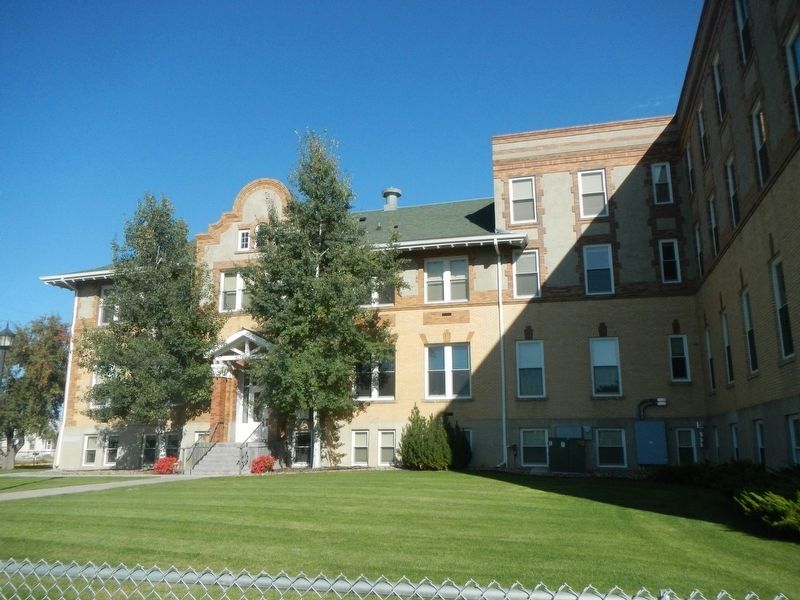
A converted two-story house served as the county hospital in 1907, a year before the Chicago, Milwaukee, St. Paul and Pacific Railroad arrived in Miles City. With encouragement from the railroad, which needed a place to treat injured workers, the . . . — — Map (db m164171) HM
“Remember the Flu epidemic” declared a notice advocating support for Rosebud County Hospital. In 1918 and 1919 influenza killed over 5,000 Montanans. Flu victims in Forsyth received care at the Masonic Hall, temporarily converted into an . . . — — Map (db m164791) HM
In 1837-38 a smallpox epidemic spread from the American Fur Trading Company steamboat St. Peter which had docked at Fort Union. The terrible disease for which the Indians had no immunity eventually affected all Montana tribes. A story is told among . . . — — Map (db m28814) HM
First Permanent Home
Gay Men's Health Crisis
1982-1984
Co-founded 1981 by:
Nathan Fain
Larry Kramer
Dr. Lawrence Mass
Paul Popham
Paul Rapoport
Edmund White
————————— . . . — — Map (db m125928) HM
The oldest known graves here, dating from as early as the 1860's, are those of the Randall and Rowlett families. Finis Dudley Beauchamp (1825-1893), a Confederate veteran from Mississippi, donated the 3-acre site to the newly formed Aurora Lodge . . . — — Map (db m183377) HM
Deaths of laborers and their family members were frequent along the Blue Ridge Railroad. Pneumonia, tuberculosis, and heart disease took a heavy toll. About thirty-three Irish men, women, and children living in shanties near the tunnel perished . . . — — Map (db m237793) HM
Side 1
In the summer of 1887, a notice was published confirming that the route for the Mobile and West Alabama Railroad would be the Choctaw Corner route. Soon the sounds of building could be heard over the swamp that was the . . . — — Map (db m101601) HM
On this island, formerly known as Hospital Island, stood the sheds erected to house emigrants who were victims of cholera in the great epidemic of 1832. Many persons died here, including Doctor Robert Gilmour, a native of Scotland and president of . . . — — Map (db m87065) HM
English:
Grosse Île and the Irish Memorial National Historic Site commemorates the significant waves of immigration welcomed to Canada between the opening of the 19th century and the First World War. During this period Québec was . . . — — Map (db m80672) HM
This building was erected in 1845 by the Protestant Orphans Asylum Society, to care for children left homeless after the disastrous fires and yellow fever epidemics of the 1830s. It has operated continuously since that time. — — Map (db m111293) HM
Chief Juan Antonio and his band of Cahuilla Indians helped white settlers in the San Bernardino area defend their property and livestock against outlaws during the 1840s and 1850s. In late 1851, Juan Antonio, his warriors and their families, settled . . . — — Map (db m131558) HM
Pochea was one of cluster of Indian villages forming the very large settlement of Pahsitna which extended along the ridge east and west of Ramona Bowl. Pahsitnah was thriving when the Spanish first passed by in 1774. A tragic story tells of the . . . — — Map (db m50668) HM
In the late 1890's Dr. Wm. F. Snow conceived the idea of a student hospital guild for Stanford students. A typhoid epidemic in 1902-03 emphasized a need for a hospital. Concerned citizens and students provided funds for the transformation of a . . . — — Map (db m250460) HM
Born in New Jersey in 1812, a convert to the church, renowned preacher and missionary, Peter Augustine Anderson was the first American Dominican to work in California and the first priest to offer mass in the Sacramento Valley. He was stricken with . . . — — Map (db m284295) HM
Florida's first railroad was constructed for the Lake Wimico & St. Joseph Canal & Railroad Company. Work began in 1835 and the first train ran in March 1836. The line extended nine miles from St. Joseph to Lake Wimico. The state's first steam . . . — — Map (db m129676) HM
The 'old' Palmetto Cemetery was established prior to 1888 and was used until 1910. The cemetery comprises one acre of land donated by Samuel Sparks Lamb, recognized founder of Palmetto. It is known as the Yellow Fever Cemetery because of the . . . — — Map (db m217024) HM
These statues tell the story of two residents of the Segui Kirby Smith House. Edmund Kirby Smith (right) was born in this house in 1826 and Alexander H. Darnes (left) a slave of the Smith's was born ca. 1846.
E. K. Smith graduated from West . . . — — Map (db m143639) HM
During the yellow fever epidemic of 1821, this half-acre plot was set aside as a public cemetery. Many Protestant pioneers to the new Florida Territory are buried here. Often such burials, made at public expense, went unmarked. The Presbyterian . . . — — Map (db m46703) HM
Catoosa County holds the distinction of having more active servicemen die within its boundaries than any other county in America apart from Adams County, Pennsylvania, where the Battle of Gettysburg occurred in July of 1863. The total number of . . . — — Map (db m213029) HM
The first Medical Society in Georgia, sixth oldest in America, was organized June 28, 1804, and continues to be active in Savannah today. Dr. Noble Wimberly Jones, first President, was the son of a member of General Oglethorpe's first settlers of . . . — — Map (db m12082) HM
One of the oldest church buildings in Danville. Erected in 1830 after Trinity parish founded in 1829. Rebuilt on the original walls following fire which swept central part of town, 1860. James Birney and Ephraim McDowell members of first vestry. In . . . — — Map (db m121539) HM
Decades-old graveyard discovered near here. Graves, with unmarked headstones, believed to be those of itinerant railroad workers struck down by cholera epidemic during the construction of the Bardstown-Springfield-Louisville Railroad around 1854, or . . . — — Map (db m171587) HM
Organized by the Bethel Baptist Association and opened in 1854 as Bethel Female High School. Used by CSA as hospital during Black Measles epidemic, 1861-1862. Bethel Women's Jr. College, 1917. Closed 1942-1945; rooms rented to Camp Campbell Army . . . — — Map (db m136778) HM
Organized in 1813, traditionally by the Rev. Gideon Blackburn, a pioneer minister and missionary to the Cherokee Indians. Present church building, not including later additions, was built during the period 1848-1852. Used as a hospital during severe . . . — — Map (db m88905) HM
In 1833 town trustees bought about an acre for $45 for public burial ground. First cholera epidemic in U.S. reached here. Seventy-five victims were buried here in 1833. John Ward, town trustee and a leader in forming cemetery, and his wife were both . . . — — Map (db m67786) HM
Dr. Luke P. Blackburn Correctional Complex
Originally Kentucky Village, this complex renamed in honor of Dr. Luke P. Blackburn, 26th Governor of Ky., in recognition of his pioneer efforts in prison reform. Elected Governor in 1879, after . . . — — Map (db m170039) HM
House in which Paducah's famed humorist, Irvin S. Cobb, was born in 1876 stood here until 1917. The home of Dr. Reuben Saunders, Cobb's maternal grandfather, a pioneer physician who practiced here 1847-l891. For discovery of a cure for cholera in . . . — — Map (db m158785) HM
Established in 1856, Holy Trinity was moved to this site in 1858. Five of its priests lost their lives treating the victims of the Yellow Fever Epidemic of 1873. The present church, in Romanesque Revival style, was built in 1896. — — Map (db m168349) HM
Opened 1882 as city's Catholic Cemetery. Several priests who died in 1873 yellow fever epidemic rest here, including Father Jean Pierre, founding pastor of Holy Trinity Church. Also many pioneer members of Shreveport's French and Italian Societies . . . — — Map (db m143742) HM
Begun in 1819, construction dragged on for five years because of epidemic yellow fever. Its fifth building (hence the name "pentagon") soon collapsed into a pile of bricks. But the remaining structures survived both Civil War bombardment and nearly . . . — — Map (db m87472) HM
On June 8, 1905, during the yellow fever epidemic, three Leeville residents: Joseph C. Picciola, Camille Rebstock and Adrien Lefort Purchased this plot of land from the Martin Family for the Leeville Cemetery Co. for $95. It became a large . . . — — Map (db m100120) HM
In 1882, residents of Grayling built the town's first church for the Methodist Episcopal congregation that had organized in 1879. In 1918, local lumberman Nels Michelson donated funds to erect a large brick church in honor of his late wife, . . . — — Map (db m95652) HM
In 1832 Arthur Power, founder of Farmington, donated this parcel of land for a cemetery and Friends Meeting House. The Friends referred to their burial ground as "God's Acre." The first persons buried here were Selinda and Phebe Minerva Power, . . . — — Map (db m169083) HM
Earliest evidence of Meridian's settlement, containing burials of first settler Richard McLemore, victims of 1871 riot, and 1878 Yellow Fever epidemic. Listed in National Register of Historic Places. — — Map (db m111129) HM
Residence of W.J.L. Holland, who gave his quarters and his life during the yellow fever epidemic of 1878. The benevolent Holland died while chairman of the relief committee. — — Map (db m85133) HM
Established in 1848 when Bethesda Presbyterian Church was built here under the leadership of Rev. Andrew Harper Caldwell. Given to the town of Senatobia in 1924 by Senatobia Presbyterian Church. Many local citizens, including veterans of every war . . . — — Map (db m102663) HM
The reinterred graves of two members of the Balch Household are in Pine Grove Cemetery. Rev. Benjamin Balch (1743-1815) was the first chaplain of the Continental Navy and earned the title of “Fighting Parson,” then served as the pastor of the local . . . — — Map (db m235105) HM
Oldest standing church in Dover. Built by architect Richard Upjohn. Congregation organized 1849. Originally met in nearby Stone Academy. Church served as hospital during 1918 influenza epidemic. — — Map (db m91187) HM
In 1925 Togo led a dog sled team in blizzard conditions to Nome, Alaska, to deliver a life-saving antitoxin during a diphtheria epidemic. He traveled nearly 300 miles, farther than any other dog in the relay. His courage saved many lives. — — Map (db m303107) HM
Est. in 1852. Includes graves of Confederate leaders, officers, and soldiers, & victims of yellow fever epidemic of 1862. Six blocks N. — — Map (db m275685) HM
The Starnes-Parker building was completed in 1908 by F.E. Starnes, D.F. Parker, & J.C. Parker. Space for two retail businesses was downstairs & a performance hall, known as the Albemarle Opera House, was located upstairs. The Opera House was largely . . . — — Map (db m259863) HM
Using the power of eminent domain, the United States Government purchased 9,000 acres of land in Perkins Township, Erie County, Ohio to build the Plum Brook Ordnance Plant in 1941, displacing many families and businesses. This tract included the . . . — — Map (db m79099) HM
Fr. John Henni founded St. Aloysius Orphanage in 1837 to care for German-speaking Catholic children who were left abandoned by the cholera epidemics of the 1830s. The orphanage has occupied its main building since 1856. All of the orphanage’s other . . . — — Map (db m169831) HM
St. Vincent's Hospital, renamed the St. Vincent Medical Center in 1983, was founded in 1855 by the Sisters of Charity of Montreal, the "Grey Nuns." They came, following the 1854 cholera epidemic, in answer to a plea from a local Catholic priest . . . — — Map (db m225387) HM
A rare surviving example of a quarantine station, the Lazaretto was the introduction to America for many immigrants. Established in 1799 in reaction to a yellow fever epidemic, it operated until 1893 to inspect cargo and passengers for infectious . . . — — Map (db m14759) HM
This highly awarded and nationally recognized weekly newspaper was founded here in 1976. A driving force in Philadelphia’s LGBTQ+ community, the PGN issued groundbreaking reporting on the HIV/AIDS epidemic and raised the visibility for LGBTQ+ rights . . . — — Map (db m188745) HM
President George Washington sought refuge here from the 1793 yellow fever epidemic. The following summer, the president returned with his family to enjoy the cooler Germantown countryside. Interactive exhibits and guided tours offer a glimpse into . . . — — Map (db m46860) HM
In 1793, after the dreaded Yellow Fever Epidemic of that year, The Trustees of Holy Trinity Church established a residence for orphans they found wandering on the streets. In 1807, the orphanage was legally incorporated as "The Roman Catholic . . . — — Map (db m213988) HM
The highest-ranking Jewish officer in the Continental Army and member of the American diplomatic service. He died on October 7, 1793 at age 53 in the Yellow Fever Epidemic. While being wheeled to the Strangers' Burial Ground (now Washington Square), . . . — — Map (db m212547) HM
Steve Smith and Michael "Dolly" Wilson opened Warehouse 28 in April 1978. The Warehouse began as a gay disco, but it quickly attracted anybody, gay or straight, who wanted to dance. As the AIDS epidemic exploded, the Warehouse staged drag-show . . . — — Map (db m250064) HM
Aided by infusion of northern capital, Tennesseans worked hard to recapture economic and cultural momentum lost during the war. African Americans continued gaining ground in the postwar period. Yellow fever epidemics pointed to the need for stronger . . . — — Map (db m215725) HM
Eleven years post Civil War, today's Meharry Medical College was established to teach former slaves, who were dying of epidemic illnesses, the art of medicine in order to heal themselves and our community. Since 1876, Meharry has trained a . . . — — Map (db m208978) HM
In August, 1878, fear of death caused a panic during which 30,000 of 50,000 Memphians fled this bluff city. By October, the epidemic of yellow fever killed 4,204 of 6,000 Caucasians and 946 of 14,000 Negros who stayed. With some outside help, . . . — — Map (db m7583) HM
Court Square was almost sold to developers in the 1870s to pay back debts incurred in the yellow fever epidemics. It was almost sold again in the early 1900s for a skyscraper, and still again in the 1940s for parking. — — Map (db m148966) HM
The daughter of a Confederate sympathizer, Ginnie Moon was a noted Southern Civil War spy. Born in Ohio, Ginnie moved to Memphis with her mother in 1862. She was arrested for spying soon after the Federal Army occupied the city, but escaped to . . . — — Map (db m55309) HM
Founded January 10, 1851, St. Agnes Academy was sponsored by the Dominican Sisters from Kentucky. The school continued to operate during the Civil War and some nuns were pressed into service as nurses. Through the yellow fever epidemics of the . . . — — Map (db m84700) HM
At this site, on November 17, 1871, the Christian Brothers purchased what was the Memphis Female College. Brother Maurelian, who served as the first president of Christian Brothers College, along with three other Brothers and one layman, opened . . . — — Map (db m148989) HM
On the hillside before you, inside the fort walls, stood some 100 log huts, part of 400 built in the area to house the Confederate garrison. The activity of hundreds of men probably created acres of mud during the winter snows and spring rains. . . . — — Map (db m173018) HM
Founded 1828 by Henry Wm. Munson, who bought site from Stephen F. Austin, Father of Texas. This land joined Peach Point Plantation, Austin's home. Munson, one of Texans in uprising over injustices at Anahuac and Velasco in 1832, died in yellow fever . . . — — Map (db m244748) HM
Burials in this historic cemetery began in the 1840s, with several mass graves dating from an 1849 cholera epidemic. Pioneer families and their descendants, as well as prominent state, county, and city officials, are also interred in the community . . . — — Map (db m182147) HM
Jewish settlers came to the Brownsville/Matamoros area in the mid-1840s. In 1868 one-half acre of land next to the City Cemetery was purchased by the Hebrew Benevolent Society from Charles Stillman for $1. Victims of an 1858 yellow fever epidemic, . . . — — Map (db m222665) HM
William Patrick Williams (ca. 1818-1898) and his wife Elizabeth (Boles) (ca. 1822-1899) migrated to Texas from Mississippi during the Civil War. After a brief stay in Cherokee County, they settled in this area, arriving by wagon train. Their nearby . . . — — Map (db m94584) HM
In this area, now covered by Canyon Lake, German emigrants were the first settlers. A society of nobles (Mainzer Adelsverein) sponsored the emigration of 7,380 Germans to Texas from 1844 to 1847. They founded New Braunfels in 1845. Moving . . . — — Map (db m208689) HM
The town of Bolivar was laid out by Dr. Hiram Daily in 1852 with a burial plot on high ground nearby. Though the site had probably been used as a burial ground for many years, the earliest marked grave is that of 4-month-old Zolly Cofer Waide, who . . . — — Map (db m194006) HM
Settlement of this area of Donley County began in the late 19th century, before the town of Jericho was founded as a station on the Chicago, Rock Island and Gulf rail line about 1902. Early community burials took place in the pasture near this . . . — — Map (db m100417) HM
Built in 1916 by Jesse Walter Gilmer (1883-1961), the two-story Gilmer Hotel was originally wooden, with an upper gallery on the east and south sides. It was frequented by traveling salesmen as well as local ranchers and other visitors. The dining . . . — — Map (db m201797) HM
The first families in this community migrated from Alabama in the 1850s. Originally known as Avant or Avant Prairie, the settlement became Sunshine after the Sunshine Methodist Church moved here from Harrison Chapel in 1870.
In 1869 W.S. . . . — — Map (db m271661) HM
Built by Reverend John McCullough in 1849. Patterned after private Presbyterian schools in historic Chester County, Pennsylvania. The institution was a landmark in pioneer Texas education. Eminently suited for the purpose, the school compound . . . — — Map (db m143657) HM
Organized in 1866, this institution was the first private hospital established in the state. Originally known as Charity Hospital, it was founded by three French Catholic Sisters, members in the Order of Sisters of Charity of the Incarnate Word. . . . — — Map (db m50051) HM
A native of England, Joseph Brooks (1831-89) migrated to Texas with his wife Mary Ann (Farrer) (1833-1900) in 1853. After serving in the Civil War, Brooks moved to Navasota, where he survived an 1867 yellow fever epidemic and became a leading area . . . — — Map (db m214706) HM
Georgia native Kate Dorman and her husband Arthur McGill owned the Catfish Hotel at Sabine Pass as early as 1847. McGill died in an accident in 1858, and in 1859 Kate married John Dorman. In 1862 the Catfish Hotel became a temporary hospital, and . . . — — Map (db m273322) HM
Georgia native Kate Dorman and her husband, Arthur Magill, owned and operated the Catfish Hotel at Sabine Pass as early as 1847. Arthur Magill was killed in an accident in 1859, and the following year Kate, a widow with two young daughters, married . . . — — Map (db m273324) HM
Commanded by Col. Ashley W. Spaight, the 11th Battalion of Texas Volunteers, Confederate States Army, was nicknamed the "Swamp Angels." Tracing its origins to the "Sabine Pass Guards" militia formed in 1861, the battalion served during the Civil War . . . — — Map (db m118675) HM
Soon after the Terrell State Hospital opened in July 1885, a portion of the property was set aside for burial of patients who died while hospitalized. The first burial here occurred Oct. 22, 1885. The oldest gravestone is dated Jan. 19, 1888, but . . . — — Map (db m98111) HM
Publication of this newspaper, one of the oldest in the state still in operation, began about 1845 in the nearby town of Matagorda (22 miles south). The business was moved to Bay City in the 1890's, soon after the town was named the new county . . . — — Map (db m292803) HM
The first documented burial in this cemetery, that of Phebe A. Martin, took place in 1875, three years after the town of Trinity was laid out on the George W. Wilson survey. Nearly 100 graves, many of them from an 1897-98 diphtheria epidemic, date . . . — — Map (db m206842) HM
Born in Buckingham County, Va.; came to Texas, 1847. Settled in Huntsville; entered law practice with Henderson Yoakum. Married Amanda Smith, 1849. Served in the 8th State Legislature, 1859-61; the Confederate army, 1862; and the Congress of . . . — — Map (db m129702) HM
This cemetery existed as early as 1846, for three graves were placed here that year. Pleasant Gray, Huntsville's founder, deeded in 1847 a 1,600-square foot plot at this site. The original tract has been greatly enlarged by other donations from . . . — — Map (db m8074) HM
When the widow of Sam Houston died of yellow fever during the epidemic of 1867, the danger of contagion made it impossible to carry her to Huntsville for burial beside her husband. She lies here, with her mother, Mrs. Nancy Lea, near the sites of . . . — — Map (db m118731) HM
Rufus Forbush buried his wife Polly Clark, at this spot on 22 August 1851. In 1852, after several victims of a black smallpox epidemic had been buried here, he contributed the land for use as a pioneer cemetery and many of the prominent early . . . — — Map (db m272817) HM
Named for Secretary of War Russell A. Alger, the camp was established in May 1898 on a 1,400-acre farm called Woodburn Manor. Some 23,000 men trained here for service in the Spanish-American War. The large military population greatly affected the . . . — — Map (db m4183) HM
Death and disease stalked the colony year-round. Over the first 18 years, six of seven residents of Jamestown perished – over 6,000 deaths. Dr. Lawrence Bohun arrived at Jamestown in June of 1610, and stayed until the spring of 1611. . . . — — Map (db m17400) HM
Horses and mules were essential to the operation of the Civil War, and vast numbers of animals were needed. Lynchburg, one of the four quartermaster depots for the Confederacy, was supplying General Robert E. Lee's Army of Northern Virginia. In . . . — — Map (db m257197) HM
Founded in 1855, the Hospital of St. Vincent dePaul was Norfolk’s first civilian hospital. Located two blocks south at the corner of Church and Wood strees, the hospital was opened in the home of Ann Plume Behan Herron by eight Daughters of Charity . . . — — Map (db m3324) HM
This was begun in 1827 and opened in 1830. The hospital was taxed to its capacity in the Great Yellow Fever Epidemic in 1855 which decimated Portsmouth and Norfolk. This hospital has cared for the sick and wounded of the Navy in all wars of the . . . — — Map (db m216386) HM
Riek Stienstra
1942-2007
zij/haar she/her;
Riek Stienstra was de drijvende kracht achter een consultatiebureau
gericht op lhbtq+-gezondheid, inclusief buddyzorg voor mensen met hiv/aids.
Haar speerpunten waren . . . — — Map (db m312959) HM
Horses and mules were essential to the operation of the Civil War, and vast numbers of animals were needed. Lynchburg, one of the four quartermaster depots for the Confederacy, was supplying General Robert E. Lee's Army of Northern Virginia. In . . . — — Map (db m179832) HM
Toronto has faced many public health challenges in its history.
In 1832 and 1834, the city experienced two outbreaks of cholera, which spread in drinking water polluted with sewage. The epidemics killed hundreds and resulted in the creation of . . . — — Map (db m302395) HM
"We are definitely in an era of building; the best kind of buildings - the building of great projects for the benefit of the public and with the definite objectives of building human happiness".
Franklin Delano Roosevelt
Delano park was . . . — — Map (db m86510) HM
Sacramento City Cemetery Welcome to Sacramento's Historic City Cemetery. Established in 1849, it fulfilled the needs of a rapidly growing city. It is located on some of the highest ground in the city to protect it from the annual flooding of . . . — — Map (db m136280) HM
On this site in Henry Wadsworth Longfellow’s narrative poem, “Evangeline,” Gabriel LaJeunesse and Evangeline Bellefontaine were reunited in the almshouse of the Society of Friends, located here 1729–1841. — — Map (db m50804) HM
The Black Hills and other forests within the Rocky Mountains region have suffered epidemic mountain pine beetle attacks in recent years. The beetles are native to the Black Hills and commonly infest a few trees throughout the forest. However, the . . . — — Map (db m278099) HM
Relying on their faith in God, on June 6, 1881, a group of 33 German immigrant families met to establish a church under the leadership of Pastor G. Schmidt. These visionary pioneers bought five acres of land from a farmer named Carl Boy for $10 and . . . — — Map (db m212170) HM
Cedar Grove Cemetery was established in 1831 as the first secular cemetery by the Town of Portsmouth. It was placed on the National Register of Historic Places in 1992. The four-acre parcel cost $400.00 and was sectioned into 167 lots which sold for . . . — — Map (db m119425) WM
This land was set aside as a common burial ground outside the stockade of the new fortified town of Halifax
First grave dug June 21, 1749
Granted to St. Paul’s Church June 17, 1793
Closed to burials August 18, 1844
Welsford-Parker Monument . . . — — Map (db m77743) HM
William Teddy was an Ojibway/Cree native Canadian born in 1855 in the Missinabie/Moose River region of Northern Ontario. Records show that William worked as a native guide for tourists, recreational fishermen and prospectors travelling thru the . . . — — Map (db m218189) HM
This stone house, completed by February 1837, was first occupied by Dr. John Hutchison, Peterborough's first permanently established physician. A native of Kirkcaldy, Scotland, Hutchison had come to Upper Canada by 1818 and practiced in the Rice . . . — — Map (db m260696) HM
1029 entries matched your criteria. Entries 101 through 200 are listed above. ⊲ Previous 100 — Next 100 ⊳
Thin black lines indicate changes in relevance. Between each pair of lines entries are ordered geographically but all have the same relevance.
* Inflectional forms of words are their plurals, singulars, and possessives as well as gramatical tenses and similar variations.