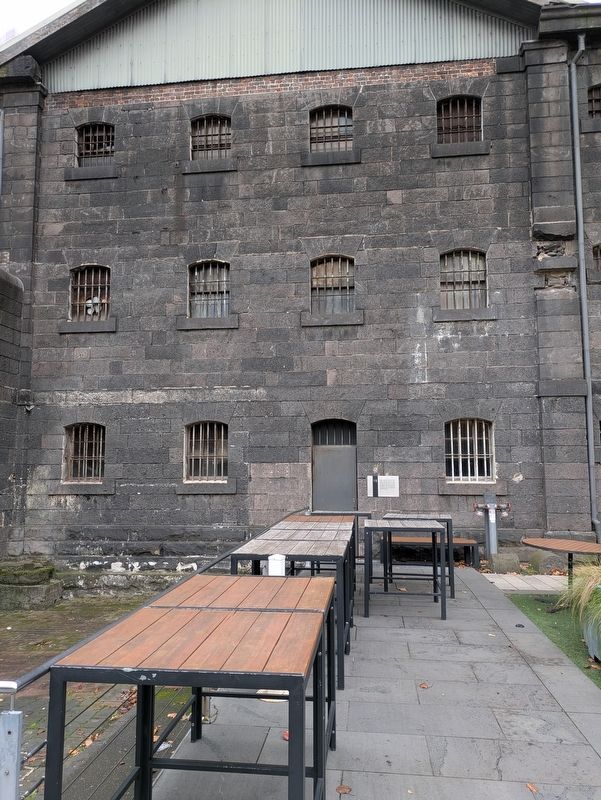
South-west door to the 2nd Cell Block. Between 1861 and 1907, all condemned prisoners passed through this door on their way to the gallows in the Central Hall of the Gaol. (Note the remains of stone steps and iron bootscraper beside the door.) — — Map (db m303787) HM
Dedicated to the Men
of
3rd Cavalry Regiment
South Vietnam
1965-1972
Battle Honours
Long Tan ∙ Bein Hoa ∙ Hat Dich ∙ Binh Ba
Coral ∙ Balmoral
"Resolute" — — Map (db m310002) WM
Erected by Members of the
5th Victorian Contingent, V.M.R.,
in memory of their
Fallen Comrades in South Africa. 1901-02
Casualties (Plaque 1)
Capt. J. Kelly ∙ Lieut.(s) S.R. Coulter ∙ J.G. Chrisp ∙ A.G. . . . — — Map (db m309906) WM
The house is the last of a terrace of six brick two-roomed cottages built in 1877 by John Casselden, a shoemaker and small-time developer. The cottage is the last remaining in the area known as "Little Lon", long associated with slums, light . . . — — Map (db m302302) HM
Adam Lindsay Gordon was born in 1833 and migrated from England to South Australia in 1853. A keen and daring horseman, he worked as a trooper in the mounted police and as a horse breaker and is commemorated as a jockey at Flemington Racecourse with . . . — — Map (db m299347) HM
A significant early example of modern multi-storey apartment buildings, Alcaston House was designed by architects A & K Henderson in 1928 to provide residential apartments and office suites. The use of Classical detailing and Renaissance Revival . . . — — Map (db m299433) HM
Early Melbourne life unearthed
Archaeological excavations of the Wesley Place Precinct in 2017 uncovered evidence of more than 20 homes and businesses and over 100.000 artefacts dating from different periods of the nineteenth century. In . . . — — Map (db m303544) HM
Welcome
This Arid Garden, which includes the Field Collection, is part of the Cacti and Succulent Collection of the Royal Botanic Gardens Victoria.
In 2020, the former 1945 Arid Garden was redesigned and the
1880s Tecoma Pavilion was . . . — — Map (db m296325) HM
On this site the Royal Australia Engineers (RAE) and the Royal Australian Artillery (RAA) had their main Victorian Army Reserve depots from 1931 to 1991.
The RAE depot faced Olympic Boulevard (then called Swan Street) while the RAA depot . . . — — Map (db m298808) HM
An Atlas of 40 Million Stars
Star (def): heavenly bodies appearing as apparently fixed luminous points in the sky at night.
"Australasia's greatest contribution to astronomical knowledge is now in progress...the great international . . . — — Map (db m296517) HM
The Athenaeum Building
is Registered by Heritage Council Victoria
The original Mechanics Institute was built on this site in 1842. The present building was completed in 1886 to a design by architects Smith and Johnson. The statue of . . . — — Map (db m296790) HM
Aubrey Bowen Wing,
Royal Victorian Eye and Ear Hospital
is registered by the
Heritage Council of Victoria
Established in 1896 with a bequest from Dr Aubrey Bowen, one
of the pioneers of ophthalmology in Australia, this Victorian . . . — — Map (db m299608) HM
Those heroes that shed their blood and lost their lives... You are now lying in the soil of a friendly country. Therefore rest in peace. There is no difference between the Johnnies and the Mehemets to us where they lie side by side now here in this . . . — — Map (db m296524) WM
The redevelopment of the Sandridge Bridge precinct was envisioned by the Victorian Government and the City of Melbourne. Australians' History on the Sandridge Bridge was envisioned by Melbourne businessman, Les Erdi. These visionaries have . . . — — Map (db m311420) HM
Maree Clarke. Australia / Mutti Mutti, Yorta Yorta, Boon Wurrung and Wemba Wemba woman, b. 1961 and Trent Jansen, Australia, b. 1981.
Balit-dhan Bali-nganjin is an expression of the incredible ingenuity and initiative shown by members of the . . . — — Map (db m303290) HM
Built in 1891-93 to a design by architects Lloyd Tayler and Alfred Dunn, this is one of the finest examples of Victorian Classicism. Its octagonal dome and entrance archway are derived from Italian Baroque. — — Map (db m295871) HM
This plaque commemorates the life work of one of the 'fathers' of the Garden State.
Baron Ferdinand von Mueller K.C.M.G
1825-1896
This distinguished botanist and explorer was the founder of the National Herbarium of Victoria.
As . . . — — Map (db m296339) HM
The infamous break dance battle between Osher Gunsberg and Larry Emdur occurred here on 27 September 2015. Gunsberg immediately fractured his shoulder, diving too exuberantly into The Caterpillar. Ignoring the jeers of the crowd, Emdur danced only . . . — — Map (db m299339) HM
(Source: State Library of Victoria, H96.160/1303)
Bill Proudfoot was a constable in the Victorian police force, but he was more famous for his position as fullback and captain of the Collingwood football team at the turn of twentieth century. . . . — — Map (db m302206) HM
From 1936-1938, a remarkable international cacti-collecting expedition took place in South America. Ralph Field invested financially and, for £200, was guaranteed delivery of at least thousand varieties. The two-year expedition covered 6000 . . . — — Map (db m296321) HM
This east-west bluestone strip marks the location of the bluestone Gaol wall that separated the Men's Hospital Compound from the Gaol Wardsmen's Yard and Gaol Laundry. — — Map (db m303834) HM
Bob Rose
One of Collingwood's greatest players and one of the most revered figures in the history of the game, Bob Rose was the heart of the Collingwood Football Club.
A great champion, four-time Copeland Trophy winner, star of the . . . — — Map (db m298535) HM
Botanic Gardens
Established 1846
Curators or Directors
John Arthur 1846 to 1849
John Dallachy 1849 to 1857
Baron von Mueller 1857 to 1873
William R. Guilfoyle 1873 to 1909
John Cronin 1909 to 1923
William Laidlaw 1923 to 1925 . . . — — Map (db m299168) HM
The steps of Parliament House (1856) provide us with a good view of the emerging theatre, bohemian and cafe society end of Bourke Street in 1900. The Windsor Hotel annexe has changed little from the Old White Hart Hotel pictured here. The old . . . — — Map (db m299547) HM
This building embraces a century of architectural, urban, medical and social history for generations of Victorians. Once part of a hospital complex filling the entire city block, its story includes:
One women's centre
Three hospitals . . . — — Map (db m305544) HM
Bringing home the Shopping
Since it first opened, the Queen Victoria Market, has offered budget-conscious shoppers the best values in all departments. During the Great Depression of the 1930s, the Market, more that ever before, provided . . . — — Map (db m309301) HM
Silhouetted against the sky are the dark evergreen branches of several Araucaria, trees native to Australia and the islands of the Pacific, including the distinctive profile of the Cook's Pine (or Captain Cook's Pine).
It is just one of the . . . — — Map (db m300207) HM
The Derrick family's legacy
The Caretaker's Cottage was built in 1914 by Ronald A. Derrick, the secretary of the Wesleyan Sunday School. It was erected with the boundary wall along Little Lonsdale Street for a cost of £850. The architecture is . . . — — Map (db m303359) HM
Carlo Catani C.E. J.P. 1852-1918
Engineer-in-Chief
Public Works Department of Victoria
In 1895 Carlo Catani planned and undertook to straighten the Yarra River upstream of Princes Bridge to alleviate flooding. He designed Alexandra . . . — — Map (db m301815) HM
Erected by the People of Victoria to honour the memory of
Charles George Gordon
who fell at Khartoum
January 26 1885
"I have tried to do my duty""This is the happy warrior. This is he that every man in arms should wish to . . . — — Map (db m299436) WM
Charles Joseph La Trobe CB
1801 - 1875
Superintendent, Port Phillip District of N.S.W. 1939-1851
Lieutenant Governor of the Colony of Victoria 1851-1854
Unveiled by Professor David De Kretser AC Governor of Victoria, 21 November 2006 . . . — — Map (db m303662) HM
City Court
Designed by G.B.H. Austin of the Public Works Department and built by Swanston Bros in 1911, the building originally accommodated three large courtrooms and offices with a two storey octagonal main vestibule. The facades, faced . . . — — Map (db m303667) HM
To mark the finish of laying a coaxial cable from Sydney to Melbourne by Post Office lines staff, this stone was unveiled on 10th November 1961 by the Hon. G.W. Davidson, O.B.E., M.P., Postmaster General.
The two cities were first linked by . . . — — Map (db m300885) HM
The north east corner of Collins and Elizabeth Streets circa 1903 looking east up Collins Street to the Melbourne Town Hall Clock Tower and to the north along Elizabeth Street to the GPO Clock Tower.
The present building on the corner, . . . — — Map (db m295885) HM
Colonial Mutual Life Building
The carved stone blocks assembled here as 'Colonial Square' are a reminder of one of the richest periods in Melbourne's architectural history.
The blocks of granite are from the former Colonial Mutual . . . — — Map (db m304391) HM
Within these walls, on 15th April 1915,
the world-famous soprano,
Dame Nellie Melba,
began to teach aspiring singers the
principles of her celebrated vocal technique.
On 26th February 1931,
Melba's funeral cortege paused near the . . . — — Map (db m299611) HM
Melba was born in Burnley Street Richmond on 19 May 1861. Christened Helen Porter Mitchell, she worshipped in The Scots' Church, sang in its choir and attended Presbyterian Ladies College before making her debut at the Monnaie Theatre in Brussels in . . . — — Map (db m305883) HM
Daniel Mannix
Archbishop of Melbourne
Born in Ireland in 1864, Third Archbishop of Melbourne (1914-63)
Dr Daniel Mannix was the most influential churchman in
twentieth-century Australia, an Australian patriot and Ireland's loyal
son. . . . — — Map (db m299619) HM
Daniel O'Connell
The Liberator
1775 - 1847
The leading Irish Statesman and Catholic Parliamentarian of his day,
O'Connell was the founder of the Catholic Association,
a mass movement which promoted universal human rights and . . . — — Map (db m299618) HM
In 2020, this garden was designed by landscape architect Andrew Laidlaw to showcase cacti and succulents including the extraordinary collection acquired from Robert Field.
This site has seen two previous garden styles; a palm house in the late . . . — — Map (db m296320) HM
In the heart of Melbourne's CBD, 271 Spring Street forms the northeastern corner of the Little Lon precinct, an area that throughout most of the nineteenth and twentieth centuries had a reputation as a slum and brothel district. Few traces now . . . — — Map (db m302155) HM
"Never seen anything like it" - the truffle-like fungus Cribbea
Fungimap volunteers help uncover the distribution of Australian fungi. In 2003, two volunteers found a very strange fungus in the mallee country near Pinaroo (South . . . — — Map (db m296338) HM
These gates, made in England, stood for 60 years at the entry to "Nareeb" Kooyong Road Toorak, the home of Mr. and Mrs. Walter Simmons and their family. Their daughter, Miss Gertrude Simmons, bequeathed them to the National Trust of Australia . . . — — Map (db m296255) HM
In memory of Dr. Constance Stone, the first Australian woman to qualify as a medical practitioner. Because Australian medical schools were closed to women, she studied overseas. In 1896, together with some of the first women medical graduates of . . . — — Map (db m309762) HM
Duke of Wellington Hotel
is registered by the Heritage Council of Victoria
This rare example of pre-gold rush Melbourne Hotel was built in 1850 and demonstrates the small scale and corner location typical of such buildings. It was used as . . . — — Map (db m296786) HM
During the 1880s, as many as seven families lived within the Gardens.
This four-roomed cottage was built in 1888 as the senior
gardener's residence. Being located beside a gate, it provided a handsome entrance and protection for the . . . — — Map (db m296327) HM
Earth, mother
You are standing on ancestral lands, the 'Country' of people of the Kulin Nation.
Aboriginal people felt intensely for their country. It was alive, it could talk, listen, suffer, be refreshed, rejoice. They were on it . . . — — Map (db m299159) HM
In 1891 the newly formed Metropolitan Fire Brigade held a competition for the design of their headquarters. The building, built in 1892 by T. Cockram & Co., was designed by the third placed firm of Smith & Johnson in association with architects . . . — — Map (db m299607) HM
Edith Cavell
October 12th 1915
Erected by the Edith Cavell Trust Fund
Unveiled 11-11-1926
Sculptor: Miss Margaret Baskerville
(Rear of Sculpture): Nurse Cavell's Last Message to the World
"But to this I would say . . . — — Map (db m296659) WM
In Memory of
Edward George Honey
1885-1922
A Melbourne Journalist who while living in London first suggested the solemn ceremony of Silence now observed in all British Countries in remembrance of all those who died in war
"Lest We . . . — — Map (db m296522) WM
Engaging the Senses
At the time of European settlement, the area occupied by the Queen Victoria Market was part of the estate of the Wurndjeri-william clan of the Woi wurrung language group, or tribe. This language group was part of the . . . — — Map (db m309090) HM
Exhibition Building, William Street, Melbourne (Exhibition of Colonial Production) 1854
Built in 1854 in William Street on part of the Old Royal Mint site, and modelled on the London Crystal Palace of 1851, it housed Victoria's first . . . — — Map (db m309765) HM
(Top Plaque)
To Commemorate the laying of the
Foundation Stone of this Building on
February 19th 1879 this plaque was unveiled by
His Excellency
The Honourable Sir Henry Winneke,
K.C.M.G., K.C.V.O, O.B.E., K.St.J., Q.C.
on February . . . — — Map (db m305355) HM
(Top Plaque)
Exhibition Building
Great Hall
Built 1878-80
Architect Reed & Barnes
Builder David Mitchell
Classified "A"
(Bottom Plaque)
The National Trust Plaque
was unveiled on May 24th, 1973, by
Sir Harold Gengoult . . . — — Map (db m305345) HM
(Top Plaque)
1880 - 1980
Her Majesty the Queen
Conferred the Title Royal
on the Exhibition Building
on October 1st 1980
The Centenary of its opening for
The Melbourne International Exhibition 1880-81
The Exhibition . . . — — Map (db m305348) HM
The exhibition fountain was commissioned for the Melbourne International Exhibition of 1880. This was the sixth exhibition the city had staged and the grandest by far.
Australia's isolation gave these exhibitions an importance it is difficult . . . — — Map (db m304328) HM
Federal Coffee Palace, corner Collins and King Streets
Located on the corner of King and Collins streets, and completed in 1888, the Federal Coffee Palace was then the largest hotel in Australia with nearly 500 rooms. Built as a temperance . . . — — Map (db m309774) HM
Ferenc Puskás
1927 - 2006
World Football Icon Ferenc Puskás coached in Melbourne between 1989 - 1992. He achieved NSL championship glory with South Melbourne FC at the site of the former Olympic Park Stadium. As a player, his record is . . . — — Map (db m298823) HM
A young boy's hobby
This is a wonderful story of how a young boy's hobby, first nurtured in these Gardens, grew over two lifetimes into an extraordinary cactus collection of international significance.
In 1908, Ralph Field was just 12 . . . — — Map (db m296324) HM
Erected by the Rotary Club of Melbourne
To commemorate the work of Rotary's Founder
Paul Harris
and of
Angus S. Mitchell
First Australian President of Rotary International
Oct. 1953 — — Map (db m301812) HM
The site of the Princes Bridge Hotel (Young and Jackson's) was purchased for £100 at the first Melbourne Land Auction in 1837 by John Batman, founder of this Great City — — Map (db m299337) HM
First Stage of Demolition 1884
The Princes Bridge location has long been the major crossing point of the Yarra, firstly using punts and then a wooden bridge from 1845. This large simple span granite and basalt bridge was opened in 1850 . . . — — Map (db m309779) HM
The mid-1800s were formative years for Fitzroy Gardens, with the path network established, many trees planted and fountains installed.
The English Elms lining this pathway are some of the many planted during this era. Tree avenues were designed . . . — — Map (db m300865) HM
Fitzroy Gardens is a haven on the edge of the city, with many points of interest for visitors to enjoy.
Set aside as a public reserve in 1848, the 26 hectare site officially became Fitzroy Gardens in 1862. It is the City of Melbourne's premier . . . — — Map (db m299956) HM
Flagstaff Gardens, which are just to your right, are Melbourne's oldest gardens. They take their name from a flagstaff erected in 1840 at the settlement's highest point, in order to communicate between the harbour and town. This became known as . . . — — Map (db m309772) HM
The 1837 hand-drawn map of colonial Melbourne shows the location of 'Burial Hill' set in a 'Lightly Wooded' landscape of she-oaks, eucalypts and wattle trees.
As the settlement grew the surrounding landscape was soon cleared and the trees . . . — — Map (db m309820) HM
The hilly vantage point of Flagstaff Gardens is strongly linked to the colonial history of Melbourne.
In the 1840s the hill was the place where the early settlers came for a bird's eye view' of the harbour and to share the latest news. . . . — — Map (db m309821) HM
The Bank of Australasia, established in London in 1835, opened its first branch in Melbourne in 1838. In 1875 architects Reed and Barnes designed a two storey Classical revival style building for the bank. The three upper storeys, added in 1930, . . . — — Map (db m295809) HM
The Sisters of the Community of the Holy Name had leased a brick hall, once a dancing academy, on this site from the 1880s as a base for their work in the poverty stricken area around Little Lonsdale Street. In 1913 the hall was incorporated into . . . — — Map (db m302422) HM
This is the site of Melbourne's earliest permanent church built in 1839 for the Independent or Congregational Church, which earlier had held services in John Pascoe Fawkner's Tavern. The present polychrome brick church was designed by Reed and . . . — — Map (db m305722) HM
Former Leitrim Hotel
is registered by the
Heritage Council of Victoria
Designed by Henry Tolhurst and built in 1888 for the Victoria Brewing Company in the then-notorious Little Lon area, this former hotel is notable for its ornate . . . — — Map (db m303550) HM
More than the minister's home
Built in 1859, the Manse was part of the church complex designed by Joseph Reed. Originally the minister's residence, it was later used for the Wesley Central Mission's programs. In the early to mid-twentieth . . . — — Map (db m303547) HM
The offices of the National Mutual Life Association were built in two stages. In 1891 the first stage, built by Robert Gamlin, comprised the Collins Street facade and three bays of the Queen Street facade. It was completed in 1903. The Gothic . . . — — Map (db m295811) HM
This building was designed by Percy Everett, Chief Architect of the Public Works Department, and built in 1940/43. It housed the Police Headquarters until 1977 and is Melbourne's outstanding example of the Art Deco skyscraper. The adjoining . . . — — Map (db m304322) HM
The Royal Mint was constructed in 1871/72 to mint the gold from Victoria's goldfields. The two-storey office and guards' homes, designed by J. J. Clark of the Public Works Department, gardens and perimeter wall are all that remain of the complex . . . — — Map (db m311608) HM
Former Royal Mint
is registered by the
Heritage Council of Victoria
This outstanding Renaissance Revival style complex was designed by Public Works Department architect J. J. Clark. It was built in 1871-72 to mint coins for the . . . — — Map (db m310545) HM
A place of education and compassion
Designed by Joseph Reed, as part of the original church complex, the School House was built in 1859. It originally featured segregated classrooms for boys and girls accessed by separate entries. In 1893 it . . . — — Map (db m303357) HM
Former Working Men's College
The Working Men's College, which later became the Royal Melbourne Institute of Technology was founded by Francis Ormond. It was built in two stages: the Bowen Street frontage was constructed in 1883/87 to a . . . — — Map (db m303666) HM
This Gallipoli Oak tree was planted on 18 November 2018, on the 50th anniversary of the start of immigration from the Republic of Türkiye to Melbourne.
A project of Friends of Gallipoli Inc. — — Map (db m296657) HM
This arched entrance was cut into the Gaol Wall in 1925 to provide vehicular access to the Police Garage, which occupied the site until 1995. — — Map (db m303836) HM
The granite paving and seat represent the alignment of an original Gaol bluestone wall, which extended north-south across the end of the Hospital Compound.
(Presumed to have been demolished when the verandah was added to the Hospital in 1876). — — Map (db m303833) HM
Daily and Nightly Life at Melbourne Observatory
nocturnal (def): active by night, as many animals
"It is a very popular belief that practical astronomy consists of star-gazing. Looking at the moon or searching for some unknown . . . — — Map (db m296457) HM
The Gill
Built in 1888 as a factory and offices for Moss White & Co. Tobacco Importers
Architect Nahum Barnet
Established in 1929 as the Salvation Army Gill Memorial Home for Men
Designed by Staff-Captain Percival Dale . . . — — Map (db m309789) HM
When Director William Guilfoyle set out to redesign the gardens in 1873 he removed his predecessor Mueller's straight lines of planting and replaced them with sweeping lawns, curving pathways, lakes and hidden vistas of the Gardens that we enjoy . . . — — Map (db m296259) HM
The wide, spreading branches of this mature tree provide welcome summer shade. A fast growing native of New South Wales and Queensland, strongly identified with the area of Moreton Bay near Brisbane, it produces round, purplish figs which attract . . . — — Map (db m300206) HM
When suffragists campaigned for the vote in the late nineteenth century, critics said that women had no interest in political rights. Leading activists including Marie Kirk, Vida Goldstein and Annette Bear-Crawford, working with organisations such . . . — — Map (db m300881) HM
Referencing the Monster Petition of 1891, this artwork celebrates the individual collective efforts of Victorian women and their fortitude in claiming the right to vote. It is a permanent acknowledgement of those who united to bring about change. . . . — — Map (db m300878) HM
231 entries matched your criteria. The first 100 are listed above. Next 100 ⊳