292 entries match your criteria. The first 100 are listed. Next 100 ⊳
Santa Fe Trail Historical Markers
This is an important trade route from New Franklin, Missouri (and parts west as the railroad moved west) to Santa Fe, New Mexico. The trail was in use from 1822 until the late 1880s.
By Mark Hilton, June 27, 2018
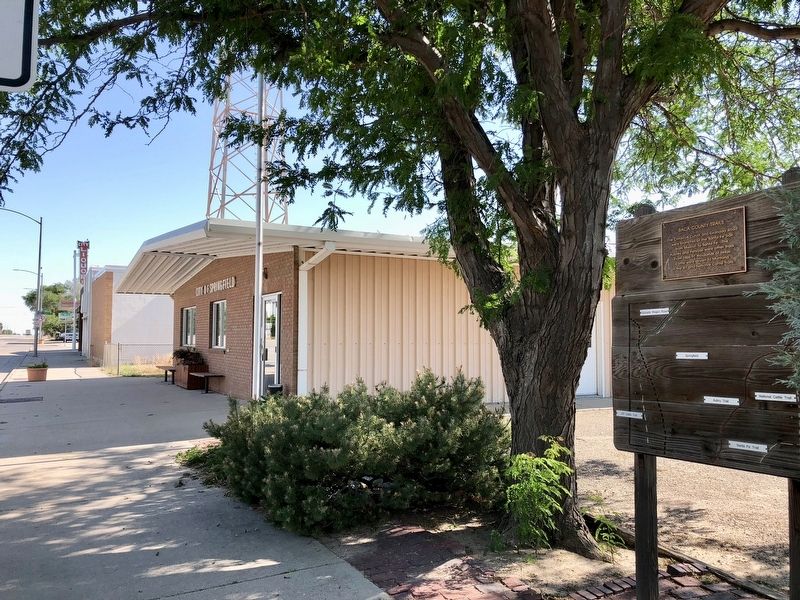
Baca County Trails Marker near the Springfield Town Hall.
The Cimarron Cutoff and Granada Road were branches of the Santa Fe Trail from Missouri to Santa Fe. The Aubrey and Penrose were other trails. From 1866-97 thousands of Texas cattle were driven to Montana on the XIT and National Cattle trails. — — Map (db m120040) HM
Dinosaur Freeway Geology of John Martin Reservoir
is part of the Dakota sandstone
formations which extend from Denver,
Colorado to Tucumcari, New Mexico.
In the Cretaceous period the region
was bordered with lakes, swamps . . . — — Map (db m181091) HM
Trail of Commerce
The heavily laden freight wagons traveled in parallel columns to minimize dust and for convenience when circling the wagons at night or when danger threatened. A circle of wagons provided a fine defensive position. But the . . . — — Map (db m77883) HM
Established in 1973, this National Historic District encompasses about 40 irregularly shaped city blocks in the Heart of Trinidad. The first log cabins and adobe houses were built here in 1861. Most of the existing buildings were constructed . . . — — Map (db m282383) HM
From this spot in August 1846, you could have watched a U. S. Military Force invading the Republic of Mexico. The U.S. Army of the West was already well into Mexican territory, for the International Boundary was then the Arkansas River, about 80 . . . — — Map (db m281896) HM
Commercial Street, which you are now facing, is a paved-over wagon trail that was here before the town was built. It was one path of the Mountain Route of the famed Santa Fe Trail. Thousands of ox-drawn freight wagons rumbled past here from 1821 . . . — — Map (db m281682) HM
Panel 1
Road to Santa Fe
"...for it begins upon the outside line of the outside State (Missouri) and runs directly toward the setting sun..." - Sen. Thomas Hart Benton, following the Santa Fe Trail survey, 1825
For . . . — — Map (db m97715) HM
This monument
marks the route of the
Santa Fe Trail
1822 - 1879
placed by the
Daughters of the
American Revolution
and the
State of Colorado
It also commemorates
the faithful work of
Harriett Parker Campbell . . . — — Map (db m77856) HM
The flat-topped mountain visible between the buildings, looking south on Commercial Street, was an important landmark for wagon trains on the Mountain Route of the Santa Fe Trail. This landmark guided them to the foot of Raton Pass over which . . . — — Map (db m280781) HM
This memorial is the
Property of the State of Colorado
The Santa Fe Trail
1840 - 1878
Two roads or forks of the Mountain Branch
of the Santa Fe Trail-Bent's Old Fort to
Taos and Santa Fe-joined . . . — — Map (db m104912) HM
The Santa Fe Trail was a major trade route to and from Santa Fe, New Mexico between 1821 and 1880. Wagon ruts, visible from the highway, evidence the thousands of caravans that traversed the route during its 59-year period of use. The Santa Fe Trail . . . — — Map (db m191749) HM
Welcome to Colorado. You have reached a traditional jumping-off point — one used for centuries by people traveling into this region. Native Americans passed this way seasonally on their way to and from hunting grounds. Spanish explorers marched . . . — — Map (db m280682) HM
The entire block across Main Street from you is the Trinidad History Museum, a complex of three museums and historic gardens overlooking the Mountain Route of the Santa Fe Trail. The Baca House, on the right, was built in 1870 by John Hough, a . . . — — Map (db m282400) HM
Erected at the request of the Daughters of the American Revolution 1910 by A.E. Reynolds
Bent's Fort Santa Fe Trail as shown by ruins of walls in 1909
1822 The Santa Fe Trail 1875
This stone marks the point of the trail where the . . . — — Map (db m192004) HM
The Santa Fe Trail was an overland two-way trade road that connected Franklin, Missouri, with Santa Fe, New Mexico. After stopping at Bent's Old Fort for rest and resupply, traders heading east had about 180 miles to cover before reaching the point . . . — — Map (db m289485) HM
After a stay at Bent's Fort, traders heading west had a rough road ahead. The Sangre de Cristo Mountains loomed and the main route of the trail was through the rugged Raton Pass. The road was so rocky that in the 1840s a day's progress could be . . . — — Map (db m289395) HM
Travelers from Missouri would have crossed more than 600
miles of plains by the time they stood here. They picked this
more difficult Mountain Route of the Santa Fe Trail for its
reliable water. With less than a quarter of the trip . . . — — Map (db m180840) HM
From cattle kings to cowboys and cow towns to hell on wheels railroad camps, this portion of the Santa Fe Trail encompasses all of the legends of America's Old West. Hiram S. Holly, town founder, arrived here in 1871 with 1,300 cattle. His 50,000 . . . — — Map (db m289600) HM
The Heart of the Old West Colorado's portion of the Santa Fe Trail is a 184-mile section of the Santa Fe National Historic Trail. It is designated as one of America's Byways and a Colorado Scenic and Historic Byway. The trail begins in Missouri . . . — — Map (db m289642) HM
An area along the Arkansas River bottoms, 45 miles westward from a point 20 miles east of Lamar was known as “The Big Timbers” during the “Building of the West.” Big Timbers received its name from giant cottonwoods which flanked both banks of the . . . — — Map (db m213689) HM
Location, Location, Location
Thousands of caravans used the Santa Fe Trail between 1821 and 1880. The trail clung close to the Arkansas River for hundreds of miles across the open plains. The Arkansas Valley offered gentle terrain . . . — — Map (db m106937) HM
John Martin Reservoir The Southeast Colorado region, including the Big Timbers area, was once a great inland sea. The first transportation routes across the Santa Fe Trail were established by prehistoric migrating groups that . . . — — Map (db m213693) HM
The Story Begins… in 1922 when Mrs. John Trigg Moss representing the National Society of the Daughters of the American Revolution and Harry Truman joined forces to petition Congress to designate a "National Old Trails Road," . . . — — Map (db m213698) HM
The Santa Fe Trail was the main trade route between Franklin MO and Santa Fe NM. The main part of the trail was 780 miles long. Thousands of freight wagons rumbled along the trail each year, except for the winter months. The trail passes several . . . — — Map (db m106939) HM
The Heart of the Old West Santa Fe Trail Scenic and Historic Byway is an 188 mile portion of the Santa Fe National Historic Trail designated as one of America's Byways and a Colorado Scenic Byway. The entire Santa Fe Trail begins in . . . — — Map (db m213699) HM
The Santa Fe Trail passed through present Lamar a quarter-mile south of this sign. In 1821 it became America's first international commercial highway, and for sixty years it was one of the nation's great routes of commerce and westward expansion. . . . — — Map (db m213700) HM
In the early 19th century, the Santa Fe and Taos trails became the most renowned trading rouses in the West. For 60 years, American and Mexican traders drove great caravans of prairie schooner across a sweeping sea of grass - an 800-mile route that . . . — — Map (db m188275) HM
Mexico won its independence from Spain in 1821, allowing the road to Santa Fe to open. This trail of commerce between Missouri and Mexico was a major international trade route. Economies were influenced from Mexico City to England. William Becknell . . . — — Map (db m302596) HM
In the 1800s, the Santa Fe Trail was the Interstate-70 of the American West, and Conestoga wagons were its freight-hauling tractor trailers. Between 1822 and 1879, the trail was a commercial thoroughfare between Missouri and Santa Fe, guiding . . . — — Map (db m302743) HM
A mile northeast is Pawnee Rock, a famous landmark on the Santa Fe Trail. Considered the mid-point of the long road between Missouri and New Mexico. Pawnee Rock was a symbol of challenges overcome. Many early travelers mentioned it in their . . . — — Map (db m55303) HM
"We first rode nearly north about a mile to a remarkable Rocky Point . . .We rode upon the top which is probably 50 feet above the plain below, and from whence there is a charming view of the country in every direction."
—George Sibley, . . . — — Map (db m64191) HM
We set out at the ushal time and at 8 miles West We passed point of Red Rocks about 600 yds from the river and at Eleven miles crossed the paney River….Some Cottenwood on the Banks and Some Bushis. the Red Rock is evidently a volcanic production . . . — — Map (db m64249) HM
No one actually knows how Pawnee Rock was named. Josiah Gregg, who had been over the Santa Fe Trail eight times beginning in 1831, wrote: the attention of the traveller is directed to the ‘Pawnee Rock' so called, it is said, on account of a . . . — — Map (db m64243) HM
From 1821 until late in the 1800s Pawnee Rock was a noted landmark along the Santa Fe Trail. Thousands of wagons lumbered and creaked by here carrying goods to or from the great American Southwest. Many travelers recorded their impressions of . . . — — Map (db m64245) HM
Slowly along came the line of wagons, and the prairie breeze brought us, in sound, faint and far between, the driver’s invocations to their mules.
Matthew C. Field, journalist
1839
From 1821 until the late 1860s the Santa Fe Trail ran . . . — — Map (db m64241) HM
Standing here 175 years ago Santa Fe Trail travelers looked out over a sea of grass. About three miles to the south a line of timber marked the Arkansas River which meandered across the prairie. A few plum thickets dotted the landscape, and an . . . — — Map (db m64203) HM
Standing here 175 years ago Santa Fe Trail travelers looked out over a sea of grass. About three miles to the south a line of timber marked the Arkansas River which meandered across the prairie. A few plum thickets dotted the landscape, and an . . . — — Map (db m64205) HM
Pawnee Rock changed very little for ten thousand years. The hill was grass-covered with a fifty-foot-high face on the southeast side in front of you. Wind, water, and vegetation slowly eroded the stone.
But Pawnee Rock has changed. The top of . . . — — Map (db m64242) HM
In honor of the brave men and women
who passing over the old Santa Fe Trail,
endured the hardships of frontier life,
and blazed the path of civilization for posterity
Pawnee Rock, given to the State of Kansas
by Benj. P. Unruh,
in . . . — — Map (db m64248) HM
Here, and for the next 300 miles west, Highway 56 roughly follows the old Santa Fe Trail, and frequently crosses it. White settlement began in this area in 1854, the year Kansas became a territory, and in 1855 the town of Palmyra was founded. When . . . — — Map (db m20073) HM
South of this park are 18 acres of virgin prairie. Purchased 1967 by Douglas County from Russell Hays for a permanent prairie preserve and historic site. Evidence of Santa Fe Trail plainly visible. Original site of DAR marker was near pioneer . . . — — Map (db m20062) HM
Across the small foot bridge and up the trail is the entrance to a 16-acre remnant of a tallgrass prairie. It is dedicated to Dr. Boyd, who was a biology professor at Baker University, 1941-1982. Dr. Boyd was instrumental in getting the county to . . . — — Map (db m63702) HM
First important repair stop on the Santa Fe Trail
Blacksmith - General Store - Hotel
Well - Saw Mill - Post Office
Lawyer
Settled 1856 Surveyed 1857
The Palmyra Association donated the land for Baker University and City of . . . — — Map (db m91202) HM
This well was hand dug when the town of Palmyra was established in 1857, it served travelers on the Santa Fe Trail, as well as townspeople.
The well is 25 ft in diameter and 56 ft deep and about 17 ft to water. — — Map (db m91201) HM
This Angling Road is the Original Santa Fe Trail.
Park Area Donated by I. and J. Stickle to Baker University in 1907.
D.A.R. Monument Commemorates the Dispersal of Free-State and Pro-Slavery Forces after the Battle of Black Jack.
Original . . . — — Map (db m20075) HM
Santa Fe Trail followed high land to the SW of this marker.
Two miles south of here the Marion Town Company laid out the Town of Marion in honor of Gen. Francis Marion, "The Swamp Fox" of Revolutionary War fame. Town well, Blacksmith Shop, two . . . — — Map (db m19729) HM
North of this point one mile, the Santa Fe Trail’s Dry Route ran southwest to merge with the Wet Route at the Caches, two miles west of present Dodge City. At a later date, the Dry Route ran one mile south of this point to merge with the Wet Route . . . — — Map (db m213913) HM
When the Union Pacific Railway, Eastern Division reached Hays City in October, 1867, this site became the temporary starting point of the Santa Fe Trail until mid-1868. The Five-Mule Concord Coaches of the Santa Fe Mail Company left here daily on . . . — — Map (db m96493) HM
Wright Park is a memorial to Robert M. Wright, a director of the Dodge City Town Company, early-day businessman, and civic leader. For eight years following 1859, Wright worked as a trader and contractor, hauling grain and cutting hay and wood . . . — — Map (db m271451) HM
Fort Dodge, named for Maj. Gen. Grenville M. Dodge, was established here in 1865. It was a supply depot and base of operations against warring Plains Tribes. Custer, Sheridan, Miles, Hancock, "Wild Bill" Hickok and "Buffalo Bill" Cody are figures . . . — — Map (db m65406) HM
"Long ago the Arapahoes had a fine country of their own. The white man came to see them, and the Indians gave him buffalo meat and a horse to ride on…the country was big enough for the white man and the Arapahoes, too…The government sent . . . — — Map (db m65508) HM
Camping near this location Sept. 10, 1825, the survey team remained through September 21 waiting for a courier with information from the U.S. Government as to how to proceed further. West of the 100th meridian which surveyor Joseph Brown mistakingly . . . — — Map (db m65720) HM
has been designated a
Registered National
Historic Landmark
under the provisions of the
Historic Sites Act of August 21, 1935
This site possesses exceptional value
in commemorating or illustrating
the history of the United . . . — — Map (db m65494) HM
Unlike the emigrant trails that took travelers west to Utah, Oregon, and California, the Santa Fe Trail mainly handled commercial traffic moving east and west.
When Santa Fe became part of the United States in 1848 after the Mexican-American . . . — — Map (db m65519) HM
Pioneered by William Becknell in 1821, the Santa Fe Trail was a 900-mile overland road that connected Franklin, Missouri, with Santa Fe, New Mexico, and was an important commercial trade route. Near here, trail travelers had to decide which route . . . — — Map (db m65496) HM
Eighteen Miles a Day
Hundreds of freight wagons laden with trade items once lumbered by here, passing just uphill from where you are standing. Large caravans took six to ten weeks to travel the 900 miles between Mexico (present-day New . . . — — Map (db m65512) HM
For 60 years, this prairie soil was torn by the hooves of mules, oxen, and horses, and compacted by the weight of the large freight wagons they pulled. The wagons of a caravan traveled four abreast to avoid dust and to quickly form defensive . . . — — Map (db m65440) HM
You are standing on a bluff above the Arkansas River, an international boundary between the United States and Mexico during the early years of the Santa Fe Trail. This area was prone to flooding and the ruts offer an excellent illustration of how . . . — — Map (db m65495) HM
The Santa Fe trail, extending 750 miles from the Kansas City area to the old Spanish settlement of Santa Fe, was the great overland trade route of the 1820's to 1870s. Its commercial use began in 1821, when William Becknell headed west with a pack . . . — — Map (db m55277) HM
About two miles west were the Lower Springs of the Cimarron River, known today as Wagon Bed Springs. For early-day travelers on the famous Santa Fe Trail, the springs were an “oasis” in dry weather. Several shortcuts of the trail converged here, . . . — — Map (db m213735) HM
The Santa Fe Trail passed by here bringing people and goods along the trading route. Just to the south, the river formed the border with Mexico. Traders and travelers required accommodations, supplies, and protection. This ranch was established in . . . — — Map (db m308799) HM
Cimarron, settled in 1878, got its name as the starting point at one time of the shorter Cimarron or dry route to Santa Fe. Here the Santa Fe Trail divided, one branch heading directly southwest, the other (present US 50) following the Arkansas . . . — — Map (db m204576) HM
Travelers of the Santa Fe Trail had a choice to make at this point. Southwest from here cut off many miles to Santa Fe., N.M., but a waterless plain frequented with hostile Indians presented a formidable hazard. (The longer route via Trinidad . . . — — Map (db m308798) HM
Heavy freight wagons lumbering to and from New Mexico, and emigrant families and gold seekers heading west to Oregon and California all shared this route from Independence and Kansas City. The trails split here at Gardner Junction.
Preserving . . . — — Map (db m131353) HM
Spanning 900 miles of the Great Plains between the United States (Missouri) and Mexico (Santa Fe), this great trail of commerce between two countries was also a route for the frontier military and emigration to the West. For 60 years, the trail was . . . — — Map (db m131377) HM
The Indian Removal Act of 1830 required that many American Indian Tribes in the eastern part of the United States be moved to the Great Plains Region west of the Missouri River — lands identified as the “Permanent Indian Frontier.” . . . — — Map (db m131313) HM
"This morning we passed the road to Oregon that leaves, about eight miles from Round Grove, the Santa Fe Road, and turns to the right towards the Kansas. A way post had been put there, marked "Road to Oregon." —Dr. Frederick A. . . . — — Map (db m131352) HM
"We took the Oregon road, instead of that to Santa Fe and went twelve miles before we discovered our error. In returning two of our wagons broke down, by which we were detained two days until July 4th. We at last got fairly on the Santa Fe . . . — — Map (db m131312) HM
Travel along the Oregon and California trails increased in the 1840s with the cry of “Westward Ho.” When the 1848 discovery of gold was made at Sutter’s Mill in California, the desire to reach the gold fields ahead of others intensified . . . — — Map (db m131310) HM
Here US-56 lies directly on the route of the Oregon-California and Santa Fe trails. Nearby, the trails branched. On a rough sign pointing northwest were the words, "Road to Oregon." Another marker directed travelers southwest along the road to Santa . . . — — Map (db m21669) HM