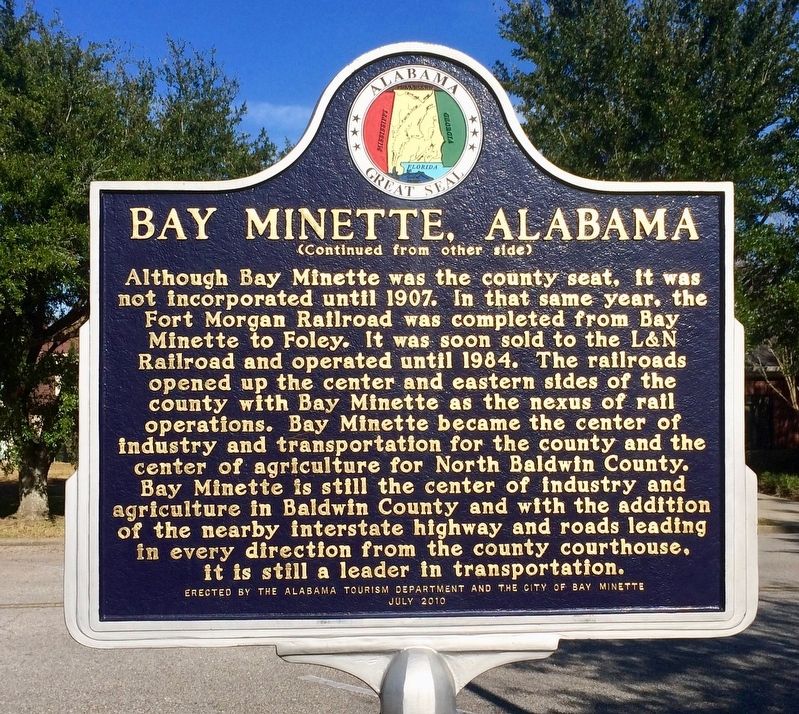
Side 1
In 1860, the center of commerce in Baldwin County ran along the rivers with the remainder of the county mostly wilderness. In 1861, with secession declared, the Alabama Legislature allocated funds to finish the stalled Mobile . . . — — Map (db m100846) HM
The City of Foley was founded in 1905 by John B. Foley of Chicago. Mr. Foley, who was in the pharmaceutical business, heard about this area from a railroad land agent as they traveled to President William McKinley's funeral in 1901. Mr. Foley . . . — — Map (db m188732) HM
As early as 1889 settlers came to this community, then known as Bennett, to farm. In 1891, John E. Loxley, from Michigan, opened a lumber mill he named 'Bennett Mill'. The settlement was later renamed Loxley, honoring the timber merchant. . . . — — Map (db m234691) HM
Sonora Community
The community of Sonora was named in 1901 by the wife of the first postmaster, G.L. Sharretts. Situated near Red Hill Ford on Baker Branch and the intersection of travel routes between Silverhill, Magnolia Springs, Marlow . . . — — Map (db m130878) HM
The Central of Georgia Railroad completed a track spur connecting Eufaula, Alabama and Ozark, Alabama in the spring, 1890. The present site of Clio, Alabama was originally a water station known as Adkison Head. Old Clio was a small settlement . . . — — Map (db m200616) HM
The Southwestern Railroad of Georgia was the first rail line to connect with Eufaula when the railroad bridge between Georgetown, Georgia and Eufaula was completed in late 1865. In 1867 the Vicksburg & Brunswick Railroad Company was formed to build . . . — — Map (db m48624) HM
The railway system was an important part of the iron and steel industry and the operation of the Blocton coke ovens. The ovens were constructed with rails on top for the charging car, often called a larry. There were rails between each row of ovens . . . — — Map (db m215680) HM
Starting in 1889, the Louisville and Nashville Railroad, also known as the Birmingham Mineral Railroad, began railroad freight and passenger
service to Oneonta with the completion of the rail line from Boyles Railroad Yard near Birmingham to the . . . — — Map (db m38894) HM
The origin and development of Oneonta was due to the coming of the Birmingham Mineral Railroad, a part of the Louisville & Nashville Railroad. Because of the presence of iron ore, limestone and coal in the area, there was always a great potential . . . — — Map (db m156406) HM
The Union Springs Train Depot was built in 1899. Although the
building no longer exists, this mural memorializes it as a
significant landmark in the town's early 20th century experience.
The depicted Coal Chute loaded coal into the tender of . . . — — Map (db m252712) HM
City of Georgiana Founded in 1855
Early settlers moved from Virginia, the Carolinas, Kentucky, Tennessee and Georgia into the deep forests of southern Butler County. In 1855, the Rev. Pitt S. Milner established a home-stead and post . . . — — Map (db m86265) HM
Side 1
West Commerce Street Historic District
The completion of the railroad in the late 1850s brought this District into being. The District grew into a major trade center between Montgomery and Mobile. The capital accumulated . . . — — Map (db m70753) HM
Searcy School House was built in 1922, six miles north of Greenville,
Alabama. This historic building is one of the few original wood-frame
school houses remaining in Butler County. Considered state of the art
for its day, it was built by men of . . . — — Map (db m191642) HM
Local "Jim Crow" laws in the first half of the 20th century enforced racial segregation in public transportation facilities throughout the South. The U.S. Supreme Court decision in Boynton v. Virginia (1960) upheld that segregation in these . . . — — Map (db m106602) HM
The Chief Ladiga Trail was named for a Creek Indian leader who signed the Cusseta Treaty in 1832. Under the terms of that agreement, the Creeks gave up claim to their remaining lands in northeast Alabama. Because he had signed the treaty, Ladiga was . . . — — Map (db m36438) HM
The Depot was constructed in 1860 by the Selma, Rome and Dalton (GA) Railroad. It was used as a transfer and storage point for Confederate troops and materials during the War Between the States. — — Map (db m36443) HM
First incorporated as a town, February 7, 1852, in Benton County, Oxford's second incorporation was approved February 21, 1860 in Calhoun County. Long before this territory was “settled”, it was inhabited by Creek Indians. In the time . . . — — Map (db m106589) HM
Originally the Dixie Hotel was the Dixie House, operated by Mrs.
Martin Tyler Ledbetter from 1910-1916. Traveling salesmen were
regular guests as well as local residents who boarded the train at
the Hotel. Mrs. Ledbetter set a table with a . . . — — Map (db m285145) HM
The Alabama Tennessee River Railroad was chartered by the Alabama legislature in the session of 1836-1837. Work was begun at Selma in 1851 and the rails reached Blue Mountain in 1861. Work was terminated during the War Between the States.
In . . . — — Map (db m27995) HM
In 1902, a coal mine was opened at Lake Lahusage in neighboring DeKalb County. The mined coal was carried by a "dinky line" to the brow of Lookout Mountain at Five Points in Cherokee County. The TAG railroad built a spur line about 2½ miles in . . . — — Map (db m202239) HM
Post Office est. in 1836. During the Civil War, the main body of U.S. General William Tecumseh Sherman's Army camped around the town in October 1864. A private home served as his headquarters. Despite pleas from citizens, his troops burned the mill . . . — — Map (db m114532) HM
Cherokee County established - 1836
Area Cherokee Indians relocated - 1838
Taff Community established - 1842
Community named in honor of Taff family - 1842
Union and Confederate soldiers occupied the area - 1864
Taff post office established . . . — — Map (db m114743) HM
In February 1937, W.P. Brown & Sons Lumber Co. signed a contract with Alabama Power for an estimated 20,000,000 feet of saw timber. The south end of Brown's property is located 1,000 feet back of this marker and extended northward ¾ mile. Brown . . . — — Map (db m114741) HM
The town's name was derived from the name of the Henslee Family which were early settlers in the community. A post office was established in 1837. The Rome & Decatur Railroad (later Southern Railway) began rail service through the town in 1888. . . . — — Map (db m261856) HM
Completed in 1891 as the Chattanooga Southern Railway, the line ran 91.7 miles from Chattanooga to Gadsden. It was re-organized as the TA&G in 1911. From 1922 until 1951, the "scooter" motor car handled passenger service on the line. The railroad . . . — — Map (db m114744) HM
Put into blast on June 1, 1874, the furnace would change ownership two times prior to being purchased by the Bass Foundry and Machine Co. of Fort Wayne, Indiana in 1880. A rail spur was built from the furnace to Selma, Rome and Dalton Railroad at . . . — — Map (db m114842) HM
Was originally named Ambersonville after one of the early families that settled the community. A post office was established in 1842 as Liberty and changed to Spring Garden in 1844. The Selma, Rome and Dalton Railroad began rail service through the . . . — — Map (db m114959) HM
This bell was salvaged from Frisco Railroad steam locomotive No. 734, built in 1905 and scrapped during the early 1950's.
It was donated to Confederate Park by Alf Miller Israel Thompson in memory of Pvt. L. Israel, Co E, 19th Alabama Infantry . . . — — Map (db m129335) HM
Side 1
In the summer of 1887, a notice was published confirming that the route for the Mobile and West Alabama Railroad would be the Choctaw Corner route. Soon the sounds of building could be heard over the swamp that was the . . . — — Map (db m101601) HM
Front
Originally home to Creek and Choctaw Indians, Whatley was first settled by pioneers about 1808. Some of the most famous events in Clarke County’s history happened in or near Whatley. A Creek War battle occurred here in 1812 at Fort . . . — — Map (db m110971) HM
This building was built in 1903 with additions in 1916 and 1997. The first freight shipments and passengers came here on the Alabama Midland railroad in 1898 immediately after construction of the roadbed. That was also the year when most of the . . . — — Map (db m30307) HM
Side A Prehistoric man arrived in this area bout 10,000 years ago.
Later Indian cultures left many stone artifacts and pottery vessels.
In the 1780s, a French trading post and Indian village were located near the mouth of Spring Creek. . . . — — Map (db m83389) HM
Side A Ashe Boulevard was built on the early railroad bed which connected Florence and Southport to the main railroad line in Tuscumbia. Trains first traveled along the railroad bed and across the Tennessee River in 1858 after the Memphis . . . — — Map (db m39237) HM
(Obverse):
The area around the Big Spring was inhabited by prehistoric Native Americans as early as 10,000 years ago. The first settlement was a French trading post and Indian village about 1780 on Cold Water Creek (Spring Creek) near the . . . — — Map (db m83396) HM
During the early 1800s, the Tennessee River was the fastest way to travel and transport goods through the South. While much of the river was deep and easy to navigate, the area between Tuscumbia Landing and Decatur was riddled with a series of . . . — — Map (db m247212) HM
Built-in 1887, the 5th Street Tuscumbia Railway Depot was constructed by the Memphis and Charleston Railroad to serve the city of Tuscumbia and its surrounding area. From the 1850s until the construction of the new depot, all ticketing and . . . — — Map (db m247213) HM
Side 1
In the early 1900s, Repton was a bustling railroad town along the Louisville and Nashville Railroad. Among other businesses, it boasted several hotels, banks, stores, a livery stable, cotton gin and the only hospital with a Board . . . — — Map (db m100840) HM
Andalusia becomes the County Seat
The first county seat on the banks south of the falls of the
Conecuh River was "Covington Courthouse," sited soon after the
County was created in 1821. In 1826, when John Devereux was
postmaster, the name . . . — — Map (db m283903) HM
The Depot In 1900, the L&N Railroad won the right to establish the railroad through this area. The town is named for Henry Opp, who represented L&N in successful legal negotiations. The coming of the railroad consolidated the surrounding areas . . . — — Map (db m39777) HM
The Horse Shoe Lumber Company
E.L. More, president of the A&F Division of the L&N Railroad, arrived in River Falls from Nashville in 1897 to spearhead the construction of a branch line of the L&N. Recognizing a business opportunity in the . . . — — Map (db m154408) HM
The town of Petrey was named for the family of George Petrey and his
first wife Martha Ann Blackwater, who settled in the area around 1850
after traveling from the Carolinas. The town was originally called
Forkland, but was renamed in honor of . . . — — Map (db m271052) HM
Rutledge was the first county seat of Crenshaw County and held that position from March 1867 to May 1893. Originally called Barber’s Cross Roads, it was briefly named Crenshaw; but June 10, 1867, it was changed to Rutledge in honor of Captain . . . — — Map (db m72053) HM
The Louisville and Nashville Railroad Company completed building this Mission Style depot in 1913. When the tracks were laid below ground level, it replaced Cullman's first station located on First Avenue at Third Street, SW.
Passenger service . . . — — Map (db m29975) HM
The first church in the City of Cullman was established on this block of land donated by the North and South Railroad in February 1874. Lots 154, 155, and 181 were granted to Henry Dietz, August Henning, and George Stoback as trustees of the . . . — — Map (db m33841) HM
Side 1
Old Indian trails leading to the Mulberry River were still fresh when a few dirt farmers began to settle just west of what is now Hanceville. From the beginning a steady stream of settlers, many of whom were German and Irish . . . — — Map (db m156413) HM
(side 1)
The Atlantic Coast Line (ACL) Depot once stood behind Broad Street, nestled close to the tracks between Depot Avenue and Depot Lane. The Alabama Midland Railway, later known as the Atlantic Coast Line, completed its tracks across . . . — — Map (db m132528) HM
In the early 1830s, when railroads
were new to America, the term "Hell
in Harness" was a widely accepted
description of the new steam-powered
locomotives that belched fire, steam, and
smoke. The earthen embankment before
you was built to . . . — — Map (db m274598) HM
"Cahawba's magnificent churches,
splendid mansions and business houses
will become the habitations of owls and
bats," predicted a concerned citizen
in a letter to the editor of the Dallas
Gazette in February of 1857. He
warned . . . — — Map (db m245237) HM
In 1858, the railroad company graded away an Indian mound that stood here. A brick warehouse was built in its place. From 1863 - 1865 the Confederate government used this warehouse to hold captured Federal Soldiers. You are standing on a pile of . . . — — Map (db m22666) HM
This cellar was under Joseph Babcock's brick store. During the Civil War the building was used as a commissary.
Babcock's warehouse and cotton shed were located to your right on the bluff overlooking the river. The family home, kitchen, and . . . — — Map (db m23287) HM
Brick Store to Depot
In 1858, the Cahaba, Marion and Greensboro Railroad company laid train tracks down Capitol Street so bales of cotton could be transported from distant plantations to warehouses in Cahaba. From the warehouses, the cotton . . . — — Map (db m150848) HM
In the late 1850s, Cahaba experienced a building boom. Everyone expected the town to prosper because of the new railroad. One of the first large brick structures built in this prosperous period was completed in 1856 by Dr. Saltmarsh.
He . . . — — Map (db m23009) HM
Anvil used in Selma’s Confederate Arsenal to make armament for Southern forces.
Presented to Sturdivant Museum Association April 1, 1961 by the Southern Railway Company which as the Selma, Rome and Dalton Railroad Company purchased the anvil . . . — — Map (db m37690) HM
Around 1889-1891 Fort Payne experienced a great industrial boom due to promotion by New England investors who speculated greatly on the area’s mineral deposits. During this period several highly ornate commercial and civic buildings, along with the . . . — — Map (db m261857) HM
The Louisville & Nashville Depot was built in Wetumpka in 1906 and exemplifies the L&N plan for small town depots. The station served as a passenger and freight depot until service was terminated in the 1930s and as a freight depot until 1973. In . . . — — Map (db m83724) HM
Settled by A.J. Hall in 1852 and occupied by Confederate troops because of its value as a railroad stop during the War Between the States (1861-65), Canoe was the site of a March 27, 1865 encampment of Union forces. The 1870s brought expansion . . . — — Map (db m72265) HM
Immortalized in folksongs, outlaw Morris Slater robbed L&N trains, gave to poor, long evading capture. Killed near here in 1896. — — Map (db m191630) HM
Williams Station, Alabama
1866-1897
Creek Indians lived in these parts some 200 years before trains began stopping here in 1866 to leave supplies for a farmer, William Larkin Williams, who lived nearby. Workers, who came first to build . . . — — Map (db m154553) HM
Erected by his friends and the Escambia County Bar
Association in memory of James Edward Hart, Jr.
(1942 – 1992), who contributed much to his community, his church and his profession. He loved trains. Due to his efforts, passenger service . . . — — Map (db m39033) HM
Front As railroads were reconstructed following the Civil War, a junction of north-south and east-west lines was established along the Alabama-Florida border near the confluence of Big Escambia Creek and the Conecuh-Escambia River. A . . . — — Map (db m47484) HM
This is the site of Francis B. "Frank" Bonifay's law office. Bonifay was the first Probate Judge of Escambia County Alabama 1869 - 1870. Jesse Howard was elected in 1871 and served for a short time but resigned and Bonifay served from 1870 - 1874. . . . — — Map (db m130674) HM
William Henry Chase, a Massachusetts born captain in the U.S. Army Corps of Engineers came to Pensacola, Florida in 1826 to supervise the construction of the network of harbor fortifications for the defense of the newly authorized Navy Yard. His . . . — — Map (db m130676) HM
Located 1½ miles south, town of Pollard established 1861 at juncture of Alabama & Florida and Mobile & Great Northern railroads. Named for Charles T. Pollard, builder of Alabama & Florida Railroad.
One of largest military training camps of . . . — — Map (db m84371) HM
For thousands of years, two important Indian trade routes ran across what was to become Etowah County. The “High Town Path” ran from Charlestown, S.C. west to the Mississippi River, near Memphis, TN. The “Creek Path” begins . . . — — Map (db m39226) HM
Belk was known as Beebe in the 19th century. Later, the name
was changed to Mulberry Tank for the water tank located on the
first railroad. It served the steam engine trains as a regular stop
until 1933. The name Belk was established in 1904 due . . . — — Map (db m285017) HM
Town of Berry Established 1883
Thompson Berry settled in this area in the 1840s. Berry devoted
most of his time to raising cattle and farming. As time passed, he
became the owner of a gin and gristmill and several thousand
acres of land . . . — — Map (db m163759) HM
The Depot
The Depot, a treasured landmark in the history and growth of Red Bay, was built by Illinois Central Railroad in 1907. The trains provided a lifeline for towns like Red Bay. They brought necessities like sugar, flour, cheese, canned . . . — — Map (db m83746) HM
Vina was first known as Jones Crossroads, and later it was called New Burleson before the railroad came through the area. In the early 1900s, the Illinois Central Railroad was built through Jones Crossroads and the town’s name was changed to Vina . . . — — Map (db m83751) HM
Abbeville Southern Railroad. For the first 75 years of its history, Abbeville’s commerce was tied directly to the Chattahoochee River by Indian trails and wagon roads. The arrival of the first train on the Abbeville Southern Railroad, . . . — — Map (db m60685) HM
Newville, Alabama
James Madison Wells founded a village called Wells circa 1882. When Abbeville Southern Railroad laid tracks through the town in 1893, its name was changed to Wells Station. The post office was built in 1894. Wells Station . . . — — Map (db m71810) HM
This depot, an example of late 19th century Victorian railroad architecture, was constructed by the Alabama Midland Railroad in March, 1888 as a way station on the Bainbridge-to-Montgomery route. The depot was the only building to survive a . . . — — Map (db m73355) HM
Constructed by the Atlantic Coastline Railroad in 1907 during Dothan's rapid growth as a commercial center of the Wiregrass Region, this building serves as a reminder of the most popular and accessible form of transportation in the early 20th . . . — — Map (db m73357) HM
Taylor, one of the area's oldest communities, became a small town
around 1870. Billy Taylor, son of James and Wealthy Taylor,
established the post office and was appointed the first postmaster.
Thus Taylor derived its name from the first . . . — — Map (db m179475) HM
Vital Memphis-Charleston Railroad, "backbone of Confederacy", spanned Tennessee River here. Bridge burned several times, 1862-3.
Gen. Mitchell (US), occupying Huntsville after Battle of Shiloh, seized Bridgeport in April 1862 and held it . . . — — Map (db m83788) HM
Planter, tavern operator, newspaper editor, legislator, and land developer, he sought in vain to have the Jackson County seat moved from Bellefont to the settlement that bore his name. After his death in 1863, his widow reached an agreement in 1868 . . . — — Map (db m22260) HM
The Memphis and Charleston Railroad Company constructed the Scottsboro Railroad Depot in 1860-1861 as a passenger and freight facility. The rail line ran throughout the Confederacy and the Union considered its capture vital to cutting off supplies . . . — — Map (db m22258) HM
In late December 1863, Union Maj. Gen. John A. Logan established his Fifteenth Army Corps headquarters in Scottsboro, Alabama. On January 11, 1864, by command of Gen. Logan, Brig. Gen. Hugh Ewing, commanding the Fourth Division, was ordered to guard . . . — — Map (db m100044) HM
A one-story depot building was constructed here in 1853, when the railroad was first laid through Stevenson. That building burned after the Civil War and was replaced by the present brick depot and hotel in 1872.
During the Civil War, Stevenson . . . — — Map (db m22271) HM
Created 1972 by the Jefferson County Historical Commission, the district is based on this avenue. Morris Avenue was named for one of the founders of Birmingham, Josiah Morris, who paid $100,000 for 4,157 acres of the original site of the city in . . . — — Map (db m27156) HM
The crossing of railroads in 1872 adjacent to this site gave rise to the industrial city of Birmingham. In 1881 Alabama railroad magnate and entrepreneur James Withers Sloss, capitalizing on the unusual coincidence of coal, iron ore and limestone in . . . — — Map (db m23498) HM
A key reason for Rev. Shuttlesworth's success was that he led the ACMHR
by example. He was the first to put himself, even his family, in harm's
way for the sake of the Movement. He did not ask ACMHR members to
do anything he was not willing to do . . . — — Map (db m189112) HM
"Tuxedo Junction" was the street car crossing on the Ensley-Fairfield line at this corner in the Tuxedo Park residential area. It also refers to the fraternal dance hall operated in the 1920's and 1930s on the second floor of the adjacent building, . . . — — Map (db m25623) HM
The arrival of two railroad lines in Jones Valley opened nearby deposits of iron ore, limestone, and coal to commercial development and helped make Birmingham one of the great industrial cities of the post Civil War South.
In 1871, the year of . . . — — Map (db m69018) HM
In 1884, when Birmingham was
scarcely a decade old, the L&N
Railroad laid the first tracks for
its mineral railroad, to begin
hauling ore from Red Mountain
mines to furnaces, mills, and
rail connections in Jones Valley.
By the early 1900s, . . . — — Map (db m189284) HM
The concrete marker below
made with blast furnace slag
instead of rocks is located a
few feet from its original
position where it designated the
beginning and angle of the
curve in the train tracks. — — Map (db m188883) HM
This neighborhood developed in the 1880s as one of Birmingham's first streetcar suburbs. It was the Town of Highlands from 1887 to 1893, when it became part of the City of Birmingham. The heart of the neighborhood was Five Points Circle, a major . . . — — Map (db m83829) HM
The railroad trestle support wall across the road is a remnant of L&N's 156-mile Mineral Railroad, the backbone of the local iron industry. This segment ran along the north edge of Vulcan Park on its route around the Birmingham District, linking . . . — — Map (db m83831) HM
John Valentine Coe, president of Birmingham Lumber and Coal Company, commissioned this two-story Craftsman-Tudor Revival style house in 1908. Coe, who had previously been a lumber merchant in Selma, moved his family and business to Birmingham at the . . . — — Map (db m83858) HM
On October 1, 1886, the North Birmingham Land Company was formed to develop a planned industrial and residential town on 900 acres of land, formerly part of the Alfred Nathaniel Hawkins plantation north of Village Creek. The plan included sites for . . . — — Map (db m26700) HM
East Lake was planned in 1886 by the East Lake Land Company to help sell home sites to the men who came in the 1870's to work in Birmingham's steel industry. First named Lake Como, after the lake in the Italian Alps, it soon came to be called East . . . — — Map (db m83828) HM
The Creek Indian Cession of 1814 opened this section of Alabama to settlement. At the time of statehood in 1819 many pioneer families had located here in what later became known as Jones Valley. By 1820 the area was called Ruhama Valley as a result . . . — — Map (db m26680) HM
"No. 4018 made its last run from Bessemer, Alabama to Birmingham, Alabama on February 29, 1952 and was given by the railway to the City of Birmingham on May 29, 1952." — — Map (db m134921) HM
Nathan Byars, II settled here in 1836, followed by William D. Satterwhite in 1853, and Phillip Thomas Griffin and his wife Mary Ann Byars Griffin in 1854. These early settlers cleared land, built homes and farmed in what was a vast wooded . . . — — Map (db m26946) HM
In 1858, the State of Alabama, wanting to develop coal and iron industries in Jefferson County, Had John T. Milner survey Shades Mountain for the most practical route for the South and North Railroad to cross. He selected Brock's Gap, named for . . . — — Map (db m26773) HM
In 1858 James Taylor Ross, a Scotchman, migrated to the South, acquired land and homesteaded in what is now Shades Valley. He provided land for the construction of a railway, including a bridge spanning Ross Creek. After the Ross family moved . . . — — Map (db m27302) HM
The story of “steel drivin’ man” John Henry is one of America’s most enduring legends. The strong ex-slave became a folk hero during construction of the Columbus & Western Railroad between Goodwater and Birmingham. He drilled holes for . . . — — Map (db m22207) HM
10689 entries matched your criteria. The first 100 are listed above. Next 100 ⊳