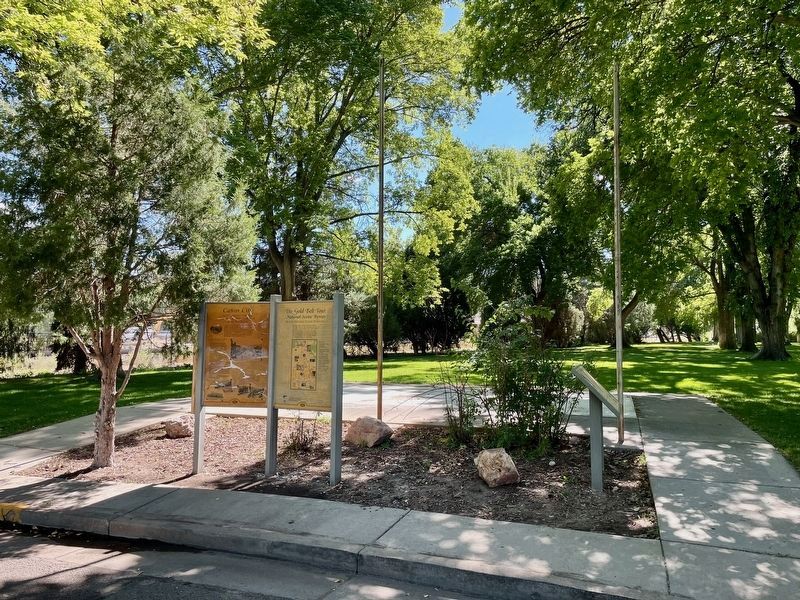
On Royal Gorge Boulevard (U.S. 50) east of South 3rd Street, on the right when traveling east.
During the late 18th century and early 19th century, Cañon City prospered as a trade and transportation center serving the agriculture and mining industries of the region. From its earliest days, Cañon City attracted visitors to soak in warm . . . — — Map (db m153316) HM
Near County Road 3A 4.5 miles south of U.S. 50 when traveling south.
A Fitting Name
This amazing chasm was originally known as the "Grand Cañon of the Arkansas," which was sometimes confused with the "Grand Canyon of the Colorado." In the summer of 1874, Charles Savage, a famous railroad photographer from . . . — — Map (db m232533) HM
On County Road 3A 4.5 miles south of U.S. 24, on the right when traveling south.
Lt. Zubulon M. Pike and his men, who traveled through this area in November and December 1806, were the first American explorers to view the Arkansas River Canyon now known as the Royal Gorge. A small party from the Maj. Stephen H. Long . . . — — Map (db m34858) HM
On County Road 3A, on the left when traveling east.
Highest suspension bridge in the world
Completed in seven months - Dedicated Dec. 7, 1929
Chief Engineer George Cole
Consulting Engineer O.K. Peck
This property has been placed on
National Register of Historic Places
By
U.S. . . . — — Map (db m39304) HM
On Colorado Route 120 south of Route 115, on the right when traveling south.
Paving the Way
The Rio Grande Railroad Viaduct helped bring the world to the Royal Gorge.
"The opening of the new bridge is hailed with joy by Florence," wrote the Florence Daily Record on July 14, 1931, as the first autos . . . — — Map (db m232499) HM
On U.S. 50 0.2 miles east of Phantom Canyon Road (County Road 67), on the right when traveling west.
Clockwise, from top
• The Pioneer Museum in Florence highlights the town's industrial past. Ample coal and water made the town an optimal site fer processing ore shipped via the Florence and Cripple Creek . . . — — Map (db m153002) HM
On U.S. 50 0.2 miles east of Phantom Canyon Road (County Road 67), on the right when traveling west.
Royal Gorge Railroad War
Racing to lay the first tracks into the Colorado Rockies in April 1878, the Denver & Rio Grande and its rival, the Atchison, Topeka & Santa Fe, reached the Royal Gorge in a dead heat. Competing construction crews . . . — — Map (db m152999) HM
Four bridges once stood southwest of the original town site of Sapinero. Cars and trucks used the high bridge to travel between Gunnison and Montrose. Anglers used the low bridge to access the river.
The Denver & Rio Grande Railroad needed . . . — — Map (db m158933) HM
Near 10th Street 0 miles south of Illinois Street, on the right when traveling east. Reported permanently removed.
Bridging Our History
This bridge is the second Billy Drew Bridge erected on this site. The original Billy Drew Bridge was built in 1976 as part of Golden’s celebration of the Centennial-Bicentennial, the nation’s 200th anniversary and . . . — — Map (db m287882) HM
Colorado Transcript, September 13, 1882: “Washington Avenue Bridge was badly damaged last Saturday evening by some ignoramus driving and crowding a big drove of cattle on to it. The damage has since been repaired.”
Golden Globe, . . . — — Map (db m49897) HM
On Washington Avenue. Reported permanently removed.
John M. Ferrell came to the Golden valley from upstate New York in June of 1859. He camped on the southeastern banks of Clear Creek and created the Washington Avenue crossing for the gold rushers. When Golden was organized, Ferrell became one of . . . — — Map (db m287883) HM
On Washington Avenue, on the right when traveling south.
Clear Creek’s flow is heavily influenced by the runoff of melting snow high in the mountains, as well as from major thunderstorms hitting its watershed. The creek has flooded many times with the river’s historic flood season running from June . . . — — Map (db m288680) HM
On Washington Avenue. Reported permanently removed.
In June, 1859, while the first bridge was being built over Clear Creek, the famous reporter Horace Greeley passed through Golden. He attempted to cross Clear Creek from this point on the south bank. Horace embarked on his mule from the river bank . . . — — Map (db m288342) HM
Near Washington Avenue, on the right when traveling south.
History of the Avenue Bridge
The 1859 gold rush brought many people
from all walks of life to the Golden valley as a
portal to the mountain gold fields. When spring
came, Clear Creek's waters rose and it became
a daring adventure for . . . — — Map (db m288288) HM
On Washington Street, on the right when traveling north.
History of the Avenue Bridge 2
The 1864 bridge was destroyed by flood in
1867, despite the citizens' valiant effort to
defend it from unusually high spring waters.
Vigilant people had, however, saved as much
wood as they could in . . . — — Map (db m288404) HM
On Washington Street, on the right when traveling south.
Local funding was unavailable during the Great Depression. Thus, the Works Progress Administration (WPA) built the new bridge as a gift to Golden. Superintendent ES. Johnson and his workers built the sturdiest bridge on the
site up to that time. . . . — — Map (db m288406) HM
On east side of Washington Street Bridge, on the right when traveling east.
Although Golden's citizens once understood that the crossing could be safe from floods if its span was extended, they could not afford it. Unfortunately, over time the danger was forgotten. Modern study rediscovered this problem and its solution. . . . — — Map (db m288407) HM
Before the first bridge on this site was completed, travelers forded the river just east of this bridge. It became risky during the peak of the spring river flows due to the melting snows that filled the streams and rivers.
In June of 1859, . . . — — Map (db m50179) HM
“I’ll put this crew up against any ‘hire and fire’ outfit in the country,” supervisor E.S. Johnson told the Colorado Transcript newspaper on April 29, 1937. His crew was confronting a huge building challenge: a race against time to . . . — — Map (db m288036) HM
On County Highway 250 0.5 miles east of U.S. 550, on the left when traveling east.
Captain Charles H. Baker, who discovered gold in the San Juan in 1860, led a party of prospectors to this area in 1861. They placer mined on El Rio de las Animas, built the first bridge (300 feet north), and established the town called Animas . . . — — Map (db m177471) HM
On Ranchos Florida Drive 0.2 miles east of County Highway 222, on the right when traveling east.
The Florida River Railroad Bridge No. 437 (distance in miles from Denver, Colorado), provided an important river crossing in the Denver and Rio Grande's (D&RG) route to Denver. The Union Bridge Company fabricated the Pratt through-truss bridge in . . . — — Map (db m177463) HM
Everything was up to date in Durango when its trolley started to run in 1891. It eventually ran from the railroad depot two miles north to Animas City. Operating until 1920, it was the shortest franchised trolley line in the United States. There . . . — — Map (db m267897) HM
On Morrow Point Dam Road 1 mile north of U.S. 50, on the left when traveling north.
Promoters called this the "Scenic Line of the World" to entice travelers to see western Colorado by rail. The Denver & Rio Grande guidebook Around the Circle invited readers to join the trip: "Unlike many of the Colorado canyons, . . . — — Map (db m158937) HM
Fir logs, up to 30 feet in length, formed the base for the diversion dam. Although built in the winter when the river was sluggish, pumps were needed to divert the flow around the construction site. The dam is used to fill the tunnel when the water . . . — — Map (db m120247) HM
Surveyors took daily measurements to ensure that drillers, powdermen, muckers, and haulers stayed on course inching their way toward the valley. Crews at the other end plowed toward the canyon. Using points across the river, as well as in the . . . — — Map (db m120245) HM
On West Main Street at Townsend Avenue, on the right when traveling north on West Main Street.
The Tunnel That Made the Desert Bloom
Early settlers in the Uncompahgre Valley found getting water to the fertile but arid soil an ongoing challenge. Originally, irrigation water from the Uncompahgre River was diverted onto the land through . . . — — Map (db m120134) HM
On State Highway 52 0.1 miles north of Interstate 76, on the right when traveling north.
Spanning the South Platte River, the Rainbow Arch Bridge carried vehicular traffic from its completion in 1923 until its closure in 1988. Engineer James B. Marsh of Des Moines, Iowa, designed the structure in 1922. Denver bridge contractor Charles . . . — — Map (db m47194) HM
On State Highway 181 south of State Highway 165, on the left.
Built in 1928, the Greehorn Bridge carried Pueblo County Road 273/Apache City Road over Greeenhorn Creek and was a rare example of a Warren deck truss structure. Because of its association with the early route known as the Great North - South . . . — — Map (db m189636) HM
The Farmington Canal crossed various topographic features- rivers, hills, roads and woodlands. Boats traveling the length of the canal passed through 28 locks that compensated for changes in elevation. Perhaps the most impressive engineering . . . — — Map (db m111590) HM
Near Old Bridge Road 0.1 miles south of Drake Hill Road.
A toll bridge was built here
in 1734 by order of
the General Assembly
it was the first
highway bridge across
the Farmington River — — Map (db m102001) HM
Near Osprey Commons South east of Beach Park Road, on the right when traveling east.
The Work of the Salt Marsh
You are standing at the edge of an ancient marsh, above layers of peat forty feet deep. Once an inland freshwater lake, the Hammock estuary is now flooded twice daily by nutrient-rich salt tides.
Tidal salt . . . — — Map (db m272470) HM
On Colchester Avenue (Connecticut Route 16) at Browns Mill Road, on the right when traveling north on Colchester Avenue.
Comstock Covered Bridge
Built in 1873 by the Towns of Colchester and East Hampton
The Comstock Covered Bridge is one of only three historic covered bridges remaining in Connecticut. With a main span 80 feet in length (measured . . . — — Map (db m310615) HM
On Connecticut Turnpike (Interstate 95) west of Ferry Road, on the right when traveling south.
Dedicated and opened to traffic
May 25, 1993
The Honorable Lowell P. Weicker, Jr.
Governor
Emil H. Frankel
Commissioner of Transportation
Parsons Brinckerhoff Quade & Douglas
Designer
Parsons Brinckerhoff Construction Services, . . . — — Map (db m271249) HM
On Connecticut Turnpike (Interstate 95) west of Ferry Road, on the right when traveling south.
Designed and supervised by the Connecticut Highway Department
Ground Broken - March 30, 1947
Completed - December 4, 1948
Governors
Hon. Raymond E. Baldwin
Hon. Wilbert Snow
Hon. James L. McConaughy
Hon. James C. Sharon
Old . . . — — Map (db m271241) HM
On Maple Street at South Main Street on Maple Street.
Originally called Salem Bridge, Naugatuck was settled in 1702 as a farming community, and, as the Industrial Revolution began, quickly transformed into a mill town. The Naugatuck River is ultimately linked to the borough's settlement and . . . — — Map (db m304245) HM
Near Whitney Avenue at Armory Street, on the right when traveling north.
The Town Bridge
Ithiel Town patented the design for this bridge in 1820. Town was a New Haven-based pioneer in American architecture and engineering. He designed both Center Church and Trinity Church that still grace New Haven's Green. He . . . — — Map (db m252731) HM
On Oregon Road at River Road ( Route 70), on the right when traveling south on Oregon Road.
Length 78 feet – width 16 feet
Listed on the Register of
Historic Places
by the U.S. Department of
the Interior,
National Park Service
Erected in 1891
by
the Berlin Iron Bridge Company
Red Bridge is of lenticular pony truss . . . — — Map (db m26587) HM
On Maple Street 0.1 miles west of North Street, on the right when traveling west.
Site of
King’s Bridge - 1711
connecting
Peacocke Lane (Maple Street)
to Governor’s Lane (Avenue)
Freelove Baldwin Stow Chapter
D.A.R.
July 4, 1962 — — Map (db m26331) HM
On River Street 0.1 miles north of West River Street, on the right when traveling north.
[ east side of the column ]
This Bridge Dedicated
On the 300th Anniversary
Of the Settlement Of
The Town of Milford
A Memorial to Three
Milford Men Who Were
Governors of the Colony
and
State Of Connecticut
[ north side . . . — — Map (db m26445) HM
On New Haven Avenue (Connecticut Route 162) at Daniel Street, on the left when traveling east on New Haven Avenue.
( stones on the large north west tower )
In Memoriam
Robert Treat
For Thirty Years
Governour & Deputy Gov.
of the Colony of
Connecticut
Obit - 1710
Ansantawae
His Mark
1639
Memorial Committee
G.A. Tomlinson P.S. . . . — — Map (db m72854) HM
The original Hillhouse Avenue Bridge was one of fourteen bridges provided by the Farmington Canal Company to carry city streets across the canal. The wooden bridge at this site rested on abutments of unmortared rubble. The New Haven construction . . . — — Map (db m57663) HM
On East Rock Road east of Livingston Street, on the left when traveling east.
The original bridge at this location, was built in the year 1900, and called the Rock Lane Bridge. For more than 80 years, the bridge carried a 20-foot wide timber deck roadway with an asphalt overlay and a 5-foot wide timber sidewalk; all . . . — — Map (db m250337) HM
On East Street at Water Street (U.S. 1), on the right when traveling north on East Street.
A Memorial Bridge
The new Pearl Harbor Memorial (Q) Bridge is the country's first extradosed cable-stayed bridge and Connecticut's "Gateway to New England." The signature design for the bridge was selected to remember and pay tribute to the . . . — — Map (db m265253) HM WM
On West Main Street (U.S. 1) east of Gravel Street, on the right when traveling east.
Power to raise the bridge comes from electric motors, which drive the large “Bull Wheels” connected with Linkage arms to the two plate girders which make up the lift span.
The huge concrete weights at the ends of the overhead rocking trusses . . . — — Map (db m114881) HM
On Yantic Road, on the right when traveling north.
Plaque sponsored by the Yantic Volunteer Fire Department
The village of Yantic, located in the city of Norwich lies in the northwest corner, bordered
by the towns of Bozrah and Franklin. These towns were once part of the . . . — — Map (db m268372) HM
On Main Street at South Street ( Route 66), on the right when traveling east on Main Street.
The frogs upon this bridge recount the celebrated Windham Frog Fight 0f 1754. The spools represent Willimantic’s historic prominence in cotton thread manufacture. David E. Phillips, an inspirational teacher and writer suggested the decorative . . . — — Map (db m140528) HM
Near Still River Drive 0.2 miles east of Pumpkin Hill Road, on the right when traveling east.
By the 1890’s New Milford’s old wooden bridges had outlived their usefulness, considering their age, the increasing amount of traffic and the coming of the horseless carriage. A sturdy and very ornate iron bridge, built by the Berlin Iron Bridge . . . — — Map (db m22740) HM
On Church Hill Road (U.S. 6) at Queen Street, on the right when traveling west on Church Hill Road.
French General Jean Baptiste Donatien de Vimeur, comte de Rochambeau, and thousands of French ground and naval forces arrived in Newport in July of 1780 to assist the Americans in the War for Independence. After wintering in Newport, Rochambeau’s . . . — — Map (db m26915) HM
On Jesup Road at Taylor Place, on the right when traveling east on Jesup Road.
The Post Road Bridge
1807 Westport was a prosperous shipping community with wharves, docks, and shipyards along both sides of the Saugatuck River. The first Post Road Bridge was owned and built by the Connecticut Turnpike Company, a public . . . — — Map (db m30644) HM
On Barley Mill Road, on the right when traveling north.
Original Town Lattice Truss Covered Bridge – ca. 1850
Bridge Deck Rehabilitated – 1964
Listed on National Register of Historic Places – 1973
Complete Rehabilitation & Steel Beams Added – 1982
Rehabilitated Stone Foundation and
Replaced . . . — — Map (db m62043) HM
Near New Castle Avenue (Delaware Route 9) at Cherry Lane.
Delaware Memorial Bridge
1951 - 1968
South Span Dedicated August 18, 1951
North Span Dedicated September 12, 1968
Vice President Hubert H. Humphrey dedicated these Bridges on September 12, 1968 to the Men and Women of the State . . . — — Map (db m146111) HM WM
On South Old Baltimore Pike at (south) Old Cooches Bridge Road, on the right when traveling west on South Old Baltimore Pike.
American light infantry and cavalry under General William Maxwell encountered advance guard of British and Hessian troops under Generals Howe, Cornwallis and Knyphausen in this vicinity September 3, 1777. American troops were expert marksmen drafted . . . — — Map (db m147686) HM
On Dayett Mills Road south of Old Baltimore Pike, on the right when traveling south. Reported permanently removed.
On September 3, 1777 over 800 Americans forming the Light Infantry Corps of Brigadier General William Maxwell engaged about 2,000 British Light Infantry and Hessian and Anspach "Jägers" (light infantry) in a series of skirmishes ending at . . . — — Map (db m157141) HM
On Rockland Road at the Brandywine River, on the right when traveling west on Rockland Road.
This bridge is named in honor and remembrance of
Joseph C. Pennington, Jr.
A man who dedicated over 45 years of his life helping build the infrastructure of Delaware. In 2002 he was inducted into the American Society of Highway . . . — — Map (db m184906) HM
Near South Park Drive north of North Van Buren Street, on the right when traveling north.
An iron bridge once stood where the wooden bridge stands now. Deep in the winter, a mother and her daughters pause for this photograph taken in the early 20th century. — — Map (db m240820) HM
On Washington Street at North Park Drive, on the right when traveling south on Washington Street.
The Washington Street bridge, completed in 1921, was dedicated to the "sons of Delaware who joined forces of their country in The Great War" on Memorial Day, 1922. The 250 foot, open spandrel arch bridge serves as a lasting and rare example of . . . — — Map (db m131164) HM
On Washington Street just north of West 14th Street, on the right when traveling north.
Dedicated to the "Sons of Delaware who joined forces of their country in the Great War" on Memorial Day, 1922.
The monument is presented in architectural detail and messages in bronze
[Captions:]
40' tall monumental pylon in . . . — — Map (db m240744) HM
Washington Street
Bridge Commission
Created by
the General Assembly of the
State of Delaware
March 31, 1919
Alfred I. Dupont, Chairman •
Benjamin F. Shaw •
Isaac Elliott •
John S. Rossell • . . . — — Map (db m240912) HM WM
On South Market Street (Business U.S. 13) south of South Shipley Street, on the right when traveling south.
"…when he was called on to speak he just shifted that cigar and spoke from the heart."
columnist Bill Frank on the death of his friend, Senator John E. Reilly, Sr., Wilmington Evening Journal, February 28, . . . — — Map (db m183457) HM
On Turn Point Road (Local Road 50A) west of South Inlet Road, on the right when traveling west.
The Indian River Inlet has not always existed in its current location. This barrier beach environment is dynamic, and the opening to the inlet has opened and closed at different locations.
When the inlet closed, navigation, water quality, . . . — — Map (db m206345) HM
Near Coastal Highway (Delaware Route 1 at milepost 12), on the right when traveling north.
The present inlet was formed in 1929 and was widened and stabilized by the Corps of Engineers from 1938-1940. The first three bridges that spanned the inlet were plagued by a series of failures due to environmental and meteorological conditions. . . . — — Map (db m108109) HM
Near Inlet Road 0.6 miles south of Coastal Highway ( Route 1), on the left when traveling south.
The Indian River Inlet has not always existed in its current location. This barrier beach environment is dynamic, and the opening to the inlet has opened and closed at different locations.
When the inlet closed, navigation, water quality, . . . — — Map (db m150130) HM
Elegant Design
The Lewes railroad swing bridge, originally designated Bridge No. 38.71 by the Pennsylvania Railroad, carried the Delaware Coast Line Railroad and predecessor railroads over the Lewes-Rehoboth Canal. Built in 1916 by the . . . — — Map (db m244755) HM
Last Stop: Lewes Station!
The Junction & Breakwater Railroad's (J&BRR) Lewes Station once stood near where the Lewes Public Library is now located. The railroad station served as a stop on the J&BRR route to and from Georgetown and . . . — — Map (db m244756) HM
On Lewes Georgetown Trail just south of Gills Neck Road (Local Road 267), on the right when traveling north.
Bridging History
The Junction & Breakwater Railroad (J&BRR) was founded in 1857 but because it was built in stages, it took more than a decade for the railroad to link Harrington with Lewes, with trains finally running to Lewes in early . . . — — Map (db m244426) HM
On Lewes Georgetown Trail just south of Gills Neck Road (Local Road 267), on the right when traveling north.
Bridge Mechanics
The Lewes Swing Bridge (Bridge 3-928R) was a center-bearing bobtail swing bridge. The bobtail name comes from the bridge span's asymmetrical design, where the span's longer "arm" extended approximately 60 feet while the . . . — — Map (db m244433) HM
On Lewes Georgetown Trail south of Gills Neck Road (Local Road 267), on the right when traveling east.
Preservation of the Bridge
The federal government is frequently engaged with projects that affect historic properties. Sometimes these projects result in the deconstruction or altering of properties. In 1966 Congress established the . . . — — Map (db m244447) HM
This railroad swing bridge, No. 3-928R, was built in 1916 to carry the Delaware, Maryland & Virginia Railroad over the newly constructed Lewes-Rehoboth Canal. The railroad was originally built to service menhaden fish processing factories in Lewes; . . . — — Map (db m244754) HM
A rare example of a hand-cranked, bobtail swing bridge. Built in 1916 by the Pennsylvania RR, it remained in service until 2017. It was moved to this site in February 2022.
[Third Panel]
The bridge and grounds are . . . — — Map (db m244751) HM
On Rehoboth Avenue (Route 1A) at 3rd Street, on the right when traveling west on Rehoboth Avenue.
Walk the Boards
The first Rehoboth Beach boardwalk was 1,000 yards long and consisted of 8-foot-wide oak planks laid on the sand. Built in 1873, it was replaced in 1884 with a new boardwalk 8 feet wide and 1.25 miles long. . . . — — Map (db m198889) HM
On 16th Street Northwest just south of Fuller Street Northwest, on the right when traveling south. Reported permanently removed.
The designer and constructor of several hundred bridges and tunnels.
A road and railroad engineer, and a national hero of Peru.
He constructed the Central Trans-Andean Railway, the highest railroad in the world (5,000 meters above sea . . . — — Map (db m210087) HM
On Calvert Street Northwest west of Biltmore Street Northwest, on the right when traveling west.
Named in honor of
Edward Kennedy Ellington
1899-1974
Native Son
Composer - Performer - Playwright
International Statesman of Goodwill — — Map (db m67913) HM
On 7th Street Northwest south of H Street Northwest, on the right when traveling south.
dragons to bring rain,
prosperity,
and friendship
More than 280 dragons, crowned by 700 glazed tiles, look down from the Chinatown Friendship Archway before you. Symbols of the spirits that bring rain and . . . — — Map (db m130938) HM
On Macomb Street Northwest at Ross Place Northwest, on the right when traveling west on Macomb Street Northwest.
In 1912, renowned country house architect, Charles Adams Platt designed several buildings on this 20 acre country estate in collaboration with landscape architect Ellen Biddle Shipman.
Initially named The Causeway for its stone bridges . . . — — Map (db m112392) HM
On Macomb Street Northwest west of Ross Place Northwest, on the right when traveling east.
The historic gardens of the Tregaron Estate with pathways, flowing streams and stone bridges are an enduring treasure and place of discovery.
Tregaron Conservancy is dedicated to the preservation and rehabilitation of the woodland garden . . . — — Map (db m112393) HM
On 21st Street Northwest near P Street Northwest, on the left when traveling north.
Before the city built a bridge over Rock Creek at P St., this area was a favorite fording place. In fact, it was here that the Baltimore Light Dragoons and French units led by Lafayette, Count Rochambeau and Duc De Lauzan crossed Rock Creek . . . — — Map (db m98789) HM
On Key Bridge (U.S. 29) south of M Street Northwest, on the left when traveling south.
This Bridge is named in honor of
Francis Scott Key
Author of the Star Spangled Banner
September 14, 1814
Then conquer we must for our cause it is just
And this be our Motto In God is our Trust
Erected by the National Society . . . — — Map (db m111006) HM
On M Street Northwest at 34th Street Northwest, on the left when traveling west on M Street Northwest. Reported permanently removed.
Before 1620 the area of the Francis Scott Key Park was inhabited by members of the Algonquian, Nacostine, Nacotchatank, Piscatoway and Patawomeke tribes. In 1634 it became part of the English Colony of Maryland.
Beginning in the 18th . . . — — Map (db m119) HM
Near C&O Canal Towpath Northwest east of Thomas Jefferson Street Northwest, on the left when traveling east.
Left panel: Georgetown became a port city soon after its 1751 founding. Located on the Potomac River, it was the logical choice for the canal’s terminus. Canal activity further spurred Georgetown’s economic growth. By the late 1800s, it was . . . — — Map (db m97762) HM
On Beach Drive Northwest 1.1 miles south of Joyce Road Northwest, on the right when traveling south.
This may look like a natural arrangement of rocks but it is really a feat of engineering. Rocks are precisely placed to build a series of boulder step pools that raise the water level making it possible for fish to swim over an active sewer line. . . . — — Map (db m147381) HM
Near Beach Drive Northwest 0.3 miles east of Shoreham Drive Northwest, on the right when traveling east.
Woodley Lane Bridge was constructed in 1888 and represented the latest style in light-weight bridges. Often referred to as the "High" bridge it stood 54 feet above the creek, 450 feet long, 32 feet wide and was supported by two red sandstone . . . — — Map (db m145076) HM
On Manning Place Northwest west of Sherier Place Northwest, on the left when traveling west.
Archaeology is the study of physical objects people leave behind. At Carolina Park, archaeology has revealed that native peoples lived and worked here over thousands of years. Local stone materials were made into projectile points for spears and . . . — — Map (db m213803) HM
After the great ice-flood of 1784 continued siltation of the river threatened to close the Georgetown Port. In an attempt to deepen the Georgetown Harbor a causeway was constructed on this location in 1805. A road connected it with . . . — — Map (db m166592) HM
On 28th Street Northwest at Woodley Road Northwest, on the left when traveling east on 28th Street Northwest.
The first map of Woodley Park, called Kervand's Woodley and dated 1875, shows Woodley Lane (now called Woodley Road) as the only road through the area and the heart of the new subdivision. As recently as 1887, Woodley Lane was described as "a . . . — — Map (db m112395) HM
On Cathedral Avenue Northwest at 29th Street Northwest, on the right when traveling west on Cathedral Avenue Northwest. Reported missing.
The first development called “Woodley” named after the Woodley estate (now home to the Maret School), was owned by Mrs. A. E. Kervand and was first recorded as a subdivision in 1875. Winding Woodley Lane was its main street. By 1878 . . . — — Map (db m112394) HM
On Woodley Road Northwest at Woodley Place Northwest, on the right when traveling east on Woodley Road Northwest.
Developers first plotted the residential neighborhood of Woodley Park in 1875, attached to this high land overlooking Rock Creek, where Philip Barton Key had built an estate that he named Woodley. (You can see the Woodley mansion on the campus of . . . — — Map (db m87471) HM
On Marion Barry Avenue Southeast east of Martin Luther King Jr Avenue Southeast, on the right when traveling east.
The African Diaspora Ancestral Commemoration Institute (ADACI) is a Washington D.C. nonprofit 501(c)(3) founded in 1992, which institutionalizes the commemoration of the millions of African ancestors who perished during the Middle Passage — the . . . — — Map (db m294008) HM
3934 entries matched your criteria. Entries 301 through 400 are listed above. ⊲ Previous 100 — Next 100 ⊳