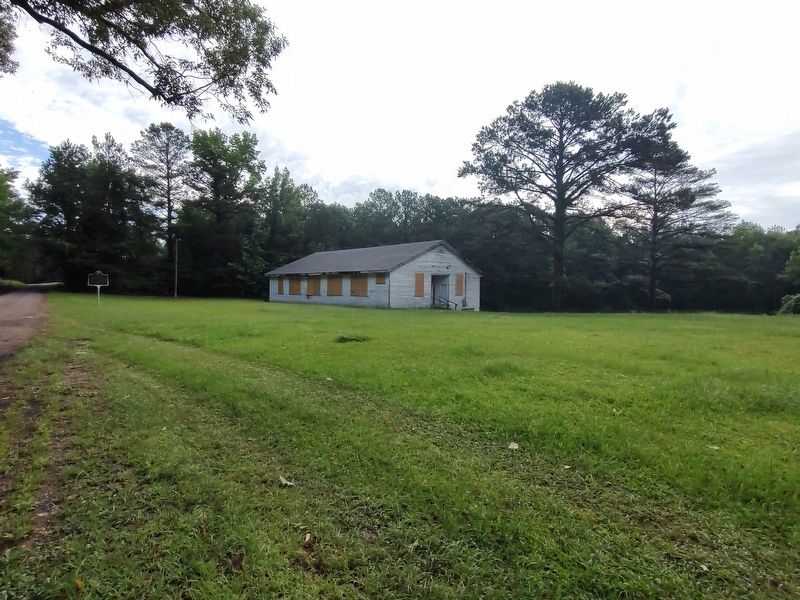
In 1928, the county constructed a two-room schoolhouse with Ms. Ruby C.
Todd, a Jeanes Supervisor of Negro Schools, serving as teacher. The school
provided a 7th through 12th grade education for Black students. In 1935,
the school added five new . . . — — Map (db m302617) HM
(side 1)
Early settlers in Anderson date back to 1818 when James Anderson settled approximately a mile south of here. The earliest permanent settlement was located about one mile north of here on Anderson Creek around 1825 and was known . . . — — Map (db m133189) HM
African Americans, through enslavement and Jim Crow, constructed campus buildings and worked at the University of North Alabama since its beginnings in 1830, yet they were denied admission as students for 133 years. In 1963, Wendell Wilkie Gunn . . . — — Map (db m156930) HM
This school named Burrell Academy, formerly in Selma, Alabama, was given to Florence by the American Missionary Association. In 1903, Burrell Normal School opened and served African ~American students in grades 1-12. In 1937, the Florence City Board . . . — — Map (db m83940) HM
About 1840, African- Americans began holding religious services in a brick cow shed overlooking the town spring near this site. It was purchased in 1857 by the local Methodists for this congregation, with Robin Lightfoot, a slave, as its pastor. In . . . — — Map (db m156921) HM
(side 1)
Coffee High School opened at this site in the fall of 1917. Camilla Coffee donated the land in honor of her late husband, Capt. Alexander D. Coffee, son of Gen. John Coffee, a Founding Father of Florence. Because of her generosity, . . . — — Map (db m104643) HM
George Washington Foster, planter, built this Greek Revival Mansion. An Act of the legislature was required to close Court Street, In fall of 1864 it was headquarters of Nathan B. Forrest, General, CSA. Foster's daughter, Sarah Independence McDonald . . . — — Map (db m28868) HM
This park was donated to the people of Florence by Dr. Kirk R. and Lillian Cook Deibert who initially acquired this property in 1952. The acreage was once a part of a large ante-bellum plantation owned by Judge Sidney Cherry Posey. In 1875 his heirs . . . — — Map (db m33086) HM
Dr. E. B. Norton was a member of the U.S. Education Mission sent to Japan after World War II to advise Gen. McArthur on the complete reorganization of the Japanese School System, which is still in place today. — — Map (db m219325) HM
Oldest state~supported
teacher college south of Ohio R.
1830 ~ opened as LaGrange College
(Methodist) at nearby Leighton.
First charted college in state.
1855 ~ moved here and re~named
Florence Wesleyan University.
Flourished until . . . — — Map (db m83970) HM
Side A The Cypress Land Company reserved this block for educational purposes. In 1847 the Florence Female Academy, consisting of two buildings, was established. The Academy was soon in financial trouble. Despite a $20,000 contribution from . . . — — Map (db m83973) HM
The lion habitat is named in honor of George H. Carroll (1926-1998), a long-standing friend and supporter of the University of North Alabama (UNA). Mr. Carroll was the loving husband of Virginia Sego Carroll and father of Steven, Judy, and George . . . — — Map (db m35658) HM
Gilbert School, named in honor of Henry C. Gilbert, school superintendent 1892-1904 and long time member of Board of Education was built in 1920, costing $79,000. The structure was planned by George D. Waller, architect. A relief sculpture . . . — — Map (db m83988) HM
As Deputy Director-General of UNESCO,
Dr. John W. Taylor pioneered international programs
following WWII aimed at ending illiteracy by
promoting education within communities. He
introduced an early version of distance learning
through . . . — — Map (db m219310) HM
Named for Alabama's first United States Supreme Court Justice, John McKinley made his home in Florence, Alabama from about 1821 to 1842. Born May 1, 1780 in Culpepper County, Virginia, he died July 19, 1852 and is buried in Louisville, Kentucky. . . . — — Map (db m28930) HM
Built by Theophilus Brown Larimore and his wife, Esther Gresham Larimore, as a home and educational center. Near site of foundry and arsenal of War Between The States, it served as a school, 1871-1887, to train ministers and Christian workers of the . . . — — Map (db m35261) HM
On this site Nicholas Marcellus Hentz conducted a girls' school. Native of Metz, France, Hentz was a painter, entomologist, author, and was once a professor at University of North Alabama. Experimenting with silkworms, he planted groves of mulberry . . . — — Map (db m84029) HM
Part of the city's first residential area, this district contains a variety of architectural styles. Originally the dwellings were log cabins. An early sawmill on Cypress Creek and a nearby brick yard provided lumber and bricks for many of the . . . — — Map (db m156926) HM
Born in Tuscumbia, Lived in Sheffield Daughter of Robert Burns Lindsay, Governor of Alabama 1870.
Teacher of Alabama's first kindergarten - 1898.
Ranks as one of the greatest kindergarten teachers in the world. Author of 14 books for children. . . . — — Map (db m84041) HM
At age 16 in 1982, Maurice Causey won a Ford
Foundation Scholarship to the American School of
Ballet. He has served at Ballet Master for
the Royal Swedish Ballet and the
Netherland Dance Theater.
Inducted 2018 — — Map (db m219179) HM
First school in Florence Public school system built 1890 on land given by Governor Robert M. Patton. It was occupied in 1891. Designed originally to serve all white elementary school children of Florence. Usually served six grades divided into nine . . . — — Map (db m84042) HM
In early 1840s about 14 African-American members from First Methodist formed own congregation “Church Springs” near South Court Street. In 1857, a nearby brick cow shed was converted for its use under Rev. Robin Lightfoot who became a . . . — — Map (db m84050) HM
The sculpture relief located above the Library's front entrance on North Wood Avenue was created by James Abbott Stoves (1868-1948). Stoves was a stone carver and proprietor of Florence Marble Works. The sculpture was originally placed above the . . . — — Map (db m304195) HM
This sculpture relief was created by James W. Stoves and placed above the entrance to Gilbert Elementary School in 1921. In 1980, following the demolition of Gilbert school, it was moved to Hibbett Middle School. Because of its theme which relates . . . — — Map (db m84048) HM
Built by John Simpson in 1843, on the site of his earlier home, this residence was occupied at various times by both armies during the Civil War. Purchased in 1867 by George W. Foster, builder of Courtview, for his daughter, Virginia, and her . . . — — Map (db m45808) HM
The Wesleyan Bell was manufactured by the C.S. Bell Company in Hillsboro, Ohio, it is made of alloy steel, has a diameter of 38 inches, and is 24 inches high (not including its yoke). The weight of the bell is 660 pounds. When 350- pounds mountings . . . — — Map (db m28881) HM
Chartered 1856 as Florence Wesleyan University, R.H. Rivers, President. Regarded as North Alabama's most eminent landmark, this Gothic Revival Structure was designed by Adolphus Heiman, Nashville, And built by Zebulon Pike Morrison, Florence, as new . . . — — Map (db m28864) HM
Educator and geographer Dr. William R. ("Bill)" Strong received the National Council for Geographic Education's distinguished Teaching Award (1986).
As Geographer-in-Residence at the National Geographic Society
(1991-1993), he earned its . . . — — Map (db m219338) HM
In 1947, Dr. Willie H. ruff, III was selected for the All-Black 766th Air Force Band, playing at every Air Force Base in the U.S. As Professor of Music at Yale University, 1971-2017, his teaching inspired students from across the globe.
Inducted . . . — — Map (db m219301) HM
As the Head Coach for the football team at the University of North Alabama, Robert Hue ("Bobby") Wallace's team earned three consecutive Division II National Championships (1993-1995),
and he was named Division II Coach of the Year three . . . — — Map (db m219300) HM
Coffee High School was located at this site from 1951 to 2004. From 1917 to 1950 it was located three blocks southwest, on the north side of Hermitage Drive at the intersection of North Walnut Street. Growth of the school over the years at that . . . — — Map (db m238220) HM
West End High School
1957-1969
West End High School was located here in the Oakland Community, less than a half-mile east of this location.
It was the first high school for African-Americans in western Lauderdale County, and the second . . . — — Map (db m232313) HM
Descended from early Lauderdale County pioneers, Andrew Lee Phillips established a general merchandise store here in 1888. Later, he owned and operated a gin, grist mill, and flour rolling mill. In 1917, he was responsible for the city's first bank . . . — — Map (db m176948) HM
East End High School was the first school for African-American students in eastern Lauderdale County. Several elementary schools for Africian-American children were established in the area, including the Rogersville School located on the north . . . — — Map (db m215931) HM
(side 1)
Prior to 1912, a private school, Rogersville High School, was housed in a two-story wooden frame building located in this vicinity. On August 7, 1907, an act was passed by the Alabama Legislature to establish a state high school in . . . — — Map (db m84297) HM
(side 1)
Springfield Community 1810
Springfield Community is believed to have been among the earliest settlements in Lauderdale County. It was laid out as a town and considered as the location for the county seat. As early as 1810, . . . — — Map (db m100604) HM
The elevation to the northeast was known as Gallagher Hill. It was owned by John Gallagher who was born 1784 in Donegal County, Ireland. Coming to America 12 Aug 1812, he was a Lawrence County official by 1822. Later known as Science Hill, the . . . — — Map (db m69668) HM
A scientist of national fame, Peters (1810-1888) lived for many years in Moulton with his wife Naomi (Leetch), a relative of President James K. Polk, who possibly visited here. A man of many talents, Peters was a noted linguist, early civil rights . . . — — Map (db m69670) HM
Near this site in the 1920's a school was constructed with funds and labor from the African~American Community along with funds from the Public, Whites and the Rosenwald Foundation. In the 1950's new buildings replaced the wooden structures. Most of . . . — — Map (db m195203) HM
The
first known mention of Mt. Hope is in Alexander
Sommerville's mortgage of 21 Aug 1830. His store, cotton
gin. and land were located 1/4 mile west of the present
town. By 1833, Mt. Hope is found in the earliest court
records as both a town . . . — — Map (db m284781) HM
The African American community of Courtland, led by Principal Richard A. Hubbard, bought this land to establish a public school for its students in a segregated South. Prior to this, Black students gathered in various locations as part of the . . . — — Map (db m302013) HM
Local farmer Frank Davis and his wife, Annie Lee, offered their house as a classroom space for African American students after a devastating fire destroyed the North Alabama Baptist Academy building in 1928. Located in a part of town once known as . . . — — Map (db m277899) HM
Side 1
Auburn
1865~Present
Only one house was built in the village in the decade after the Civil War, and though the state took over the bankrupt college in 1872, the institution received no state appropriation until 1883. . . . — — Map (db m79947) HM
In 1836 Judge John Harper with 34 other Methodists from Harris County, Georgia settled here. They built a log structure on this site, the first church and school in Auburn. In 1856 church leaders inspired the Methodist Conference to open East . . . — — Map (db m74442) HM
Used popularly since the founding of East
Alabama Male College in 1856, the name Auburn
University was made official by the Legislature
in 1960, in recognition of the school's second
century of service to the state and nation.
Originally . . . — — Map (db m183914) HM
On January 31, 1921, farmers gathered on the campus of Alabama
Polytechnic Institute (API), now Auburn University, to form the
Alabama Farm Bureau, now known as the Alabama Farmers Federation.
Former Alabama Extension Service Director Luther . . . — — Map (db m194773) HM
Side A:
The University Chapel is the oldest public building in the city of Auburn. Built as a Presbyterian Church, the first service was held in the original Greek Revival-style building on September 13, 1851. Edwin Reese, spiritual leader . . . — — Map (db m39831) HM
Veterinary Science began at the Agricultural and Mechanical College, now Auburn University, in 1892 with the arrival of Dr. Charles Allen Cary. By 1907, Cary had built the program to a degree-granting school, and in 1922 the program began moving . . . — — Map (db m267369) HM
(Side 1)
Dr. Charles Cary, a native of Iowa and graduate of Iowa State in 1887, came to Auburn in 1892 and taught the first class of veterinary medicine at Alabama Polytechnic Institute. He has been called the Father of Veterinary . . . — — Map (db m74436) HM
Side 1
In 1846, Auburn's founder, Judge John J. Harper deeded the property on this corner to Simeon Perry, as town agent for two of the earliest public schools in Auburn. A member of the settlement party, Perry laid out the original . . . — — Map (db m79948) HM
The first African American student entered the library to register at Auburn University at this site. Acting on a court order, Auburn president Ralph Brown Draughon accepted the application of Harold Franklin as the first African American student in . . . — — Map (db m90861) HM
Centennial Garden
commentates the granting of a state charter to the
East Alabama Male College
February 1, 1856
Established by Alabama Methodists
to foster Christian education.
Formally opened on October 1, 1859
Used as a . . . — — Map (db m183916) HM
This post oak started growth in 1850 and was 6 years old when East Alabama Male College was established. It was 33 years old when the Alabama Agricultural Station was established, 91 when the nation entered World War II, and over 100 when this site . . . — — Map (db m74430) HM
J. F. Drake High School
J.F. Drake High School, formerly Lee County Training School, educated Black children of the community from 1958 to 1970. It bears the name of Dr. Joseph Fanning Drake. Drake consisted of 12 classrooms, gymnasium, . . . — — Map (db m74457) HM
(Side 1)
Max Adams Morris
Max Adams Morris b. December 7, 1918, of Blountsville, Alabama, entered Alabama Polytechnic Institute (API) in 1938, was a varsity football player and became a member of "A" club, Scabbard & Blade, and . . . — — Map (db m85166) HM
Marker Front:
The Greek Revival rock and mortar house was built by Addison Frazer (1809-1873) between 1852 and 1854 and served as the center for a 2,000 acre cotton plantation. Frazer owned 100 slaves and was on the Board of Trustees of . . . — — Map (db m25988) HM
(Side 1)
Near this site once stood "Four-Story Cottage," the home of Robert Wilton Burton. A one-story house with wide porch and bay window, Burton built it in 1885 with proceeds from the sale of four stories to children's magazines. Born . . . — — Map (db m74440) HM
The Alpha Mu chapter of Sigma Alpha Epsilon was founded on June 15, 1878 at the Agricultural & Mechanical College of Alabama (now Auburn University). John E.D. Shipp came to Auburn as a student determined to organize a chapter at a time when . . . — — Map (db m66726) HM
At the Auburn train depot on February 16, 1861, Jefferson Davis reviewed the Auburn Guards, the first Confederate military company thus honored. Davis was en route to his inauguration as President of the Confederacy. The Auburn Guards were comprised . . . — — Map (db m74455) HM
The Cullars Rotation
(Established 1911)
The Cullars Rotation is the oldest, continuous soil fertility study in the South and the second oldest cotton study in the world. It was started in 1911 by the Alabama Agricultural . . . — — Map (db m74463) HM
The East Alabama Methodist College occupying this site was used as a Confederate hospital
1864 • 1865
1888
Alabama Polytechnic Institute
Agricultural & Mechanical College
Burned June 24, 1887. — — Map (db m183920) HM
Established in 1896 by Professor J.F. Duggar, the Old Rotation at Auburn University is: (1) the oldest, continuous cotton experiment in the U.S.; and (2) the 3rd oldest continuous field crop experiment in the U.S.; and (3) the 1st experiment to . . . — — Map (db m74429) HM
Wittel Dormitory has long been admired as one of Auburn’s most significant examples of classic nineteenth-century design. Built in the early 1900’s by Samuel S. Wittel to house professional women, it also served as a home for three generations of . . . — — Map (db m66725) HM
The Botsford family came to the Farmville area,
then Chambers County, in 1839. Later, Robert and
Ida Botsford donated land for a new school. In
1923, the white wood frame structure with white
siding was built. It had three classrooms . . . — — Map (db m289589) HM
Side 1
On this site once stood the first of over 5,300 Rosenwald schools for black children built between 1913 and 1932. The schools were started in a collaboration between Julius Rosenwald, CEO of Sears, Roebuck, and Company and Booker . . . — — Map (db m73539) HM
Side 1
On February 9, 1876, the City of Opelika paid D.B. Preston $80 for two acres of land to establish an African-American section of Rosemere Cemetery. This rectangular area of the cemetery contains 176 blocks, with 16 being partial . . . — — Map (db m75139) HM
In honor of Dr. J. W. Darden “A dedicated humanitarian, a builder of men, a physician, a Christian and a socially conscious citizen.” This marker honors Dr. Darden, his wife, Mrs. Jean Darden, the many teachers who gave so much of themselves to . . . — — Map (db m286106) HM
Founded in 1951, J.W. Darden served as Opelika's African American high school until integration in 1972. The school's namesake, Dr. John Wesley Darden, was the first African American doctor in Lee County. The school fostered pride and served as the . . . — — Map (db m285898) HM
Side 1
Killgore Scholarships
Here James A. Killgore (1888-1966) and his wife, Ophelia Parker, operated a grocery store from 1916 to 1944. The Killgores worked hard, practiced frugality, and invested money wisely, desiring to help . . . — — Map (db m75123) HM
On September 10, 1929, Southside Elementary School and its Northside counterpart opened to serve the children of Opelika. Designed by noted Montgomery architect Frank Lockwood, these model educational facilities were built of colonial brick, and . . . — — Map (db m285897) HM
Athens was incorporated in 1818, one year prior to the admission of Alabama as the 22nd state. It is the seat of Limestone County, created by an act of the Alabama Territorial Legislature. Athens has a legacy of providing quality education for . . . — — Map (db m159697) HM
Wealthy and influential Virginia family settled here in 1820's. Daniel Coleman (1801-1857) built his stately home a block west about 1826. During the Civil War, home was occupied by Yankee troops who took Elizabeth Coleman's teeth for their gold . . . — — Map (db m85389) HM
From the 1850s to the 1970s, the Louisville & Nashville Depot was located between Market and Washington streets. The building has been used as a dress ship, a photographer's studio, and in 2004 was remodeled for the Limestone County Archives. . . . — — Map (db m93878) HM
Fort Henderson Built on this site in 1863 by federal forces occupying Athens. It was a five-sided earthen fort with some frame buildings and underground bomb-proofs. Abatis lined the fifteen-foot deep perimeter ditch, a small portion of which . . . — — Map (db m41787) HM
Mary Fletcher Wells, A Philanthropist and educator born in Villenova, New York
Came to Athens , Alabama , at the end of the Civil War. Declaring she came "With a Bible in one hand and a speller in the other” After serving as a nurse for the Union . . . — — Map (db m266535) HM
This is the earliest known cemetery in the town of Athens, and the final resting place for many of its first citizens. The earliest burials date from the 1820’s and continue through the mid-1800’s, with an occasional burial past 1900. Through the . . . — — Map (db m71525) HM
“Trinity School founder Mary Fletcher Wells
and the American Missionary Association
forged the path for reconstruction in Limestone
County's African American population in an
approach based on the belief that education
and religion . . . — — Map (db m158194) HM
"It is impossible to adequately describe what
Trinity means to me. It means everything.
Without Trinity I don't exist." — Dr. Charles
Eric Lincoln: scholar, theologian, author,
former Duke professor, and Trinity graduate
Trinity . . . — — Map (db m158185) HM
This cistern is the last remnant of Trinity School located here 1865-1907. The cistern was used to store rainwater collected from the roof. No physical evidence remains of the Ross Hotel, the Chapman Quarters, and other buildings on this block, . . . — — Map (db m72219) HM
The Southeast Air Forces Training Center operated by Southern Aviation Training School, also known as Pryor Field, was constructed in 1941. These two aircraft hangars and beacon tower are the remaining artifacts of one of only a few World War II . . . — — Map (db m85425) HM
Limestone County High School (grades 9-12) was established in 1912. Money for the building, nearly $10,000, was obtained from three sources: the sale of property of an old Elkmont Elementary School, state funds, and private donations. Honored and . . . — — Map (db m93851) HM
Limestone County's First High School
"Limestone County High School” was established in Elkmont in 1912. The original building constructed in 1912, stood on Evans Street where Elkmont High School is currently located.
The County Board . . . — — Map (db m154184) HM
Preservation and Restoration
The residents of Mooresville value the town's past and are committed to historic preservation by working to raise funds to protect its public historic buildings. Some buildings have been lost or changed purpose as . . . — — Map (db m281040) HM
Mooresville's history began in 1805 when the first settlers arrived in the area and set up homesteads on lands occupied by the Chickasaw Indians. The Indians later ceded the land to the Federal Government and public land sales began in 1818. . . . — — Map (db m189567) HM
Reverend Mansfield Tyler (1826-1904), who was born enslaved near Augusta,
Georgia, organized First Missionary Baptist Church of Lowndesboro in the
late 1860s. He led 137 Black and five White members of Lowndesboro Baptist
Church to establish . . . — — Map (db m304065) HM
The Lowndesboro School is among the oldest surviving Reconstruction-era
African American schoolhouses in the United States. It was founded in 1867
by Dr. Mansfield Tyler, an educator, minister, and member of the Alabama
House of . . . — — Map (db m245992) HM
Franklin School, originally constructed on this lot, was in operation as early as the 1890s teaching grades 1-11. By the mid 1930s, it was downsized to grades 1-6. There were northern and southern classrooms adjoined by a common auditorium. The . . . — — Map (db m68028) HM
It was under this tree that participants in the U.S. Public Health Study of Untreated Syphilis in Negro Males in Macon County, Alabama, met to wait for Nurse Rivers, the Shiloh School nurse, to come and either administer treatment, update health . . . — — Map (db m95113) HM
Shiloh-Rosenwald School
The Shiloh-Rosenwald School, located in Notasulga, was a collaboration between educator Booker T. Washington and Julius Rosenwald, CEO of Sears. Rosenwald schools are landmarks in the history of African-American . . . — — Map (db m95109) HM
Francis Marion Whatley He was born on September 21, 1839 and died on April 22, 1903. He married Matilda Thompson (1842-1877) who died at 35 years of age. He later married Emma E. Radney (1861-1941) he had 14 children with 4 dying as infants. . . . — — Map (db m261580) HM
Unmarked grave in Cubahatchie Baptist Church Cemetery. Half-blooded Creek Indian, planter, soldier, Indian agent,
and historian, Stiggins lived on a nearby farm fronting the Federal Road from 1831 until his death. There he wrote "A . . . — — Map (db m60534) HM
Tuskegee consists of 80 square miles and is the county seat of Macon County, Alabama. Tuskegee rests in the heart of the rural Alabama Black Belt and is 40 miles east of Montgomery. Tuskegee was founded by General Thomas S. Woodward in 1833 after he . . . — — Map (db m99679) HM
Harris Barrett School
The SIC built this two-room school in 1904 and named it for Harris
Barrett, graduate and cashier of Hampton Institute and SIC book-
keeper. Local farmers took up Booker T. Washington's call for education
and committed . . . — — Map (db m245694) HM
The actual sight of a first-class house that a Negro has built is ten times more potent than pages of discussion about a house that he ought to build, or perhaps could build. —Booker T. Washington, Up From Slavery . . . — — Map (db m101919) HM
In August of 1963, the United States District Court M. D. Alabama sided with the plaintiff in Lee v. Macon County Board of Education. This pivotal civil rights case involved the integration of, the all-white Tuskegee High School (located on . . . — — Map (db m139878) HM
We shall prosper . . . as we learn to dignify and glorify labor and put brains and skills into the common occupations of life. —Booker T. Washington
Tuskegee Institute's vocational training program began in this . . . — — Map (db m101934) HM
[Center]
He lifted the Veil of Ignorance
from his people and pointed
the way to progress through
education and industry
[Far left]
We shall prosper in proportion as we
learn to dignify and glorify labor . . . — — Map (db m100163) HM
19538 entries matched your criteria. Entries 201 through 300 are listed above. ⊲ Previous 100 — Next 100 ⊳