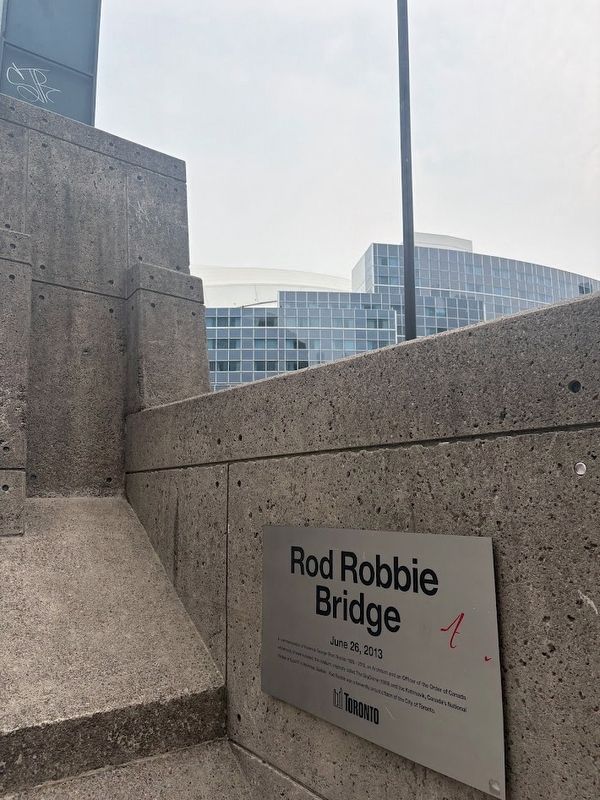
In commemoration of Roderick George (Rod) Robbie 1928-2012, an Architect and an Officer of the Order of Canada whose body of work included, this stadium, originally called The SkyDome (1989) and the Katimavik, Canada's National Pavilion at Expo'67 . . . — — Map (db m306322) HM
Constructed in 1906-7, the theatre is an intimate but
lavish version of the traditional 19th century theatre,
with two balconies as well as side boxes. John M. Lyle
(1872-1945), one of Canada's most distinguished architects of the . . . — — Map (db m276924) HM
From the day that Sir Adam Beck School opened, in 1921, it became the Alderwood community's primary meeting place. It has hosted meetings of ratepayers, the Volunteer Fire Department, dances, political forums and field days. In the torrid summer of . . . — — Map (db m310668) HM
The farmhouse that once stood near this site
was built by a Black man, William Lafferty and
his sons between 1851 and 1856. He came to
Upper Canada from the United States in the
1830's. William settled in the town of York
(now Toronto) where he . . . — — Map (db m310666) HM
Billy Bishop Toronto City Airport
Opening in 1939 to take advantage of the rise in commercial aviation, Billy Bishop Toronto City Airport was built to integrate an aircraft terminal with a modern port.
The Advisory Airport . . . — — Map (db m299682) HM
[First Panel:] 9 April 1940 Norway was attacked by overwhelming forces. King Haakon VII, Crown Prince Olav and the government left Tromso 7 June for Great Britain in order to continue the fight for freedom in exile. Negotiations had . . . — — Map (db m20989) HM
Born near Edinburgh, Scotland, Brown emigrated with his father to New York in 1837. In 1843 he moved to Toronto and the following year founded the “Globe” newspaper which achieved great political influence. Elected to the legislature as a reform . . . — — Map (db m207894) HM
Born in St. Raphael, Macdonald was first elected to represent Glengarry in the legislature of the Province of Canada in 1841. He became one of the leaders of the Reform Party and served in several administrations prior to Confederation in 1867. . . . — — Map (db m208016) HM
This tree was planted by James Simpson, Esq., Mayor of Toronto, on the occasion of the celebration of the twenty-fifth anniversary of the accession of King George the Fifth to the Throne — May 6th 1935 — — — Map (db m243754) HM
[English] The first university in this province, King's College was chartered in 1827 through the efforts of the Reverend John Strachan. This site was acquired by the College the following year. Sectarian and political criticism of . . . — — Map (db m207856) HM
Born in Cotterstock, Northamptonshire, Simcoe entered the army in 1770, and during the American Revolution commanded the 1st American Regiment (Queen’s Rangers). In 1791 he was appointed the first Lieutenant-Governor of the newly formed province of . . . — — Map (db m207899) HM
[English] As part of the Legislative Assembly’s Millennium celebrations, these red oak trees were planted by The Hon. Gary Carr, MPP, Speaker, Mr. Sean Conway, MPP, Dean of the House and the Pages of the Legislative Assembly (Group . . . — — Map (db m243779) HM
[English] The Ontario Human Rights Code came into effect on June 15, 1962 and established equal rights and freedom from discrimination as primary elements of provincial law. The first legislation of its kind in Canada, the . . . — — Map (db m207885) HM
The precise geographic position of the Geodetic Station “Ontario Post One” is latitude 43° 39’ 45.421” North-longitude 79° 23’ 26.620” West. The coordinate position in the Ontario Coordinate System based on the North American Geodetic Survey 1927 . . . — — Map (db m243784) HM
Born at Kensington Palace, the daughter of Edward, Duke of Kent, King George III’s fourth son, Alexandrina Victoria became Queen at the death of her uncle, King William IV, in 1837. Although she never visited Canada, her son, Edward, Prince of . . . — — Map (db m207900) HM
[English] In 1859, the city leased land here from King’s College, and in 1860 a park, named after Queen Victoria, was opened by the Prince of Wales, later Edward VII. Queen’s Park was long considered as a location for new parliament . . . — — Map (db m207768) HM
[English] Officially opened by the Prince of Wales (later King Edward VII) during the Royal Tour of 1860, Queen's Park is an early example of the public park movement in Canada. Landscaped according to a picturesque design, its . . . — — Map (db m207767) HM
Born in Williamsburg Township, Dundas County, and educated at the Cornwall Grammar School, Whitney was called to the Bar in 1876. He was elected to the Provincial Parliament as Conservative Member for Dundas in 1888. A noted orator, he was the . . . — — Map (db m207891) HM
Born in Kingston, Mowat studied law under John A. Macdonald. After moving to Toronto in 1840, he was elected a liberal member of the legislature of the Province of Canada in 1857 and served as Provincial Secretary in 1858 and Postmaster General, . . . — — Map (db m207895) HM
Prior to colonization and urban development altering the landscape, the land Toronto now occupies was teeming with waterways that flowed through marshes and forests of pine and oak trees. Taddle Creek ran for six kilometres across land that remains . . . — — Map (db m274706) HM
[English] The "Mac-Paps" were a unit of the International Brigades, a volunteer force recruited world-wide to oppose the fascist forces bent on overthrowing the government of Spain. Formed in Spain in 1937, the battalion was named . . . — — Map (db m207700) HM
[English] The Nine-Hour Movement of 1872 was a broad labour effort to achieve a shorter work day through concerted strike action. The printers of the Toronto Typographical Union went on strike for a nine-hour day in late March. On . . . — — Map (db m207870) HM
[English] The Royal Tour of 1939 was the first visit to Canada by a reigning British monarch. Between May 15 and June 15, King George VI and Queen Elizabeth travelled by train across the country. They arrived at the North Toronto . . . — — Map (db m207836) HM
Representing the billionth forest tree seedling distributed from Ontario Government nurseries since 1908, was planted on November 14th, 1968, by The Honourable John P. Robarts, P.C., Q.C., Prime Minister of Ontario. — — Map (db m243777) HM
Born near Dundee, Scotland, Mackenzie came to Upper Canada in 1820, and four years later founded a political newspaper, the “Colonial Advocate”, at Queenston. Sharply critical of the ruling oligarchy in the province, he entered politics, became . . . — — Map (db m207897) HM
In 1874, Benjamin Hinchcliffe opened the first tavern on this site. It was a two storey, roughcast structure with a stable. In 1908, John Wilson Siddall designed the present building in the Edwardian Classical style.
After Albert, Molly, and Morris . . . — — Map (db m274902) HM
In the late 1960s the Bloor-Jane-Runnymede Businessmen's Association concluded that the chief problem it faced was in the raising of funds to carry on its services to the local business community.
It developed a scheme whereby the business . . . — — Map (db m288919) HM
John Taylor (1773-1868), his wife Margaret Hawthorne and seven
children emigrated from Uttoxeter, Staffordshire in 1821. In 1839, three
sons, John, Thomas and George, purchased this land from Samuel
Sinclair (1767-1852) except for a portion . . . — — Map (db m309812) HM
Chapel of St. James-the-Less
In its vigorous, harmonious composition, this small funeral chapel is a splendid example of High Victorian Gothic design.
Its sense of strength and spirituality is derived from the subtle contrast of . . . — — Map (db m274524) HM
The Rekai family arrived in Canada in 1950 from Paris, France, after escaping from Budapest two years earlier when the Soviet Union occupied Hungary. Upon receiving their licenses to practice medicine in Canada, brothers John and Paul purchased a . . . — — Map (db m274509) HM
The country home of Lieut.
Col. John Graves Simcoe
first Lieutenant Governor
of Upper Canada 1791-1796.
Stood on these heights
just south of this site
1794-1829. Named after
Francis Gwillim Simcoe,
son of Lieut. Governor
and Mrs. Simcoe, . . . — — Map (db m274492) HM
The wife of the first Lieutenant-Governor of Upper Canada, Elizabeth Posthuma Gwillim was born at Whitchurch, Herefordshire, England. Orphaned at birth, she lived with her uncle, Admiral Samuel Graves, and subsequently married his god-son, John . . . — — Map (db m274497) HM
Established in 1807 as the Home District Grammar School,
Jarvis Collegiate is one of the oldest public secondary schools
in Ontario. In 1812 the Reverend John Strachan, later
first Anglican Bishop of Toronto, became headmaster and
during the . . . — — Map (db m282159) HM
Fondée en 1807 l'école Jarvis est l'une des plus anciennes
ecoles secondaires publiques de l'Ontario. Le reverend
John Strachan, qui devait être le premier eveque anglican
de Toronto, en devint le directeur en 1812 et jeta les . . . — — Map (db m282178) HM
After the Toronto Island parish was established in 1875 Bishop Arthur Sweatman was the prime mover in the building of this Anglican church. Designed by Arthur R. Denison, architect, the Early English Gothic style frame church was opened at the . . . — — Map (db m35520) HM
This lighthouse, one of the earliest on the Great Lakes, was completed in 1808 as an hexagonal tower 52 feet high, topped by a wooden cage with a fixed whale-oil lantern. In 1832 it was raised to 82 feet and later equipped with a revolving light. . . . — — Map (db m271167) HM
Established in 1913 by Henry Dworkin and Sam Easser, the Labor Lyceum Association sought to advance the interests of the city's Jewish trade union movement. Through the sale of $5.00 stock certificates, the Association purchased the houses at 344 . . . — — Map (db m288831) HM
This building was the first purpose-built Yiddish-language theatre in Canada and a cultural landmark in the local Jewish community.
Architect John MacNee Jeffrey designed the Standard Theatre in the Art Deco style, possibly with architect . . . — — Map (db m288830) HM
The Wong Association of Ontario (Wong Kung Har Wun Sun Association) traces its origins to one of the oldest Chinese family associations in Canada — Wong Kung Har Tong, established in 1912. It was originally located in Toronto's first Chinatown, near . . . — — Map (db m293791) HM
On August 16, 1933, at the end of a playoff game for the Toronto junior softball championship,
one of the city’s most violent ethnic clashes broke out in this park (then known as Willowvale Park). Toronto was a predominantly British and Protestant . . . — — Map (db m297298) HM
Joseph Bloor (also "Bloore") was a prominent landowner, brewer, and philanthropist. Born circa 1789 in Staffordshire, England, he immigrated to the Town of York, now Toronto, in 1819 with his wife, Sarah (née Lees), and their three children. . . . — — Map (db m274537) HM
Sir Oliver Mowat (1820-1903) built this Georgian-style
house in 1836 on land originally owned by Samuel Peters
Jarvis. Mowat, one of the fathers of confederation, was
Premier of Ontario (1872-1896) and Lieutenant-Governor
of Ontario . . . — — Map (db m281544) HM
April 7, 1977 marked the introduction of Major League Baseball to Toronto when the Blue Jays Baseball Club played their first home game. They won that memorable opener, and have since brought great excitement and entertainment to the City. Playing . . . — — Map (db m199994) HM
Considered among our finest poets, Isabella Crawford was born in Ireland and came to Canada with her parents about 1858. After settling first in Paisley, Ontario, the family lived later in Lakefield and Peterborough. As a young woman Isabella . . . — — Map (db m217200) HM
In 1931 George McCordick converted an old farmhouse into a clubhouse and turned the surrounding countryside into a challenging golf course. The Cliffside Golf Course was located south of Kingston Road and west of Midland Ave. with a beautiful . . . — — Map (db m217878) HM
The layers of sand and clay exposed in these cliffs display a remarkable geological record of the last stages of the Great Ice Age. Unique in North America, they have attracted worldwide scientific interest. The first 46 metres of sediments contain . . . — — Map (db m39366) HM
by Risto Turunen, October, 1992 Wrote Elizabeth Simcoe in 1793 “…After rowing a mile we came within sight of what is named, in the map, the Highlands of Toronto. The shore is extremely bold and has the appearance of chalk cliffs… We talked of . . . — — Map (db m236694) HM
Lots 10 and 11 were purchased by James Beaty and William Armstrong in 1830. This row house with storefront was constructed for brothers Fredrick and Albert Wilkins, proprietors of a local real estate company. First tenant was John McKnight, grocer, . . . — — Map (db m272018) HM
Prior to the use of natural gas, the Consumers' Gas Company complex that once dominated this area produced both coal gas and water gas to provide light and fuel for Toronto. This building was constructed for the final purification process of water . . . — — Map (db m272012) HM
Enoch Turner Schoolhouse
In 1849, this building opened as Ward Street School, Toronto's first free school. Enoch Turner, a wealthy local brewer, financed the construction and operation of this school on land donated by Little . . . — — Map (db m270511) HM
Once one of the city's largest centres of charity, the House of Providence stood nearby for over 100 years. It was initiated by Toronto's Roman Catholic Bishop, Armand-François-Marie de Charbonnel, in response to the plight of the . . . — — Map (db m272089) HM
Founded in 1842, this is the oldest surviving church in the city of Toronto. Under the patronage of the Right Reverend John Strachan, first Anglican Bishop of Toronto, funds were raised to start construction in 1843. Its first rector was the Rev. W. . . . — — Map (db m270510) HM
In 1822 St. Paul's was established as the first Roman Catholic Parish between Kingston and Windsor. The first Church built of red brick, was opened on this site in 1824. The land to the East of the Church was used as Toronto's first Catholic . . . — — Map (db m272084) HM
On August 19, 1942, six thousand allied troops embarked on 250 vessels from southern England on a daylight raid on the German occupied French resort town of Dieppe. Almost 5000 of these soldiers were young Canadian men.
Of the Canadians who . . . — — Map (db m309879) HM
Jean Gertrude Davidson, known throughout her life as True moved to East York in 1947, where she become actively involved in her new community. Her energetic and enthusiastic support for enriched educational programming led to her election to the . . . — — Map (db m309819) HM
William McKay was an early supporter of the development of the Township of East York. In 1891, McKay bought about 16 hectares (40 acres) for a farm between present-day Sammon, Cosburn, Durant, and Glebemount Avenues. In the 1920s,
McKay aided . . . — — Map (db m281917) HM
Built in the heart of a former railway town, 292 Main Street is an example of 19th-century Ontario farmhouse design, with decorative brickwork in contrasting colours. Lumber merchant and landowner Donald George Stephenson was the home's first owner . . . — — Map (db m309880) HM
Celebrated pianist Glenn Gould was born in Toronto and lived here on St. Clair Avenue West for much of his adult life.
His visionary approach to musical interpretation brought him international acclaim. Gould was praised for his technical skill and . . . — — Map (db m297406) HM
Designed by architectural firm Mathers & Haldenby, this building housed the executive headquarters of the multinational petroleum corporation Imperial Oil Limited from 1957 to 2005.
It was among the first major office buildings on St. Clair Avenue . . . — — Map (db m297401) HM
{Marker Text in English:}
Writer, artist, and illustrator of historical novels and textbooks, Charles Jefferys emigrated to Canada from England in 1879. After studying at the Toronto Art Students League, he joined the New York . . . — — Map (db m37092) HM
Procedures pioneered by William Thornton Mustard (born 8 August 1914 in Clinton, Ontario) had an historic impact on the field of surgery. He attended the University of Toronto Schools and the University of Toronto Medical School. During WWII while . . . — — Map (db m217699) HM
An outstanding Canadian architect, civil engineer and railway manager, Cumberland was born in England and practised there before immigrating to Toronto in 1847. He quickly gained recognition, designing such notable buildings as St. James Cathedral . . . — — Map (db m293863) HM
Born in 1893 in a house that stood near this site, Gladys Marie Smith appeared on stage in Toronto at the age of five. Her theatrical career took her to Broadway in 1907 where she adopted the name Mary Pickford. The actress's earliest film, "Her . . . — — Map (db m199993) HM
[English] Notre place (Our Place) is a place of gathering, reflection and celebration that pays tribute to Ontario’s Francophonie. Notre place is an official legacy of the Commemoration of 400 years of French presence in Ontario . . . — — Map (db m243791) HM
Pendarves - Cumberland House
Renowned Toronto architectural firm Cumberland & Storm designed this building as the family home of senior partner Frederic W. Cumberland, Completed in 1860 and named Pendarves, the original Italianate . . . — — Map (db m294031) HM
Located in this building for more than 50 years, the University of Toronto's School of Hygiene was a vital centre for teaching and research into the prevention of disease and promotion of good health.
Until 1955, this building was also home to . . . — — Map (db m294093) HM
{The marker has a both an English and French version. In English:}
In one of the most important advances in modern medicine, a team of investigators isolated and purified insulin in a building which stood on this site. On May 17, . . . — — Map (db m36194) HM
This institution, the first general infirmary in Upper Canada, began operation in 1829. It was periodically hampered by administrative and financial difficulties but through the initiative of the influential businessman, Sir Joseph Flavelle, . . . — — Map (db m293737) HM
Original use: coal-fired production of steam
for engine room and for distillation
Designated under the
Ontario Heritage Act, 1976 — — Map (db m270708) HM
Distillery Architects
Between 1858 and 1895 David Roberts Sr. and his son David Roberts Jr. designed and oversaw the construction of all the 19th century buildings remaining at the Distillery.
David Roberts Sr. (1810-1881) was a . . . — — Map (db m270591) HM
Original use: fermentation in wooden tuns,
yeast house, storage of whisky in barrels
Designated under the
Ontario Heritage Act, 1976 — — Map (db m270733) HM
Original use: fermentation to make alcohol;
later, machine shop, molasses storage tank
Designated under the
Ontario Heritage Act, 1976 — — Map (db m270764) HM
Original use; two steam-powered pumps
delivering 3,000 gallons of water per minute
Designated under the
Ontario Heritage Act, 1976 — — Map (db m270767) HM
Gooderham and Worts Distillery Complex
The seeds of Canada's largest 19th-century distilling firm were sown in 1837 when a still was set up on this site to convert surplus grain from an 1832 grist mill into whisky. Exploiting new . . . — — Map (db m270596) HM
Original use: alcohol distillation, punification and discillation of water to adjust proof
Designated under the Ontario Heritage Act, 1976 — — Map (db m270707) HM
Original use: gristmill and granary, mashing
and distillation areas, steam engine room
Designated under the
Ontario Heritage Act 1976 — — Map (db m270714) HM
In 1920, the Canadian government granted Gooderham & Worts
the right to ‘denature' alcohol (render it undrinkable by adding chemicals) for industrial use. Tank House 7 was
adapted to house the denaturing operation.
Designated under the . . . — — Map (db m270773) HM
Original use: storage and blending in tanks,
scaling loft above for weighing and shipping
Designated under the
Ontario Heritage Act, 1976 — — Map (db m270862) HM
City Hall was designed in 1887 by E. J. Lennox to fit this central site at the head of Bay Street. In one structure, these municipal buildings combined a City Hall, in the east portion, and Court-house in the west. The building, . . . — — Map (db m308117) HM
Built for the Canadian Bank of Commerce, now the Canadian Imperial Bank of
Commerce (CIBC), the historic bank branch at 197 Yonge Street was designed
by architecture firm Darling and Pearson in the Beaux-Arts style. The building
has classical . . . — — Map (db m282016) HM
Once one of Toronto's grandest office buildings, this landmark served as the headquarters of the Confederation Life Association until 1955. Plans for the building arose from an international competition won by Knox, Elliot and Jarvis, architects. . . . — — Map (db m217687) HM
Cyril "Cy" George McLean was among Canada's most accomplished and celebrated jazz musicians who broke racial barriers in live music, paving the way for generations of Black musicians.
Born in Sydney, Nova Scotia, McLean was introduced to the . . . — — Map (db m293859) HM
Jackie Shane was a pioneering transgender musician who electrified Toronto's
nightclubs in the 1960s with her high-energy R&B shows.
Born in Nashville, Tennessee, Shane sang in choirs as a child and joined the
city's R&B scene as a teen. . . . — — Map (db m281567) HM
The Le Coq d'Or Tavern was one of the most popular rock'n' roll venues in Toronto in the 1950s and 1960s.
Businessman George Bulucon opened the Le Coq d'Or in the late 1940s on the Yonge Street strip, a raucous entertainment district between . . . — — Map (db m259775) HM
Mackenzie House was the last home of William, Lyon Mackenzie, Toronto's first mayor, outspoken newspaper editor, and primary leader of the 1837 Rebellion in Upper Canada. The defeat of the rebels forced Mackenzie to flee to the United States. . . . — — Map (db m302332) HM
Since its opening in 1894, Massey Hall has served as one of
Canada’s most important cultural institutions. A gift to Toronto
from wealthy industrialist Hart Massey, it provided the city with
professional concert facilities. Its . . . — — Map (db m302479) HM
439 entries matched your criteria. The first 100 are listed above. Next 100 ⊳