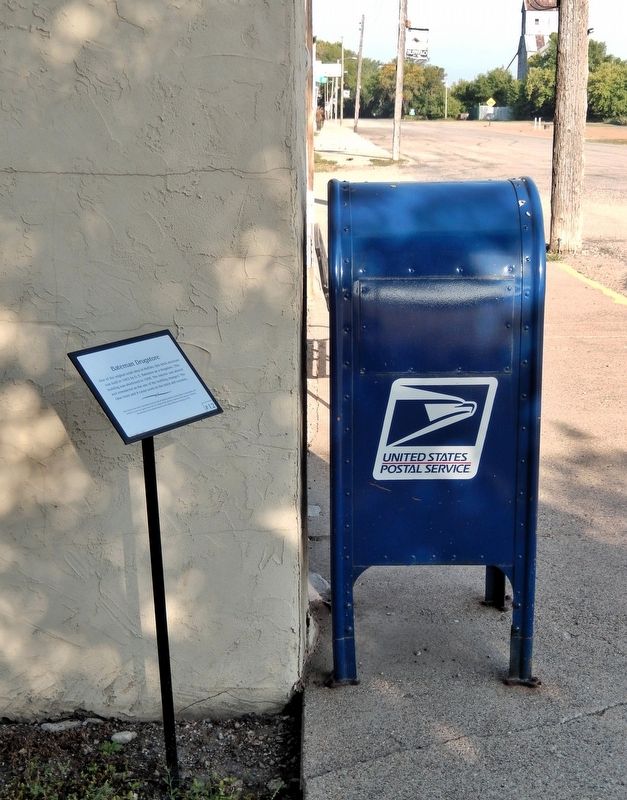
One of the original retail sites in Buffalo, this brick structure was built in 1902 by G. E. Batemen as a drugstore. This building was shortened in 1998. The interior was altered and remodeled as the use of the building changed. The false front and . . . — — Map (db m306101) HM
The First Presbyterian Church of New Buffalo, Dakota Territory, was organized in 1880 and built their first church in 1886. A new church was built on this same site in 1928. Tudor style building was designed by architect William Kurke, who also . . . — — Map (db m278991) HM
T. A. Quirk & Company was organized in 1884 by Thomas A. Quirk. This Boomtown style office building was constructed in 1908. At one time the lumber yard had a lumber shed, a store, three storage sheds, and coal facilities on the south side of the . . . — — Map (db m306159) HM
August 16, 1863, General Sibley marched over this spot with 3400 soldiers on his return after driving the Indians across the Missouri River. — — Map (db m169803) HM
The High School is the last remaining example of non-residential Classic Revival style architecture in Buffalo. It was
designed by Architect A. J. O'Shea and built in 1916 by Meineke Building Company of Fargo at a cost of $20,000. The school closed . . . — — Map (db m278980) HM
Donated by Beverly Sproul and her family to honor the men and women of the Buffalo Area who served in the Armed Forces.
John T. Backes •
Donald Deehler •
Clair N. Boyd •
Evan S. Brown •
Donald Burns •
Edwin F. W. Buttke •
C.L. . . . — — Map (db m278956) WM
The original portion of the rectory was built in 1887 and the two story front section was added in 1895. The property was donated to the Buffalo Historical Society in 1995 and opened to the public in 1998 as the Margaret Fraase Library. The wood . . . — — Map (db m278986) HM
This classical revival home was built in 1901 for S. G. and Emma More. Architect Milton Earl Beebe designed this home using
2x6 foot balloon framing, clapboard siding and field stone foundation. The More family owned the entire block and built an . . . — — Map (db m278987) HM
Built in 1885, this church was formerly the Calvary Episcopal
Chapel and the first church built in Buffalo. It was designed by
architect George Hancock who held ND architect license #1 and
was constructed of native prairie stone. The Buffalo . . . — — Map (db m278983) HM
The Peterson residence was built in 1915 by S. G. More, a prominent Buffalo banker, as a wedding gift for his daughter Edith when she married Arthur Peterson. The
Classic Revival style home was designed by Fargo architect A. J. O'Shea. Descendants . . . — — Map (db m278988) HM
This church was built in 1900 by the Hancock Brothers of Fargo and is an example of vernacular architecture. It was named after Buffalo businessman, Thomas A. Quirk, who donated most of the lumber. The Grotto and Cross were built with concrete and . . . — — Map (db m278990) HM
George M. Black was an early merchant in Fargo, opening The Black Store on Broadway in 1912. In 1929, after witnessing the stock market collapse, he bet big on Fargo and sold his store to Sears Roebuck and Company. He used the proceeds to finance . . . — — Map (db m239934) HM
In 1864, the Northern Pacific Railroad was charted to build a line from the Great Lakes to Puget Sound. The initial funding for construction would come from the sale of Northern Pacific bonds. However, in 1873 lack of funding halted construction, . . . — — Map (db m239986) HM
The new Fargo City Hall project began in 2016 and opened in 2018. The exterior of the building features 12 panels of art created by a local artist, Catie Miller, who shares her interpretation of Fargo's past, present, and future with a focus on . . . — — Map (db m240299) HM
This Northern Pacific depot, designed by nationally known architect Cass Gilbert, was built in 1898. A park with gardens and fountain surrounded it. No longer in use because of declining passenger traffic in the 1960's, the depot was in danger of . . . — — Map (db m240296) HM
Eddie and Hildegarde Kraus began their careers in the entertainment industry as teenagers (he as a waiter in an Opera House, and she as a pianist and organist). Eventually, Eddie's career led to managing several Fargo-Moorhead theatres. As . . . — — Map (db m240096) HM
On Thanksgiving Day, November 24, 1904, the Fargo Streetcar Railway accepted its first passenger. Fare was 5¢ per person and service was available from 6 AM to midnight every day, except Sunday, when hours were shorter. Seven cars were available . . . — — Map (db m239997) HM
In 1881, wishing to reduce freight charges, 23 Fargo businesses pooled $100,000 to build a railroad line. It would originate from Fargo, and run south to Ortonville, Minnesota (117 miles away).
Construction of the line began in 1883, and on the . . . — — Map (db m305976) HM
On this site, the afternoon of June 7, 1893, began what would later become known as The Great Fargo Fire. Originating at Herzman's Dry Goods Store, the fire spread its destruction north, east, and west from this location until it had consumed 31 . . . — — Map (db m305988) HM
For more than a century, the twin steeples of First Lutheran Church and the Cathedral of St. Mary have stood like beacons on north Broadway, illuminating the faith journeys of the prairie's immigrant people. The spires usher travelers into and out . . . — — Map (db m240098) HM
Just like the name hints, the Ford Building was built in 1915 as a Ford automobile plant and showroom to service the Dakotas. Built in a Chicago style along the Great Northern Railroad tracks, this building boasted the perfect location to . . . — — Map (db m240297) HM
When autos appeared in the 1890s, only the wealthy could afford to buy them. But by the 1920s assembly lines made cars affordable for the middle class, and sales soared. At the end of the decade there were 25 million cars on the road and U.S. . . . — — Map (db m100837) HM
This caboose was built by the Great Northern in August 1942 and is one of 50 wood sided, cupola cabooses. It was constructed in the St. Cloud shops. The original number was X227 (the X stands for non-revenue) and it was acquired by Burlington . . . — — Map (db m239898) HM
The Great Northern Railway started out in 1857 as the Minnesota & Pacific. It was not until 1890 that it became known as the Great Northern, and this name was given in honor of rails that crossed the great territory. The Great Northern entered . . . — — Map (db m240291) HM
In the late 1800's, the Red River Valley was a boom in agricultural development. The introduction of the Bonanza Farms and the overall increase in farming of wheat created a preference for larger threshers and powerful engines grew. Machinery Row, . . . — — Map (db m239996) HM
North Dakota State University is a land-grant institution, created under the Morrill Act of 1862. From its establishment in 1890, its mission has included research and education in scientific agriculture to benefit the public as well as students. . . . — — Map (db m240225) HM
On July 2, 1864 President Abraham Lincoln signed an Act of Congress creating the Northern Pacific Railroad Company.
Following closely the route taken by a government expedition in 1854, the northern railroad route to the west coast would . . . — — Map (db m239998) HM
Original site of Gethsemane Episcopal Cathedral. Land purchased by General Cass from the Northern Pacific Railroad. Gethsemane Church was built in 1874 and replaced with Gethsemane Cathedral in 1900. The cathedral burned in 1989. The present . . . — — Map (db m305989) HM
Osco Drug painted this advertisement after opening in 1942. This spot was originally filled by a window before Osco Drug moved in, so when the advertisement was revealed during this building's renovation in 2017, this portion of the advertisement . . . — — Map (db m239970) HM
Established in 1965 as the Red River Art Center in Moorhead, MN, the Plains Art Museum was given its current name in 1975. In 1996, the Museum moved across the river into North Dakota and embarked on renovating a former International Harvester . . . — — Map (db m240293) HM
The Native American Medicine Garden The concept for this medicine wheel garden originated with the sacred medicine wheel representing various symbolisms and teachings. It honors seasonal cycles, represents rituals, and expresses . . . — — Map (db m240295) HM
While steamboats delivered and loaded cargo up and down the Red River, recreational use of the Red River blossomed. Sleigh races, ice-skating, skiing, toboganning, and ice fishing provided winter recreation. Boating, swimming, diving, and public . . . — — Map (db m240099) HM
The story of the Red River Valley and Red River of the North began over 11,000 years ago when Lake Agassiz was formed. A glacier extended from Canada south and covered what is now the Red River Valley. As it began to melt and recede northward, . . . — — Map (db m239991) HM
As the first settlers broke up the fertile Red River Valley prairie sod, flax was usually the first crop they sowed, followed by hard red spring wheat and barley. Crop agriculture was and continues to be a major economic force in North Dakota. . . . — — Map (db m240253) HM
[2020 marker] This replica Statue of Liberty was commissioned by Industrial Builders, the company that built the Veterans Memorial Bridge, to replace the statue originally donated in 1950 to The City of Fargo by the Boy . . . — — Map (db m209100) HM WM
Roberts Commons, or as the locals call it, RoCo, is the first mixed-use parking garage in Downtown Fargo. The Carnegie Public Library once stood at the site and during excavation for Roberts Commons, the brick foundation of the library was . . . — — Map (db m240298) HM
Sodbuster: San Isidro Sodbuster: San Isidro combines the artistic traditions of the American Southwest with imagery that represents the hardworking farmers of the Red River Valley. The term "Sodbuster" is a colloquialism for farmers, . . . — — Map (db m240401) HM
At one time the Red River was home to over a dozen steamboats including the Anson Northup (later renamed the Pioneer), the International, the Selkirk, the Dakota, the Alpha, the Cheyenne, the . . . — — Map (db m239995) HM
Amendment ICongress shall make no law respecting an establishment of religion, or prohibiting the free exercise thereof; or abridging the freedom of speech, or of the press; or the right of the people peaceably to assemble, and to petition the . . . — — Map (db m239971) HM
Throughout the years, entertainment has played a major role in the quality of life in our region. Early traveling Chautauquas brought education and entertainment to the prairie with oratory, musical and dramatic productions presented under imposing . . . — — Map (db m240080) HM
The Ford Building, designed in the Chicago School style of architecture by John Graham, was one of several similarly-designed Ford Branch Plants that were built throughout the United States in the early 1900s. Fargo was the 25th such branch. The . . . — — Map (db m240100) HM
Moorhead and Fargo were platted when the Northern Pacific railroad arrived at the Red River in 1871 less than one block north of here. The towns grew up at this intersection of river and rail. Steamboats traveling the shallow Red River stopped . . . — — Map (db m100836) HM
In 1926, the Rudolph Wurlitzer Company of New York installed a new pipe organ in the Fargo Theatre to provide musical accompaniment for silent film. It consisted of a console with two keyboards and seven sets of pipes. The chambers included a . . . — — Map (db m240095) HM
Early FargoReynold's Variety House and Shea's Variety House were known for their dancing girls, ribald comedians, food and drink. Pinkham's Hall and Egbert's Hall served a variety of purposes including school, church services and theater. . . . — — Map (db m240073) HM
N.D. Votes For Women League Office on third floor of Delendrecie Bldg. 1912-1918. Suffragists worked here for voting rights for women. — — Map (db m205236) HM
Early explorers to the Red River Valley discovered a wide range of wildlife living along the Red River. One could have easily spotted a moose, American elk, mink or even a black bear. Although these animals may be uncommon now, there is a variety . . . — — Map (db m240286) HM
This dormitory, completed in 1931, was rededicated and named June 10, 1957, in honor of Omar O. Churchill respected staff member who also served for two years as acting Dean of the School of Agriculture during the period 1904-1950. Doctor Churchill . . . — — Map (db m290074) HM
Originally known as Science Hall, this building was begun in 1901 with additions in 1917 and 1930. It was renamed on June 4, 1951 in honor of Archibald Ellsworth Minard 1878-1950 whose faithful and devoted service to the college extended from . . . — — Map (db m299400) HM
Welcome to Fargo-Moorhead's most notorious photo op!
This is a "stunt double" for the equipment used in a key concluding scene of the movie FARGO.
Feel free to pose for a picture and share your experience online.
Step inside the FM . . . — — Map (db m102057) HM
Founded in 1989 by Fargo printer, Mike Stevens, the walk of fame was originally located on the city sidewalks of Mike's print shop, Express Press, in downtown Fargo. It was moved to the current site during the summer of 2000. The first inductee . . . — — Map (db m102055) HM
The son of a Kentucky frontiersman, Lincoln had to struggle for a living and for learning. Five months before receiving his party's nomination for President, he sketched his life: "I was born February 12, 1809, in Hardin County, Kentucky. My . . . — — Map (db m238199) HM
On April 30, 1789, George Washington, standing on the balcony of Federal Hall on Wall Street in New York, took his oath of office as the first President of the United States. Born in 1732, into a Virginia planter family, he learned the morals, . . . — — Map (db m238197) HM
On February 6, 1911, Ronald Wilson Reagan was born to Nelle and John Reagan in Tampico, Illinois. He attended high school in nearby Dixon and then worked his way through Eureka College. There, he studied economics and sociology, played on the . . . — — Map (db m238200) HM
Author of the Declaration of Independence and the Statute of Virginia for Religious Freedom, third president of the United States, and founder of the University of Virginia — voiced the aspirations of a new America as no other individual of his . . . — — Map (db m238198) HM
The Maple Creek crossing at old Watson was probably used as early as 1825 by Selkirk colonists moving from Pembina area to Fort Snelling. They were followed in 1843 by the fur brigades of Kittson and Rolette. Major Woods crossed here in 1849, en . . . — — Map (db m175424) HM
Pioneers first settled in the area that later became Kathryn, North Dakota as early as 1876. As the Northern Pacific Railroad constructed the Casselton-Marion spur line, a man named John Runck joined a civil engineer to plat land he purchased from . . . — — Map (db m279296) HM
Jews have been part of North Dakota's social, economic, agricultural and political life since territorial days. Between the 1880's and the 1920's, aided by the Jewish Agricultural and Industrial Society, primarily Russian and Romanian Jews came to . . . — — Map (db m134335) HM
This tablet marks the site where Generals Grant and Sheridan stopped September 4th 1883, with a party enroute west to drive the Golden Spike which completed the Northern Pacific Railroad. — — Map (db m209097) HM
Drugstores offered their communities much more than prescriptions and other medical
products. The display features original furnishings from Norwegian immigrant Lars P. Bjerklie's drugstore from Gilby, North Dakota that he operated from 1889 to . . . — — Map (db m278933) HM
Elbert Heale "Jappe" Trenaman, born in Canada in 1874, came to Page, North Dakota with his mother in the 1880s. He and an
associate named Shinn opened the Brass Rail, a spot that residents remembered as one of the best-known places for meals. . . . — — Map (db m278925) HM
One of the last remaining circular town bandstands that stood in the Buffalo park. This one from Buffalo, ND is now restored and stands proudly at Bonanzaville, USA. — — Map (db m278818) HM
Fargo's current county courthouse is the third courthouse constructed for the town.
The first opened in 1877 and later served as a YMCA building and boarding house. The
second replaced the first in the mid-1880s and burned down during renovations . . . — — Map (db m278870) HM
1906
Cass County District Court
Restoration made possible by a grant from the Alex Stern Family Foundation, given in memory of Alex Stern, Bertha Stern, William Stern, Sam Stern, Helen Stern and Edward A. Stern, A. M. Eriksmoen, . . . — — Map (db m278823) HM
The Cass-Clay Creamery was built on site at Bonanzaville in 1984 and designed to resemble a former 1930s creamery from Kenmare, North Dakota. Much of its interior and equipment comes from the Cass-Clay Cooperative Creamery headquartered in Fargo. . . . — — Map (db m278927) HM
A bonanza farm home from Mapleton Township. Home of Mary Dodge Woodward. She kept a diary here accurately recording pioneer life. From this, her granddaughter wrote the book "The Checkered Years". — — Map (db m278820) HM
The cook car, or "cooker," was a mobile kitchen used to provide onsite meals for workers. They were transported out into fields during harvest season or to active construction sites where cook car staff would prepare and serve hot meals. Cook cars . . . — — Map (db m278931) HM
One-room schoolhouses were common features on the Great Plains during the late-
nineteenth and early-twentieth centuries. Settlers constructed many of the first schools and they used readily available materials like sod or wooden logs. The . . . — — Map (db m278819) HM
The Embden Depot was built in 1900. The town of Embden moved from its original location near the farm of Enos Gray,
the postmaster of Embden, to a spot along a new spur line of the Northern Pacific Railroad. The new line through Embden
was called . . . — — Map (db m278707) HM
Land claims in Fargo, North Dakota were filed soon after it was determined the
railroad would cross at that point. Homesteader A. H. (Harry) Moore entered the Red River Valley area in 1869 and filed one of the earliest claims. Moore built an oak . . . — — Map (db m278744) HM
Christian Furnberg was a young boy when he and his mother moved to Dakota Territory
in 1871. As a boy, Christian would peddle goods to people in the area, shortly after getting married, Christian borrowed $50.00 from his sister-in-law to open a . . . — — Map (db m278748) HM
Martin Habberstad came to Houston County, Minnesota from Eidsvoll, Norway in 1869 and his wife Mary (Tosterud) Habberstad followed in 1871. Martin entered Cass County, North Dakota searching for farmland in early 1875. He chose a spot
near Kindred . . . — — Map (db m278776) HM
Martin Hendrickson Hagen emigrated from Norway with his parents and they first settled in Springfield, Minnesota. Martin
moved to a homestead southwest of Horace with his wife Helene Larsen in 1887. The Hagens built a home there in 1897 where they . . . — — Map (db m278822) HM
Addison, North Dakota was a Great Northern Railroad station first named Williams when established in 1880 for nearby bonanza farmer H. M. Williams. Pioneer Addison Leech, Sr. later bought Williams' farmland and the township was renamed Addison in . . . — — Map (db m278935) HM
David Henderson Houston was born in Glasgow, Scotland on June 14, 1841 and came with his farming parents to Cambria, Wisconsin. David entered the Dakota Territory in 1879 searching for farmland and chose a homestead and timber claim south of Hunter, . . . — — Map (db m278875) HM
Hunter's first newspaper, The Hunter Hawk, began in 1883 and was published by local surgeon Dr. Charles McKay. Following Dr. McKay, Henry and Charles Stone took over and published The Eye from 1885 until 1891 when they started a new newspaper in . . . — — Map (db m278727) HM
In early spring 1882, homesteaders Francis Rogers and Henry McCarten formed a party of settlers that entered Brown County, North Dakota to file land claims. Members of this party were the first settlers of Sargent Township. The township was platted . . . — — Map (db m278768) HM
This is a replica of a Cogswell, ND building.
With the Homestead Act of 1862, hopeful new land seekers were required to register their applications for new plots with the land office. The land office would then provide titles to their property . . . — — Map (db m278773) HM
An Elm Tree in Boston became known as The Liberty Tree. This tree became a rallying point for the growing resistance to the rule of Britain over the American Colonies. In 1765, Patriots in Boston staged the first act of defiance against the British . . . — — Map (db m278879) HM
German homesteaders John and Dora Maier left Odessa, Russia and entered Eureka, South Dakota in the late 1880s. They first farmed near fellow Germans from Russia before moving to Moorhead, Minnesota. The Maier's built a house on their new homestead . . . — — Map (db m278723) HM
The Martinson Cabin was originally a barn built in 1913 on the shore of Pelican Lake. It was built by either Laura A. Schave or Carl Torstenson as both owned the plat of land during that time. Older residents recalled it served as a lodge for local . . . — — Map (db m278887) HM
Named after Donald Moum, the Ag Building was erected in 1996. It contains a collection of agricultural technology that was used and developed in our region. In addition to threshing machines, plows, and seeders, the beginnings of agricultural . . . — — Map (db m278920) HM
This garden is a living tribute to all of America's veterans and their families. In silence and respect, this is a place to remember why millions of Americans have fought and died for our liberty and our freedom.
Here we renew our promise to . . . — — Map (db m278877) WM
Since Fargo, North Dakota has had a formal government, there has been some form of fire protection for the city. The first Mayor, George Egbert, appointed Barney Griffin and L. B. Cornwall as the first two fire wardens on April 12, 1875. Early . . . — — Map (db m278922) HM
St. John's Lutheran Church was located northwest of Horace, North Dakota. It played a very important role in the spiritual and social lives of the people of Horace and the surrounding areas. St John's was originally part of the Sheyenne . . . — — Map (db m278777) HM
This marker commemorates the men and women who achieved American independence. These Patriots, believing in the noble cause of liberty, fought valiantly to found a new nation. 1775-1783
Presented by
North Dakota State Society . . . — — Map (db m278878) WM
In 1870, permanent settlers first established homes near the Wild Rice River in what later became the Eagle Township. More homesteads were filed along the tracks of the Fargo & Southern Railroad, which later became the Chicago, Milwaukee, St. Paul . . . — — Map (db m278817) HM
Peder Borderud, Simon Hanson, Simon's nephew John Rustad, and Ole Svengaard
visited the Red River Valley from Mitchell County, Iowa to examine homestead
possibilities in 1870. They returned to Iowa and came back to the Red River Valley
with more . . . — — Map (db m278881) HM
The Trangsruds were an early pioneering family in Cass County. Hans and Berte
Trangsrud immigrated from Oslo, Norway to America with their children: Amund,
Bernard, Axel, and Bertia in 1870. The family first settled in Mitchell County, Iowa and . . . — — Map (db m278880) HM
Built around 1900, this barber shop was originally located in Buffalo, ND. W.J. Frederick first operated it as the "City Tonsorial Parlor." From 1909-1964, Lewis Easton owned and operated it as the "U-R Next Barber Shop." Easton was also a law . . . — — Map (db m278721) HM
The U-R Next Barbershop first operated in 1900 as W. J. Frederick's "City Tonsorial Parlor" in Buffalo, North Dakota. It was located on a corner lot where the R. Stiles Hotel once stood in 1879 for settlers who came to file land claims. In 1909, . . . — — Map (db m278718) HM
Cass County Board of Commissioners
H. Eklund - Chairman
I. Sandbeck - L. Younker
L. Sutton - W. Bailey
County Engineer - A. Cousins
Built By
Jardine Bridge Co., Inc. Fargo, North Dakota
Historic Bridge
The above plaque was taken . . . — — Map (db m91441) HM
Standing Rock
Standing Rock, a sacred site to the Native people of this region, is called "Inyan Bosndata" in the Santee language.
The rock itself is what geologists call
metamorphic gneiss (pronounced
"nice")—a combination of . . . — — Map (db m177311) HM
The Inyan Bosendata of the Dakota
Indians used this site as a place
for ceremonials and offerings.
In 1839 the explorers Nicollet and
Fremont noted this landmark on the
maps of that date. The state geographic board has designated this
place . . . — — Map (db m175432) HM
Born near Hatton, ND May 19, 1896. 1915 — Mayville State College graduate. Enderlin Educator — 20 years. 1918 — Worked for women’s suffrage with League of Women Voters. 1935 — President of ND American Legion Auxiliary. 1946-1954 — First female ND . . . — — Map (db m213991) HM
An Ancient Sea Eastern North Dakota was covered by the
Western Interior Seaway between sixty
and ninety million years ago. This warm
subtropical sea was less than 500 feet
deep and stretched from the Arctic
Ocean to the Gulf of . . . — — Map (db m183997) HM
Fort Ransom, a United States Military Post, established on this
site on June 18. 1867, was one of a chain of forts in Dakota
Territory established to protect frontier settlements. All
buildings were of substantial log construction and . . . — — Map (db m175426) HM
Historic Fort Ransom
Fort Ransom (1867-72) was one of several small military outposts established by General Alfred H. Terry to place troops in strategic locations along frontier transportation routes as a defensive measure against Indian . . . — — Map (db m176138) HM
130 entries matched your criteria. The first 100 are listed above. The final 30 ⊳