315 entries match your criteria. The first 100 are listed. Next 100 ⊳
Vermont Division for Historic Preservation Markers
More than 340 green and gold markers placed by the Vermont Division for Historic Preservation and its predecessors (such as the Vermont Historic Sites Commission and the Vermont Board of Historic Sites) that are associated with an event, person, or architecture significant to local Vermont or national history.
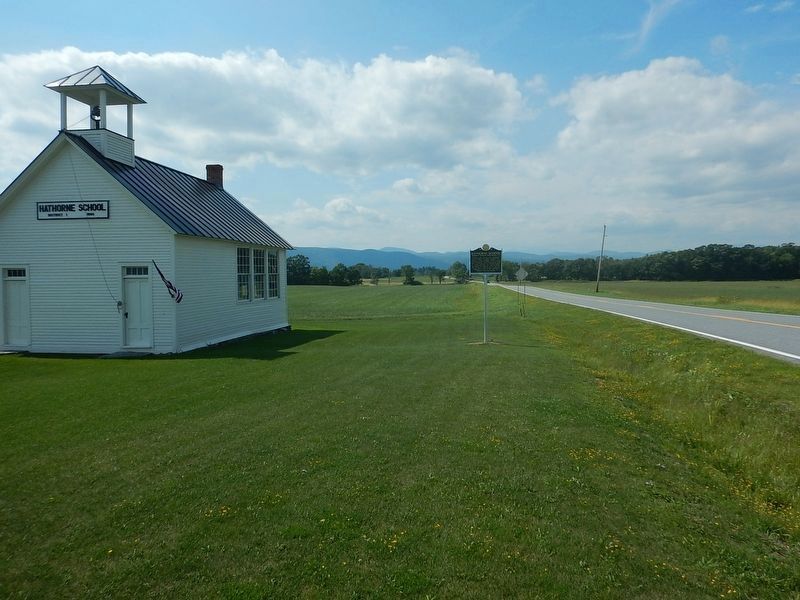
Erected c. 1864, this one-room schoolhouse served hundreds of children in Bridport for nearly a century. Originally founded as the first district school in Bridport, it later became known as Hathorne School, reflecting the name of a nearby . . . — — Map (db m96475) HM
William Slade was one of Vermont’s great public servants and an ardent abolitionist. Born when Vermont was an independent republic, he died just before the Civil War.
A graduate of Middlebury College admitted to the bar in 1810, Slade was a . . . — — Map (db m135841) HM
Here in 1833, Rowland E. Robinson was born of Quaker parentage. He became a popular illustrator and interpreter of nature and Yankee dialect. "Rokeby" was a station on the "Underground R.R." Here are the blind author’s memorabilia. Open to the . . . — — Map (db m75967) HM
Frederick Douglass delivered a fiery abolitionist speech here in July 1843. Born in slavery in Maryland, Douglass freed himself by escaping to the north, where he became a tireless crusader for African American freedom and equality. He was among . . . — — Map (db m95449) HM
The one-room Corner School, established here at “Codfish Corners,” operated from 1871 to 1951 for grades 1 through 8. Previously, G.V. Wilson’s blacksmith shop (1860-69) and the I.H. Archer Store (1869-74) stood at this site. Granville once had 10 . . . — — Map (db m196206) HM
Born in Middlebury on October 4, 1887, Ray Lyle Fisher grew up on farms along Otter Creek and Creek Road. Ray starred in baseball and football at Middlebury High School and Middlebury College before joining the New York Yankees in 1910. He pitched . . . — — Map (db m294651) HM
From 1796 to 1814 Court Square was the site of the first Addison County Courthouse, which also served as the seat of the Vermont Legislature (1800, 1806), and home of Middlebury’s first female academy (1800). Here in June 1804 a New York . . . — — Map (db m294654) HM
Emma Hart came to Middlebury in 1807 to take charge of the Female Academy. After her marriage to Dr. John Willard, the town’s first physician, she gave the earliest collegiate instruction for women in America at a Seminary in her home, during the . . . — — Map (db m294655) HM
On July 13-14, 1843, in the Addison County Courthouse, Frederick Douglass and other prominent abolitionists of the New England Anti-Slavery Society launched their six-month 100 Conventions tour to generate anti-slavery sentiment in Vermont, New . . . — — Map (db m273540) HM
John Deere learned the blacksmith trade here as an apprentice in the shop of Capt. Benjamin Lawrence from 1821 to 1825. The shop was located below this spot on Mill Street, in what is known as "Frog Hollow". In 1836 Deere removed to Grand Detour, . . . — — Map (db m294657) HM
After Ethan Allen seized Fort Ticonderoga, the Americans built Fort Mt. Independence, northwest from here on the Lake. Following Burgoyne’s invasion, Gen. St Clair evacuated the Forts, retreating across these hills to Hubbardton. Vermont . . . — — Map (db m9232) HM
This vital American military road to the south of here was built on the September 7, 1776, orders of Gen. Horatio Gates to connect Mount Independence, a new Revolutionary War fortification on Lake Champlain, to Hubbardton, Rutland, and Fort No. 4 . . . — — Map (db m97307) HM
A distinguished American poet by recognition and a Vermonter by preference, Robert Frost was Poet Laureate of Vermont and for many years “First Citizen” of the Town of Ripton. He was long associated with the Middlebury College School of . . . — — Map (db m37171) HM
Levi Parsons Morton, son of a minister, was born on this site, May 16, 1824, and for 8 years lived in Shoreham. He became a New York City banker, Member of Congress, Minister to France, Vice-President under President Harrison, and Governor of New . . . — — Map (db m95458) HM
This Howe truss Railroad Bridge is one of only two covered railroad bridges left in Vermont. It was built in 1897 on the 15.6 mile Addison Branch connecting the Rutland Railroad at Leicester Junction with the Delaware and Hudson at Ticonderoga, New . . . — — Map (db m85416) HM
Below the Otter Creek Falls was the site of Thomas Macdonough's shipyard, where the U.S.S. Saratoga was built in 40 days and other ships launched that defeated the British at the Battle of Plattsburgh, 1814. — — Map (db m75977) HM WM
Stephen Bates (1842-1907) was born enslaved on the Shirley Plantation in Virginia. He escaped in 1862 and after the Civil War came north to Vergennes with U.S. Congressman Frederick E. Woodbridge. Bates was first elected Sheriff in 1879 and served . . . — — Map (db m195671) HM
Born at Amherst, Mass., Silas Wright came to Weybridge as an infant and grew up here. Graduated from Middlebury College in 1815, he studied Law at Sandy Hill, N.Y.; began Law practice at Canton, N.Y. in 1819, and entered politics there. A Brigadier . . . — — Map (db m77967) HM
The U.S. Government established a Morgan horse breeding program in 1905 at the University of Vermont to study and refine the Morgan horse as a superior cavalry mount. That program moved here in 1907 when Joseph Battell donated this farm to the U.S. . . . — — Map (db m77965) HM
This renowned American painter and illustrator lived in Arlington from 1939 to 1953. Moving into this house in 1943, Rockwell employed neighbors as models to create memorable images for calendars, advertisements, and magazines. Iconic pictures like . . . — — Map (db m97290) HM
This ancient tree was already a monarch of the forest in 1778. Visible then from the Arlington home of Thomas Chittenden, first Governor of Vermont, it is believed to have inspired Ira Allen in designing Vermont's Great Seal. Note a similarity . . . — — Map (db m90228) HM
Oldest frame building one block east, built by Jehiel Hawley, 1764, was home of Thomas Chittenden, Vermont’s first Governor. Legend says the western vista, with its great pine, became the State Seal in 1779. Ethan and Ira Allen lived nearby. — — Map (db m78249) HM
Known for her depiction of rural life in Vermont, Fisher was a popular novelist and proponent of education. She introduced the Montessori teaching method to American readers and helped found the Adult Education Association in the U.S. Born in . . . — — Map (db m78248) HM
“I could not look upon the peaks of Ascutney, Eillington, Mansfield, and Equinox without being moved in a way that no other scene could move me. It was here that I first saw the light of day; here i received my bride; here my dead lie . . . — — Map (db m77057) HM
Built as a summer cottage in 1865 for lawyer-entrepreneur-philanthropist Trenor Park and his wife Laura, the mansion was financed with a fortune amassed in California in the aftermath of the California Gold Rush. It was designed by the New York . . . — — Map (db m94423) HM
On August 16, 1777, British forces sent by Gen'l Burgoyne to seize supplies at Bennington were turned back by New Englanders under Gen'l John Stark and Vermont's Col. Seth Warner. This 306 foot commemorative shaft planned 100 years later, was . . . — — Map (db m13600) HM
Seth Warner came to Bennington in 1763, followed later by his cousins Ethan Allen and Remember Baker in an area known as the New Hampshire grants. In 1770, as the leaders of the Green Mountain Boys, the men joined forces against the threat of New . . . — — Map (db m303968) HM
When wealthy North Bennington resident Trenor Park purchased the Bennington-Rutland Railroad, he found that the railroad "barons" of the Troy and Boston Railroad refused him access to the New York lines. Rather than fight this monopoly, Park built a . . . — — Map (db m36902) HM
State Highway 9 traverses scenic Hogback Mt. to the Connecticut River Valley. Old Bennington, site of the Battle Monument and Historical Museum, was the meeting place of the Green Mountain Boys. It was the first town chartered by Governor Benning . . . — — Map (db m94427) HM
In 1884, the State General Assembly authorized an initial $10,000 appropriation to establish a soldiers’ home to care for disabled veterans of the Civil War. The former country estate of Seth B. Hunt, erected in 1860, was chosen. The Soldiers’ . . . — — Map (db m108851) HM
Jonathon Fenton established a pottery and kiln near this site in 1801. He first made redware from clay found along the banks of the Mettowee River. He then became the first potter in Vermont to make salt-glazed stoneware. In 1810 he moved his . . . — — Map (db m78224) HM
Here, near Mt. Aeolus, Isaac Underhill opened the first marble quarry in 1785. Dorset quarries were most active in early 1800's when small slabs were used for hearths, doorsills and headstones. With better transportation and saws, larger blocks . . . — — Map (db m78226) HM
On the site at Hagar Brook stood the small clapboarded mint-house in which Reuben Harmon, Jr. coined copper for the Republic of Vermont, 1785-1788. When the Federal Government was instituted in 1789, Vermont abandoned minting. This rare currency of . . . — — Map (db m73639) HM
Bill Wilson was born November 26, 1895, in a room behind the bar at the Wilson House Hotel. From age 11 until entering the Army, he lived at the Griffith House across the church yard from his birthplace. Bill W. wrote the book "Alcoholics Anonymous" . . . — — Map (db m94430) HM
Falcomb Knuche "Fred" Nicklewhite was born on the
island of Eleuthera in the Bahamas and moved with
his family in 1898 to Vermont. Trained as a master
tailor. Nicklewhite spent summers working at the
Equinox Hotel in Manchester and winters . . . — — Map (db m268185) HM
Eastward on the hillside can be seen the Manchester estate of Robert Todd Lincoln, eldest son of President Abraham Lincoln and Mary Todd Lincoln. He became fond of Vermont, and for over twenty years made this his summer home. He died here July 25, . . . — — Map (db m95552) HM
Ethan Allen crossed Lake Champlain to capture Fort Ticonderoga on May 10, 1775 for "America's First Victory." Allen's expedition passed through here on May 5, 1775. Nathan Beman from Manchester guided the expedition into the fort; John Roberts of . . . — — Map (db m78237) HM
Begun in the 1920s as an informal artists' group for the exhibition of painting and sculpture, the Southern Vermont Arts Center has grown to become a leading Vermont institution devoted to performance, exhibition and studio art. It acquired the . . . — — Map (db m78227) HM
Marker Front: On September 12, 1886 a group of golfers, principally from Troy and New York City, who summered in Dorset, laid out a nine hole golf course, then known as The Dorset Golf Links on this present site. The Club's first president . . . — — Map (db m77585) HM
This site commemorates the gateway of Vermont’s earliest Dutch settlement, the Rensselaerwyck Manor settlement. The Diel Homestead, built by Bastion Diel in the early 1700s, is considered the second earliest dwelling in Pownal. The property’s large . . . — — Map (db m157547) HM
Here two Presidents taught school at the beginning of their careers. Chester A. Arthur, a graduate of Union College, educated Pownal youth in 1851. Later while an undergraduate at Williams College, James A. Garfield did likewise. When Garfield was . . . — — Map (db m78255) HM
Pownal was the site of one of the state’s oldest white settlement’s when Dutch settlers lived here for a short time after 1724. Up this valley came the pioneers from Connecticut including Ethan Allen, who led the dauntless Green Mountain Boys & . . . — — Map (db m150438) HM
Condemned to death by the N.Y. Assembly, Col. Cochran fought the Yorkers for Vermont land grants. Joining the Green Mt. Boys, he was with Ethan Allen at Ticonderoga and Seth Warner at Crown Point. Later he commanded Continental forces in the Mohawk . . . — — Map (db m77947) HM
Jonas Galusha, born in Norwich, CT in 1753, moved his family to Shaftsbury in 1775. During the Revolutionary War he served with Seth Warner's Green Mountain Boys and was at the Battle of Hubbardton and a Captain during the Battle of Bennington. A . . . — — Map (db m27799) HM
Moving west, Howard became Senator from Michigan, & wrote resolutions adopted by Convention at Jackson, July 6, 1854, on which The Republican Party was founded. He was also the sole author of the 13th Amendment to the Constitution. His birthplace . . . — — Map (db m90226) HM
In 1817, Silas Hawes patented his metal carpenter's square, created by welding up-and-down saws at right angles. Hawes and Stephen Whipple, blacksmiths by trade, formed Eagle Square Company to produce the carpenter's square. To meet demand, in . . . — — Map (db m303975) HM
Ira Allen lived on this site by the Batten Kill and as Treasurer and Surveyor-General his "Office" helped shape the destiny of the Republic of Vermont. Here Ethan's family lived; here he dictated his freethinking "Oracles of Reason" in 1782. To his . . . — — Map (db m78238) HM
Named for the fine quality chisels and edge tools manufactured on site, the small village of Chiselville lies southwest of this 1870 Town lattice truss covered bridge. In 1853, a group of entrepreneurs led by Norman R. Douglass of Shaftsbury . . . — — Map (db m103815) HM
Prominent economist, socialist, teacher, writer and scholar, Scott and his wife Helen Knothe, lived in Winhall from 1932 to 1952. During the Great Depression they moved from New York City to begin a new life in Vermont. Here in their homestead, . . . — — Map (db m103814) HM
This water-powered mill on the Stevens River was built in 1872 by Alexander Jack. It originally housed a patented woolen print and dye works. In 1893, James Judkins retooled it as a wagon and woodworking shop. Judkins’ Shop was later run by sons . . . — — Map (db m136055) HM
Henry Stevens
Born in Barnet on December 13, 1791, and educated at Peacham Academy, Henry Stevens was at various times a farmer, innkeeper, mill owner, legislator, postmaster, temperance leader, stage line proprietor, and operator of the . . . — — Map (db m77691) HM
Local builder Fred “Silo” Quimby built this round barn, considered a great curiosity, in 1900 for farmer James R. Moore. Popularized by Midwest agricultural colleges in the 1890s, round barns were considered more economical to build and . . . — — Map (db m136060) HM
The Connecticut River, starting at the International Boundary, flows 380 miles to the Atlantic Ocean. In its course the river falls 1640 feet. In 1928, the New England Power Association started a two-year project to build one of the largest . . . — — Map (db m74467) HM
On this site, in 1849, Benjamin Greenbank converted an existing small mill into a 5-story woolen factory. As many as 45 people worked here to produce up to 700 yards of cloth a day. Greenbank's Hollow, as it became known, included a company store, . . . — — Map (db m61392) HM
Born crippled and poor in Danville in 1792, Stevens was schooled by his mother, Sally Morrill Stevens, and at nearby Caledonia County Grammar School, graduating from Dartmouth College in 1814. He became a brilliant lawyer, committed to racial . . . — — Map (db m20664) HM
This farm was established in 1883 by Elmer A. Darling (1848-1931), a native of East Burke who became part owner/manager of the world famous Fifth Avenue Hotel in New York City. After the hotel closed in 1908, Mr. Darling retired to the life of a . . . — — Map (db m75981) HM
Dr. Merle Frampton established Camp Wapanacki here in 1938. It was the first camp in the country dedicated to children with blindness and visual impairments. Dr. Frampton and his wife, Iris, managed Wapanacki until 1942, when operations were . . . — — Map (db m136061) HM
Founded in 1780, the Town of Lyndon was home to 59 residents at the time of the 1790 census. In June 1791 the inhabitants and freeholders were invited to the first town meeting, held here at the home of Daniel Reniff.
On July 4, Elder Philemon . . . — — Map (db m177610) HM
bought a farmhouse on this site in 1883. Continually enlarged by Vail, it became his permanent residence and office. Conferences held here culminated in the creation of the American Telephone and Telegraph Company with Vail its president, who . . . — — Map (db m75108) HM
Caledonia County was set out from Orange County in 1792. Peacham chose to provide a County grammar school rather than a courthouse. The Caledonia County Grammar School (Peacham Academy) was chartered in 1795, the third County grammar school in . . . — — Map (db m77694) HM
In the style of a Scottish stone croft (farmhouse), this house was erected by James Whitehill, a prosperous farmer and one of a large number of immigrants from Inchinnan Parish, Scotland, who settled Ryegate under the sponsorship of the Scotch . . . — — Map (db m77692) HM
Opened on July 18, 1959 as Vermont’s first organized auto racing track under the guidance of the Northeastern Racing Association, the State’s first motor sports sanctioning body. By instituting formal point and purse structures and focusing on . . . — — Map (db m65865) HM
After experimenting with new types of farm equipment, plows, and stoves, Thaddeus Fairbanks invented the platform scale here in 1830. With his brothers Erastus and Joseph, he founded the company which still bears their name. Many St. Johnsbury . . . — — Map (db m74468) HM
After experimenting with new types of farm equipment, plows and stoves, Thaddeus Fairbanks invented the platform scale here in 1830. With his brothers Erastus and Joseph, he founded the company which still bears their name. Many St. Johnsbury . . . — — Map (db m77603) HM
Vermont's first and for many years only four year vocational school opened on Western Avenue on September 3, 1918. Needing skilled workers during World War I, Fairbanks, Morse & Co. started an all-day co-operative school where young men could learn . . . — — Map (db m77584) HM
When Eleazer Wheelock founded Dartmouth in 1769, he sought land grants to support the new college. In 1785 the Vermont legislature chartered and named a town of 23,000 acres for Wheelock. In the early 1800's substantial support for financially . . . — — Map (db m87807) HM
“Footpath in the Wilderness” extends length of state. This 261 – mile hiker’s trail, built by the Green Mountain club during the years 1910-29, extends along the mountain summits from the Mass. State line to the Canadian border. Convenient shelters . . . — — Map (db m151129) HM
On June 24, 1861, the first Vermont soldiers who enlisted for service in the Civil War for three years left Burlington for Washington by rail. Four days earlier, the 866 officers and men from across the state had been mustered into the Union Army . . . — — Map (db m75584) HM
Here in June 1813, a Vermonter, Lieut. Churchill, and men built a parapet and set up a battery. On Aug. 3 a British gunboat and 2 sloops, 1½ miles offshore, began a cannonade. This attack was repulsed in 20 minutes by the American Battery and . . . — — Map (db m75582) HM
In this park on July 22, 1863, Vermont's only ethnic Civil War unit was welcomed home from the battle of Gettysburg. Lonergan commanded Co. A, 13th VT Regiment - the Irish Company - and he received the Medal of Honor for gallantry in the battle. . . . — — Map (db m88639) HM
First International
Ice Hockey Game
In February 1886 the Burlington Coasting Club hosted a week-long Carnival of Winter Sports. In addition to parades and concerts, activities included coasting (bobsledding), ice skating, and snowshoe races. . . . — — Map (db m151137) HM
Beginning in the early 1900s, the area directly to the east housed numerous emigrants. Many moved here from Italy with hopes to build better lives. Some worked in the lumber mills and railroad yards that bordered the lake. In the process, they . . . — — Map (db m75562) HM
The Revolutionary War (1775-1783) was our nation's fight for independence from Great Britain to establish a new country with a government based on equality, justice, and humanity. Patriots from all corners of what would become the State of . . . — — Map (db m261849) HM WM
The mortal remains of Ethan Allen, Vermont leader, fighter, writer and philosopher, lie in this cemetery beneath the marble statue, but his spirit is in Vermont now. — — Map (db m51646) HM
Named to commemorate the 100th anniversary of the University of Vermont’s first graduating class, Centennial Field has been the home of UVM athletics since 1906. The three ballparks that have stood on this site have hosted semi-professional and . . . — — Map (db m307277) HM
Putting behind him the martial deeds of a hero, Ethan came here in 1787 to till the soil as a peaceful farmer. On Feb. 12, 1789, he died here after a trip across the ice to South Hero. Memorial Tower was built on Indian Rock, traditional Algonquin . . . — — Map (db m75585) HM
In 1808, the Federal government, reacting to unfair British policies, passed an Embargo Act, forbidding trade with Great Britain. The Champlain Valley relied on trade with British Canada and the Act was unpopular and significant smuggling . . . — — Map (db m98393) HM
Located on the streetcar line between Burlington and Winooski, Athletic Park was the home of the University of Vermont's baseball and football teams and track-and-field events from 1887 until Centennial Field opened in 1906. It was also where . . . — — Map (db m75483) HM
The Champlain Glass Company, established in 1827,
was the first manufacturing enterprise in Burlington.
The company, located between N. Champlain and
Park (Water) streets, produced and shipped window
glass locally and to the west by the Erie . . . — — Map (db m261847) HM
In 1962 architecture student Bill Truex experienced the transformation of Stroget, Copenhagen's main shopping area from traffic-snarled nightmare to successful pedestrian mall. Seven years later, while on the Burlington Planning Commission, Truex . . . — — Map (db m89110) HM
Designed by noted architect Peter Banner of Boston, the Federal-style Meeting House was built in 1816 for the First Congregational Society (Unitarian) and is the oldest surviving place of worship in Burlington. Banner's design features a projecting . . . — — Map (db m97755) HM
Mary Fletcher, born in Jericho, Vt., moved here with her family at age 20. Following her father’s death, the family established Fletcher Free Library (1873). Mary Fletcher continued her parents’ benefactions. She founded Mary Fletcher Hospital . . . — — Map (db m75501) HM
Pate-King House. The Pate-King family lived here for 67 years, opening their home as a hotel and apartment. Cleta Pate (1874-1957) was born in the Philippines, where she married Buffalo Soldier William King. In 1910, the family moved to . . . — — Map (db m261846) HM
"We consider it criminal in the sight of God and man, longer silently to submit to our indignities, or suffer them to be transmitted to posterity." Andrew Harris was one of the first African Americans to earn a college degree. The antislavery . . . — — Map (db m97754) HM
In 1962 architecture student Bill Truex experienced the transformation of Stroget, Copenhagen's main shopping area from traffic-snarled nightmare to successful pedestrian mall. Seven years later, while on the Burlington Planning Commission, Truex . . . — — Map (db m89112) HM
General William Wells (1837-1892) In 1861 William Wells joined the First Vermont Cavalry as a Private and rose to the rank of Brevet Major-General. Promoted more times than any other Vermonter during the American Civil War, he participated in . . . — — Map (db m75549) HM
On Oct. 4, 1905, at 2:30 p.m. in front of the bay window in the parlor of this house, Grace Goodhue married Calvin Coolidge of Plymouth Notch, VT. Calvin Coolidge became President of the United States and Grace served as First Lady from 1923-1929. . . . — — Map (db m75591) HM
The Green Mountain Club was born at a meeting of Vermont hiking enthusiasts in the Van Ness House hotel, which stood on this site from 1870 until it burned in 1951. The club's mission is to "make the Vermont mountains play a larger part in the life . . . — — Map (db m200490) HM
Born here on Oct. 20, 1859, John Dewey attended local schools and in 1879 graduated from the University of Vermont. Dewey was world-renowned as a philosopher and author of many books. Ideas drawn from his educational doctrines profoundly influenced . . . — — Map (db m75558) HM
Vermont. Major Cross-State Route to the Connecticut River. From this point, where the Winans launched their steamer "Vermont" in 1808, travelers drive eastward on Route US 2, cutting through the Green Mountain Range at Bolton to . . . — — Map (db m75561) HM
In 1849 an 11,000 year old Beluga Whale was found north of this site in what had been the Champlain Sea. Resident J.G. Thorp collected the bones, and naturalist Zadock Thompson assembled the skeleton now displayed in the Perkins Museum of Geology . . . — — Map (db m75963) HM
The First Special Service Force was formed in July
1942 as the only joint U.S.-Canadian unit in World War II.
Many Vermonters volunteered to serve. Led by
U.S. Army Col. Robert T. Frederick, the Force
trained rigorously in Montana, Virginia, and . . . — — Map (db m261839) HM
In July 1909, the 10th U.S. Cavalry arrived at Fort Ethan Allen for a four-year assignment. Nicknamed the "Buffalo Soldiers" during the American Indian Wars, the 10th Cavalry was one of the first peacetime all-black regiments established in the . . . — — Map (db m104074) HM
A descendant of one of Burlington’s original settlers, Ray Williston Collins was born on this farm on February 11, 1887. After graduating from Burlington High School and the University of Vermont, Collins joined the Boston Red Sox in 1909 and soon . . . — — Map (db m86646) HM
In July 1909, the 10th U.S. Cavalry arrived at Fort Ethan Allen for a four-year assignment. Nicknamed the “Buffalo Soldiers” during the American Indian Wars, the 10th Cavalry was one of the first peacetime all-black regiments . . . — — Map (db m104492) HM
On this hill from 1795 to 1865 thrived an African American farming community. The first settlers at the bottom of this road in 1798, from MA, were Samuel Peters, Hannah Lensemen & husband Prince Peters. Prince served in Captain Silas Pierce's MA . . . — — Map (db m304252) HM
Named for Thomas Chittenden, first governor of Vermont and great-great grandfather of Frank Howe. Frank and his father Lucian rebuilt this mill in 1885 changing from grinding with millstones to the new gradual reduction roller process. Grain was . . . — — Map (db m97753) HM
For fifty years Wilson A. Bentley, a farmer and self taught scientist, developed his technique of photomicrography to reveal to the world the grandeur and mystery of the snowflake — its universal hexagonal shape and its infinite number of . . . — — Map (db m74314) HM
The 1960s through the 1980s were an exciting time for racing fans in Chittenden County. In 1964, a plan was made to build a paved 1/3-mile NASCAR-sanctioned oval track in Milton. The newly built I-89 allowed easy access for traveling racers and . . . — — Map (db m121198) HM
315 entries matched your criteria. The first 100 are listed above. Next 100 ⊳