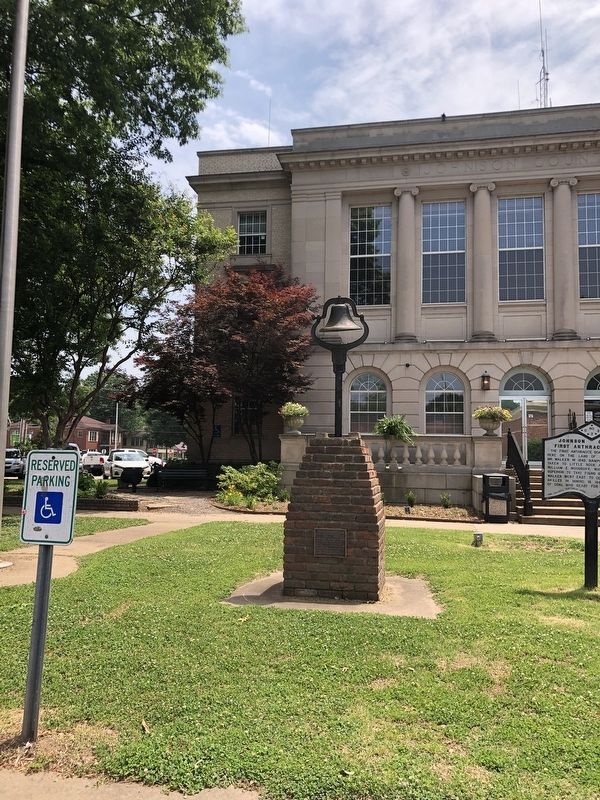
This bell was in use at the school at Lone Pine 1921-1953. The bricks in this monument were made on the site and used to build the Hagarville Academy in 1918. — — Map (db m225423) HM
A quiet night in 1964 was interrupted by the unusual sound of an airliner approaching Walnut Ridge Airport. Its arrival sparked enough interest that three local teens went to investigate, only to discover John, Paul, Ringo and George walking from . . . — — Map (db m170608) HM
Born along Rock 'n' Roll Highway 67 in
Pocahontas, Billy Lee Riley was known for
fronting one of the hottest rock bands on
the touring circuit. His four years at Sun
Records resulted in a number of singles
that influenced rock musicians for . . . — — Map (db m170391) HM
Carl Perkins delivered what many consider
the first big hit of rock 'n' roll music.
His "Blue Suede Shoes" in 1956 shot
to number one across a broad range of
music charts and became the first million-
selling single for Sun Records.
Perkins . . . — — Map (db m170395) HM
With an astounding 55 number one hits to
his credit, Conway Twitty was a legendary
performer. Bụt while he is remembered
best as a country superstar, he started
his career and scored his first big hit as a
rockabilly singer. . . . — — Map (db m170389) HM
"Great Balls of Fire” was his signature hit, and the title could just, as easily
have described Jerry Lee Lewis himself. His unbounded energy on the
stage made Jerry Lee a nearly unrivaled performer, unlike anything most crowds had ever . . . — — Map (db m170386) HM
Northeast Arkansas native Johnny Cash
brought his own style to Rock 'n' Roll
Highway 67. His music was more country
than rock, but he produced an innovative
sound that enthralled fans for over five
decades.
Most of Johnny's shows along Rock . . . — — Map (db m170304) HM
Before his trademark dark,
glasses and “Oh, Pretty Woman”.
made him a legend Roy Orbison
was a regular performer along
Rock 'n' Roll Highway 67. As a
recording artist with Sun Records
in the 1950s, Orbison was among
the musicians . . . — — Map (db m170402) HM
Rock' n' Roll Highway 67 is more than
a collection of venues for Albert Austin
"Sonny" Burgess. It is home. The
rockabilly pioneer has always made his
home in Newport, and it was there that
he first made his name as an outstanding
musical . . . — — Map (db m170388) HM
Wanda Jackson created a sensation
in rockabilly music, and on Rock 'n'
Roll Highway 67. In-a music industry
dominated at the time by male performers,
Wanda stormed onto the scene while still a
teenager.
Porky's Roof Top in Newport was . . . — — Map (db m170965) HM
From the farm fields of Walnut Ridge to sold-out
halls in Chicago, Washboard Sam became a major
player on the blues scene in the 1930s and '40s.
Born Robert Brown on July 15, 1910, Washboard
Sam was a native son of Walnut Ridge, where
he was . . . — — Map (db m170300) HM
This property has been placed on the National Register of Historic places by the United States Department of the Interior.
Founders Odessa Smith, Newton Smith, Dan Smith, Thelma Skies, Shelba Clowdis
Alleene Birth Place of Chet Lauck The Lum . . . — — Map (db m172967) HM
Elvis Presley first performed at the Arkansas Municipal Auditorium on November 24, 1954. Although he may have played other dates, his confirmed appearances in 1955 include March 3, April 22, May 27, September 2, and November 17. This plaque was . . . — — Map (db m286494) HM
Jake Charles “Jay” Franks was among the first Texarkanians to record under their own name on a prominent national record label, Modern Records, in 1952. Franks and other affiliated musicians made history when their racially-integrated ensemble . . . — — Map (db m286493) HM
Johnny Cash played at the Arkansas Municipal Auditorium with Elvis Presley twice in 1955. His first performance on September 2nd was made famous in the movie “Walk the Line”. His second performance was on November 17th. This plaque was presented on . . . — — Map (db m286495) HM
By 1956, Pat Cupp and The Flying Saucers, Ruth Cupp, Johnny Gatlin, Pete Waller & J.O. Livesly, had appeared many times with Carl Perkins, Johnny Cash, Roy Orbison and others. Unhappy with record producers, Pat entered the Air Force in 1957. Today . . . — — Map (db m286489) HM
During segregation in the twentieth century, Ash Street was the social and commercial heart of the Black community of Blytheville. On Saturdays, when sharecropper families would dress up and come to town, Ash could be so crowded that people would . . . — — Map (db m213826) HM
Johnny Cash (1932-2003) was one of the most influential musicians of the
20th century. Successful with country, rock & roll, folk, blues, and gospel music, Cash sold over 90 million albums during his long career. Several of his songs reflect his . . . — — Map (db m160373) HM
Moving to Osceola with his family at age 8, Blues legend Albert King (1923-1992) earned an early living picking cotton on nearby farms. King began his magnificent professional career in Osceola with his group, In The Groove Boys. King's T99 Club, . . . — — Map (db m36412) HM
Louis Jordan, born July 8, 1908, in Brinkley, Arkansas, was one of the
state's brightest musical stars, ruling the rhythm and blues charts of the
World War II era with hits like "Choo Choo Ch'Boogie," "Let the
Good Times Roll," "Is You Is or . . . — — Map (db m117265) HM
Willie Cobbs was born July 15, 1932 in Smale, a small farming town near Brinkley in Monroe County, Arkansas. Known as an American blues singer, harmonica player, songwriter, and nightclub owner, his recording career has spanned six decades. His . . . — — Map (db m172846) HM
The music of the Arkansas Delta is the music of America. With roots in gospel or "church music,"
the blues, jazz, country, and rock n'roll flowed from the rich, fertile landscape bordering the lower Mississippi River and spread out across the . . . — — Map (db m51908) HM
Traveling road shows, vaudeville, dog-and-pony shows, mind
readers, magicians, bell ringers and boxing matches-they all
appeared live at Helena's Grand Opera House. In the days before
radio, movies and television live entertainment was king. . . . — — Map (db m107996) HM
Legendary singer and guitarist Glen Campbell was born in Billstown, Arkansas on April 22, 1936. He died in Nashville, Tennessee on August 8, 2017 after a courageous battle with Alzheimer's disease. Campbell brought country music to the mainstream as . . . — — Map (db m184564) HM
HISTORY
Built in the 1920s and first exhibited at the 1924 Arkansas State Fair, it is
believed to be the last operating "over-the-jumps” carousel in the world, with
an original undulating wooden platform mounted on a 1960s-vintage
caterpillar . . . — — Map (db m212071) HM
Max Aronson was born at 713 Center Street, (a house formerly located across the street), on March 21, 1880, to Esther and Harry Aronson, a Jewish dry goods salesman. The Aronson family relocated to Pine Bluff, Arkansas in the 1890's. Aronson’s first . . . — — Map (db m99370) HM
Max Aronson was born at 713 Center Street, (a house formerly located across the street), on March 21, 1880, to Esther and Harry Aronson, a Jewish dry goods salesman. As a child, Max Aronson relocated to St. Louis, before moving to the . . . — — Map (db m120205) HM
What we know today as The Heights, known earlier as Pulaski Heights, started as a place called Forest Park, Little Rock's largest private park. The last stop on the trolley line, the park was created by the streetcar company to draw visitors to this . . . — — Map (db m161349) HM
Rock and Roll pioneer Billy Lee Riley was born to Amos and Helen Riley on October 5, 1933 in a white frame house located on this site. Riley and his band, the Little Green Men, helped originate the unique sound of Sun Records that became a . . . — — Map (db m208461) HM
In the mid 1950s Elvis Presley's career was just beginning to take off. Elvis had made at least one record at Sun Studio in Memphis when he and his then manager made a stop at this location to request that his record be played on KPOC. He was . . . — — Map (db m207800) HM
Arkansas's first All-American in football was born in Pocahontas on this place, graduated from PHS and the U. of Arkansas at Fayetteville, accomplishing much both academically and in sports.
Schoonover was also 2nd team All-American in . . . — — Map (db m180434) HM
In the early days of Saline County's history the settlers would gather here after the crops had been "laid by" for rest, relaxation, and to give thanks to The Lord. The early meetings were held under brush arbors lighted bu pine knots and included . . . — — Map (db m104059) HM
[side 1] Elton Britt, born James Elton Baker, came from the Zack community in Searcy County near the Buffalo River. Britt, from a musical family, was the first million seller in Country Music and received the first Gold Record . . . — — Map (db m229584) HM
Ten years before the outbreak of the Civil War, the Old Red Mill stood on the future site of the New Theatre. The mill was used as a hospital during the Civil War, was damaged by the 1898 cyclone and finally disappeared around 1908. On the back . . . — — Map (db m92362) HM
Rosetta Tharpe, considered gospel music's first crossover artist and a reputation "the original soul sister" and "Godmother of rock and roll." Born March 20 1915, in Cotton Plant Arkansas she began performing at age four. A singing and . . . — — Map (db m238212) HM
Built in 1879 by Patrick and Ann Britt,
This building was originally named the Britt Hotel.
In 1883, promoter and entrepreneur Johnny Croll purchased the saloon and soon the entire building became known as Croll's. This site was famous as the . . . — — Map (db m243880) HM
City of Berkeley Landmark
designated in 2001
In 1919 John and Ada Hinkel donated seven hillside areas to the City of Berkeley in appreciation of the Boy Scouts’ service to the nation during the First World War. Before making their gift, the . . . — — Map (db m53849) HM
Chinaka Hodge
class of 2002, started writing and
performing poems as an awkward, pimply,
BHS freshman, and art-making
saved her life. She is a playwright,
poet and performer.
Phil Lesh
class of 1957, played the trumpet while
at . . . — — Map (db m154873) HM
Originating among working class Englishmen in 1844, the Young Men's Christian Association was brought to North America in 1851 to promote a "full and balanced life" through religious devotion and athletic activity. Berkeley's charter organization . . . — — Map (db m50295) HM
Berkeley Repertory Theatre was founded in 1968 by U.C.
Dramatic Art student Michael Leibert, who wanted o create
an East Bay professional repertory company. Its first production, "Woyzek;” initially staged at the International
House, soon . . . — — Map (db m154321) HM
City of Berkeley Landmark
designated in 1982
Built as the Strand Theater in the Art Nouveau architectural style, this was one of the neighborhood’s first commercial structures. Admission was ten cents for adults, five for children and the theater . . . — — Map (db m54813) HM
Clam chowder, baked beans and 10¢ beer – these and fish dinners drew crowds to fabled Spenger’s. It all began in the 1860s when Johann Spenger from Bavaria started fishing in the Bay. The gabled structure he built here housed his business and . . . — — Map (db m52303) HM
City of Berkeley Landmark
designated in 1986
Over the years this complex housed Cooper Woodworking, the Sperry Flour Company, the American Photoplayer Company, and other industrial and manufacturing enterprises. American Photoplayer manufactured . . . — — Map (db m53818) HM
City of Berkeley Landmark
designated in 2005
The Berkeley Piano Club, dedicated to the performance and study of music, was founded in 1893 by a group of local women. Early meetings were held in members’ homes and later in a barn at the . . . — — Map (db m54726) HM
During the summer of 1969, the house at
835 Folger Avenue was home to the band
Commander Cody and his Lost Planet Airmen.
The band's style mixed country, rock 'n' roll,
western swing, rockabilly, and jump blues
together on a foundation of . . . — — Map (db m239011) HM
Once a hiding and trading place in the 1850's for the notorious bandit Joaquin Murrieta, known in California as "El Famoso," this canyon has produced many rodeos dating back to the rancho days circa 1820.
Harry Rowell, originally from England, . . . — — Map (db m94033) HM
RenderMan software revolutionized photorealistic rendering, significantly
advancing the creation of 3D computer animation and visual effects. Starting in
1981, key inventions during its development at Lucasfilm and Pixar . . . — — Map (db m284305) HM
In the second half of the 19th Century, when Emeryville was transitioning from a former Mexican cattle ranch into
a future American city, two abutting property owners played major roles in its development: Joseph S. Emery and Edward Wiard. In . . . — — Map (db m238970) HM
The western branch studio of the Essanay Film Manufacturing Company stood on this site from 1913 to 1933. It was the first movie studio built for that purpose in Northern California.
The Essanay company of 52 people led by movie star cowboy . . . — — Map (db m63811) HM
Francis X. Bushman, Charlie Chaplin, Wallace Beery, Marie Dressler, Ben Turpin, Vic “Slippery Sam” Pottel and “Alkalie (sic) Ike” starred here 1910/1912. Earliest films starred Gilbert Anderson (Max Aronson) alias “Bronco Billy,” 1958 Oscar winner. . . . — — Map (db m64009) HM
Early ranches in California commonly held rodeos twice a year. Vaqueros collected cattle from the surrounding area and neighbors met to mark their calves with brands and earmarks. In the Livermore area, early residents, including the Bernal, Marsh, . . . — — Map (db m195394) HM
This statue depicts a cowboy removing his hat and replacing it with a helmet in defense of our country.
This monument symbolizes patriotism and dedication to our country. The ranching, farming and cowboy communities, along with other men and . . . — — Map (db m195459) HM
This is a superior rendering of the "Art Deco" or "Moderne" style of movie palace built during the rise of the motion picture industry. The Paramount, which opened on December 16, 1931, is the most ambitious theatre design of architect Timothy L. . . . — — Map (db m100560) HM
Live performance venues and movie theaters
once lined the streets downtown, with at least a
dozen as late as the 1950s. Many initially featured
vaudeville acts and silent films. The Fox and
the Paramount are the only two that remain . . . — — Map (db m160533) HM
Spine of West Oakland
The elevated BART tracks are the latest link in Seventh Street's long history as the transportation spine of West Oakland. The street once led to the long Wharf and Mole on the western waterfront where the . . . — — Map (db m92787) HM
“Loves Labor Lost,” a comedy by William Shakespeare, was the first play performed in the Eucalyptus Amphitheater in the spring of 1908. Set in a grove of trees for which it was named, the theater had a unique stage from which some of . . . — — Map (db m72377) HM
Here stands one the first commercial buildings in Pleasanton, possibly as old as 1864. Originally a general store, this building has been a bar, brothel, bank and unofficial Wells Fargo stagecoach stop. Since 1959 it has become well-known as the . . . — — Map (db m211819) HM
This plaque was presented in 1976 by the
Pleasanton Bicentennial Heritage Committee
in commemoration of the nation's 200th birthday.
This site was the location of the Nevis Pavilion,
erected in the 1860's, and was for many years the
source . . . — — Map (db m193943) HM
This grandstand is located on a portion of the historic Rancho El Valle de San Jose, granted to Pico, Sunol and Bernal by Mexico in 1839 forming part of Mission San Jose lands. Early settlers trained and raced horses here over 100 years ago. — — Map (db m65971) HM
The Heritage House has been the center of historical horse racing activities in the Livermore – Amador Valley for over 90 years. Built around 1900, it is the sole remaining structure from the days of the privately-owned racing business that . . . — — Map (db m112794) HM
Originally constructed as the New Lincoln Theatre
by the architectural firm of Miller and Warnecke,
this building housed Pleasanton's first moving picture
house and opened in 1927. In 1937 the theatre
became The Roxy Theatre after an ownership . . . — — Map (db m193941) HM
Markleeville had few amenities during its rollicking youth, though like most respectable
pioneer towns, it boasted a hurdy house. These establishments provided the predominantly
male population a chance to unwind with a drink and possibly . . . — — Map (db m169617) HM
This building, built in the year of 1854, was originally a hardware store on the ground floor and a dance hall on the upper floor.
Ione Parlor No. 33, N.S.G.W. bought the building in the year 1884 and has continuously owned it and met here . . . — — Map (db m2380) HM
Prior to 1914, theatergoers viewed silent movies and 'legitimate' shows in the Women's Pavilion at the west end of Main Street. Around this same time, Claude Violet operated the "Electric Theater" in another Ione location. His space was limited, so . . . — — Map (db m193579) HM
In 1876 Ione’s Annual Picnic moved from Shakeley Hill to this location. The 100 acre park is part of an 1840 land grant and was leased to the city by the Howard Estate May 11, 1967. The park during it’s early years hosted many of the important horse . . . — — Map (db m42400) HM
Home (built 1859) of Armstead C. Brown (1816 – 1902) & son George until 1947. A.C. Brown was a lawyer, first president of Jackson City Trustees, state assemblyman 1863 – 66 & 1860 – 70, county judge 1876 – 78. Gave land to north for school purposes. . . . — — Map (db m27683) HM
A lifelong fourth generation rancher from Ione with summer ranges in the mountains near Kirkwood, Benny Brown made his first appearance in this arena in 1951 at the age of 13. The event was cattle penning. His mother was his partner, and he won . . . — — Map (db m42453) HM
The front building built in 1860. The opera house was built on back in 1892 by John and Michael Levaggi, early pioneers and stone masons from Italy. Bricks used were kilned east of Sutter Creek and hauled to the site by twelve mule team. Amapola . . . — — Map (db m29814) HM
Oroville State Theatre
has been placed on the
National Register
of Historic Places
by the United State
Department of the Interior
Built 1928 — — Map (db m61555) HM
E Clampus Vitus-What mystery and magic that name recalls! Mystery as to its meaning which is unknown; magic as its name conjures the Golden Days of California’s statehood. E Clampus Vitus was established in West Virginia in the 1840’s by Ephraim Bee . . . — — Map (db m122664) HM
Founded in 1927 by Gerald (Jerry) Gill and family, the park consisted of four picnic sections, over forty acres, four baseball diamonds, two swimming pools, a wading pool for children, large dance hall and two snack bars.
At one time the grounds . . . — — Map (db m94663) HM
This area in the mid 1850s, was a known hideout for legendary bandit Joaquin Murrieta, who worked as a vaquero for John Marsh on his rancho just east of here. It was also frequented by John "Grizzly" Adams, famed California mountain man.
In 1927 . . . — — Map (db m94657) HM
I want to be an artist or nothing.
Eugene O’Neill, 1914
When Eugene O'Neill began writing for the stage, the American theatre was
dominated by vaudeville and romantic melodrama. Influenced by Strindberg, Ibsen, and . . . — — Map (db m200162) HM
The Cerrito Theater opened Christmas Day, 1937. Architect William B. Davis included Art Deco elements and fanciful murals in the theater. The theater closed in 1966 and was restored forty years later by the El Cerrito Redevelopment Agency. — — Map (db m94120) HM
From the late 1920s until the early 1950s, El Cerrito and nearby unincorporated areas were popular destinations for people to play the slots, high-low games, numbers and more while enjoying fine food and entertainment. — — Map (db m94100) HM
The Festival of the Holy Ghost was started in Portugal by Queen Izabel to celebrate the end of a famine in 1296. Since the 1920s, Portuguese Americans have gathered in El Cerrito in late June to carry out this annual tradition with a parade, the . . . — — Map (db m94192) HM
Golden Gate Lanes, El Cerrito's only bowling alley was located near here. Other summer staples included Bardon's Fruit Market, Betsy's Kitchen and Big Boys Barbecue, Motorcycle Hill, the Whoopie Bumps, and Peek-a-Boo Park, an early auto-court . . . — — Map (db m94222) HM
Walt Gatto's "IT" Club, located at Central and San Pablo was named for Clara Bow, the famous cinema "IT" Girl. Redd Foxx, Gypsy Rose Lee, The Vagabonds, Sally Rand, Frank Fontaine, and Johnny Mathis all played the famous "IT" Club. — — Map (db m94122) HM
The Figone family's "Six Bells" restaurant stood near here for many years. Later Berkeley-born and well-known Major League Baseball player (and later manager) Billy Martin opened "Cerro Square" here in the early 1960s. — — Map (db m94124) HM
This was the site of Pitt Arena, which featured equestrian events during the 1930s and 1940s. Owned by Babe and Claude Pitt, the arena showcased the horsemanship of the El Sobrante Horsemen's Association, San Pablo Horsemen's Association, Western . . . — — Map (db m148703) HM
Opened in 1949, the Park Theatre was the only commercial movie theatre in El Sobrante. It was owned and built by Dick Jeha, member of a prominent local family in the business community. More than just a movie house, the Park served for years as a . . . — — Map (db m94296) HM
Community spirit led to construction of this hall by the Lafayette Improvement Club. Land was donated by Frank and Rose Ghiglione with funds and labor provided by the townspeople. A grand opening ball and midnight supper were held on May 1, 1914. . . . — — Map (db m49861) HM
The Orinda Theatre
opened its doors in 1941
and is the city's most
prominent visual
landmark with its
signature dorsal fin
marquee. It is a
textbook example of
Streamlined Moderne
Architecture, a late type
of Art Deco design
inspired by . . . — — Map (db m154890) HM
Since opening its doors on May 4, 1920, this theatre has been a cornerstone to the New York Landing Historic District in Old Town Pittsburg. Like many Bay Area theaters of the 1920's, the California Theatre was designed by A.W. Cornelius in a . . . — — Map (db m146532) HM
Over 900 people attended a champagne gala to
celebrate the opening of the first theatre in the
young city of Pleasant Hill. The first movie shown
that night of February 21, 1967 was "Dr. Zhivago".
Originally built for Century Theatres, the . . . — — Map (db m114353) HM
Port Costa's old timers are quite certain that the rumor of the Burlington Hotel being a bordello is untrue. Their reasoning is that the respected owners and their families lived nearby, therefore it could not have been a bordello.
However, the . . . — — Map (db m57971) HM
Walnut Creek's first park - City Park (now Civic Park) - opened in 1949 at the site of an abandoned sewer farm. City Park had a lighted ballfield and tennis courts and, until 1976, was the site of the annual Walnut Festival, held in September. — — Map (db m93798) HM
By the mid-1960s, community theater groups needed better performance space. The City re-purposed an obsolete walnut warehouse as the Civic Arts Theatre & Gallery - affectionately nicknamed "The Nuthouse." In 1990- and after extensive private . . . — — Map (db m93756) HM
In 1965, the City repurposed an abandoned walnut warehouse to house the Civic Arts Theatre & Gallery - affectionately nicknamed "The Nuthouse." Some 25 years later ant through extensive private fundraising, the Lesher Center of the Arts was built, . . . — — Map (db m93784) HM
The plush El Rey Theatre was Walnut Creek's second movie house and a popular venue for nearly 50 years. The El Rey showed films ranging from Shirley Temple's "Wee Willie Winkie" to the cult classic "Rocky Horror Picture Show." An office building . . . — — Map (db m93808) HM
The 400-seat Ramona, Walnut Creek's first cinema, opened in 1920 as a silent-movie house. The theater sat on Main Street, next to the Contra Costa Courier newspaper and where Cypress Street now connects to Broadway. It was owned by Theodore . . . — — Map (db m93828) HM
Desiring a place for community meetings and events, a newly formed Town Hall Association acquired the lot at Main and Bonanza. Several years later, and with a loan from the new San Ramon Valley Bank, the group built the imposing two-story Town Hall. — — Map (db m93824) HM
Saloons and gambling halls provided the main form of entertainment for miners during the gold rush. One of Old Hangtown’s largest gaming halls, The United States Trio, once stood on this site. Owner and entrepreneur, Benjamin Nickerson, first . . . — — Map (db m65251) HM
Before roads were built in the Tahoe area in the 1920s, sailing on a steamer was the only way for visitors to reach the resorts lining the south shore. The Tod Goodwin outdid all the other steamers in size and speed. It could carry 150 . . . — — Map (db m275578) HM
Guests at the Pope estate had the option of staying in one of three unique cabins, each with its own charm.
Many liked the "Log Cabin" best because it was closest to the lake. The cabin across and up the lawn called the "Pachero," was reserved . . . — — Map (db m112980) HM
Horseback riding was a focus of the Tahoe summer experience. William Tevis Jr. was an ardent lover of horses. He became an internationally known, prize-winning polo player and horseman, and spent many hours riding and "bronco-busting" in rodeos and . . . — — Map (db m112979) HM
The big, beautiful Valhalla main building was built for entertaining. Its grand hall and huge lawn could hold scores of friends and family. The porch along the outside of the building could even be transformed into sleeping porches for extra guests. . . . — — Map (db m275580) HM
7545 entries matched your criteria. Entries 201 through 300 are listed above. ⊲ Previous 100 — Next 100 ⊳