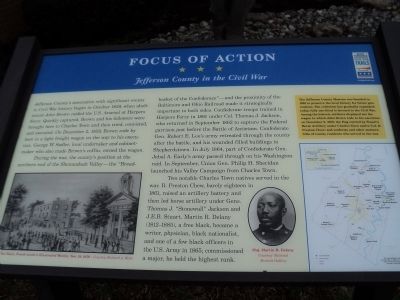
Jefferson County’s association with significant events in Civil War history began in October 1859, when abolitionist John Brown raided the U.S. Arsenal at Harpers Ferry. Quickly captured, Brown and his followers were brought here to Charles Town . . . — — Map (db m41671) HM
This is where seven men were hanged in December 1859 and March 1860 for their part in John Brown’s Raid on Harpers Ferry. The scaffold stood here in a large field. A month after the trial, on December 2, 1859, John Brown was the first to die. He . . . — — Map (db m41650) HM
The Federal offensive in the Shenandoah Valley begun in May 1864 faltered in the summer with Confederate victories and Gen. Jubal A. Early's Washington Raid in July. Union General Philip H. Sheridan took command in August, defeated Early . . . — — Map (db m238786) HM
One of the most famous trials in American history was held in this building in 1859, when John Brown and his followers faced charges of treason against Virginia, inciting slaves to rebel, and murder. Judge Richard Parker presided.
The trial . . . — — Map (db m170247) HM
The present church, the fourth on this site, was completed in 1851. Federal troops occupied it during the Civil War and severely damaged it. The churchyard contains the graves of many Washington family descents. They are buried near the eastern . . . — — Map (db m41675) HM
About two o’clock in the afternoon of September 17, 1862, Confederate Gen. A.P. Hill’s 3,000-man division began crossing the Potomac River at Boteler’s Ford about two miles northwest of here, en route to the battle raging at Antietam Creek near . . . — — Map (db m1955) HM
The Reverend Doctor Josiah P. Smeltzer laid the cornerstone of St. John's Lutheran Church on April 30, 1850. The building was completed two years later and dedicated on August 1, 1852. Little more than seven years had passed when, at dawn on . . . — — Map (db m70794) HM
This is the site of the last Civil War engagement in Jefferson County and one of the last fights involving Col. John S. Mosby’s Rangers. It also marked the end of the Independent Loudoun Rangers, a small cavalry unit recruited in 1862 from Loudoun . . . — — Map (db m59417) HM
The Federal offensive in the Shenandoah Valley begun in May 1864 faltered in the summer with Confederate victories and Gen. Jubal A. Early's Washington Raid in July. Union Gen. Philip H. Sheridan took command in August, defeated Early at . . . — — Map (db m206976) HM
The Federal offensive in the Shenandoah Valley begun in May 1864 faltered in the summer with Confederate victories and Gen. Jubal A. Early's Washington Raid in July. Union Gen. Philip H. Sheridan took command in August, defeated Early at . . . — — Map (db m238787) HM
Fresh from victory at the Second Battle of Manassas, Gen. Robert E. Lee’s Army of Northern Virginia crossed the Potomac River on September 4-6, 1862, to bring the Civil War to Northern soil and to recruit sympathetic Marylanders. Union Gen. . . . — — Map (db m1957) HM
After Confederate Gen. Robert E. Lee's smashing victory over Union Gen. John Pope at the Second Battle of Manassas, Lee decided to invade Maryland to reap the fall harvest, gain Confederate recruits, earn foreign recognition of the . . . — — Map (db m157752) HM
On Wednesday, September 17, 1862, twelve-year-old Mary Bedinger, asleep at her home Poplar Grove outside Shepherdstown, was awakened by the roar of cannons. Confederate and Union forces in position near Sharpsburg, Maryland, just across the Potomac . . . — — Map (db m41694) HM
The Federal offensive in the Shenandoah Valley begun in May 1864 faltered in the summer with Confederate victories and Gen. Jubal A. Early's Washington Raid in July. Union Gen. Philip H. Sheridan took command in August, defeated Early at . . . — — Map (db m161830) HM
In September 1862, after the Maryland Battles of South Mountain and Antietam, Shepherdstown became a scene of indescribable suffering. “The whole town was a hospital,” wrote resident Mary Bedinger Mitchell. “There was scarcely a . . . — — Map (db m1939) HM
In July 1861, this area swarmed with retreating Confederate troops and pursuing Federal forces. Union Gen. George B. McClelland had ordered Gen. Jacob Cox to march his 3, 000 raw Ohio recruits into western Virginia from Gallipolis, Ohio, to drive . . . — — Map (db m59146) HM
(Preface): Confederate Gen. Albert G. Jenkins led 550 cavalrymen on a 500 mile raid, Aug. 22-Sept. 12, 1862, attacking Federal forces, capturing prisoners, and destroying military stores. From Salt Sulphur Springs he rode along the Tygart and . . . — — Map (db m59137) HM
(Preface): Confederate Gen. Albert G. Jenkins led 550 cavalrymen on a 500-mile raid from Salt Sulphur Springs, Aug. 22-Sept. 12, 1862, attacking Federal forces and destroying military stores. He captured and paroled 300 Union soldiers, . . . — — Map (db m59143) HM
Two significant dwellings that stood elsewhere during the Civil War have been relocated to this park for public use:
Craik-Patton House. The Rev. James Craik, son of George Washington’s personal secretary, constructed this house in . . . — — Map (db m59136) HM
A memorial dedicated to the Kanawha Riflemen stands across the road behind you, on the exact route of the James River and Kanawha Turnpike. Former Confederate Gen. John McCausland, the last surviving Confederate general officer, attended the . . . — — Map (db m126800) HM
"I direct you to have guns in readiness to fire on Charleston. If rebels come in here Charleston shall be destroyed, for it is the work of disloyal citizens." - Gen. Eliakim P. Scammon, May 112, 1863, to Col. Rutherford B. Hayes. Union . . . — — Map (db m59139) HM
Camp White, the main Union camp at Charleston, was located directly across the Kanawha River from here. Col. Rutherford B. Hayes, 23rd Ohio Infantry, occupied the camp and Charleston in March 1863. He ordered his men to build a fort on top of the . . . — — Map (db m59521) HM
Sectional differences in western and eastern Virginia fueled resentment and political divisions before the Civil War. The divisions soon became irrevocable after the convention in Richmond voted on April 17, 1861, for Virginia to secede and join . . . — — Map (db m269343) HM
In July 1861, this area swarmed with retreating Confederate troops and pursuing Federal forces. Union Gen. George B. McClellan had ordered Gen. Jacob Cox to march his 3,000 raw Ohio recruits into western Virginia from Gallipolis, Ohio, to drive . . . — — Map (db m59150) HM
In the decades before the Civil War, this region, called the Kanawha Salines, had a booming salt industry. Salt extraction
created vast wealth here. By 1846, this area led the nation in salt production with 3.2 million bushels produced. . . . — — Map (db m266671) HM
In the decades before the Civil War, this region, called the Kanawha Salines, had a booming salt industry. Salt extraction created vast wealth here, and by 1846, this area had led the nation with 3.2 million bushels produced. During the Civil . . . — — Map (db m266670) HM
Three generations of Jacksons operated mills here, beginning with Col. Edward Jackson before 1800. Jackson’s Mill included saw and gristmills, carpenter shop, blacksmith forge, slave quarters, barns and other outbuildings, and a general store on . . . — — Map (db m58720) HM
In 1831, this became the home of six-year-old Thomas Jonathan Jackson (1824-1863) and his four-year old sister, Laura Ann Jackson (1826-1911). Their father, Jonathan Jackson, had died in poverty in 1826. In 1830, their mother married Blake G. . . . — — Map (db m173734) HM
When the Civil War began in 1861, the one-story wing on the far left of the building in front of you was all that stood here at the Trans-Allegheny Lunatic Asylum. The foundation of the main building had been completed; it was used to stable horses . . . — — Map (db m58721) HM
(preface) On April 20, 1863, Confederate Gens. William E. "Grumble" Jones and John D. Imboden began a raid from Virginia through present-day West Virginia on the Baltimore and Ohio Railroad. Taking separate routes, they later . . . — — Map (db m262729) HM
On April 20, 1863, Confederate Gens. William E. “Grumble” Jones and John D. Imboden began a raid from Virginia through present-day West Virginia against the Baltimore and Ohio Railroad. Taking separate routes, they later reported . . . — — Map (db m21232) HM
(Preface):
On April 20, 1863, Confederate Gens. William E. “Grumble” Jones and John D. Imboden began a raid from Virginia through present-day West Virginia against the Baltimore and Ohio Railroad. Taking separate routes, they later . . . — — Map (db m21205) HM
(Preface):
On April 20, 1863, Confederate Gens. William E. "Grumble" Jones and John D. Imboden began a raid from Virginia through present-day West Virginia on the Baltimore and Ohio Railroad. Taking separate routes, they later reported . . . — — Map (db m306235) HM
On April 20, 1863, Confederate Gens. William E. “Grumble” Jones and John D. Imboden began a raid from Virginia through present-day West Virginia against the Baltimore and Ohio Railroad. Taking separate routes, they later reported . . . — — Map (db m21136) HM
Ahead near Pierpont Avenue stood the home of
Francis Harrison Pierpont, governor of the Restored
Government of Virginia and the “Father of West Virginia.” Here he brought his bride, Julia Augusta Robertson Pierpont, in 1854. Here their . . . — — Map (db m75030) HM
Francis H. Pierpont, governor of the Restored Government of Virginia and the "Father of West Virginia" died on March 24, 1899. He is buried here with his wife, Julia Augusta Robertson Pierpont. They first met when he interviewed her in 1847 for a . . . — — Map (db m172346) HM
This was the childhood home of Albert Gallatin Jenkins. He was born in 1830 and was educated at Marshall Academy, Jefferson College, and Harvard Law School. Jenkins practiced law and served in the U.S. House of Representatives (1857-1861).
When . . . — — Map (db m73694) HM
This house, the home of physician Robert B. McNutt, is the only antebellum dwelling in Princeton. It survived the fire that Col. Walter H. Jenifer of the 8th Virginia Cavalry ignited on May 1, 1862, as he evacuated the town.
Jenifer was . . . — — Map (db m37744) HM
You are standing at the site of Fort Fuller (also called Fort Kelley), overlooking the Potomac River Valley ahead of you and the New Creek Valley behind you. On August 4, 1864, Confederate Gen. John McCausland attacked the fort from your right, . . . — — Map (db m180048) HM
On April 20, 1863, Confederate Gens. William E. “Grumble” Jones and John D. Imboden began a raid from Virginia through present-day West Virginia on the Baltimore and Ohio Railroad. Taking separate routes, they later reported that they . . . — — Map (db m117118) HM
Here, where you are standing, you can see both sides of the Greenbrier River where Alderson’s Ferry crossed. The ferry was named for Elder John Alderson who received the original charter from the Virginia Legislature in 1786. During the Civil . . . — — Map (db m238228) HM
This is the Chapman House, built in 1803 and the home of one of Union’s most prominent families. Augustus A. Chapman and his son, George Beirne Chapman, both served the Confederacy in the Civil War.
Augustus Chapman, an attorney, was twice a . . . — — Map (db m59260) HM
In May 1864, as Union Gen. George Crook led his force through Union on a Sunday morning after his victory at Cloyd’s Mountain, VA., on May 9, “there was a Sabbath stillness, scarcely anyone to be seen.” Although some of the Federals thought that . . . — — Map (db m59262) HM
This is the home of John Echols, lawyer and general in the Confederate army. A graduate of Washington College in Lexington, Virginia, he also attended the Virginia Military Institute and Harvard University.
After John Brown’s failed Harpers . . . — — Map (db m59264) HM
The white building in front of you and the red brick house behind you are the former Union College, a Presbyterian school founded in 1820 as Union Academy and the earliest private school still standing in West Virginia. The white dormitory-dining . . . — — Map (db m59266) HM
Standing here, you're surrounded by Civil War history.
To your left rests the monument dedicated in 1901 to honor local men who served the Confederate States of America. Thirteen Virginia companies were formed here in Monroe County.
To . . . — — Map (db m298526) HM
The Confederate Monument, dedicated in 1901 to honor the local men who served the South, is up the walkway to your left. Thirteen Confederate companies were formed here in Monroe County.
From the top of the hill, behind the monument and the . . . — — Map (db m59269) HM
On January 1, 1862, Confederate Gen. Thomas J. "Stonewall" Jackson led four brigades west from Winchester, Va., to secure Romney in the fertile South Branch Valley on the North Western Turnpike. He attacked and occupied Bath on January 4 . . . — — Map (db m207036) HM
On January 1, 1862, Confederate Gen. Thomas J. "Stonewall" Jackson led four brigades west from Winchester, Va., to secure Romney in the fertile South Branch Valley on the North Western Turnpike. He attacked and occupied Bath on January 4 . . . — — Map (db m58634) HM
(Preface): On January 1, 1862, Confederate Gen. Thomas J. "Stonewall" Jackson led four brigades west from Winchester, Va., to secure Romney in the fertile South Branch Valley on the North Western Turnpike. He attacked and occupied Bath on . . . — — Map (db m159339) HM
The summer of 1861 had been disastrous for Confederate arms in western Virginia (present day West Virginia) and by the New Year the Virginia counties west of the Alleghenies were on the road to statehood. On January 1, 1862, Confederate Gen. . . . — — Map (db m310539) HM
On January 1, 1862, Confederate Gen. Thomas J. "Stonewall" Jackson led four brigades west from Winchester, Va., to secure Romney in the fertile South Branch Valley on the North Western Turnpike. He attacked and occupied Bath on January 4 . . . — — Map (db m159462) HM
On January 1, 1862, Confederate Gen. Thomas J. "Stonewall" Jackson led four brigades west from Winchester, Va., to secure Romney in the fertile South Branch Valley on the North Western Turnpike. He attacked and occupied Bath on January 4 and . . . — — Map (db m58636) HM
In 1861, both Union and Confederate forces vied for control of Western Virginia. By July, Union Gen. Jacob D. Cox had driven Confederate Gen. Henry A Wise’s army out of the Kanawha Valley and was advancing east on the James River and Kanawha . . . — — Map (db m271677) HM
In July 1862 a dramatic scene unfolded on the courthouse grounds in front you. The notorious Confederate spy known as Nancy Hart, who had been confined here by Union Lt. Col. William Starr of the 9th West Virginia Infantry, tricked a guard into . . . — — Map (db m262716) HM
On August 26, 1861, chaos reigned on the fields in front of you when Confederate Gen. John B. Floyd’s 3,000 men attacked the 7th Ohio Infantry at 5 A.M. as the men ate breakfast in their camp. The fight occurred because Union Gen. Jacob D. Cox had . . . — — Map (db m271678) HM
The story of Nancy Hart is a blur of fact and legend. Born in Virginia in 1843, she settled with her family first in southwestern Virginia and then in Roane County by the mid-1850s. There, she grew to young adulthood and learned to ride and shoot as . . . — — Map (db m262715) HM
On the morning of May 14, 1861, the companies of Capt. Andrew H. Britt and Edward W. Stephens marched across the Wheeling Suspension Bridge to Wheeling Island. They settled into camp on the northwestern corner of the island at the fairgrounds.
. . . — — Map (db m92543) HM
Imagine the Wheeling Island landscape in front of you filled with thousands of marching soldiers, galloping horses, and booming cannons. Clouds of woodsmoke and gun smoke hung over the fields that stretch north along the back channel of the Ohio . . . — — Map (db m200542) HM
This building, erected as a Federal customs house in 1859, is known as West Virginia Independence Hall. Considered the birthplace of West Virginia, it is the site of a series of events that led to the state’s creation in 1863.
In spring and . . . — — Map (db m34566) HM
Although the residents of the western part of Virginia owned far fewer slaves than their counterparts to the east, antebellum Wheeling was part of the social and political fabric of slaveholding Virginia. A slave-auction block stood at the . . . — — Map (db m71029) HM
The Athenaeum, once the biggest building in Wheeling, stood here. It was constructed in 1854, with three stories supported by cast-iron roof and floor beams. It served as an adjunct of the nearby Baltimore and Ohio Railroad station, to encourage . . . — — Map (db m71019) HM
West Virginia, born of a nation divided, was the setting for the first campaign of America’s Civil War. Although still part of Virginia in 1861, many citizens of the west remained loyal to the Union, rather than the Confederacy. By late May, Union . . . — — Map (db m198566) HM
In April 1861, as Virginia debated seceding from the Union, Governor John Letcher instructed Wheeling Mayor Andrew Sweeney to seize control of this building. Sweeney defied Letcher's orders and secured the building for the United States. In doing . . . — — Map (db m200541) HM
You are standing at the site of Wheeling Hospital during the Civil War. Local doctors and the Catholic Bishop Richard V. Whelen founded the hospital on March 12, 1850, 11 years before the war began. At first, the hospital was located in a . . . — — Map (db m313800) HM
Gen. Thomas J. "Stonewall" Jackson's unsuccessful attack on Union forces at Kernstown on March 23, 1862, alarmed Federal officials, who assigned additional troops to the Shenandoah Valley to guard against a Confederate assault on . . . — — Map (db m155456) HM
On May 6, 1862, Union Gen. Union Gen. Robert C. Schenck made his headquarters here at the McCoy House—invited by homeowner William McCoy—when he and his brigade arrived in Franklin.
the next day, Schenck and his men hurried . . . — — Map (db m307983) HM
On the evening of January 13, 1865, Union Maj. Elias S. Troxel, 22nd Pennsylvania Cavalry, was leading a two-hundred-man scouting expedition south from New Creek in present-day Mineral County. After passing through Petersburg, he joined Capt. . . . — — Map (db m45040) HM
On April 20, 1863, Confederate Gens. William F. “Grumble” Jones and John D. Imboden began a raid from Virginia through present-day West Virginia on the Baltimore and Ohio Railroad. Taking separate routes, they later reported that they . . . — — Map (db m58229) HM
In August 1861, Confederate soldiers under Gen. Henry R. Jackson of Georgia erected Camp Bartow here. Fortifications on these hills guarded a disputed "middle ground" between Union and Confederate forces on the Staunton-Parkersburg Turnpike. The . . . — — Map (db m258133) HM
In March 1863, Confederate Gen. John D. Imboden presented Gen. Robert E. Lee a plan to invade the northwestern counties of Virginia. Imboden’s goals were to destroy Baltimore and Ohio Railroad bridges and trestles, recruit young men for the . . . — — Map (db m253469) HM
In the spring of 1861, Union forces rushed into northwestern Virginia to secure the vital Baltimore and Ohio Railroad, protect important turnpikes, and support Unionists against Confederates. Many residents in the northwest, although still part . . . — — Map (db m58300) HM
Nearly five months after West Virginia was admitted into the Union, the Confederate army of Brigadier General John Echols still occupied the prosperous Greenbrier Valley region of the new state. From its headquarters in Lewisburg, his army was . . . — — Map (db m34393) HM
On November 5, 1863, Union Gen. William W. Averell established his command post and camp on the wide plain in front of you known as the Little Levels. Averell came here with his combined force of infantry and cavalry while conducting a raid on . . . — — Map (db m59356) HM
William L. "Mudwall" Jackson and the main body of the 19th Virginia Cavalry were in camp near Mill Point on November 3, 1863, when they received a message from Lt. George W. Siple, a Pocahontas County native in Capt. William L. McNeel's Company . . . — — Map (db m34333) HM
John D. Sutton, 10th West Virginia Infantry, wrote, "The army went into camp in the levels between Mill Point and Hillsboro." These fields were later owned by 2nd Lt. Matthew John McNeel, Company F, 19th Virginia Cavalry, and the Capt. . . . — — Map (db m34146) HM
In the spring of 1861, Union forces rushed into northwestern Virginia to secure the vital Baltimore and Ohio Railroad, protect important turnpikes, and support Unionists against Confederates. The two sides fought numerous engagements . . . — — Map (db m259967) HM
During the war, Union and Confederate forces crossed the Greenbrier River covered bridge many times to attack and counterattack through Pocahontas County. This area was then called Marlin's Bottom, on or near three turnpikes. Across the river, the . . . — — Map (db m179229) HM
Huntersville (three miles northwest of here) in January 1862. Camp Northwest became Confederate Col. William L. Jackson’s headquarters and a supply depot for the outposts under Jackson’s command. Called the Huntersville line, it stretched from the . . . — — Map (db m58226) HM
(Preface) On April 20, 1863, Confederate Gens. William E. "Grumble" Jones and John D. Imboden began a raid from Virginia through present-day West Virginia on the Baltimore and Ohio Railroad. Taking separate routes, they later . . . — — Map (db m198742) HM
(Preface) On April 20, 1863, Confederate Gens. William E. "Grumble" Jones and John D. Imboden began a raid from Virginia through present-day West Virginia on the Baltimore and Ohio Railroad. Taking separate routes, they later . . . — — Map (db m198797) HM
On April 20, 1863, Confederate Gens. William E. "Grumble" Jones and John D. Imboden began a raid from Virginia through present-day West Virginia on the Baltimore and Ohio Railroad. Taking separate routes, they later reported that they . . . — — Map (db m235168) HM
Here at Buffalo Presbyterian Church on May 13,
1861, Confederate Capt. William E. Fife mustered
the Buffalo Guards, the militia company he had
raised in 1859. The families of church members
who served in the company included the Alexanders, . . . — — Map (db m137304) HM
Confederate Gen. Albert G. Jenkins led 550 cavalrymen on a 500-mile raid, Aug. 22 to Sept. 12, 1862, attacking Federal forces, capturing prisoners, and destroying military stores.
From Salt Sulphur Springs he rode along the Tygart and Buckhannon . . . — — Map (db m137358) HM
In the spring of 1861, Union forces rushed into northwestern Virginia to secure the vital Baltimore and Ohio Railroad, protect important turnpikes, and support Unionists against Confederates. The two sides fought numerous engagements . . . — — Map (db m165110) HM
Situated at a crossroads on the Staunton-Parkersburg Turnpike, Beverly was a strategic location and proved to be a focal point during the Civil War. There were no large plantations here and political opinions were split, yet the majority of . . . — — Map (db m239896) HM
The Civil War brought repeated conflict to Beverly, and many Civil War "firsts" occurred here. U.S. Gen. George McClellan launched the war's first campaign from this strategic crossroads. His forces, assisted by local guide David Hart, defeated . . . — — Map (db m261671) HM
Life in Beverly changed following the Union victory at Rich Mountain on July 11, 1861. Many of the community’s outspoken Southern sympathizers fled south. Some of those who remained resented the hardship that came with Union occupation, although . . . — — Map (db m155078) HM
On April 20, 1863, Confederate Gens. William E. “Grumble” Jones and John D. Imboden began a raid from Virginia through present-day West Virginia against the Baltimore and Ohio Railroad. Taking separate routes, they later reported that they . . . — — Map (db m159285) HM
West Virginia, born of a nation divided, was the setting for the first campaign of America's Civil War. Although still part of Virginia in 1861, many citizens of the west remained loyal to the Union, rather than the Confederacy. By late May, Union . . . — — Map (db m193394) HM
You are standing at the heart of the first campaign of America's Civil War, looking west toward Rich Mountain. Late in May 1861, Gen. George B. McClellan moved troops across the Ohio River "to secure Western Virginia for the Union" and to protect . . . — — Map (db m23238) HM
Following success at Rich Mountain in July 1861, Federal troops under Gen. Joseph Reynolds built Camp Elkwater to deter Confederates from returning. Fortifications here blocked the narrow valley floor and a turnpike leading to the Virginia Central . . . — — Map (db m239333) HM
After the defeat in Philippi on June 3, 1861, Confederate forces retreated to this point. Gen. Robert S. Garnett was sent to Western Virginia to reorganize these troops and halt the southeast advance of Federal forces.
Here on June 14, he . . . — — Map (db m155081) HM
(Preface): On April 20, 1863, Confederate Gens. William E. “Grumble” Jones and John D. Imboden began a raid from Virginia through present-day West Virginia against the Baltimore and Ohio Railroad. Taking separate routes, they . . . — — Map (db m155086) HM
(Preface)
In the spring of 1861, Union forces rushed into northwestern Virginia to secure the vital Baltimore and Ohio Railroad, protect important turnpikes, and support Unionists against Confederates. The two sides fought numerous . . . — — Map (db m266073) HM
(Preface): On April 20, 1863, Confederate Gens. William E. "Grumble" Jones and John D. Imboden began a raid from Virginia through present-day West Virginia on the Baltimore and Ohio Railroad. Taking separate routes, they later reported that . . . — — Map (db m50353) HM
Gunfire crashed out in the streets around you at noon on May 7, 1863, as hundreds of mounted Confederate raiders commanded by Col. Asher Harman stormed into town from your right. Waiting for them were 75 woefully outmatched members of the . . . — — Map (db m301372) HM
Confederate Gen. Albert G. Jenkins led 550 cavalrymen on a 500-mile raid from Salt Sulphur Springs, Aug. 22-Sept. 12, 1862, attacking Federal forces and destroying military stores. He captured and paroled 300 Union soldiers, killed or . . . — — Map (db m189967) HM
In August 1861, a Union militia unit led by Capt. William Pell of Spencer was stationed in Spencer and charged with the area's protection. The first armed conflict consisted of three incidents over 11 days:
1—Confederate guerillas fired on the . . . — — Map (db m11447) HM
April 12, 1861—Confederates attack Fort Sumter.
April 17, 1861—Virginia Secession Ordinance adopted.
June 19, 1861—Statewide vote on ordinance confirmed. Roane County voted in favor of secession, although majority of future West . . . — — Map (db m13900) HM