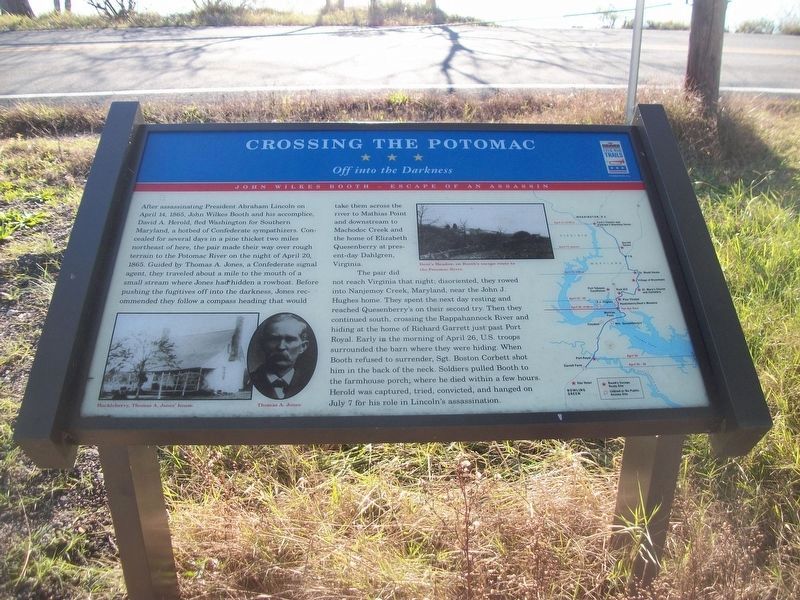
After assassinating President Abraham Lincoln on April 14, 1865, John Wilkes Booth and his accomplice, David A. Herold, fled Washington for Southern Maryland, a hotbed of Confederate sympathizers. Concealed for several days in a pine thicket two . . . — — Map (db m128807) HM
Divided loyalties and ironies tore at Marylander’s hearts throughout the Civil War: enslaved African-Americans and free United States Colored Troops; spies and smugglers; civilians imprisoned without trial to protect freedom; neighbors and . . . — — Map (db m24540) HM
Divided loyalties and ironies tore at Marylanders' hearts throughout the Civil War: enslaved African Americans and free United States Colored Troops; spies and smugglers; civilians imprisoned without trial to protect freedom; neighbors and . . . — — Map (db m186732) HM
Divided loyalties and ironies tore at Marylander’s hearts throughout the Civil War: enslaved African-Americans and free United States Colored Troops; spies and smugglers; civilians imprisoned without trial to protect freedom; neighbors and families . . . — — Map (db m1104) HM
This house was the home of Dr. Samuel Alexander Mudd and his wife, Sarah Frances Dyer. Early on the morning of April 15, 1865, John Wilkes Booth arrived here with a companion, David E. Herold, and asked Mudd to set Booth’s broken leg. Afterward, . . . — — Map (db m921) HM
This house was the home of Dr. Samuel Alexander Mudd and his wife, Sarah Frances Dyer. Early on the morning of April 15, 1865, John Wilkes Booth arrived here with a companion, David E. Herold, and asked Mudd to set Booth's broken leg. Afterward, . . . — — Map (db m295569) HM
Divided loyalties and ironies tore at Marylanders’ hearts throughout the Civil War: enslaved African-Americans and free United States Colored Troops; spies and smugglers; civilians imprisoned without trial to protect freedom; neighbors and families . . . — — Map (db m922) HM
During the Civil War, U.S. Col. James Wallace, commander of the 1st Regiment, Eastern Shore Maryland Volunteers, used this building as his headquarters. The regiment which camped east of here, drew most of its members directly from the Eastern . . . — — Map (db m113141) HM
During the Civil War, Union Co. James Wallace (1818-1887), 1st Regiment, Eastern Shore Maryland Volunteers, used this building as his headquarters. The unit, which camped east of here, enlisted most of its members from the Eastern Shore. It . . . — — Map (db m205006) HM
Although isolated from Maryland's largest population centers, the Eastern Shore was important to the state's role in the Civil War and exemplified the citizens' divided loyalties.
In the years before the war, enslaved African-Americans here . . . — — Map (db m8331) HM
Welcome to Dorchester County! When the Civil War intruded into quiet communities, residents here, as elsewhere on the Eastern Shore, faced difficult choices.
Before the war, enslaved African Americans here began escaping bondage via the . . . — — Map (db m190251) HM
Anna Ella Carroll was born on Maryland's Eastern Shore in 1815. Often called an unofficial member of President Abraham Lincoln's cabinet, she was a Unionist author and newspaper reporter who had traveled extensively throughout the South and Midwest . . . — — Map (db m45304) HM
Anna Ella Carroll, sometimes called an unofficial member of Abraham Lincoln's cabinet, is buried in the Old Trinity Church graveyard. Carroll, born on Maryland's Eastern Shore in 1815, remains an enigma, but there is no question that she . . . — — Map (db m252052) HM
On Saturday, September 6, 1862, the Army of Northern Virginia was spread along the entire length of Buckeystown Turnpike all the way to Frederick. The soldiers camped in the fields on either side of the road on the evenings of September 5-6, and by . . . — — Map (db m152272) HM
Union troops pursuing the Confederate army to Virginia after the Battle of Gettysburg in July 1863 crossed the Potomac River here. Called Berlin at the time of the Civil War, this town truly experienced the challenges of life on the border. Both . . . — — Map (db m1863) HM
Fresh from victory at the Second Battle of Manassas, Gen. Robert E. Lee’s Army of Northern Virginia crossed the Potomac River on September 4-6, 1862, to bring the Civil War to Northern soil and to recruit sympathetic Marylanders. Union Gen. George . . . — — Map (db m1958) HM
The Battle of South Mountain struck Crampton’s Gap late in the afternoon of September 14, 1862, when Union Gen. William B. Franklin finally ordered an attack against Confederate Gen. Lafayette McLaws’s force here. As the Confederate defensive line . . . — — Map (db m1909) HM
Union surgeons turned Burkittsville, a quiet rural village of some 200 people, into a hospital complex after the September 14, 1862, Battle of Crampton’s Gap. The building in front of you, the German Reformed Church, was Hospital D. . . . — — Map (db m190155) HM
"[There] was 14 different hospitals in this place every old hut was used for one ... the hospitals were lettered from A to O." —Union Pvt. John Lovejoy, who worked in the hospitals.
United States surgeons turned Burkittsville, a quiet . . . — — Map (db m279815) HM
None of the structures you see here in Crampton’s Gap existed during the battle on September 14, 1862. George Alfred Townsend constructed all the stone buildings and walls, as well as the Correspondents’ Arch, between 1884 and 1896. Townsend, . . . — — Map (db m1931) HM
Fresh from victory at the Second Battle of Manassas, Gen. Robert E. Lee’s Army of Northern Virginia crossed the Potomac River on September 4–6, 1862, to bring the Civil War to Northern soil and to recruit sympathetic Marylanders. Union Gen. . . . — — Map (db m4028) HM
After stunning victories at Fredericksburg and Chancellorsville, Virginia, early in May 1863, Confederate Gen. Robert E. Lee carried the war through Maryland, across the Mason and Dixon Line and into Pennsylvania. His infantry marched north through . . . — — Map (db m4033) HM
You are at the foot of Sugarloaf Mountain, where on September 5-6, 1862, Union observers watched the Army of Northern Virginia cross the Potomac River to invade Maryland. A signal station had been established here in the summer of 1861, one in a . . . — — Map (db m245994) HM
Elizabeth Ann Bayley Seton founded the Roman Catholic community of the Sisters of Charity of Saint Joseph's here in 1809 (after 1850, called Daughters of Charity). The sisters played a prominent role during the Civil War as nurses and human service . . . — — Map (db m9483) HM
Elizabeth Ann Bayley Seton founded the Roman Catholic community of the Sisters of Charity of Saint Joseph's here in 1809 (in1 1850, merged with the Daughters of Charity). The sisters played a prominent role during the Civil War as nurses and . . . — — Map (db m147294) HM
President Abraham Lincoln replaced Army of the Potomac commander Gen. Joseph Hooker with Gen. George G. Meade on June 28, 1863, as the army pursued Gen. Robert E. Lee’s Army of Northern Virginia. Meade placed Gen. John F. Reynolds, I Corps . . . — — Map (db m1546) HM
On the last day of June 1863, Emmitsburg became a Union army supply base. Union Gen. John F. Reynolds, commanding the left wing of the Army of the Potomac (I, III, and XI Corps), arrived as I Corps came into Emmitsburg to obtain needed supplies, . . . — — Map (db m9489) HM
On the last day of June 1863, Emmitsburg became a Union army supply base. Union Gen. John F. Reynolds, commanding the left wing of the Army of the Potomac (I, III and XI Corps), arrived as I Corps came into Emmitsburg to obtain needed supplies, . . . — — Map (db m147296) HM
After stunning victories at Fredericksburg and Chancellorsville, Virginia early in May 1863, Confederate Gen. Robert e. Lee carried the war through Maryland, across the Mason-Dixon Line and into Pennsylvania. His infantry marched north through . . . — — Map (db m217372) HM
About 80,000 Union troops settled here in Saint Joseph's Valley as June 1863 drew to a close, "until the grounds around were actually covered with Soldiers." Emmitsburg was placed under martial law, and the Vincentian priests at Saint Joseph's . . . — — Map (db m9485) HM
About 38,000 Union troops from three corps passed through Saint Joseph's Valley during the five days before the Battle of Gettysburg, until it seemed to the sisters that "the grounds around were actually covered with Soldiers." Emmitsburg was . . . — — Map (db m204242) HM
Gunfire echoed around this spot on the blisteringly hot summer day of July 9, 1864, as Union troops fought to defend Jug Bridge — which sat 400 yards in front of you — during the Battle of Monocacy.
In July 1864, Confederate Gen. Jubal Early . . . — — Map (db m307791) HM
Fresh from victory at the Second Battle of Manassas, Gen. Robert E. Lee’s Army of Northern Virginia crossed the Potomac River on September 4–6, 1862, to bring the Civil War to Northern soil and to recruit sympathetic Marylanders. Union Gen. George . . . — — Map (db m18382) HM
Fresh from victory at the Second Battle of Manassas, Gen. Robert E. Lee's Army of Northern Virginia crossed the Potomac River on September 4-6, 1862, to bring the Civil War to Northern soil and to recruit sympathetic Marylanders. Union Gen. George . . . — — Map (db m194555) HM
After crossing the Potomac River early in September 1862, Confederate Gen. Robert E. Lee reorganized the Army of Northern Virginia into three separate wings. On September 9, he promulgated his campaign strategy - to divide his army, send Gen. Thomas . . . — — Map (db m18381) HM
After crossing the Potomac River early in September 1862, Confederate Gen. Robert E. Lee reorganized the Army of Northern Virginia into three separate wings. On September 9, he promulgated his campaign strategy from his camp here. The strategy—to . . . — — Map (db m194556) HM
You are on the grounds of Rose Hill Manor, the final home of Maryland's first governor, Thomas Johnson. During its stay near Frederick, the Army of the Potomac's large Artillery Reserve occupied these grounds. Created after the Battle of . . . — — Map (db m2803) HM
Fresh from victory at the Second Battle of Manassas, Gen. Robert E. Lee’s Army of Northern Virginia crossed the Potomac River on September 4–6, 1862, to bring the Civil War to Northern soil and to recruit sympathetic Marylanders. Union Gen. George . . . — — Map (db m97907) HM
Fresh from victory at the Second Battle of Manassas, Gen. Robert E. Lee’s Army of Northern Virginia crossed the Potomac River on September 4–6, 1862, to bring the Civil War to Northern soil and to recruit sympathetic Marylanders. Union Gen. . . . — — Map (db m236181) HM
Fresh from victory at the Second Battle of Manassas, Gen. Robert E. Lee of Northern Virginia crossed the Potomac River on September 4-6, 1862, to bring the Civil War to Northern soil and to recruit sympathetic Marylanders. Union Gen. George B. . . . — — Map (db m249948) HM
Fresh from victory at the Second Battle of Manassas, Gen. Robert E. Lee of Northern Virginia crossed the Potomac River on September 4-6, 1862, to bring the Civil War to Northern soil and to recruit sympathetic Marylanders. Union Gen. George B. . . . — — Map (db m249959) HM
At this intersection, President Abraham Lincoln spoke from a railroad car platform to Frederick residents assembled in the streets on October 4, 1862. He had just returned from viewing the battlefields of South Mountain and Antietam and had . . . — — Map (db m60166) HM
As the Confederate army marched through Frederick on September 10, 1862, feisty local Unionists—mostly women—showed their defiance by waving the Stars and Stripes. The poet John Greenleaf Whittier immortalized one of them in “The Ballad of Barbara . . . — — Map (db m2693) HM
After Confederate Gen. Robert E. Lee's smashing victory over Union Gen. John Pope at the Second Battle of Manassas, Lee decided to invade Maryland to reap the fall harvest, gain Confederate recruits, earn foreign recognition of the . . . — — Map (db m249951) HM
The building in front of you, Kemp Hall, was the capitol of Maryland during the spring and summer of 1861, as the state came perilously close to leaving the Union. Because secession would have placed the U.S. capital, Washington, D.C. between the . . . — — Map (db m67247) HM
The building in front of you, Kemp Hall, was the capitol of Maryland during the spring and summer of 1861, as the state came perilously close to leaving the Union. Because secession would have placed the U.S. capital, Washington, D.C., between . . . — — Map (db m249967) HM
Connections with the Civil War abound around this Courthouse Square, where the first official act of defiance against the British crown - the 1765 Stamp Act Repudiation - occurred almost a century earlier. In 1857, Roger Brooke Taney, Chief Justice . . . — — Map (db m2815) HM
In this building, soldiers who died in one of the many area hospitals following the battles of South Mountain, Antietam, Gettysburg, and Monocacy were embalmed and prepared for interment at nearby Mount Olivet Cemetery or for shipment home. James . . . — — Map (db m97908) HM
In this building doctors embalmed solders who died in area hospitals following the battles of South Mountain, Antietam, Gettysburg and Monocacy, and prepare them for internment at nearby Mount Olivet Cemetery or for shipment home. James . . . — — Map (db m249957) HM
Passionate speeches filled the air at Courthouse Square on September 24, 1864. On that date a throng of Frederick residents listened to Montgomery Blair, Abraham Lincoln's first postmaster general, and other speakers encouraging Marylanders to . . . — — Map (db m260602) HM
Frederick found itself occupied alternatively by Confederate and Union armies during the Civil War. Citizens who frequented this "Square Corner" of Market and Patrick Streets saw Gen. Robert E. Lee's Army of Northern Virginia march west from here . . . — — Map (db m2808) HM
On June 28, 1863, Gen. John F. Reynolds rode into Frederick to visit his cousin Catherine Reynolds Cramer and her sisters near the intersection of North Market and Second Streets. She would have much to write the rest of her family on July 1 about . . . — — Map (db m203920) HM
On June 28, 1863, Union Gen. John F. Reynolds rode into Frederick to visit his cousin Catherine Reynolds Cramer and her sisters near the intersection of North Market and Second Streets. She would have much to write the rest of her family on July . . . — — Map (db m261549) HM
Today, Frederick is a place where many residents and visitors enjoy good food and drink. On July 9, 1864, Confederate officers had a similar experience. On this spot, where the Market House being used as City Hall stood in 1864, they were handed . . . — — Map (db m276033) HM
It was here that George Armstrong Custer was first introduced as a general to the troops he would command. The first order signed by Gen. George G. Meade as the newly appointed commander of the Army of the Potomac on June 28, 1863 promoted three . . . — — Map (db m1539) HM
Confederate Gen. Jubal A. Early drove Union Gen. David Hunter into West Virginia after the Battle of Lynchburg, Va., clearing the Shenandoah Valley of Federal forces. To draw Union troops from Petersburg, Early launched a raid on . . . — — Map (db m167015) HM
(preface) In June 1864, Confederate Gen. Robert E Lee sent Gen. Jubal A. Early's corps from the Richmond battlefields to the Shenandoah Valley to counter Union Gen. David Hunter's army. After driving Hunter into West Virginia, Early . . . — — Map (db m232188) HM
After stunning victories at Fredericksburg and Chancellorsville, Virginia, early in May 1863, Confederate Gen. Robert E. Lee carried the war through Maryland, across the Mason and Dixon Line and into Pennsylvania. His infantry marched north through . . . — — Map (db m2792) HM
After stunning victories at Fredericksburg and Chancellorsville, Virginia early in May 1863, Confederate Gen. Robert E. Lee carried the war through Maryland, across the Mason-Dixon Line and into Pennsylvania. His infantry marched north through . . . — — Map (db m249941) HM
Near this spot, on the grounds of Prospect Hall, Union Gen. George Gordon Meade replaced Gen. Joseph "Fighting Joe" Hooker as commander of the Army of the Potomac on Sunday, June 28, 1863. Meade took command reluctantly because he was concerned . . . — — Map (db m2775) HM
Near this spot, on the grounds of Prospect Hall, Union Gen. George Gordon Meade replaced Gen. Joseph "Fighting Joe" Hooker as commander of the Army of the Potomac on June 28, 1863. Meade took command reluctantly because he was concerned about . . . — — Map (db m249943) HM
In June 1864, Confederate Gen. Robert E. Lee detached Gen. Jubal A. Early's corps from the Richmond battlefields and dispatched it to the Shenandoah Valley to counter Union Gen. David Hunter's army. After driving Hunter into West . . . — — Map (db m304343) HM
In June 1863, Federal troops marched through Jefferson as the Army of the Potomac pursued Gen. Robert E. Lee’s Army of Northern Virginia, a menacing force to the west—but where was it headed? Fearing that Lee would push through the gaps in South . . . — — Map (db m2100) HM
When the Confederate Army of Northern Virginia Invaded Maryland in June 1863, the Army of the Potomac headed north in pursuit. On Monday, June 29, a “rainy, miserable day,” the 15,000 men, 2,900 horses and mules and 475 wagons of Gen. John F. . . . — — Map (db m105250) HM
On June 29, 1863, the Army of the Potomac's II Corps, commanded by Gen. Winfield S. Hancock, broke camp south of Frederick near the Monocacy River, marched into Frederick, and turned eastward on the road to Liberty (Libertytown). The men . . . — — Map (db m4017) HM
Fresh from victory at the Second Battle of Manassas, Gen. Robert E. Lee's Army of Northern Virginia crossed the Potomac River on September 4-6, 1862, to bring the Civil War to Northern soil and to recruit sympathetic Marylanders. Union Gen. . . . — — Map (db m1520) HM
An unnamed citizen of Frederick City said the following of the Confederates he had beheld marching through his hometown: “I have never seen a mass of such filthy strong-smelling men. Three in a room would make it unbearable, and when marching in . . . — — Map (db m1521) HM
"I have never seen a mass of such filthy strong-smelling men. Three in a room would make it unbearable, and when marching in column along the street the smell from them was most offensive… The filth that pervades them is most remarkable… They . . . — — Map (db m157781) HM
The Battle of South Mountain erupted on September 14, 1862, when elements of the Union army tried to drive the Confederate rear guard from Crampton’s, Fox’s, and Turner’s Gaps and break through to the western side of the mountain to attack . . . — — Map (db m1519) HM
Eight thousand Confederates under Gen. Lafayette McLaws marched by this church on September 10-11, 1862, heading south to Harper’s Ferry. Since no Federals were in the area, McLaws expected no encounters with the enemy. Unknown to him, however, . . . — — Map (db m166869) HM
Eight thousand Confederates under Gen. Lafayette McLaws marched by this church on September 10-11, 1862, heading south to Harpers Ferry. Since no Federals were in the area, McLaws expected no encounters with the enemy. Unknown to him, Union Gen. . . . — — Map (db m252643) HM
Late in June 1863, the Union Army of the Potomac pursued Gen. Robert E. Lee's Army of Northern Virginia as it invaded the North for the second time. The Federal left flank under Gen. John F. Reynolds occupied the Middletown Valley, June 25–27, . . . — — Map (db m418) HM
When Gen. Robert E. Lee and part of the Army of Northern Virginia passes through Middletown on September 10–11, 1862, they encountered a chilly reception. The inhabitants of this single-street hamlet on the National Road loved the Union, and the . . . — — Map (db m21911) HM
(preface)
In June 1864, Confederate Gen. Robert E. Lee sent Gen. Jubal A. Early’s corps from Richmond battlefields to the Shenandoah Valley to counter Union Gen. David Hunter’s army. After driving Hunter into West Virginia, Early invaded . . . — — Map (db m76668) HM
After Confederate Gen. Robert E. Lee's stunning victory at Chancellorsville in May 1863, he led the Army of Northern Virginia west to the Shenandoah Valley, then north through central Maryland and across the Mason-Dixon Line into . . . — — Map (db m203059) HM
After Confederate Gen. Robert E. Lee's smashing victory over Union Gen. John Pope at the Second Battle of Manassas, Lee decided to invade Maryland to reap the fall harvest, gain Confederate recruits, earn foreign recognition of the . . . — — Map (db m252634) HM
Fresh from victory at the Second Battle of Manassas, Gen. Robert E. Lee’s Army of Northern Virginia crossed the Potomac River on September 4-6, 1862, to bring the Civil War to Northern soil and to recruit sympathetic Marylanders. Union Gen. George . . . — — Map (db m5923) HM
Fresh from victory at the Second Battle of Manassas, Gen. Robert E. Lee’s Army of Northern Virginia
crossed the Potomac River on September 4-6, 1862,
to bring the Civil War to Northern soil and to recruit
sympathetic Marylanders. Union Gen. . . . — — Map (db m167359) HM
After stunning victories at Fredericksburg and Chancellorsville, Virginia, early in May 1863, Confederate Gen. Robert E. Lee carried the war through Maryland, across the Mason and Dixon Line and into Pennsylvania. His infantry marched north through . . . — — Map (db m5922) HM
After stunning victories at Fredericksburg and Chancellorsville, Virginia, early in May 1863, Confederate Gen. Robert E. Lee carried the war through Maryland, across the Mason and Dixon Line and into Pennsylvania. His infantry marched north through . . . — — Map (db m167358) HM
Late in June 1863, the Union Army of the Potomac pursued Gen. Robert E. Lee's Army of Northern Virginia as it invaded the North less than a year after the Antietam Campaign. On Monday, June 29, the Federal corps marched north toward Pennsylvania on . . . — — Map (db m129752) HM
Gettysburg Campaign Late in June 1863, the Union Army of the Potomac pursued Gen. Robert E. Lee's Army of Northern Virginia as it invaded the North less than a year after the Antietam Campaign. On Monday, June 29, the Federal corps marched north . . . — — Map (db m204237) HM
In mid-June 1863, with rumors of a pending reinvasion of Maryland by Confederate forces, most Baltimore and Ohio trains stopped running past here. As tension mounted, the New York Times reported that no trains were departing Baltimore, “except . . . — — Map (db m743) HM
The rail line immediately before you served as an important means of supply and communication during the Civil War (the station, and tracks to Washington, D.C., on the southern or right side of the station were built later). Here at Point of Rocks, . . . — — Map (db m744) HM
When Union Gen. John F. Reynolds’ I Corps marched by here on June 29, 1863, en route to Emmitsburg and soon to Gettysburg, his men were progressing “swimmingly.” The workers of the Catoctin Furnace had little time to notice, since the charcoal . . . — — Map (db m105249) HM
After Confederate Gen. Robert E. Lee's stunning victory at Chancellorsville in May 1863, he led the Army of Northern Virginia west to the Shenandoah Valley, then north through central Maryland and across the Mason-Dixon Line into . . . — — Map (db m299996) HM
Imagine the more than 12,000 soldiers of the Army of the Potomac's 1st Corps clogging the streets of this small town on June 29, 1863. War was in the air, and local farmers hurried to hide horses and personal belongings. To guard the Federal rear, . . . — — Map (db m260231) HM
On June 29, 1863, Mechanicstown was full of the noise of an army on the move as Union Gen. John F. Reynolds marched I Corps to Emmitsburg. Until then, residents had only heard rumors of the advancing Confederates as nervous farmers hurried horses . . . — — Map (db m260309) HM
Constructed in 1754 on the banks of the Rappahannock River in Virginia, this building was reconstructed here in 1846 and became Landon Female Academy. Early in September 1862, while infantry of Gen. Robert E. Lee’s Army of Northern Virginia rested . . . — — Map (db m1739) HM
(preface)
In June 1864, Confederate Gen. Robert E. Lee and Gen. Jubal A. Early’s corps from the Richmond battlefields to the Shenandoah Valley to counter Union Gen. David Hunter’s army. After driving Hunter into West Virginia, Early . . . — — Map (db m76643) HM
After stunning victories at Fredericksburg and Chancellorsville, Virginia, early in May 1863, Confederate Gen. Robert E. Lee carried the war through Maryland, across the Mason and Dixon Line and into Pennsylvania. His infantry marched north . . . — — Map (db m200639) HM
After stunning victories at Fredericksburg and Chancellorsville, Virginia, early in May 1863, Confederate Gen. Robert E. Lee carried the war through Maryland, across the Mason and Dixon Line and into Pennsylvania. His infantry marched north . . . — — Map (db m2170) HM
When Civil War divided the nation, Maryland found itself on the conflict's pivotal border between North and South. Today, you can trace history along Maryland's Civil War Trail driving tours. Learn about people just like yourself, caught in the . . . — — Map (db m235065) HM
On April 26, 1863, during the Confederate occupation of Oakland, a detachment of Confederate Capt. John H. McNeill's partisan rangers attacked the Baltimore and Ohio Railroad bridge here over the Youghiogheny River. They were part of a larger . . . — — Map (db m255277) HM
After stunning victories at Fredericksburg and Chancellorsville, Virginia, early in May 1863, Confederate Gen. Robert E. Lee carried the war through Maryland, across the Mason and Dixon Line and into Pennsylvania. His infantry marched north through . . . — — Map (db m484) HM
On April 20, 1863, Confederate Gens. William E. "Grumble" Jones and John D. Imboden began a raid from Virginia through present-day West Virginia on the Baltimore & Ohio Railroad. Taking separate routes, they later reported that they . . . — — Map (db m252219) HM
On Sunday, April 26, 1863, a detachment of Confederate Capt. John H. McNeill's partisan rangers under Col. A. W. Harman attacked the Baltimore and Ohio Railroad facilities here in Oakland. They were part of Confederate Gen. William E. “Grumble” . . . — — Map (db m252220) HM
On April 26, 1863, a detachment of Confederate Capt. John H. McNeill’s partisan rangers attacked the Baltimore and Ohio Railroad facilities here at Altamont. They were part of a larger group that entered Oakland that Sunday as Confederate Gen. . . . — — Map (db m37544) HM
After the Emancipation Proclamation was issued in 1863, the U.S. Army recruited both free blacks and slaves. In August 1863, freedman Alfred B. Hilton and his brothers Aaron and Henry enlisted in the 4th U.S. Colored Troops (USCT) in Havre de Grace. . . . — — Map (db m191938) HM
On July 31, 1861, 300 men from the 12th Pennsylvania Infantry under Capt. Daniel Leasure marched into Bel Air to arrest Southern sympathizers and confiscate weapons from local militia units. The troops halted at the courthouse square, then dispersed . . . — — Map (db m156302) HM
360 entries matched your criteria. Entries 101 through 200 are listed above. ⊲ Previous 100 — Next 100 ⊳