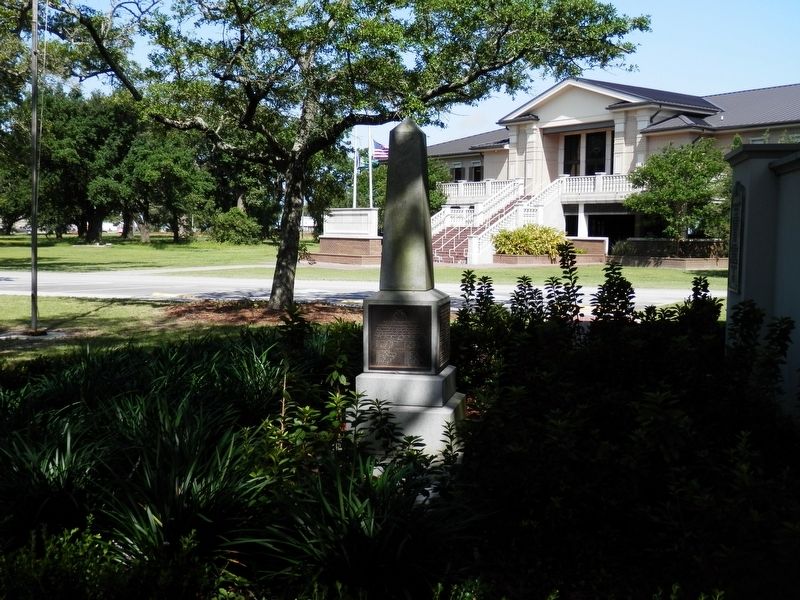
Near this spot Confederate soldiers under the command of Col. W.H. Griffin captured the Union gunboats Wave and Granite City in the Battle of Calcasieu Pass, Cameron, Louisiana, on May 6, 1864. These gallant men died for their cause:Union . . . — — Map (db m160087) HM WM
In loving memory of those men from Cameron Parish who dies in the service of their Country during
World War I
Angel Ouhon – Pvt. Killed in Action: 9-12-18 • Joseph A. Logg – Pvt. Killed in Action: 7-18-18 • Dorsle Richard – Pvt. . . . — — Map (db m214284) WM
While miraculously no one in Cameron Parish was killed, 38 of it's 40 cemeteries were breached and over 340 caskets and their remains were torn from the ground and scattered into marshes, tree tops, fields and canals from as far away as 30 miles. . . . — — Map (db m150683) HM
Avery Island is a 2,200 acre salt dome located in coastal Iberia Parish. The dome's elevation supports habitats not found in the surrounding marshes, swamps and parishes.Avery Island stands out from the surrounding wetlands, rising at its . . . — — Map (db m118435) HM
Placed on the
National Register of Historic Places by the United States Department of the Interior September 2018
Ancestral Home of the Inter-related Marsh, Avery, and McIlhenny Families; Birthplace of World-famous Tabasco® Brand Pepper . . . — — Map (db m213871) HM
Jungle Gardens includes one of the oldest timber bamboo groves in America.
In 1909, Edward Avery Mcllhenny wrote to the USDA's Bureau of Plant
Industry to inquire about growing Bamboo on Avery Island. At the time
Mcllhenny believed bamboo could . . . — — Map (db m126096) HM
Petite Anse actually means "Little Cove"'' in Louisiana French.
This particular bayou runs along the west side of Avery
Island before flowing south into Vermilion Bay and the Gulf
of Mexico (through the Avery Canal). In the 19th . . . — — Map (db m118481) HM
Edward Avery McIlhenny was inspired to create Bird City after a British colonial
official visited Avery Island. The official told the story of a Rajah in India who
built enormous "flying cages” (aviaries) to house his live bird collection. . . . — — Map (db m199131) HM
This structure is known as the Ward Boathouse. Like Edward
Avery Mclhenny, Charles Willis Ward (1856-1920) ran a
plant nursery and was an avid conservationist. Around 1910,
McIlhenny and Ward met, and with McIlhenny's permission
Ward set up a . . . — — Map (db m118532) HM
In 1936, a year after Jungle Gardens opened to the public, two of McIlhenny's
friends, Robert M. Youngs and Ernest B. Tracy of New York City, presented him
with a magnificent Buddha statue that they hoped would find an ideal home
among his Asian . . . — — Map (db m118857) HM
Edmund McIlhenny concocted the now famous TABASCO® brand pepper sauce in a wooden frame building called the “Laboratory” on the Homestead grounds of the Avery McIlhenny family. A factory built in the early 1900s replaced the Laboratory . . . — — Map (db m62015) HM
Salt evaporated from brine springs on Avery Island since 1791. On May 4, 1862, workmen enlarging these springs to produce more salt for the Confederacy hit solid salt at a depth of 16 feet. Mining operations, the first of this type in North America, . . . — — Map (db m195107) HM
A self taught naturalist, Edward Avery McIlhenny returned to Avery Island from an arctic expedition in 1898. He shortly took over the family's TABASCO® pepper sauce business. McIlhenny married Mary Matthews of New Orleans and built a house in what . . . — — Map (db m118876) HM
This area was once known as the Hog Lot. It provided green
pastures for grazing pigs and horses alike and became part
of Jungle Gardens in the 1930s. The live oaks here were
planted between the 1860s and the 1920s.
Natural groves of live oaks . . . — — Map (db m126097) HM
In its day, this garden was an engineering marvel. Avery Island is an extruded "bubble" of a salt dome, formed from the salt of an ancient Jurassic sea that left a vast bed of salt far below the marshy surface along the Louisiana coast. Over the . . . — — Map (db m119738) HM
The Cleveland Oak was named for Grover Cleveland
(1837-1908), the two-term U.S. President (1885-1889 and
1893-1897). Cleveland was a close friend of Joe Jefferson
(1829-1905), the actor of Rip Van Winkle fame who owned
nearby Jefferson Island. . . . — — Map (db m118534) HM
This live oak was selected on October 9, 1810 by Thomas Orme to mark point "D" of his survey of the Elizabeth Hays Tract, later to become the first land purchase of John Marsh whose descendants still own Avery Island. It and the live oak at point . . . — — Map (db m247067) HM
This Buddah Was built for the Shonfa Temple located northeast of Peking, by the order of Emperor Hui-Tsung 1101-1125
Its builder was Chon-Ha-Chin, most noted of ancient Buddah makers.The temple was looted by a rebel general who took . . . — — Map (db m118855) HM
was built for the
Shonfa Temple
located northeast of
Peking, by order of
Emperor Hui-Tsung
1101 - 1125
Its builder was Chon-Ha-Chin, most noted of ancient Buddha makers.
The temple was looted by a rebel general who . . . — — Map (db m260073) HM
Built by Agricole Fuselier de la Claire,
a planter and cousin of A. B. Roman,
Governor of Louisiana
(1831-1835, 1839-1843).
The house was floated up Bayou Teche
from Baldwin to its present site
by a descendant of the Builder. — — Map (db m228282) HM
This house was built in 1850 by Francis D. Richardson on Bayou Teche in Greek Revival style of the period. Richardson, a classmate & friend of Edgar Allen Poe, purchased the land for a sugar plantation. Named Bayside because of dense growth of bay . . . — — Map (db m85042) HM
This home, originally known as Pine Grove, was bought in 1830 by John W. Jeanerette, the first postmaster between New Iberia and Charenton, and for whom Jeanerette is named. This historic home escaped the destruction of military operations in the . . . — — Map (db m85278) HM
This East Lake Victorian home, built in 1897, was the home of Harry Bertram Hewes until his death in 1953. Hewes, descendant of one of the signers of the Declaration of Independence, was a founder and co~owner of Jeanerette Lumber and Shingle Co., . . . — — Map (db m86599) HM
"The Father of Jeanerette." Buried here September 12, 1816. One of the area’s first landowners. Town of Jeanerette grew up on site of his plantation. His descendants have been prominent in local history. — — Map (db m86628) HM
Founded 12 January 1879 by Napoleon J. Perche, Archbishop of New Orleans. The present church was built in 1908, Rev. M. Bardy, pastor, August 1885 - June 1928. — — Map (db m86664) HM
Once the main channel of the Mississippi River, Bayou Teche has
served as a passageway since the time of the area's first inhabitants,
the Chitimacha Indians, to today's residents of Jeanerette.
The steamboat played a major part in the . . . — — Map (db m286914) HM
This wheel is from one of the Southwestern Traction & Power Co.
streetcars. In 1912-1918 this line
operated from Jeanerette to New
Iberia. There was a turntable just
past St. Peter Street in Jeanerette
and another at Rose Hill Cemetery
on . . . — — Map (db m286910) HM
The smell of burning cane mingles with that of fresh-baked bread in Jeanerette, also known as Sugar City. Founded as a sawmill town on
the bayou in 1878, today Jeanerette is home to two active sugar mills, along with one of the world's largest . . . — — Map (db m287077) HM
About 200 destitute Acadians, former
prisoners of the British in Halifax, Nova
Scotia, arrived in New Orleans in February
1765. Offered fertile land in the Attakapas
District of what is now south-central Louisiana,
these exiles reached Bayou . . . — — Map (db m228254) HM
Panel 1 World War I Oliver Courville Charles Wallet Richard Windybank World War II Joseph A. Crochet Richard Fontenette Warren Granger Earl LeCamus Beraud Mestayer Oswald P. Ransonet Joseph Eddie Terradot ★ ★ ★ ★ To . . . — — Map (db m228447) WM
English Side In Spring 1765, during the Spanish Rule of
Louisiana, approximately 200 Acadian refugees
representing 60 families were settled here on
the Teche Ridge in three encampments along
the "Fausse Pointe" that includes . . . — — Map (db m228283) HM
Panel 1 English L'Acadie, established by France in 1604, was a
strategically located and highly coveted colony. In 1713, it
was handed over to England and renamed Nova Scotia. The
foundation of Halifax, in 1749, led part of the. . . . — — Map (db m228406) HM
Like many communities along the Teche, early life in the village of Loreauville revolved around the church. Ozaire Joseph Loreau
donated a piece of property in 1871 with the stipulation that a church be constructed in what was then called Fausse . . . — — Map (db m241839) HM
After starting business in 1898, Jules Olivier built this store in 1908 to serve his growing plantation. Mr. Olivier was commissioned the community's first postmaster in 1898 and his store housed the first Lydia post office until the arrival of . . . — — Map (db m85052) HM
Consecrated in 1858 on land donated by plantation owner Harvey Hopkins, the Episcopal Church of the Epiphany is the oldest church building still in use in New Iberia. It was added to the National Register of Historic Places in 1977. One thing . . . — — Map (db m99361) HM
Allain's Jewelry Store
Circa 1912
This building served as the local Ford Motor Corporation sales and service facility which was composed of four separate buildings. The present Allain's Jewelry store housed the dealership where . . . — — Map (db m287530) HM
In 1977, President Jimmy Carter appointed Wilbert J. Le Melle
to serve as U.S. Ambassador to the Republic of Kenya and to the
Republic of Seychelles. He was the only African American in the
President's first major ambassadorial . . . — — Map (db m287587) HM
Because movement here in the late 1800s was easier by water than by land, many daily activities occurred on or along Bayou Teche, including transportation, trade, and mail delivery.Bayou Teche is an ancient channel of the Mississippi River, . . . — — Map (db m116057) HM
In early 1779, Francisco Bouligny led a group of Spanish
colonists to establish a new town called Nueva Iberia
on the banks of Bayou Teche in the Attakapas region.
By August of that year, residents of the Attakapas, a
diverse community of . . . — — Map (db m284242) HM
Originally the Iberia House, the Bezus Building was erected circa 1880 on property purchased in 1868 by Laurent Bazus, a native of Vin-En-Bigorre, France. It is considered the oldest existing structure in New Iberia's downtown. Laurent's heirs have . . . — — Map (db m104453) HM
In 1779, a group of about 500 Spanish settlers moved from Malaga, Spain to the banks of Bayou Teche and founded the city of "Nueva Iberia," named after their Iberian Peninsula. It is the only town still in existence in Louisiana to be founded by . . . — — Map (db m98640) HM
Land was an original Spanish Grant to Francois Pellerin. Property then owned successively by the Sterling, Peebles and finally the Wyche families. This plantation has produced sugar since the late 19th century and is site of unusual water powered . . . — — Map (db m145406) HM
Booker T. Washington's Historic Visit to Howe Institute April 14, 1915. National attention was drawn to New Iberia when celebrated orator, educator and presidential adviser, Booker T. Washington, visited Howe on April 14, 1915, . . . — — Map (db m189356) HM
Frédéric Henri Dupérier, under whose leadership New Iberia was
incorporated in 1839, along with his wife, Hortense Bérard, donated the
land for St. Peter's Catholic Church in 1837. Dupérier asked that this alley remain open for his family's . . . — — Map (db m129771) HM
Frédéric Henri Duperier originally donated Church Alley
to the City of New lberia. The Duperier family lived across
the Bayou Teche in the mansion that was to become
Mt. Carmel Academy. In 1837, Duperier donated the land
for St. Peter's Catholic . . . — — Map (db m129999) HM
Actor, Author and Artist
Designed and built this home in 1870
Rip Van Winkle Gardens
Named for the character which he
immortalized and which in his day
made him America's most celebrate actor — — Map (db m198865) HM
Downtown New Iberia Commercial
Historic District retains both its
architectural and historical
identity as a center of commerce
recreation and entertainment for
the city of New Iberia and the
surrounding region. The 68.8 acre,
9 block . . . — — Map (db m286901) HM
Along with leaders of the newly formed NAACP chapter, Drs. Dorsey, Pierson, Scoggins, and Williams were violently expelled from Iberia Parish on May 17-18, 1944, because they supported Black workers, who successfully petitioned the federal . . . — — Map (db m145416) HM
Edwin, the brother of Robert F. Broussard,
was the second brother elected to serve
the State of Louisiana in the U.S. Senate,
serving from March 1921 March 1933. As a
progressive democrat, Senator Broussard
was recognized for his support of . . . — — Map (db m284324) HM
Completed in 1834, the Shadows-on-the-Teche holds many
layers of history in its walls and gardens. Built for wealthy sugar
planters, Mary and David Weeks, the house remained in the same
family for four generations.
As a former plantations have . . . — — Map (db m284337) HM
Our History The Essanee was designed by Owen Southwell in the
Art Deco Style. When first opened, the theater was
state of the art, featuring the latest Super Simplex
projectors and two RCA high fidelity sound
machines. In addition, there . . . — — Map (db m287023) HM
The Essante Theater opened on November 25, 1937. owned by Julius Scharff and Elias
Elias. The theater took its name from the first letters of their last names: S & E.
Designed in the art deco style by Owen Southwell, the theater featured the . . . — — Map (db m290653) HM
After the Great Fire of 1870, the Dreyfus Building was partitioned in 1929, with this portion becoming one of the city's early movie houses, The Evangeline Theater., Opened on April 19, 1930, by the Theodore Sliman Family, the building was . . . — — Map (db m104442) HM
A black woman, native of Haiti. During the yellow fever epidemic here in 1839, she nursed the sick, administered to the dying, closed the eyes of the dead, and wept over their graves. Loved and honored by townspeople for the remainder of her life, . . . — — Map (db m85048) HM
First Courthouse
Circa 1871
On this site stood a two story brick building erected in 1871 by P.A. Veazey. The upper story served as the first courthouse of Iberia Parish from that date until 1884 when a new . . . — — Map (db m290658) HM
A native of Philadelphia whose family refugeed from Haiti, he settled here in 1816. In 1825 he married Hortense Bérard and purchased land here. A merchant and planter, he and his wife donated in 1837 the land upon which the Catholic church was . . . — — Map (db m93351) HM
Former home of Frederick Larned Gates (1827-1897), outstanding citizen, businessman, lawyer and Civil War veteran. He served as district judge in the 1870's and 1880's. As an early industrialist, Gates developed a cotton seed oil business which was . . . — — Map (db m85047) HM
Born and raised in New Iberia, George Rodrigue (1944-2013) was best
known for his Blue Dog paintings, which catapulted him to worldwide fame
in the early 1990s. He often said, "if I wasn't from New Iberia, I probably
would never have painted in . . . — — Map (db m286903) HM
St. Peter's College, a Catholic boys' school, opened on September 9, 1918, and educated young men in grades 1-12. The first commencement was held on June 20, 1922. Inaugural faculty members were Brother A. Arsenius (principal), Brother A. Xavier, . . . — — Map (db m99403) HM
Hotel Frederic
Circa 1913
Located on this site was the 1840 home of Mr. and Mrs. J. William Robertson which was converted into the Hotel Evangeline, and frequented by the Honorable Grover Cleveland. Sold to Felix Patout in 1912, . . . — — Map (db m285662) HM
Site of the first organized school for Black students in Iberia Parish, controlled by the Union 6th District Missionary Baptist Association, with Mr. Jonas Henderson, Sr. , principal and a dedicated staff of professionals. — — Map (db m98518) HM
Iberia Parish, created in 1868, conducted the business of government in rented space until 1884 with the building of the first permanent courthouse at present day Bouligny Plaza on Main Street. With the help of Public Works Administration funds, . . . — — Map (db m99724) HM
In October of 1868, Iberia Parish was created from portions of St. Martin and St. Mary
Parishes. Iberia Parish's first permanent courthouse was constructed near this site
in 1884 the three-story plastered brick structure featured a mansard roof . . . — — Map (db m287527) HM
Text taken from second panel J. Leo Hardy a native of
New Iberia, Louisiana
is a staple figure for
the community
A true leader, at best
he was the first
NAACP President of the
local New Iberia Chapter.
Today, the chapter honors
J. . . . — — Map (db m287479) HM
Fans of author James Lee Burke will easily recognize New Iberia as the settings for several of his famed Dave Robicheaux novels. Burke, who has been called the Faulkner of crime fiction, spent summers with his family in New Iberia. This area is . . . — — Map (db m104429) HM
Once known as Orange Island purchased after the Civil War by Joseph Jefferson (1829 to 1905), world famous actor and artist. Home designed and built about 1870. — — Map (db m105148) HM
(From second panel) Jonas Henderson, Sr. gave
fifty-four years of his
life toward developing
qualitative educational
standards to the students
of his time. He was
the principal of Howe
Institute that was located
on the spot where . . . — — Map (db m286908) HM
Side 1 On November 15, 2003, Kathleen Babineaux
Blanco became the first woman to be
elected as Governor of Louisiana. Born in
New Iberia, Blanco attended Mount Carmel
Academy, an all-girls school run by the
Roman Catholic Sisters of Mount . . . — — Map (db m189240) HM
A lone chimney rises above the surface of Lake Peigneur as a reminder of the unusual disaster that occurred here in 1980.
More than 140 years ago, Lake Peigneur was described as the most beautiful lake in the South. The present-day lake and . . . — — Map (db m118837) HM
In the spring of 1779, Bouligny acting on order of Governor Bernardo de Galvez, led about 60 Spanish settlers to this site, marking the founding of New Iberia. To commemorate that event, the schoolchildren of New Iberia and the American Revolution . . . — — Map (db m86913) HM
In 1897, Dr. Emma Wakefield became the first Black woman to earn a medical degree in Louisiana. Born and raised in New Iberia to state senator Samuel Wakefield & Amelia Valentine Wakefield, Emma graduated with honors from the medical department of . . . — — Map (db m129769) HM
An educational institution for girls established in 1872 by the Sisters of Mt. Carmel. The order was founded in 1825 in Tours, France. The old building which is nearest Bayou Teche was constructed by Henry F. Duperier in 1826. — — Map (db m49066) HM
New Iberia. Early in 1779 Governor Galvez sent Lieutenant Colonel Francisco Bouligny with nearly five hundred Spanish and Canary Island Colonists to establish a settlement on the lower Bayou Teche in the Attakapas Country. These . . . — — Map (db m85049) HM
The wreckage of Teche, a steamship, lies buried below the surface at this site. The steamer, built in 1860, was originally named Sam Sugg and then Tom Sugg. It was constructed for commercial use with a small side-wheeled . . . — — Map (db m115657) HM
On property purchased in 1937 from J. Wiltz Emmer, New Iberia architect Owen J.
Southwell designed this eclectic, cottage-style building for Dr. Rene J. Broussard.
Dr. Broussard and his wife, Lelia Gonsoulin Broussard, admired the local . . . — — Map (db m284743) HM
Louisiana was a Spanish colony from 1762 to 1801. in 1777, the Spanish crown authorized
governor Bernardo de Galvez to promote Spanish emigration to Louisiana, Francisco
Bouligny, for whom this plaza is named, recruited citizens from the province . . . — — Map (db m285658) HM
Originally part of the 1777 Spanish Land Grant to François Prévost, this Iberia to Julia Street property with its circa 1890 building was purchased by Frédéric Henri Dupérier in 1829. The property remained with the heirs of Dupérier until its sale . . . — — Map (db m104448) HM
Audley Moore, also known as Queen Mother Moore, was born in New
Iberia, LA on July 27, 1898. She was a global civil and human rights
leader, political theorist, and educator advocating for the rights and
reparations of African people. She joined . . . — — Map (db m286951) HM
Robert was the first of two brothers to
serve as U. S. Senator representing the State
of Louisiana. He served in the House of
Representatives from March 1897 until
March 1912 and then was elected to serve in
the U. S. Senate until his death in . . . — — Map (db m284321) HM
On this site stood the 1885 Gothic Revival home of John Marsh Henshaw, purchased by Monsignor Jean Marie Langlois in 1913, Saint Peter's College began educating boys on September 9, 1918. A school building was constructed east of the Henshaw . . . — — Map (db m99402) HM
This building, constructed in the late 1880's, served as the easternmost terminus of The Great Fire of 1899.
Although its windows were blown out and its second floor interior charred, the brick structure stopped the fire from spreading farther . . . — — Map (db m99723) HM
Shadows-On-The Teche
Has been designated a
Registered National
Historic Landmark
This site possesses national significance
in commemorating the history of the
United States of America
1975
National Park Service
United States . . . — — Map (db m87097) HM
Life Began Along Bayou Teche
Shadows-on-the-Teche is a historic house museum property of
the National Trust for Historic Preservation. A white-columned
brick building constructed between 1831 and 1834, The Shadows
is both a survivor and a . . . — — Map (db m284241) HM
From 1862-1863 Camp Pratt was official Confederate camp of conscription and instruction for South Louisiana. At one time as many as 3,000 conscripts here. A small compound for Union prisoners of war also located at the camp. — — Map (db m174096) HM
First known as Lake Flamand for one of the early settlers, Jean Baptist Grevemberg; known as Lake Tasse by the French due to its cup shape; and known as Spanish Lake for early Spanish colonials who lived on its shores. — — Map (db m115654) HM
St. Edward Roman Catholic Church
Established 1917
Church bell donated 1923 by
Mr. Joseph Prados
Bell rang gloriously from 1923 until
the new church was built in 1957 — — Map (db m287248) HM
Saint Peter Catholic Church sits on land donated in 1837 by Frédéric Henri Duperier
and his wife, Hortense Berard. The original church was completed in 1837 with bricks
made on the site of the former Mt. Carmel Academy, a portion of which was the . . . — — Map (db m284332) HM
Established Mar. 24, 1838. Interred here are F.H. Duperier, incorporator of New Iberia, U.S. Senators Robert & Edwin Broussard, Lt. Gov. Emile Verret, James Beddell, designer of "The Shadows," & other prominent individuals. — — Map (db m85276) HM
This building, dedicated in 1951, was constructed with funds provided by the State of Louisiana. Designed by noted architect Owen J. Southwell, this local landmark, with its sugar cane mill inspired exterior and classic European Renaissance themed . . . — — Map (db m99928) HM
This building, constructed in 1892 by the Jacob Davis Family on land purchased from Leonidas Serret, remained in the Davis family until its 1936 purchase by Dr. Paul A. Lebourgeois. The pediment brickwork of the second story facade is considered . . . — — Map (db m104430) HM
In the late nineteenth century, the Dreyfus building functioned as a large wholesale grocery. The original brick structure dates back to the period just after the great fire of 1870. In late 1929, it was partitioned to create two buildings. The . . . — — Map (db m86987) HM
Built in 1858 on land donated by Harvey Hopkins. Consecrated May 16, 1858 by the Rt. Rev. Leonidas Polk, first Episcopal Bishop of Louisiana. This Gothic Revival structure is the oldest non-residential building in New Iberia. During the War Between . . . — — Map (db m86911) HM
August Erath, born in Morat, Switzerland, in 1843, came to Louisiana in 1866, married Catherine Becht, and moved to New Iberia in 1876. Erath was a brewer by trade and practiced his art here for a few years. In 1884, he commissioned the construction . . . — — Map (db m87039) HM
This building, having a second story gallery which extended over the sidewalk, was largely responsible for preventing a disastrous fire from spreading throughout the Town's business district. As flamed destroyed the block just east of here on the . . . — — Map (db m104451) HM
About 6:00 PM, October 10, 1899, fire started in a warehouse just east of here. Within minutes, the surrounding buildings were ablaze. The entire square, from Julia to Iberia Streets and from Main to St. Peter Streets burned before midnight. Only . . . — — Map (db m87040) HM
Owned by the Fitzhugh Murray family for most of the 20th century, this building was occupied and leased by several buisnesses, including Deblanc and Landry Grocery, Tibby-Rouse Auto Parts, Berard Brothers Towing Company and Nick Fritella's Shoe . . . — — Map (db m87042) HM
First hung at Fire Engine Company No. 1, Vine and Main Streets, circa 1868, this bell was moved to the Fire Station—City Hall—Central Market erected 1898 on Main. About 1900 the Bernard Blacksmith Shop, later the A.M. Bernard Wagon . . . — — Map (db m98516) HM
Throughout much of the nineteenth century, New Iberia was the area terminus for water-borne traffic on Bayou Teche from north and east. Barges, schooners and smaller craft plied the Teche until the coming of the steamboat. In the fall of 1830, the . . . — — Map (db m87096) HM
427 entries matched your criteria. The first 100 are listed above. Next 100 ⊳