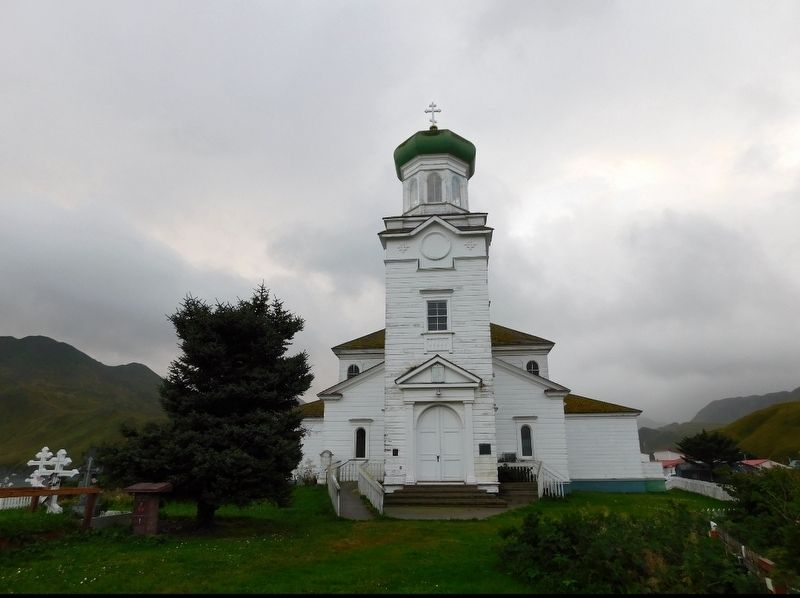
This is the oldest Russian-built church standing in the U.S. The center was built on the vessel or quadrilateral ground plan in 1825. When enlarged in 1894 wings were attached to form a cross, changing the structure to the Pskov or cruciform . . . — — Map (db m305667) HM
“Whenever the [upriver Dena'ina<] needed anything,... they come down to Alexander Creek to trade for beluga grease, seal oil...and they gave [coastal Dena'ina] caribou skins and marten skins. They helped each other, for the were the . . . — — Map (db m283052) HM
During World War II under the leadership of
Major "Muktuk" Marston and 21 paid staff, 6,368 Volunteers from
7 Native ethnic groups and European Americans, whose collective
ages ranged from 12-80 years of age, including some 30 women, . . . — — Map (db m254297) HM WM
Alaskans Fallen In World War II
SGT James Abercrombie •
PVT Daniel Adams •
PFC Ralph Aden •
SSG George F. Alexander •
ENS Awen M. Anderson •
SSG Garnet E. Archer •
CAPT Charles F. Aylworth •
CPL Bruce D. Bridwell • . . . — — Map (db m254466) WM
In 1914, the Alaska Engineering Commission designated the north bank of Ship Creek as the site of main railroad construction camp. The town of Anchorage began as a railroad construction settlement at the mouth of Ship Creek. For many years the . . . — — Map (db m260158) HM
Settlers arrived, construction boomed. By 1916 the town's population had jumped to 6,000 people. 300 families were estimated to be homesteading in the Matanuska Valley.
The Alaska Engineering Commission assumed responsibility for the town's . . . — — Map (db m260185) HM
On November 23, 1920 the Alaska Engineering Commission rel[i]nquished responsibility for local government. Anchorage incorporated into a civilian run city.
4th Avenue was still the main commercial street. Even though the population remained . . . — — Map (db m260220) HM
In the early 1930's, Anchorage was accessible by rail or air, but any travel outside the city was expensive and slow. The only roads out of the city were the rough road to Spenard Lake and a 22 mile loop north of town. After the first light . . . — — Map (db m260221) HM
In September 1940, Elmendorf Army Airfield was completed. Soldiers lived in tents while the remainder of the airbase and temporary facilities at Fort Richardson were built. The military build-up played a major role in the development of . . . — — Map (db m260229) HM
By 1943 [sic-probably 1948] Anchorage had 50 airlines. Most consisted of surplus DC-3 aircraft, based at Merrill Field. Customers would write their name on a sign-up sheet for a specific destination. When the plane was full it would leave. The . . . — — Map (db m260232) HM
In the early 1950's, Anchorage had 2 paved streets, 1 stoplight, 2 small skyscraper apartments and a new high school. The road to Seward and the new Anchorage International Air Terminal were completed. We were the first American city to have . . . — — Map (db m260233) HM
In 1778, Captain James Cook sailed up "River Turnagain", present day Turnagain Arm. At the time, the Cook Inlet-Susitna River Basins were inhabited by coastal Athabaskan Indians, the Tanainas. The Dena'ina, a sub-group of the Tanaina, lived in . . . — — Map (db m260164) HM
[Photo captions, clockwise from top left, read]
A. Pipeline map, showing most of AK (courtesy of the State of Alaska Joint Pipeline Office)
B. Oil pipeline (courtesy of the State of Alaska Joint Pipeline Office)
C. All-American City . . . — — Map (db m260238) HM
5000 B.C.
Earliest known human habitation in the Anchorage area
1756
First contact between Athabaskan Dena'ina people and European cultures. Dena'ina population in the Anchorage area estimated at 5000 people
1778
English . . . — — Map (db m260154) HM
To those Alaska Veterans
whose eyes have seen
what the protected
will never know.
Dedicated May 28, 2001
Sculptor Joan Bugbee Jackson, '01 — — Map (db m254463) WM
This memorial to Anchorage's war veterans and other who
have served in the Armed Forces of the United States was
planned, financed and constructed by those in the community
who understand and acknowledge the response to duty, the
spirit . . . — — Map (db m254465) WM
James Cook was born in Yorkshire, England, on October 27, 1728. He was apprenticed to serve on sailing ships built in Whitby, near his birthplace, to carry coal along the English coast. At age 26, he joined the Royal Navy, took part in actions . . . — — Map (db m72493) HM
Dedicated to all men and women
wounded in all our wars.
My stone is red for the blood they shed.
The medal I bear is my country’s
way to show they care.
If I could be seen by all mankind
maybe peace will come in my . . . — — Map (db m254232) WM
"Dear brothers and sisters in Christ, I thank God for
your dedication to Christ, your presence in the Church,
and your collaboration in Her Mission. And I thank God
for your prayers, in which you unite with the Whole Body
of Christ in . . . — — Map (db m254233) HM
Constructed in 1936,
this building remains on its original site.
It survived the March 27, 1964 earthquake.
Major renovation was completed in 1989.
—————————————————
The Anchorage Hotel
Built 1936
has been placed on the
National . . . — — Map (db m254236) HM
Panel 1
"Religion Gives Man Wisdom."
Martin Luther King, Jr.
[Top photo] Dr. King leads religious leaders in prayer at the Tomb of The Unknown Soldier to protest the Vietnam War, 2/6/1968 at Arlington Cemetery, Washington, D.C. . . . — — Map (db m254221) HM
His vision and purpose to extend democracy and self-government over the continent secured Alaska for the United States and advanced the frontier of freedom to America's farthest north and west. — — Map (db m278562) HM
The oldest house in Anchorage was originally built in Knik, Alaska, in 1913. Oscar Gill moved his home to Anchorage in 1916. An Iditarod Trail mail musher and three term mayor of Anchorage, Gill was speaker of the territorial House of . . . — — Map (db m173886) HM
Built in 1915, this was the first school in Anchorage. It was constructed by the Alaska Engineering Commission, the federal agency responsible for developing the railroad in Alaska.
90 students initially attended classes here but within one . . . — — Map (db m294717) HM
Each winter the city of Anchorage Alaska
is host to two of the world[']s greatest sled
dog races, the Fur Rendezvous World Championship
and the Iditarod. This is the starting line
for these two great races.
———————————————————
This . . . — — Map (db m254305) HM
1776
Two events destined to change the history of the world took place the first week of July 1776.
On the fourth day of July, the Representatives of the United States of America, in general congress assembled at Philadelphia, declared . . . — — Map (db m69767) HM
Attempting to know what came before our time is like considering the stars. History stretches out behind us for a very, very long time. The Athabaskans referred to it as Suk Du, "the time of long ago". All of Alaska's first people created stories . . . — — Map (db m260155) HM
The Raven whispers to the Bear, "I really enjoy
watching you fish for salmon in Ship Creek".
The Bear's large smile and tummy,
indicated that he loves it too!
This sculpture is dedicated to the
fun loving spirit of all Alaskans. . . . — — Map (db m254240)
With the vision of universal freedom
for all mankind
this tree is dedicated to
Spec. 4 Richard Bauer
and all
Prisoners of War
and
Missing in Action — — Map (db m254216) WM
Presented to
City of Anchorage
by the
Veterans of Foreign Wars
In honor of those who answered the call
to arms in defense of their country.
Dedicated Memorial Day 1958 — — Map (db m254464) WM
Built in 1915, this is the first permanent building constructed in Anchorage and is now the oldest building still standing here. It was erected to house the Larson-Wendler Company, the city's first general merchandise store. — — Map (db m254280) HM
Store and residence built in 1915.
Only Victorian turreted structure in Anchorage.
In 1948, Mrs. Myrtle Wendler Stalnaker opened
Club 25 restaurant.
Withstood the 8.6 earthquake of March 27, 1964.
Original location was on the southwest . . . — — Map (db m254302) HM
Dedicated to the men and women of the 3rd
Wing who established a proud legacy of
excellence and built what is today America's
premier airpower wing. — — Map (db m254621) HM
The 3rd Wing, in one form or another, has served the United States on a
continuing basis since its activation as the US Army Surveillance Group on
1 July 1919. Including squadrons active in World War I (the 19th and 90th
Fighter Squadrons), . . . — — Map (db m254540) HM WM
"I believe in the future he who holds Alaska will hold the world,
and I think it is the most important strategic place in the world."
Brigadier General William "Billy" Mitchell
12 February 1935 — — Map (db m254469) HM
As a lieutenant assigned to the 3rd Attack
Group in 1922, he made the first United States
coast-to-coast fight in under 24 hours. He
later earned the Medal of Honor for his
leadership during the carrier-based Doolittle
Raid against mainland . . . — — Map (db m254620) HM WM
One of the most dynamic combat leaders of the
3rd Bombardment Group during the Pacific
campaign, Colonel Henebry led the group
during the attack on the Japanese stronghold
at Rabaul, He was promoted to the rank of
Colonel at the young age . . . — — Map (db m254627) HM
He earned the Medal of Honor by giving his
life during a night attack against a North
Korean convoy. He continued to fly his
crippled 3rd Bombardment Wing B-26 so that
his crew could bail out. — — Map (db m254617) HM WM
As a lieutenant, he led the 3rd Bombardment
Group on the March 1942 deployment to
Australia. Colonel Strickland commanded the
group during the March 1943 Battle of
Bismarck Sea. — — Map (db m254628) HM WM
First flown in 1953, the Convair F-102 Delta Dagger
was designed as a high-altitude, high-speed
interceptor for use against Soviet Union bombers
entering production at the time.
The F-102A on display is painted with the markings of
the . . . — — Map (db m254364) HM WM
This gate is dedicated to men of the Armed Forces of the United States who died while serving their country in war and in peace.---In Memory of Kermit Roosevelt. Born 1859-Died 1943-Who fought in the British and American Armies during World Wars . . . — — Map (db m72794) WM
He joined the 3rd Attack Group after completing flight school in 1925. Promoted to four-star rank in 1954, he served as Commander, Far Eastern Command and later as Commander-in-Chief, NORAD. — — Map (db m254630) HM WM
The second Air Force Chief of Staff, he began his flying career with the 3rd Attack Group in 1924. His early experience helped him with major responsibilities during World War II, including planning the Normandy invasion. Vandenberg AFB in . . . — — Map (db m254611) HM WM
As a lieutenant, he served in various positions
with the 3rd Attack Group from 1932-1935.
During World War II, he was one of the
foremost air commanders and commanded
forces in both theaters. Following the war, he
went on to become Chairman . . . — — Map (db m254616) HM
General McCloud's untimely death on 26 July 1998, ended a remarkable and promising
career that began when he graduated number one in his class from Officer Training School in
1969. Upon graduation from flight school, he served as an F-106 and . . . — — Map (db m254426) HM
In 1999, the 3rd Wing Commander requested a C-130 for
static display in Heritage Park. The National Museum of
the USAF identified an excess Lockheed Martin C-130E
Hercules, Serial No. 64-0553 from the 86th Wing,
Ramstein AB, Germany, in May . . . — — Map (db m254369) HM WM
The Lockheed P-38 Lightning, originally designed to meet the 1937 Army Air Corps requirements
for a high altitude interceptor, became one of the most versatile fighters of World War II. It saw
action in every American theater of operations . . . — — Map (db m254425) HM WM
The Lockheed T-33 Tee Bird was developed as a
trainer version of the F-80 Shooting Star. It saw
extensive service as a trainer and as a combat support
and radar target evaluation aircraft. The Tee Bird was
the longest-serving military . . . — — Map (db m254367) HM WM
An innovative and dynamic commander of the 3rd Attack Group who pioneered early ground attack missions, Colonel Hickam was killed November 1934 while attempting a night landing. Hickam AFB in Hawaii is named in his honor. — — Map (db m254612) HM
As a lieutenant, he led the 3rd Bombardment
Group's first combat mission of World War II
and was later awarded the Distinguished
Service Cross for his leadership under great
adversity. General Ruegg retired in 1972 after
commanding the . . . — — Map (db m254625) HM
Designed as an air-superiority fighter, the McDonnell
Douglas F-15 Eagle first flew in 1972 and entered
operational service in 1974. The F-15 has become the
longest-serving fighter in aviation history and has
seen extensive combat action. . . . — — Map (db m254408) HM WM
The versatile McDonnell F-4 Phantom II first flew in
1958, entering operational service with the Navy in
1961 and the Air Force in 1962. The Phantom became
one of the principal fighters in the Air Force, serving
into the late 1990s.
The . . . — — Map (db m254360) HM WM
The Northrop F-89 Scorpion was the first aircraft
designed as an all-weather interceptor. First flown in
1948, it served as the mainstay of the fighter
interceptor force during the 1950s.
The F-89J on display is painted with the markings . . . — — Map (db m254365) HM WM
On 1 January 1945, Lieutenant Robert L. Nesmith, 54th Fighter Squadron, inadvertently flew his P-38G Lightning, serial number 42-13400, into the ground during a training mission in Temnac Valley, Attu. Although shaken, he emerged unhurt. Shortly . . . — — Map (db m254427) HM WM
As a gunner on a 3rd Bombardment Group
B-26, Sergeant Mickly scored the first Air
Force aerial victory over North Korea. He
shot down a North Korean YAK-3 fighter on
30 June 1950. — — Map (db m254623) HM WM
On Elmendorf AFB, September 22, 1995 at 0747 hours
a Boeing E-3B Sentry AWACS from the 962nd Airborne
Air Control Squadron crashed shortly after takeoff
for a routine surveillance training sortie.
This memorial is dedicated in memory of . . . — — Map (db m254409) HM
We honor the service and sacrifice of our fallen Yukla 27 aircrew with this lasting symbol of
respect for the loss suffered by their families, friends in the American and Canadian Forces and
the Alaska community. Let the following symbolism be . . . — — Map (db m254424) HM
This cabin was part of the original Portage town site. The small coastal towns of Girdwood and Portage located on Turnagain Arm were destroyed in the 1964 earthquake. Girdwood was later relocated a few miles inland, while Portage, which subsided . . . — — Map (db m70719) HM
Some Points about Quills:
*Porcupines have approximately 30,000 quills which cover every part of the body except the underside, face and ears.
*Quills are modified hairs that are barbed, lightweight, and filled with spongy substance. . . . — — Map (db m170937) HM
Commercial farming of Atlantic salmon using ocean net pens is important to the economy in several areas of the Pacific Northwest, especially along the coast of British Columbia.
However, net pen fish farming has been banned in Alaska since 1990 . . . — — Map (db m70735) HM
Good Clean Livin The largest bear enclosure in the United States is found here at the Alaska Wildlife Conservation Center. Solar electricity powers the electric fence that encloses 18 acres of land, and water is pumped into the pond by the . . . — — Map (db m170904) HM
1 to 4 years in fresh water
Most coho migrate to sea after one or two years in fresh water.
Sept 1-Nov 15 The adult cohos are the last of the Pacific salmon to arrive in the river to spawn.
Nov 15-April 1 The eggs incubate over the winter. . . . — — Map (db m70734) HM
Calves are born mid-May to early June. Cows give birth to twins 15 to 75 percent of the time and triplets occur about once in every 1,000 births.
Calves stand within minutes and begin eating vegetation a few days after birth.
Calves stay . . . — — Map (db m70720) HM
Top Predators
Eagles will prey on any animal they are capable of overtaking including ducks, gulls, porcupines, foxes and rabbits. The primary tool used to catch and kill prey are its feet. Equipped with needle sharp talons and powerful tendons, . . . — — Map (db m170902) HM
Athabascans were highly nomadic, traveling in small groups to fish, hunt, and trap.
Athabascan territory, the largest area of all the Alaska Native peoples, was home to 11 different linguistic groups who lived along five major riverways: the . . . — — Map (db m72795) HM
“Our people had log houses without nails and we all lived the same. We lived subsistence way of life, and love it that way. We have our fish houses, drying racks and all that.”
Alberta Stephan, . . . — — Map (db m72796) HM
Athabascans were masters at designing a variety of shelters—simple and functional—that kept them both warm and mobile as they set out to hunt and trade.
Emergency shelters were constructed in minutes.
A wandering hunter could pile . . . — — Map (db m72792) HM
Raven is the Creator in many Alaska Native and American Indian legends. Elements from my different legends are incorporated into this sculpture including "Raven Stealing the Stars, Sun, and Moon." The human figures in the claws symbolize icons used . . . — — Map (db m72793) HM
Before Northern Air Cargo took flight in 1956, rural Alaskan communities, mining
operations and business owners faced major challenges when it came to shipping
supplies and equipment that could not fit into small bush planes. Northern Air . . . — — Map (db m254062) HM
For generations the Inuit people of Northern Canada, Greenland, and Alaska have constructed these rock monuments for hunting and navigational purposes. Our inuksuk is a giant version based on similar monuments found throughout the Arctic. . . . — — Map (db m287075) HM
Few places on earth need air transportation more than Alaska. Towns and villages are isolated, with few roads and even fewer places to build them. Since 1913, when the first tractor biplane was brought to the Anchorage area, Alaskans have pioneered . . . — — Map (db m69797) HM
Completed 1940 connecting Lake Hood and Lake Spenard. Increased takeoff area for floatplanes & made possible Lake Hood seaplane base. — — Map (db m305878) HM
Measuring the Magnitude of Damage
The Good Friday Earthquake destroyed or severely restricted all forms of transportation, utilities and communications over a large part of south-central Alaska.
Communications and Utilities
The . . . — — Map (db m69766) HM
“And, behold … The earth did quake and the rocks rent;”
Matthew 27:51
A description of the first Good Friday
The gruesome dance of the earth finally stopped, leaving much of downtown Anchorage in ruins.
In four . . . — — Map (db m69795) HM
More devastating than the Good Friday Earthquake itself, the seismic sea waves or tsunamis, that followed caused the major loss of life and property in Alaska.
Tsunamis are generated by the sudden upward movement of the seafloor along the . . . — — Map (db m69769) HM
You are standing on the edge of the Turnagain Heights Slide, the largest and most destructive landslide in Anchorage.
Ninety seconds into the Good Friday Earthquake, an 8,000-foot strip of bluff, 1,200 feet wide began cracking apart into . . . — — Map (db m69770) HM
The U.S. Army arrived at Valdez during the Gold Rush to build a trail into the interior. They found the Valdez Glacier impassable much of the year. To bypass the glacier, they cut a narrow trail along the walls of rugged Keystone Canyon. The “Goat . . . — — Map (db m49611) HM
Miners in 1897 built the Valdez-Eagle Trail. In Klondike Gold Rush, it was used for telegraph lines to Fairbanks. 1910 upgrade, called the Valdez-Fairbanks Wagon Road, under Gen. Wiles P. Richardson, improved for wagon use in the Keystone Canyon . . . — — Map (db m257002) HM
On the far side, just above the water are the remains of the old sled trail, used in the early days. It was cut out of the rock, just wide enough for 2 horses abreast. 200 ft. above can be seen the old goat trail. This road was used till 1945. — — Map (db m49610) HM
“The Iron Trail” by Rex Beach describes these events and this area.
This tunnel was hand cut into the solid rock of Keystone Canyon and is all that is left of the “railroad era” when nine companies fought to take advantage of the short route . . . — — Map (db m49609) HM
Peter Toth is best known as a 'humanitarian' artist with a dream to honor the American Indian. Peter, his hands poised with hammer and chisel, has traveled throughout America for over 20 years fulfilling a mission to create his personal gifts of . . . — — Map (db m296604) HM
From 1911-1938 the Copper River & Northwestern Railway was the lifeline for the Kennecott mines. Nicknamed the “Can't Run & Never Will” by its skeptics, the CR&NW overcame incredible challenges in its construction and operation.
Blasted and . . . — — Map (db m173891) HM
“In constructing high trestles and in laying steel track on beds of ice and snow, storms, high winds, and extreme cold tried the patience and fidelity of the strongest and most faithful.” — Cordova Daily Alaskan April 1, . . . — — Map (db m173892) HM
The Copper River & Northwestern railroad lines (nicknamed the "Can't Run & Never Will") were built in 1908-1911, against nearly impossible odds with subzero temperatures and impenetrable
snow. The two-hundred mile route connected the coastal . . . — — Map (db m255386) HM
Widely used today on the Yukon and Copper Rivers, the fishwheel was introduced in Alaska near the turn of the 20th century. It is thought to have been prominent in the Pacific Northwest, particularly the Columbia River, prior to making its way to . . . — — Map (db m173903) HM
The prospector... knows to an ounce what he needs for a "trip" as he calls an expedition. "Anyone that can't 'pack' ninety pounds would better not come to Alaska," they say, "for this is the least with which he can get along out 'in the . . . — — Map (db m255392) HM
Visible from here are two prominent mountains: Mount Drum and Mount Wrangell. Both are volcanoes, but their silhouettes suggest a difference in their eruption histories. The younger Mount Wrangell is a shield volcano, a broad-dome mountain built . . . — — Map (db m173912) HM
Providing food and lodging for travellers, roadhouses are and have been essential in Alaska's transportation history. As travel to the Interior, beginning in 1900 over trails to Fairbanks and Eagle from Valdez and later from Cordova increased, . . . — — Map (db m294719) HM
The river says something different every day.
Under Summer's long sun, it rocks
and rolls. Glaciers melt, waters
rise. In upland rivers you can hear big
stones rolling down. First salmon and
then more people come. The . . . — — Map (db m255511) HM
Soldiers constructed the first telegraph in Alaska, known as the Washington-Alaska Military Cable and Telegraph System. Built to assist communication between U. S. Army posts, WAMCATS carried civilian messages during the Gold Rush era. . . . — — Map (db m255502) HM
The Alaska Road Commission served a multitude of purposes
including Road Work for over 50 years - starting in 1905.
Its work involved Ferries, Harbors, Canals, Flood Control,
Navigational Aids, Trails, Radio, Wireless and Telephone . . . — — Map (db m255513) HM
In 1943, without any warning to the villagers, the Alaska Road
Commission (ARC) crews began construction of a new bridge across
the Gulkana River. The approach from the west side of the river divided
the village in two and passed within a few . . . — — Map (db m255421) HM
We thank four Elders for working tirelessly and passionately for the return of our tribal lands. Some of the Elders who helped to close a very painful chapter in the lives of our people passed on before witnessing the final resolution. Elders . . . — — Map (db m255495) HM
On a clear day straight down the road
to the east you can see the Wrangell
Mts. They are [from left to right] Mt.
Sanford 16,237 ft; Mt Drum 12,010 ft.; Mt.
Wrangell 14,163 ft; Mt Blackburn 16,390
ft. Mt Wrangell is the largest . . . — — Map (db m255350) HM
The old Gulkana village was a thriving, established community. But in the 20th century,
government construction projects forced villagers to move, dividing the village from its ancestral
cemetery. The Gulkana Village Council eventually lost . . . — — Map (db m255417) HM
795 entries matched your criteria. The first 100 are listed above. Next 100 ⊳