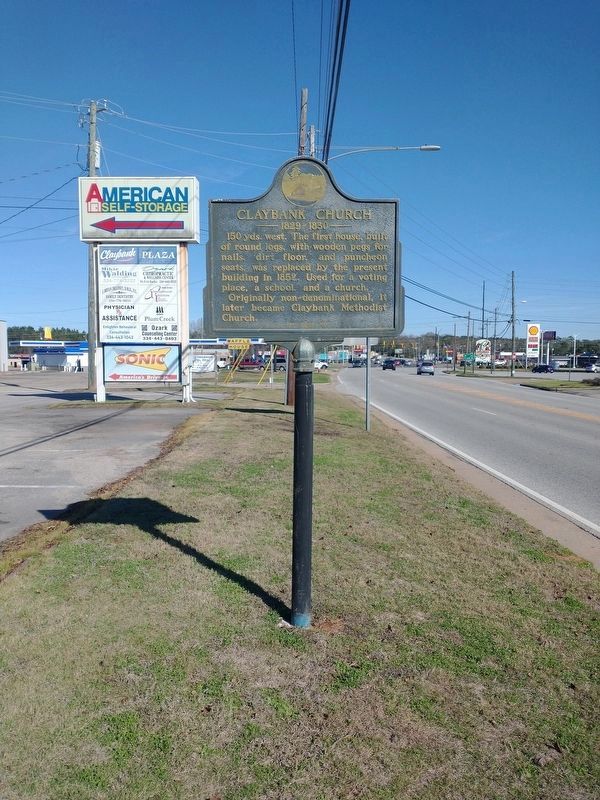
150 yds. west. The first house, built of round logs, with wooden pegs for nails, dirt floor and puncheon seats, was replaced by the present building in 1852. Used for a voting place, a school, and a church.
Originally non-denominational, it . . . — — Map (db m213369) HM
D. A. Smith High School
Dale County
The first school building on this site for African Americans was constructed in 1939 and was named Ozark Negro High School. It was replaced during the “separate but equal” period in 1952 and renamed to D. . . . — — Map (db m132087) HM
Building burned Dec. 1938
Rebuilt Sept. 1939
Ozark City School Board
T. C. Godwin • Jesse Adams • Sam J. Carroll • H. L. Holman • J.B. Mills, Chmn. • Mrs. Emma Flowers, Supt.
Building Committee
T. C. Godwin • Sam J. Carroll • B. . . . — — Map (db m267739) HM
Front
The original part of this building was home to one of the oldest
African American schools in Dale County. In 1949 on this site, the
new building for the Pinckard Colored School was constructed and
Mack M. Matthews became its . . . — — Map (db m115029) HM
The Beloit Industrial Institute was founded in 1888 by Industrial Missionary Association, an area subdivision of the American Missionary Associations. The President of the Association, Dr. Charles B. Curtis, was a Presbyterian missionary and . . . — — Map (db m83504) HM
St. Paul's African Methodist
Episcopal Church, like many
late 19th and early 20th century
churches, often established
societies and schools to help
African-Americans pull together
to cope with the challenges of
segregation.
Burial . . . — — Map (db m274590) HM
This school was the city of Selma's first public high school for African-Americans. Completed in 1949, the school was named in honor of Richard Byron Hudson, a black educator who had served for 41 years as principal of Clark Elementary School, . . . — — Map (db m82741) HM
Patton, a member of Shockley's Escort Company of the University of Alabama, was killed in a clash with the 4th Iowa Cavalry at the corner of Washington Street and Alabama Avenue. In November 1865 his father, Robert Miller Patton, was elected the . . . — — Map (db m83587) HM
In January 1885, Dr. Edward M. Brawley, President, Alabama Baptist Normal and Theological School (now Selma University) formed Tabernacle Baptist Church to be an integral part of the students' Christian formation and education. Significant . . . — — Map (db m82034) HM
Ernest Leon Doyle was born in 1918. He and Ruth Lee Willis were married
in 1942. Ernest worked as a carpenter, decorator, and insurance agent.
Ruth was a teacher and supplemented the family income as a beautician.
The couple had three . . . — — Map (db m308041) HM
Born in Tennessee, Sequoyah moved to Wills Town (DeKalb County, Alabama) area of the Cherokee Nation in 1818.
Here, in 1821, he invented an 86 symbol alphabet providing the Cherokees with the only written Indian language in the United . . . — — Map (db m261859) HM
The mission was established in 1823 by the American Board of Missions to further education and Christianity among the Cherokee Indians. Mission operated until the Indian removal in 1838.
Grave site of Reverend Ard Hoyt, first superintendent, . . . — — Map (db m261861) HM
(front)
No one knows for sure how Geraldine got its name. Some say it was named for a lovely Indian maiden. The first official record was on September 5, 1882 when Mr. William A. Johnson applied for the location of a new post office. The . . . — — Map (db m79905) HM
Here stood
The giant Black Spanish Oak
Under which
Traditionally
Sequoyah
Taught his newly invented
Alphabet
Tree felled by a storm
1934 — — Map (db m28036) HM
In the late 1930's and early 1940's Holtville School won national acclaim as one the foremost examples of the progressive education movement in the U.S. It was one of 33 southern schools in 1938 chosen to receive financial support in developing new . . . — — Map (db m83689) HM
Constructed in 1924 on five acres, this building was one of nine schools constructed in Elmore County with funding assistance from the Julius Rosenwald Fund. Between 1912-32, Julius Rosenwald, a Jewish philanthropist and CEO of Sears, Roebuck and . . . — — Map (db m70548) HM
W. B. Doby served as the first President of the Elmore County Teachers Association, Principal of Elmore County Training School, and as an ordained minister in the A.M.E. Church. Local leaders dedicated this school for African-American students on . . . — — Map (db m94614) HM
In 1920, a wooden building was constructed as the Atmore Colored School and operated until 1925. In 1926, a new wood and a brick building was erected with assistance from Rosenwald School fund and it was renamed the Escambia County Training School. . . . — — Map (db m100835) HM
Dr. J. M. Shofner (1863-1926) founder, dedicated his life to - "Give the boys and girls a chance."
Mr. Elisha Downing - Humanitarian.
First building erected named in
honor of Mrs. Esther Downing.
Trustees-1906: J. M. Shofner,
D. . . . — — Map (db m84374) HM
The Eleventh Street School, built in 1907, was one of the earliest elementary schools in Gadsden. It is the only local surviving school building of that era.
This two-story red brick structure has solid masonry exterior walls and an entrance which . . . — — Map (db m83734) HM
Sardis community derived its name from Sardis Baptist Church which was founded in 1882 on another site. There were 20 charter members. They met in a brush arbor until a building was completed in 1887, at this site. The church was a wooden, box frame . . . — — Map (db m156365) HM
The first settlers in the town of Bylor, named for
the Byler Road, were Jacob Hellums, William M.
Strong and Littleton Cole. The community grew with
the Georgia Pacific Railroad (later called Southern
Railroad), which was completed in 1883. The . . . — — Map (db m310068) HM
Located along the Byler Road, the earliest known
burial in New Liberty Cemetery is that of William
Smith in 1874. Established in 1901, charter members
for New Liberty Church were Thomas "Bud" Fowler,
Columbus Lonzo Fowler, William . . . — — Map (db m310077) HM
Alabama Christian College of Berry was located on this site from 1912-1922. The College was coeducational and was composed of Primary, Intermediate, Academic, Collegiate, Music Expression and Art Departments. Emphasis was placed on the teaching of . . . — — Map (db m163756) HM
Founded in 1889 by Mathew Freeman, who was born into slavery in 1854 and died in 1930. Shady Grove Missionary Baptist Church and Cemetery played an important role in Newtonville, Fayette County, and surrounding communities. He was a trailblazer and . . . — — Map (db m289192) HM
The first school building was built around 1900 by local citizens. The building was located just across from the Methodist Church. The building was a one-room structure & there were 2 teachers who taught at the school. All pupils walked to school & . . . — — Map (db m83748) HM
Reedtown High School is significant as the oldest remaining black
school and first black high school in Russellville. Although this
building opened in 1952. Reedtown School began 30 years earlier
as one of two Rosenwald Schools built in . . . — — Map (db m286458) HM
The eldest of G.W. and Nora Elliott's eight children, Carl Elliott was
born in Vina, Alabama, and raised on a farm on Gober Ridge. The
1930 valedictorian of Vina High School, Elliott left home at the age of
sixteen to attend the University of . . . — — Map (db m286454) HM
Mrs. Emma Knox Kenan established the library at the request of school superintendent W.W. Benson in a small cloak room of the Geneva School. The library was financed by subscriptions, book rentals and fund raisers. The property where the library now . . . — — Map (db m131869) HM
Tuskegee educator Booker T. Washington and Julius Rosenwald, Sears, Roebuck & Company president, initiated one of the most ambitiuous school building programs for African Americans in the United States. The Oak Grove School is one example of the . . . — — Map (db m83753) HM
Merged in 1918 as part of
Birmingham Southern College.
Founded here in 1856
by Methodist Church.
Weathered War and Reconstruction
to prosper in late 1800’s.
Moved to Birmingham in 1918
on merger with Birmingham College,
founded in . . . — — Map (db m83756) HM
One of state's notable academies.
Called “Rugby” of the South.
It prepared exceptional number
of Alabama leaders.
Founded by Dr. Henry Tutwiler,
one of state's foremost educators.
Closed upon his death.
One of first schools to . . . — — Map (db m203636) HM
Founded by Laura L. Ward. Building designed and constructed by Jim McCauley on land given by Glass Maybin. Classes began Sept., 1917. Principals who served school were: J. H. Jackson, W. R. Rosser, Felix Blackwood, Sr., and William B. Ward, Sr. . . . — — Map (db m71809) HM
Side 1
The Southeast Alabama Agricultural School
This school and experiment station was created by Alabama Legislative Act No. 579, February 28, 1889. This was the first school in Alabama to offer free secondary education. SAAS . . . — — Map (db m71808) HM
Lawrenceville
This early cultural, educational and religious center was settled in 1823 and named for Joseph Lawrence, prominent pioneer, farmer, and extensive land owner. A Baptist and a Methodist Church were established here prior to . . . — — Map (db m71825) HM
Newville High School
The first known school in Newville was at Center Church in 1881. When Grange Hall was built in 1891, church services and school were held on the first floor. In 1913, Grange Hall was torn down and the wood was used to . . . — — Map (db m71812) HM
After the creation of Houston County in 1903, the old Henry County branch courthouse on the public square in Columbia was converted into the Columbia Elementary School. A bell tower and this bell was added atop the main entrance of the two story . . . — — Map (db m176158) HM
(Front): Cowarts Baptist Church
Cowarts Baptist Church was founded in 1885 when dissension arose in the Congregation of Smyrna. Originally located beside the cemetery, the church was destroyed by fire during the 1890s. It was rebuilt . . . — — Map (db m64865) HM
Near this spot was the boyhood home of Rev. Bob Jones, (1884-1968), D.D., L.L.D., internationally known evangelist and founder of Bob Jones University. The eleventh child of W. Alexander and Georgia Creel Jones, he was three months old when the . . . — — Map (db m191348) HM
Side 1
Organized in 1882 at nearby Rocky Creek Methodist Church for educational purposes. This school, which occupied approximately seven acres surrounding this marker, was supported by the Methodist Episcopal Church North. This school . . . — — Map (db m73374) HM
The Town of Dutton was incorporated in 1963. The town was named after Marion M. Dutton. The prime reason for incorporating the area was to have an entity in place in order to form the Waterworks Board of Dutton and to be able to borrow government . . . — — Map (db m197512) HM
In 1905. the Methodist Episcopal Church. South. authorized Dr. Frank Gardner and his wife, Annie, to begin Flat Rock School In 1911, Flat Rock High School formally opened. It was the only high school on Sand Mountain north of Albertville. The North . . . — — Map (db m156167) HM
In 1931, at the height of the Great Depression, Paint Rock Valley citizens raised $2,625 to begin construction of a new school building. Residents gathered native field stones for the façade, which was 18 inches thick when completed. Local sawmills . . . — — Map (db m246852) HM
College Hill Historic District, located along College Avenue between Scott and Kyle Streets, was nominated to the National Register of Historic Places in 1979. This district was Scottsboro's first subdivision. The area was part of Charlotte Scott . . . — — Map (db m167089) HM
The Skyline School was built as part of the Skyline Farms Project, a self-help program that the United States government conducted in 1934-1945 for unemployed farmers. Started by the Federal Emergency Relief Administration, the program loaned . . . — — Map (db m167096) HM
During the Reconstruction Period following the Civil War, a freedmen’s community was established in this area called Averyville, named for the Pennsylvania minister and successful businessman Charles Avery, a longtime and faithful champion of Negro . . . — — Map (db m108803) HM
Thomas McAdory Owen, son of Dr. William Marmaduke
Owen and Nancy Lucretia McAdory Owen, was born
here on December 15, 1866, at the home of his maternal
grandparents, Thomas and Emily McAdory. A University
of Alabama graduate and lawyer, Owen . . . — — Map (db m215738) HM
Evalina Brown Spencer founded Highlands Day School in 1958, expanding a daycare she operated in her family's backyard. In 1962, Highlands moved from rented space in St. Luke's Episcopal Church to this site, on land donated by Joseph and Virginia . . . — — Map (db m201032) HM
From 1820 until 1878 this bell hung in the
belfry of the old Elyton courthouse, one-half mile northeast of this spot. In 1861
Jefferson County boys were mustered in
there and the bell tolled them off to war.
John Felix McLaughlin was one of . . . — — Map (db m216063) HM
In October 1963, the Bluff Park
Art Association began as a fundraiser
for the Bluff Park Elementary School
Library and was incorporated
November 2, 1965.
The founding members included:
Dorothy Copeland, Pres •
Jack A Pearson. Treas . . . — — Map (db m313144) HM
Southern members of the U.S. Congress in 1956 issued the "Southern Manifesto” that called the U.S. Supreme Court's Brown decision an "abuse of judicial power." By forcing public school integration contrary to social custom,
the high court had . . . — — Map (db m187661) HM
Shuttlesworth began to dedicate himself to the ministry and enrolled
in Cedar Grove Bible College, a Baptist institution in the Mobile suburb
of Pritchard. He took classes at night while he worked during the day.
The young couple added two more . . . — — Map (db m187628) HM
Birmingham's Black schoolchildren played an important role in moving the
city toward ending legal segregation. Under the leadership of SCLC field coordinators, thousands of children left their segregated schools to join the
marches in the downtown . . . — — Map (db m187682) HM
Many African Americans continued to push for the right to an equal
education that the 1954 Brown decision gave them. Despite angry
threats of violence and intense economic pressure, those first few African American families in Birmingham who chose . . . — — Map (db m187693) HM
Community civil rights leaders who helped organize the Movement and embraced the philosophy of nonviolence looked for well-disciplined children with good moral character who would at retaliate if they encountered bullying or violence by White . . . — — Map (db m187690) HM
Black leaders debated how best to educate their children to live in a racially segregated society. Former slave Booker T. Washington, founder
of Tuskegee Institute, was America's leading Black spokesman at the
turn of the 20th century and promoted . . . — — Map (db m187636) HM
[Note: a portion of the wording on the first panel of the marker has been torn away.(See photo #1)]Paired marker
September 9, 1957
In 1957, Rev. Fred Shuttlesworth and his followers in
the Alabama Christian Movement for . . . — — Map (db m187702) HM
The National Association for the Advancement of Colored People
(NAACP) used its Legal Defense and Educational Fund and its team of
skilled lawyers to attack the "separate but equal” education laws. Beginning in the 1930s, the NAACP filed lawsuits . . . — — Map (db m187658) HM
As Birmingham's civil rights leaders pushed to desegregate city schools, radical opponents in Birmingham pushed back, sometimes violently. Responses against school integration included death threats by telephone to parents who dared send their . . . — — Map (db m187686) HM
Immediately after the Civil War, Northern church groups funded by
sympathetic Whites rushed to the South to start elementary schools
and colleges to educate freed slaves. Soon afterward, Blacks took the
lead in educating their own children. . . . — — Map (db m187635) HM
Built 1923, 2316 7th Ave N.
Phillips High School was the flagship school in the center of Birmingham. It was named for John Herbert Phillips, the city's highly-esteemed first school superintendent, who served from 1883 until his death in . . . — — Map (db m187704) HM
Birmingham's first public school was named for Colonel James R. Powell, the city's first elected Mayor. This energetic promoter also served as the first President of the Elyton Land Company (now Birmingham Realty), which founded the city in 1871. . . . — — Map (db m83835) HM
Birmingham had the well-earned reputation of being America's deadliest
defender of segregation in the 1950s and 1960s. Civil rights leaders Rev.
Fred Shuttlesworth, head of the local Alabama Christian Movement for
Human Rights (ACMHR) and Dr. . . . — — Map (db m187681) HM
Many social scientists of the early 20th century promoted the false
belief that Blacks were intellectually and socially inferior to Whites and
fit only for service jobs. Blacks, therefore, did not deserve to be educated on the same level as . . . — — Map (db m187633) HM
In Alabama, White parents used the 1956 Alabama Pupil Placement Act that
let them “choose” which public schools their children would attend. When
Black parents in Birmingham tried to use the same law to send their children
to White schools, . . . — — Map (db m187685) HM
Birmingham’s first library was organized in 1886 and in 1891 became a subscription library for the general public. In 1908 the Birmingham Public Library Association established a free public library, and the City created an independent Library Board . . . — — Map (db m83856) HM
Thirteen years after the American Civil War, the U.S. Supreme Court
began to uphold Jim Crow segregation laws that kept African Ameri-
cans from enjoying their 14th Amendment rights. Its famous Plessy v.
Ferguson decision in 1896 supported a . . . — — Map (db m187632) HM
Southern governors, mayors and elected officials employed every means to
resist public school integration, even famously using armed state guards to
block Black students from entering. For example, Arkansas Gov. Orval Faubus
called the Arkansas . . . — — Map (db m187680) HM
On September 4, 1963, Graymont Elementary
School was the first public school in Birmingham
to be racially integrated. Two brothers, nine and
eleven years old, accompanied by their father,
James Armstrong, along with Reverend Fred . . . — — Map (db m153229) HM
Another goal of the ACMHR was school desegregation. ACMHR members
like barber James Armstrong filed lawsuits to put their children in
better-funded all-White schools after the U.S. Supreme Court's
landmark 1954 decision in Brown v. Board of . . . — — Map (db m189114) HM
September 1963
The increasing number of new African American
families moving onto Dynamite Hill required the
building of a new school. The city's segregation
laws prevented their children from attending
all-White Graymont Elementary, even . . . — — Map (db m189184) HM
Front of Marker:
Opened as Alabama Medical College in 1859 in Mobile by Josiah C. Nott and other physicians as part of the University of Alabama. Closed by the Civil War in 1861 it reopened in 1868. Reorganized in 1897, it became the . . . — — Map (db m83838) HM
Built 1992, 520 16th St. N.
The Birmingham Civil Rights Institute contains permanent exhibitions and photo galleries, offering visitors a self-directed
journey through the Civil Rights Movement of the 1950s and
1960s to the human rights . . . — — Map (db m187515) HM
In Tribute to
Carrie A. Tuggle
1858 - 1924
Scholar, Teacher and Christian.
A life of unselfish service
to the troubled and the
homeless black boys and girls.
In 1903, she founded
a school and orphanage,
the Tuggle . . . — — Map (db m27391) HM
Dedicated to
Dr. Ruth J. Jackson
1898-1982
This woman of strength and vision graduated from the Poro School of Cosmetology, the first black registered school in the State of Alabama. At the vanguard of the Civil Rights Movement, she was . . . — — Map (db m27090) HM
Emory Overton Jackson was born on September 8, 1908 in Buena Vista, Georgia to Will Burt and Lovie Jones Jackson. E. O. Jackson and his seven siblings were raised in the middle-class Birmingham enclave of Enon Ridge, located on the west side of town . . . — — Map (db m64736) HM
In Tribute to
Pauline Bray Fletcher
1878 - 1970
The First Black Registered Nurse of Alabama
Through self-sacrifice, perseverance founded in 1926 Camp Pauline Bray Fletcher.
Renewing the faith and the good health of all black . . . — — Map (db m27393) HM
Built in 1937 by Gen. Louis Verdier Clark from a design by architect William T. Warren as a community playhouse for cultural activities. It was recognized as one of the best of its kind in the nation. Mrs. Vassar Allen - first president, Bernard . . . — — Map (db m27513) HM
Raleigh B. and Edna Mae Kent donated this land to help provide an education for the families of the Oak Grove, Green Springs, and Shades Mountain communities. The wood-frame schoolhouse was completed in 1928 and named in honor of the Kent family . . . — — Map (db m291744) HM
In 1909, the township of Elyton built a school for African American children in Titusville on this site. Pioneer Black architect Wallace Rayfield, who lived nearby. selected the site. designed the building. and recommended the building contractor . . . — — Map (db m295298) HM
In 1850 George James Roebuck and his wife Ann Hawkins Roebuck built a log cabin at the mouth of Roebuck Spring. His Influence and leadership led to the area around it to be known as Roebuck. In 1900 Alabama Boys Industrial School was located . . . — — Map (db m26688) HM
Founded in 1841 at Marion in Perry County by Alabama Baptists, Howard College was named for British prison reformer John Howard.
The liberal arts college moved to this site in 1887 and relocated to its present campus in Homewood, Alabama in . . . — — Map (db m26693) HM
Miles College Leaders. Students Active During Civil Rights Era
The Colored Methodist Episcopal Church founded Miles College in
Fairfield in 1898. During the 1960s, President Lucius Pitts
encouraged students, faculty and staff to become . . . — — Map (db m153232) HM
Virgil Allen Howard, who was born in South Carolina in 1859, came to Alabama in 1884 seeking employment with the Alabama Waterworks. He and Ollie Grace Hogan were married on July 15, 1903 and made their first home in Gardendale on property they . . . — — Map (db m39221) HM
Multiple purpose Christian university founded 1841 as Howard College by Alabama Baptists at Marion.
Moved to East Lake, Birmingham, 1887. Established on this campus 1957.
Acquired Cumberland School of Law, Lebanon, Tennessee 1961. . . . — — Map (db m27296) HM
Nationally acclaimed Jefferson County School which originally served students from Homewood, Mountain Brook, Vestavia, Oak Grove, Irondale, Cahaba Heights, Hoover, Rocky Ridge, etc.
Opened Fall 1949, closed 1996, demolished 2000. Designed by . . . — — Map (db m47786) HM
This cemetery is the final resting place of many of Shades Valley's pioneer residents. A few of the earliest headstones date from the mid-1850s. Descendants of these settlers helped mold the cities of Mountain Brook and Homewood. Located on property . . . — — Map (db m26294) HM
Summit/Hale Sps., a one-room school, opened on the mountain in 1898. It moved to this site and was named Bluff Park Elementary School with 50 students and funded with community support in 1923. From two-rooms, it expanded to 32 classrooms in 1988. . . . — — Map (db m28486) HM
Just after the War Between the States Robert Berry Patton gave seven acres of land, logs from his sawmill to build a church, school and cemetery. He served as the first pastor. Fire destroyed the church in 1908 and 1938. The school served the area . . . — — Map (db m83915) HM
A subscription school organized in the 1850’s in Rocky Ridge Cumberland Presbyterian Church. Land deeded by church in 1881 to build a log school. In 1912, Professor E. D. Watkins taught all classes to the 30 students. In 1918, his 15 year old . . . — — Map (db m73065) HM
Indian, Wagon Trail, now Shades Crest Road, led to popular chalybeate springs. Summit, now Bluff Park, was a resort known for its view, cool air and healing mineral water. In 1899 school / church was built. In 1909 Bluff Park Hotel, built on land . . . — — Map (db m27311) HM
Indian, Wagon Trail, now Shades Crest Road, led to popular chalybeate springs. Summit, now Bluff Park, was a resort known for its view, cool air and healing mineral water. In 1899 school / church was built. In 1909 Bluff
Park Hotel, built on land . . . — — Map (db m28517) HM
51 Structures, 70% residential, built early 20th century to post World War II period.
The 1885 sale of Gardner Hale’s land began the housing development. The 33 acre 1924 Independent Presbyterian Church Children’s Fresh Air Farm, 1923 Bluff . . . — — Map (db m28518) HM
Front:
In 1915, the men of the Mt. Hebron Community cleared the land donated by Bess Simmons for a school. Trees donated by Mitch Poole were placed on Rufus Brasher’s wagon and taken to Will Scott’s sawmill. The school opened in the fall . . . — — Map (db m83918) HM
In 1821 the first settlers came to this area, later called Waddell. Large numbers of people first migrated here in 1863 with the construction of the Irondale Furnace. Destroyed in the Civil War, the furnace was rebuilt and operated from 1867 to . . . — — Map (db m26769) HM
Robert Jemison, Jr. (1878-1974)
The Father of Mountain Brook
A man of great vision, dreams and enthusiasm, Robert Jemison, Jr. was by far the greatest real estate developer of Birmingham’s 20th century. The Post-Herald newspaper . . . — — Map (db m83922) HM
In the late 19th century, mines began opening in West Jefferson County,
spurred by the expanding steel and iron industry in the Birmingham
district. As more mines opened, more families settled in the area during
the 1920s, creating a need to . . . — — Map (db m296446) HM
Named for Dr. Robert Green Hewitt one of the early educators in Trussville. Constructed by the Federal Government as part of the Cahaba Project. Construction of the new school began in September of 1937, at a projected cost of $310,680.72. It was . . . — — Map (db m287168) HM
In 1928, the county constructed a two-room schoolhouse with Ms. Ruby C.
Todd, a Jeanes Supervisor of Negro Schools, serving as teacher. The school
provided a 7th through 12th grade education for Black students. In 1935,
the school added five new . . . — — Map (db m302617) HM
19359 entries matched your criteria. Entries 101 through 200 are listed above. ⊲ Previous 100 — Next 100 ⊳