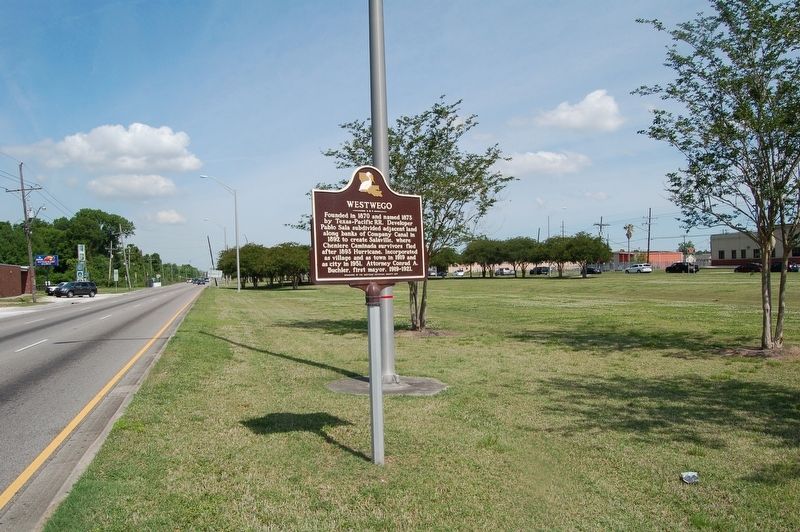
Founded in 1870 and named 1873 by Texas-Pacific RR. Developer Pablo Sala subdivided adjacent land along banks of Company Canal in 1892 to create Salaville, where Cheniere Caminada survivors fled after 1893 Hurricane. Incorporated as village and as . . . — — Map (db m116879) HM
Town incorporated in 1953; first mayor was Grady Stewart. Railroad (B.R.H.& E.) established Albany in 1907-08. Crossed by old north-south Turnpike Road from Springfield to Natchez, MS. On portion of Spanish Headright granted to Nancy Setton in 1801. — — Map (db m87573) HM
Known as Arpadhon, area is site of largest rural Hungarian settlement in U.S. Settlers attracted here in 1896 by Charles Brakenridge lumber mill. People bought cut-over timber land to farm and raise strawberries. — — Map (db m87550) HM
Mineral spring area near here owned by William Denham 1829-1855. Hotel near the springs built prior to the Civil War. Hill’s Springs post office renamed Denham Springs in 1898. The village was incorporated in 1903. — — Map (db m86398) HM
This historic site is the site of ground-water springs which at one time came to the surface.
This has figured into the city's name since at least the 1850's.
The area has been known as Amite Springs, Hill's Springs, & finally Denham . . . — — Map (db m147595) HM
Oldest in Livingston Parish. Organized in April 1837. First church was log cabin about 3 miles south of here. Frame church built at this site in 1859 on 4 acres of land. 1918 and 1955 larger churches built. Thomas M. Bond first pastor. — — Map (db m85155) HM
This small “pocket” park was renovated by the Denham Springs Main
Street organization and community partners. Members of the Denham
Springs Fine Arts Association painted the mural using photographs circa
1800s showing people drawing water
from . . . — — Map (db m145943) HM
William Oscar Osgood and his wife, Clara Rheams, owned and ran the Osgood General Merchandise Store on this corner for most of the first half of the 20th century, until it changed hands in 1943. The store was the center of a thriving community long . . . — — Map (db m189178) HM
"La Cote Francaise." Settled in 1800 via Amite River by French, German, and Italian "emigres." Jovial Creole culture was unique. Cypress sawmills, trapping, shingle making, farms and steamboat service once thrived here. — — Map (db m87501) HM
Organized in 1856. Existing building constructed in 1898. Oldest Baptist church building in Livingston Parish. Drinking water furnished by ground water spring. Surrounding area settled by Anglo-Saxon Protestants in 1800's. — — Map (db m88223) HM
Locally known by the above name, although the post office was named Springville. Served as parish seat, 1881 to 1941. Site of first electrocution in the state in 1941. Van Buren, the first parish seat, 1832-35, was on the east bank. — — Map (db m87787) HM
The M41 Walker Bulldog Tank began life in the late 1940s as the T41. It was the lightweight
member of a family of three tanks: T42 which became M47 (medium) and T43 which became M103
(heavy). The maneuverable tank had speed for modern . . . — — Map (db m233354) HM
The McDonnel Douglas F-4 Phantom aircraft was developed as superiority fighter and interceptor for deployment on
board U.S. Navy Aircraft carriers, "Flat Top" ships. It held the world speed record for more than 10 years, has a top
level flight . . . — — Map (db m233295) HM
The Jeep displayed here is actually a 1951 model jeep, distinguished from the 1942-45 WW II Army-Marine
model by its windshield without a divider bar. President Eisenhower generally traveled by Jeep, when
serving as General of the U.S. Army . . . — — Map (db m233296) HM
Surrounded by Lake Maurepas, the Amite River, Bayou Pierre, the Petite Amite, and Blind River. Lake named by Iberville in 1699 for Comte de Maurepas. Area settled by French, Spanish, and German immigrants. — — Map (db m87502) HM
Originally a Spanish settlement and early port on Amite River route from Mississippi River via Bayou Manchac. First called Scivicque's Ferry for Vincent Scivicque, native of Italy. Parish seat 1872-1881. — — Map (db m86003) HM
Originally a Spanish settlement and early port on Amite River route from Mississippi River via Bayou Manchac. First called Scivicque's Ferry for Vincent Scivicque, native of Italy. Parish seat 1872-1881 — — Map (db m96055) HM
A Spanish land grant acquired by James Rheims in 1804. Thomas Freeman, fmc, built "Sycamore" 1817-1820.
Colonel William Breed, first sheriff of Livingston Parish, purchased estate in 1838.
George Richardson acquired the property in 1856, . . . — — Map (db m86010) HM
Oldest town in Livingston Parish. Incorporated in 1838. Named for abundant ground water springs. Connected to old Natchez Trace. Site of a Spanish fort about 1800. Parish seat from 1835-1872. Old courthouse still stands. — — Map (db m87537) HM
In memory of Sallie Martinez Martin, for the dedication of this cannon on December 16, 2006, in honor of her great-grandfather, Johann Dreystadt, and the preservation of the history of Springfield, LA. Johann was born December 23, 1831 in . . . — — Map (db m86019) HM
Situated on El Camino Real (King's Highway), now LA Hwy 22, during Spanish reign (1783-1810). Site of stockade or small fort. In 1810 revolt against Spain, residents led by William Cooper remained loyal to Spanish authority. However, rebels led by . . . — — Map (db m86020) HM
Organized September 11, 1854, by elders J.L. Simpson and George H. Washington. Oldest church in the old 8th Ward. Church was a public school in early 1900's. Destroyed by storms in 1908-1909. Served by Old Fields P.O. 1856-1935. — — Map (db m85061) HM
Originally named Milton Old Field for Michael Milton who claimed land in 1853. Walker post office established in 1856. Named for Wm. E. Walker, MD, state legislator and organizer of Co. D 16th LA Inf., CSA. Town incorporated in 1909. — — Map (db m88243) HM
The Amite River Phase (4000-1500 B.C.) of the Archaic Period was a local variation of a pre-ceramic Indian culture in the area. Gravel lured Indians to the Amite River, which today remains important for this resource. — — Map (db m86004) HM
First official post office established near this site, February 20, 1894. Named after first postmaster, George W. Watson, whose family owned land that is now the center of Watson. — — Map (db m108981) HM
Often referred to as "the first man of jazz,” Charles Bolden began his musical career playing in string bands before switching to cornet and forming his own band in 1895. As was his tendency to play hot and loud, Bolden would begin his . . . — — Map (db m189068) HM
Panel 2 Born into an Afro-French household as Ferdinand Joseph
Lamothe, pianist, bandleader, songwriter, and arranger Jelly Roll
Morton is widely recognized as the first great composer in the
history of jazz. His early musical experiences in . . . — — Map (db m199674) HM
Panel 3 The son of a Baptist preacher, Joseph Oliver was born in Abend,
Louisiana. He came to New Orleans about 1900 and began
working as a cornetist several years later. Oliver's rise to
prominence was based on his ability with mutes. Was . . . — — Map (db m199711) HM
Panel 2 Trumpeter Oscar Celestin was born in Napoleonville, Louisiana,
and came to New Orleans to work with the brass bands after he
turned twenty-one. He organized a group of his own in 1910
but was also involved with projects on the side, such . . . — — Map (db m189325) HM
Panel 2 MISSING Panel 3 Jack Laine on drums, Jules Reiner-Piano, Herman Ragas-Brass. Seated on piano Alfred Laine, George Brunies, Charlie Cordella. "Papa" Laine interviewed by Richard B. Allen at a College Jazz Lecture on April 30, 1964. Panel 4 . . . — — Map (db m199704) HM
Panel 2 The son of a policeman, Alois Maxwell Hirt made his musical
debut at the Saenger Theater at age six with the Junior Police
Band. He gained a reputation as a prodigy on the classics,
but his first professional job was playing at the . . . — — Map (db m189328) HM
Erected in 1896 To replace the Duverjé Plantation House which served as the courthouse from 1866 until it burned in the great Algiers Fire of 1895.Barthelmy Duverjé acquired title to the Plantation in 1805 and in 1842 the property was subdivided . . . — — Map (db m116882) HM
Andre Seguin built the first dry dock in Algiers in 1819 on land purchased from Barthelemy Duverjé. As the City did not want ship building and repair businesses on their side of the river, those businesses blossomed along this side of the river, . . . — — Map (db m116923) HM
Henry Allen (1871-1952) trumpet player and
bandleader, and Henry "Red” Allen, Jr.,
(1906-1967), trumpet player, singer and
bandleader, lived here at 414 Newton Street
from 1906 until 1917. Henry Allen led the
Allen Brass Band an . . . — — Map (db m160931) HM
Henry Allen (1871-1952), trumpet player & bandleader, and Henry “Red” Allen, Jr. (1906-1967), trumpet player, singer, & bandleader, lived here at 921 Verret Street from 1918 until 1922. Henry Allen led the Allen Brass Band-- an . . . — — Map (db m163561) HM
Norman Brownlee (1896-1967), pianist, bandleader, instrument salesman, & Musicians’ Union official, lived here at 407 Delaronde Street from 1912 until 1922. He led his own Brownlee’s Orchestra from 1920 to 1930, which included Emmet Hardy, Arthur . . . — — Map (db m162898) HM
Panel 1 Danny Barker and Louise Dupont were married in 1930 and moved to New York. "Blue Lu" Barker spent a decade recording for Decca, Apollo and Capitol, specializing in the blues and saucy songs such as her husband's "Don't You Make Me High" and . . . — — Map (db m163873) HM
Dolly Marie Douroux Adams (1904-1979) was one of the few
women instrumentalists in the male-dominated early jazz scene.
The daughter of Olivia Manetta and Louis Douroux, she
played piano as well as bass, drums, guitar, and trumpet.
Adams began . . . — — Map (db m191602) HM
Algiers Point evolved from the plantation of Barthelemy Duverjé. The Duverjé home was built c. 1812-16, and served as the Algiers Courthouse from 1866. It was destroyed by the Great Fire of Algiers in 1895 and replaced by the current structure in . . . — — Map (db m117057) HM
Panel 2 Born in LaPlace, Louisiana, trombonist Edward Ory began his
musical career at age ten. He moved to New Orleans on his
twenty-first birthday and quickly established himself as a
successor to Buddy Bolden. While Bolden's band . . . — — Map (db m200150) HM
In the 1720s, at a spot of land now eroded by the river, stood the barracks where enslaved Africans from the Senegal-Gambia region, were held before being ferried across the river to the slave auctions. Early Algiers Point was also the home of the . . . — — Map (db m116900) HM
Panel 2
The Original Creole Band Before recordings spread the New Orleans jazz sound throughout
the nation and abroad in 1917, a number of New Orleans musicians
had already brought the city's special style of instrumental
ragtime to audiences . . . — — Map (db m199687) HM
Emmet Hardy (1903-1925), cornetist and machinist, lived here at 237 Morgan Street from 1920-1923. He played in Brownlee’s Orchestra, the New Orleans Rhythm Kings, and in small groups with violinist Oscar Marcour, the Boswell Sisters, and drummer . . . — — Map (db m162765) HM
Panel 2 Henry Allen grw up right here in Algiers. As a boy, he heard Louis Armstrong and his father's band. He would learn to play trumpet in that same band. After playing in various New Orleans groups, he joined the King Oliver Band. They toured . . . — — Map (db m189159) HM
Algiers, established in 1719, is the second oldest neighborhood in New Orleans. Originally called the "King's Plantation," it was first used as the location for the city's powder magazine, a holding area for the newly arrived African slaves, and . . . — — Map (db m116901) HM
Panel 1 • Willie J. 1900-1994 • Willie E. 1880-1964 • Percy 1900-1995 • Earl 1902-1971 • James 1859-1937 Panel 2 One of the factors that make the music scene in New Orleans so
special is the presence of musical dynasties, families that . . . — — Map (db m191333) HM
Panel 1 During his early years in New Orleans Louis Armstrong drew
upon the entire spectrum of music associated with the city. He
spent time following Joe Oliver in the "second lines” which
accompanied brass bands. By the time he was . . . — — Map (db m160939) HM
Louis Armstrong, adoringly referred to as “Satchmo," was born August 4, 1901, but chose to celebrate his birthday on July 4th,America's Independence Day. He was the first important jazz soloist and became its most influential musician. As a . . . — — Map (db m116892) HM
Panel 2 Trumpeter Louis Prima can best be described as an American
music original. In a career spanning fifty years, he was one of
the very few jazz musicians to keep abreast of stylistic changes
in popular music, going from jazz, to swing, to . . . — — Map (db m200149) HM
Manuel “Fess” Manetta (1889-1969), pianist, violinist, trombonist, trumpeter, saxophonist, and teacher, lived here at 331 Alix Street from 1913 until 1923. He played in bands with Buddy Bolden, Frank Duson, Edward Clem, Tom Albert, Papa . . . — — Map (db m163269) HM
Manuel Manetta (1889-1969) was a versatile musician and music
teacher who played piano, violin, guitar, mandolin, string bass
trumpet, clarinet, and saxophone. As a Creole of Color whose
Sicilian grandfather was a portrait painter, Manetta began . . . — — Map (db m191601) HM
Oscar J. Marcour (1895-1956), violinist and bandleader, lived here at 431 Opelousas Ave from 1917 to 1919. He played with the Jules Bauduc Orchestra at the Silver Slipper, made and Edison Dictaphone recording c. 1918-1919 at pianist Norman . . . — — Map (db m160934) HM
Panel 2 The phonograph was the medium that took New Orleans jazz from
the city's streets and dance halls to the attention of the world.
Despite the early travels of New Orleans musicians, it was the
Original Dixieland Jass Band's recordings in . . . — — Map (db m199710) HM
Once connected by a mule-drawn streetcar, Algiers and Gretna are now linked by this path of history. Follow the markers along the "Right Bank of the Mississippi River" to historic downtown Gretna, as many have done since the 1800's. — — Map (db m160913) HM
Panel 2 Sidney Bechet may have been the first New Orleans jazz musician to go beyond the early ensemble format into solo improvisation. He
established a reputation as a child prodigy working his way through
the best dance bands in town. . . . — — Map (db m189061) HM
Panel 2 Although the Boswell Sisters will forever be associated with New
Orleans,-they were born elsewhere. Martha and Constance were
born in Kansas City, Missouri, and Helvetia was born in
Birmingham, Alabama. Their father, who had been in . . . — — Map (db m189157) HM
In the early morning hours of October 20th, 1895, on the 300 block of Morgan St., near the corner of Bermuda St., a fire started that would eventually destroy about 200 homes and businesses in ten blocks between Morgan, Lavergne, Alix and Powder . . . — — Map (db m116888) HM
Although this land was purchased by the U.S. Government from Jean P. Dupiere in 1849 as a proposed Navy Yard, a U.S. Naval Station was not formally established here until 1901 when a dry dock arrived. More land was purchased from the Olivier, . . . — — Map (db m129683) HM
The transatlantic slave trade to Louisiana began in 1718, with the first of two ships bringing African captives to the region in 1719. The first ship to arrive at this site was the Expedition, which landed 91 enslaved people, most from the . . . — — Map (db m157916) HM
“Kid” Thomas Valentine (1897-1987), trumpeter and bandleader, lived here at 825 Vallette Street in 1928. Born in Reserve, LA he moved to Algiers in 1923. He played at Speck’s Moulin Rouge in Marrero and Fireman’s Hall in Westwego in the . . . — — Map (db m161017) HM
The land in front of this house, from the Mississippi River to the universities, was once a plantation acquired by Pierre Foucher in 1793. Several of the massive oak trees from the Foucher property survive to this day. Upon Pierre's death, his . . . — — Map (db m261586) HM
The history of the land bordered by St. Charles Avenue, Exposition Boulevard, Walnut Street and the Mississippi River - now known as Audubon Park - is as rich as any New Orleans tale. Originally comprised of abutting tracts of plantation land owned . . . — — Map (db m114287) HM
In the 1950's, Audubon Zoo became the first zoo to successfully breed whooping cranes. The only previous captive birth was at a Texas wildlife refuge. That chick's mother, Josephine, hailed from Audubon Zoo. One of only two remaining cranes from a . . . — — Map (db m117218) HM
This site 1781-1820 plantation of Jean Etienne Boré (1741-1820) First Mayor of N.O. 1803-1804. Here Boré first granulated sugar in 1795. Purchased for park in 1871. Site of World's Industrial & Cotton Centennial Exposition 1884-1885. — — Map (db m117167) HM
Captain Le Verrier Cooley (1855-1931) one of the last of the old-time Mississippi River steamboatmen built this house in 1896 and made it his home until 1925. Captain Cooley's career on the river spanned 62 years and he operated no less than 7 . . . — — Map (db m183902) HM
By 1893, Audubon Park was starting to resemble a modern city green space. As interest in improving the park grew, its leaders corresponded with several well-known designers, including Frederick Law Olmsted, to discuss the park's future. In 1898, . . . — — Map (db m114194) HM
George Dedroit (1859-1936), cornetist and bandleader, John “Johnny” Dedroit (1892-1988), and Paul Dedroit (1894-1963), drummer and percussionist, lived here at 6119 Camp Street from 1917 to 1936, 1929, and 1929 respectively. George led his own . . . — — Map (db m261602) HM
John “Johnny” DeDroit (1892-1988) cornetist, and bandleader, lived here at 737 Henry Clay Avenue from 1929 until 1933. He was a cornet soloist at age 12 at the Winter Garden Theater on Baronne St., and subsequently played every New . . . — — Map (db m51491) HM
In 1884, Audubon Park was the site of the
World's Industrial and Cotton Centennial Exposition. Featuring
exhibitions celebrating the 100th anniversary of the cotton industry
in the United States, the exposition opened on December 16, 1884.
One . . . — — Map (db m261573) HM
Founded 1886 as the Coordinate Women's College of Tulane University by Josephine Louise Le Mommier Newcomb (1816-1901) in memory of her daughter Harriott Sophie Newcomb (1855-1870).Originally located in the former Thomas Hale House at Camp Street . . . — — Map (db m114187) HM
Built in 1870 in Gothic Revival style for John Howard Ferguson an attorney who came to Louisiana from Martha's Vineyard and served in the Louisiana Legislature from 1877 to 1880 and then became a judge in Criminal District Court. The House remained . . . — — Map (db m156389) HM
Purchased in 1965 by The Saint Charles Avenue Presbyterian Church And named in honor of its first pastor and Pastor Emeritus The Rev. Dr. John Samuel Land (1893-1993)Dr. Land was born in York County, South Carolina and graduated in 1914 from . . . — — Map (db m156464) HM
Described at the time it was built as an "Old Colonial Cottage."
Sully was born in Mississippi in 1855 and trained in New York and Texas after which he set up practice in New Orleans where he became one of the city's leading architects. . . . — — Map (db m156755) HM
On January 7, 1815, the eve of the Battle of New Orleans, Ursulines and townsfolk prayed for victory, before the Virgin's statue, now in this National Shrine of Our Lady of Prompt Succor. Ever after, first St. Louis Cathedral and since 1851 in the . . . — — Map (db m104776) HM
The Newcomb Pottery Garden honors the artistic legacy of Newcomb Pottery, a quasi-commercial enterprise established in the late 19th century in association with the curriculum of Newcomb College...During its forty-five years in existence, the . . . — — Map (db m114188) HM
Erected 1928-1930. W.W Van Meter, Architect and Builder. A gift to the congregation from Alice Affleck Bloomfield in memory of her husband William B. Bloomfield John Samuel Land, Pastor, 1917-1959 Stained glass windows by Oidtmann . . . — — Map (db m114224) HM
The people of south Louisiana stem from many diverse and varied ethnic backgrounds. The cooking, music, dancing, and folklore of this region reflect their origins in Europe, Africa, Asia, and the Caribbean. The first Europeans to colonize south . . . — — Map (db m117199) HM
In the spring of 1927, relentless rains and northern melt caused the mighty Mississippi to overflow its banks. More than 27,000 square miles of land from Illinois to Louisiana were submerged and nearly one million people were left homeless. In . . . — — Map (db m117203) HM
Affectionately Dedicated
To The Memory of
Joseph Gumbel In recognition of his enthusiastic, persistant and effective efforts in the improvement of international friendship, trade and understanding. **** Trees from many friendly nations were . . . — — Map (db m261629)
According to a famous story, a Louisiana Black Bear was the inspiration for the first “teddy bear.” In 1902, President Theodore “Teddy” Roosevelt was hunting in Louisiana and Mississippi. The hunt went on for days without . . . — — Map (db m117201) HM
A "trenasse" is a small waterway in the brackish marsh, important to trappers for gaining access to furbearing animals. Some trenasses are natural, many more are created by man, often using a homemade craft like this one. The rotating blades in . . . — — Map (db m117198) HM
Tulane Stadium was the original home of the National Football League's New Orleans Saints from 1967-1974. The Saints' first regular season game was held on September 17, 1967. Most notable for John Gilliam's returned 94-yard kickoff return on the . . . — — Map (db m114221) HM
Founded in 1834 as the Medical College of Louisiana
which later became the state chartered
University of Louisiana.
Endowed in 1884 as the Tulane University
by PAUL TULANE (1801-1887),
Princeton, New Jersey philanthropist and
former . . . — — Map (db m271410) HM
Formed in 1938, it was unsuccessful at first, it was reorganized in March of 1940. United cab was the first cab company to go against Yellow Cab who had control of all the cab stands in the city. The organization faced an up hill battle with Yellow . . . — — Map (db m296820) HM
About 1834, Évariste Blanc had this Greek Revival mansion built on his Bayou St. John estate. His widow, Marie Fannie Labatut Blanc, planned to give the property to the Archdiocese of New Orleans for a parish church as early as 1855 .Fifty years . . . — — Map (db m104705) HM
Original depression-era Poor Boy sandwiches, made like way back when. If you're looking for a bite of history, look no further.
Streetcar Poor Boy
The first Poor Boy ever made by the Martin Brothers to feed the striking streetcar . . . — — Map (db m296815) HM
Original depression-era Poor Boy sandwiches, made like way back when. If you're looking for a bite of history, look no further.
Streetcar Poor Boy
The first Poor Boy ever made by the Martin Brothers to feed the striking streetcar . . . — — Map (db m296818) HM
Home of James Pitot, who was first Mayor of incorporated City of New Orleans, 1804-1805. Also Builder of one of the City’s first cotton presses. — — Map (db m86023) HM
The first French settlement was in the New Orleans area established here in 1708. The original site of this house was acquired by Don Bartholome Bosque who began its construction in 1799. Being completed by Joseph Reynes in 1800. It was owned by . . . — — Map (db m296142) HM
Home of James Pitot (1761 - 1831). Pitot was the first Mayor of the incorporated city of New Orleans, 1804- 1805. Also builder of one of the city's first cotton presses. Bought this house in 1811. Built around late 18th century. — — Map (db m296143) HM
The Grotto to Our Lady of Lourdes was established by Edna Pascual DeLucca on June 24, 1951 in gratitude to Our Blessed Mother for her son's safe return from World War II.
Restoration was completed by Christina DeLucca in 2017 in memory of her . . . — — Map (db m296137) WM
Short trail from Lake Pontchartrain to River shown by Indians to Iberville and Bienville, 1699. Winding trail used by early travelers to city. From Bayou St. John it led to N. Broad, Bayou Roads, Vieux Carre to Mississippi River at site between . . . — — Map (db m56026) HM
In 1909, a group of laborers went to the Pythian Temple Theatre
to see a musical comedy by the Smart Set. A skit portraying a
Zulu Tribe had as its title,
"There Never Was and Never Will Be a King Like Me".
They made their first appearance as . . . — — Map (db m150049) HM
1941
Paul (Junior) Weber, Oswald Tucker, and Lionel Acy by 1938 Chevy taxi in front of United Cab at 1401 Poydras St. Mr. Weber was a board member for nearly thirty years. Mr. Tucker and Mr. [bottom part of caption is not visible].
. . . — — Map (db m296830) HM
Erected A.D. 1919 by the people of this the Ninth Ward in honor of its citizens who were enlisted in combative service and in memory of those who made the supreme sacrifice for the triumph of right over might in the Great World War.
White men . . . — — Map (db m95670) WM
1035 entries matched your criteria. Entries 101 through 200 are listed above. ⊲ Previous 100 — Next 100 ⊳