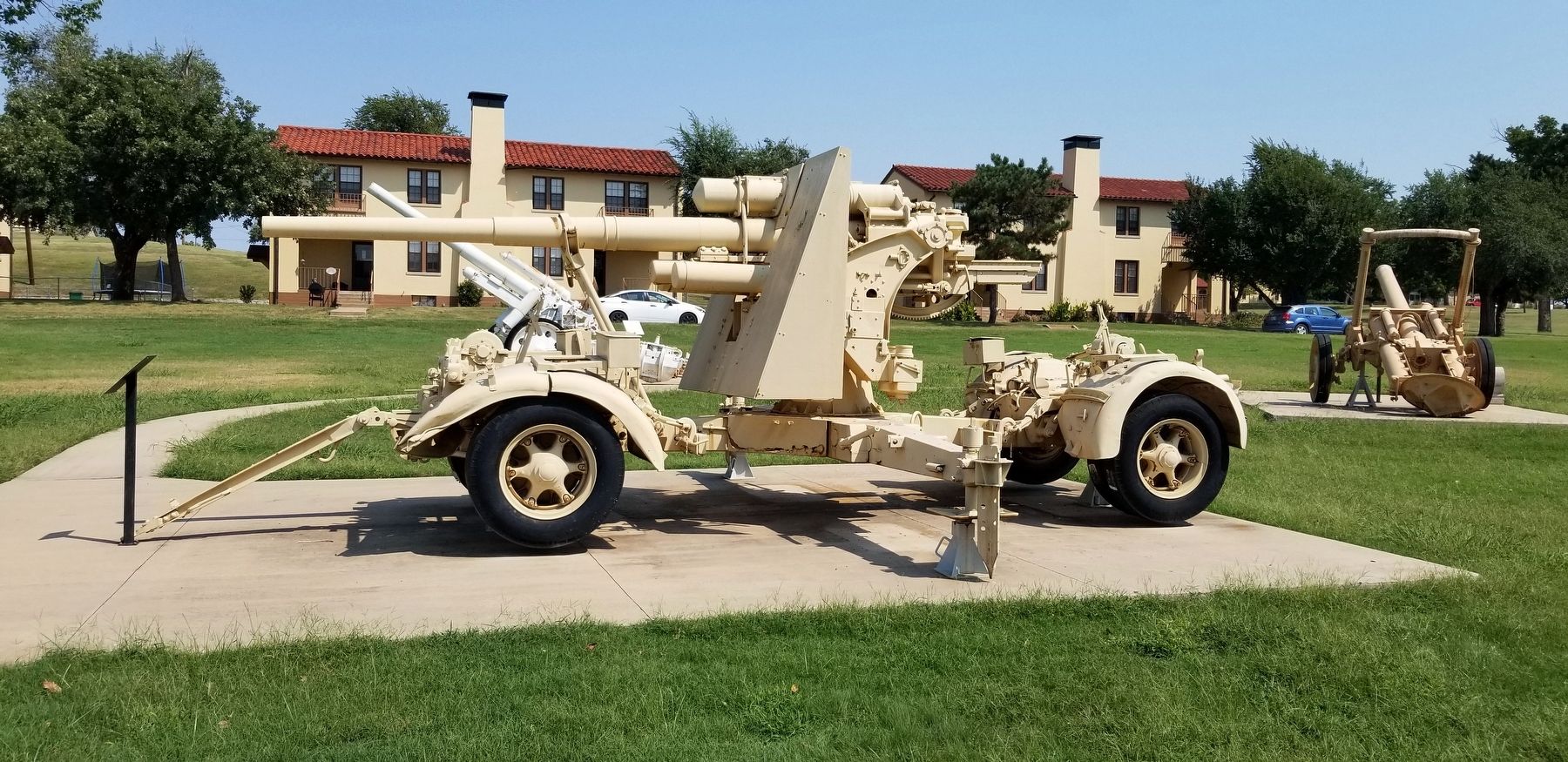
On Corral Road at Randolph Road, on the right when traveling west on Corral Road.
The most famous of all artillery in World War II was the dreaded German 88. First designed as an anti-aircraft weapon, it entered service in 1933 as the Flak 18. In 1936, the Flak 36 with a multi-sectioned barrel was introduced. This feature . . . — — Map (db m193259) HM
On Corral Road at Randolph Road, on the right when traveling west on Corral Road.
The famous Czech armament maker, Skoda, produced a 22cm prototype of this heavy mortar. The German High Command directed that the caliber be changed to 21cm to utilize the German standard ammunition. The first GrW 69s were produced in November 1944 . . . — — Map (db m193214) HM
On Corral Road at Randolph Road, on the right when traveling west on Corral Road.
In the late, 1920s the requirement for the heavy 100mm gun was given to the two rival companies of Krupp and Rheinmetall. The production model was an amalgamation of both designs with the Rheinmetall gun on a Krupp carriage. Introduced in 1933, a . . . — — Map (db m193504) HM
Near Corral Road at Randolph Road, on the right when traveling east.
The development of this cannon by Rheinmetall began in 1933 as a replacement for the aging 15cm Kanone 16. Entering service as the German Army's standard heavy gun in 1938, it weighed two tons more than its predecessor and only gave 2,500 yards . . . — — Map (db m182364) HM
On Corral Road at Randolph Road, on the right when traveling west on Corral Road.
Designed by the German famous arms company, Krupp, this powerful gun entered service in 1941. It was primarily used for long-range counter-battery fire at the corps level. The K-18 used the same carriage as the 21cm Mörser 18, which has a . . . — — Map (db m193260) HM
On Corral Road at Randolph Road, on the right when traveling west on Corral Road.
This special lightweight recoilless weapon was introduced in 1943 for service with German Airborne units. It was similar in principle of design to the German 75mm airborne gun L.G. 40. The LG was produced in three variations with the only difference . . . — — Map (db m193263) HM
On Corral Road at Randolph Road, on the right when traveling west on Corral Road.
The M1916 was an improved version of the heavily used M1896 77mm Field Gun. Because of the greatly increased use of indirect fire in World War I, the M1916 featured the 77mm Gun on the carriage of the M1916 Light Field Howitzer. This increased the . . . — — Map (db m193125) HM
On Quanah Road west of Chickasha Road, on the left when traveling west.
This building was originally constructed in 1870 to serve as the commissary storehouse. It is unique among all the historic buildings, having started as a horizontal, log structure resting on a stone foundation over 200 feet in length. By 1872, the . . . — — Map (db m60884) HM
On Quanah Road at Chickasha Road, on the right when traveling east on Quanah Road.
The structures on the east and west ends of the south line of buildings were originally constructed as warehouses by troops of the 10th Cavalry and 6th Infantry from 1872 to 1875. In 1876, the buildings were briefly occupied by troops of the First . . . — — Map (db m190850) HM
On Harry Road at Randolph Road, on the right when traveling east on Harry Road.
The Soviet S-60 57mm anti aircraft gun was a further development of the German 5cm Flak 41. Soviet designers looked to improve on the German piece and in the late 1940s created the prototype S-60 which subsequently entered service by 1950. A . . . — — Map (db m182405) HM
On Corral Road at Randolph Road, on the right when traveling west on Corral Road.
A powerful self-propelled gun was needed by the Italian Artillery to support their armored units. Only this M149/40 was completed at the Ansaldo Factory in Genoa in late 1942. It used the excellent Model 35 149mm Cannon on a highly modified Carro . . . — — Map (db m206499) HM
On Corral Road at Randolph Road, on the right when traveling west on Corral Road.
Introduced in 1908, the Type 41 was originally the standard Japanese pack artillery piece. When it was superseded by the Type 94 75mm mountain pack gun in 1934, the Type 41 was re-designated as an infantry "regimental" gun. Japanese weapon type . . . — — Map (db m206523) HM
On Corral Road at Randolph Road, on the right when traveling west on Corral Road.
The most modern of the Japanese Field Artillery of World War II was the 75mm Field Gun Type 90, which was loosely based on the French Schneider 85mm Gun, Model of 1927. The Type 90 designation came from its acceptance into Japanese Army service in . . . — — Map (db m206522) HM
On Harry Road at Randolph Road, on the right when traveling east on Harry Road.
Development of the X-7 series of unmanned aircraft began in December 1946, when the US Army Air Force requested an unmanned ramjet test vehicle for speeds up to Mach 3 and by the mid-1950s, as the Nike Ajax, Nike Hercules and Bomarc surface-to-air . . . — — Map (db m182406) HM
On Harry Road at Randolph Road, on the right when traveling east on Harry Road.
The M51 Skysweeper project began in 1948 and was a significant evolutionary step in Air Defense Artillery. Anti aircraft guns had advanced steadily during World War II, utilizing radar and analog computers (known as gun directors) to lay an entire . . . — — Map (db m182407) HM
On Harry Road at Randolph Road, on the right when traveling east on Harry Road.
The MIM-14 Nike Hercules was the most widely used of the U.S Army's Cold War missile systems. Implemented in 1958, the Hercules had several improvements over the Nike Ajax. It used solid fuel propellant and could use either high explosive or nuclear . . . — — Map (db m182431) HM
On Harry Road at Randolph Road, on the right when traveling east on Harry Road.
The MIM-23 Hawk was a U.S medium range surface-to-air missile that entered service in 1960. Originally intended to destroy enemy aircraft, the "Homing All the Way Killer" evolved into a theater ballistic missile interceptor during its thirty-five . . . — — Map (db m182453) HM
On Harry Road at Randolph Road, on the right when traveling east on Harry Road.
The Nike Ajax was the world's first surface to air guided missile and revolutionized Air Defense around the world when it became operational at Fort Meade, MD in December 1953. The Ajax was a two stage, supersonic missile designed to defeat high . . . — — Map (db m182430) HM
On Harry Road at Randolph Road, on the right when traveling east on Harry Road.
The HIPAR, or High Power Acquisition Radar was used for target acquisition, scanning the horizon out to a horizontal range of over 100 nautical miles and up to a vertical range (altitude) of over 148,000 feet (over 28 miles) for incoming hostile . . . — — Map (db m182452) HM
On Chickasha Road at Quanah Road, on the right when traveling north on Chickasha Road.
In 1869, a limestone deposit was found southeast of what is now Old Post, Fort Sill. A quarry was opened and the soldiers of the 10th Cavalry cut the rock and started the walls of the garrison buildings. Crude kilns were erected to burn lime for . . . — — Map (db m190847) HM
On Hanley Road 0.2 miles south of Randolph Road, on the right when traveling south.
A pentagonal redoubt, mounting a small cannon, was constructed here about 1872 to defend the southwestern aproaches to the post against Indian attack. It was torn down at the close of the Indian wars, about 1875. — — Map (db m191010) HM
On Ganahl Road at Back Access Road, on the left when traveling north on Ganahl Road.
The "Old" Post Chapel was constructed in 1875 by elements of the 11th Infantry and the 4th Cavalry under the command of General Ranald S. McKenzie. The sum of $2,500 was appropriated for the purchase of materials for the erection of a chapel & . . . — — Map (db m47147) HM
This building was constructed in 1872-73 by the
"Buffalo Soldiers" of the 10th Cavalry Regiment, after the barracks and quarters of the Post were completed. Prior to this time, prisoners were kept in the basement of the Cavalry barracks . . . — — Map (db m82376) HM
On Quanah Road west of Chickasha Road, on the left when traveling west.
Erected in 1870, and built of limestone quarried from a nearby hill, the Post Headquarters building housed the administrative offices. The Commanding Officer, his executive officer, the adjutant, a sergeant and a signal officer worked here. The . . . — — Map (db m60883) HM
The M-107 SPG (Self-Propelled Gun) entering into the U.S. Army Service in 1963 as a replacement for 155MM M44 and M53 SPG's of the 1950's.
The M-107 SPG was soon pressed into service in South Vietnam as the U.S. Artillery's longest range . . . — — Map (db m82382) HM WM
On Fowler Street at Randolph Road, on the right when traveling south on Fowler Street.
While the actual construction date of this building is unclear, it was being used by the quartermaster for the storage of grain in 1902. The 30'x80' wood frame structure with a full-length, limestone basement is unlike the other buildings erected in . . . — — Map (db m190956) HM
On Randolph Road at Fowler Road, on the right when traveling east on Randolph Road.
The post quartermaster was one of the more important positions on a frontier army post. Line officers were temporarily assigned to this rather demanding job, often making them the most sought after individual on post. He was responsible for . . . — — Map (db m191008) HM
On Quinette Road 0.3 miles north of Upton Road, on the right when traveling east.
In memory of William H. Quinette, Post Trader, 1878-1915. Old crossing on road to Fort Cobb. General Sheridan's HQ mess tent was pitched here 10 Jan - 23 Feb 1869 when he founded Fort Sill. — — Map (db m82383) HM
On Boundary Road 0.4 miles south of Sheridan Road, on the right when traveling south.
The noted Kiowa chief Sitting Bear (Satank) of the Society of the Ten Bravest was killed beside an elm tree 400 feet due west of here on June 8, 1871, while attacking 4th Cavalry guards. — — Map (db m60882) HM
On Hamilton Road 0.1 miles west of Chickasha Road, on the right when traveling west.
This house of native stone was built by 10th Cavalry Troops in 1870-71. While visiting Fort Sill, General William Tecumseh Sherman narrowly escaped death at the hands of Kiowa warriors during a council held on the front porch here. May . . . — — Map (db m190949) HM
On Quanah Road at Geronimo Road, on the right when traveling west on Quanah Road.
Dedicated to the Memory of Brigadier General Joshur W. Sill, 1831-1862. General Philip H. Sheridan Named This Fort in Honor of General Sill 2 July 1869. — — Map (db m190948) WM
On Corral Road at Randolph Road, on the right when traveling west on Corral Road.
In 1975 during operations in Angola, South Africans found that its 140mm gun was out-ranged by the enemy's Soviet-made artillery. As a result, the G-5 was developed. It became operational in 1983 and featured an exceptionally long range. Its . . . — — Map (db m217045) HM
On Corral Road at Randolph Road, on the right when traveling west on Corral Road.
The D-20 was the principal Soviet heavy-towed howitzer of the first half of the Cold War. It was developed after World War II as a replacement for the M1937 152mm Howitzer. The D-20 was introduced in 1955 and is also known as the M-1955. The D-20 . . . — — Map (db m216912) HM
On Corral Road at Randolph Road, on the right when traveling west on Corral Road.
Introduced in the early 1960s, the D-30 has been the primary light towed artillery piece of the Soviet Army. It replaced the Soviet M1938 122mm Field Howitzer. It featured a longer, stronger barrel for increased range and traversed 360° (versus the . . . — — Map (db m216958) HM
On Corral Road at Randolph Road, on the right when traveling west on Corral Road.
The D-44 entered service with the Soviet Army in late 1945 as a multi-purpose weapon. It served as both a divisional field artillery gun and as a powerful anti-tank gun. Development of the D-44 began in 1943 and was derived from the gun on the . . . — — Map (db m216514) HM
Near Corral Road at Randolph Road, on the right when traveling west.
This was the heaviest of the Soviet field artillery weapons in World War II. Known as the B-4, this large powerful howitzer was mounted on three different carriages with the first two on wheels. The most successful carriage used tracks, which was a . . . — — Map (db m193490) HM
On Corral Road at Randolph Road, on the right when traveling west on Corral Road.
The Model 1931/37 was one of the Soviet Union's long range guns of World War II. The 122mm Field Gun M1931/37 (A-19) was composed of the tube of the 122mm Field Gun M 1931 mounted on the carriage of the 152mm Gun Howitzer M1937. This weapon proved . . . — — Map (db m206525) HM
On Corral Road at Randolph Road, on the right when traveling west on Corral Road.
The Model 1938 weapon was one of the most popular and successful Soviet designs of World War II. Even though it was a completely new design, it was still able to fire the same projectiles as its predecessor, the Model 1910/30. The M1938 was the . . . — — Map (db m193491) HM
On Harry Road at Randolph Road, on the right when traveling east on Harry Road.
Like its German, American and British counterparts, the Soviet 52-K 85mm anti aircraft gun was designed as a heavy air defense gun, but was quickly adopted for multi-role use. It was designed in 1939 and served with Soviet and Warsaw Pact nations . . . — — Map (db m182396) HM
On Corral Road at Randolph Road, on the right when traveling west on Corral Road.
This was originally a Soviet built 76.2mm Field Gun Model 1939. The M39 was a new design by artillery engineer, Vasiliy Grabin, of Joseph Stalin Factory No. 2 in Gorky. Also designated the F-22 USV, the M39 was an entirely new design that solved the . . . — — Map (db m193201) HM
On Corral Road at Randolph Road, on the right when traveling west on Corral Road.
Developed in the early 1950s, the M1954 (M-46) was first seen in the 1954 May Day Parade in Moscow. It was assigned the NATO M1954 model designation. The Soviet designation is the M-46 and it replaced the smaller 122mm M1931/37 A-19 Field Gun. The . . . — — Map (db m216959) HM
On Corral Road at Randolph Road, on the right when traveling west on Corral Road.
The M1973 entered Soviet Army service in the early 1970's. It replaced the main large-caliber, towed artillery piece of Soviet artillery brigades and divisions, the M-46 130mm Field Gun. M1973 was the NATO designation assigned when this . . . — — Map (db m216520) HM
On Corral Road at Randolph Road, on the right when traveling west on Corral Road.
The M1974 has been a primary self-propelled artillery piece for the Soviet Army with over 10,000 estimated to have been built between 1972 and 1991. Though it entered service in 1971, the weapon was first seen during a military parade in Poland in . . . — — Map (db m216948) HM
On Harry Road at Randolph Road, on the right when traveling east on Harry Road.
Although never formally given an identifying nomenclature, the Sprint missile was a significant piece of US Army anti-ballistic missile technology and an integral part of the Sentinel and Safeguard ABM systems. The Sprint was a two-stage . . . — — Map (db m182433) HM
On Corral Road at Randolph Road, on the right when traveling west on Corral Road.
Introduced in 1902, this gun replaced the 3.2-inch Field Gun, Model of 1897, as the U.S. Army's standard light artillery piece for the Field Artillery. Slight modifications in the manner of production of the tube and breech mechanism resulted in the . . . — — Map (db m191794) HM
On Corral Road at Randolph Road, on the right when traveling west on Corral Road.
This was the heavy field gun of U.S. Field Artillery at the beginning of World War I. The M1906 used two spring cylinders plus a hydraulic cylinder to absorb the recoil and to return the tube to the in-battery position. This dual recoil system, . . . — — Map (db m191840) HM
On Corral Road at Randolph Road, on the right when traveling west on Corral Road.
Prior to World War I, this heavy siege piece was highly regarded for its rugged reliability and large, bunker-penetrating round. It was unique among American artillery in having the variable length recoil mechanism situated above the tube. Though . . . — — Map (db m191852) HM
On Corral Road at Randolph Road, on the right when traveling west on Corral Road.
The 8-inch Howitzer was known as a very accurate artillery piece that delivered a shell weighing over 200 lbs. The Westervelt Board findings of 1919 made the existing 155mm Gun and 8-Inch Howitzer systems inferior in range, traverse and elevation. . . . — — Map (db m193496) HM
On Corral Road at Randolph Road, on the right when traveling west on Corral Road.
The JB-2 was the first American guided missile (an American copy of the German V1 Flying Bomb) and it was called the Loon, JB-2 (Jet Bomb). Intended for the invasion of Japan, the first JB-2 was launched in October 1944. The war ended, however, . . . — — Map (db m206529) HM
On Corral Road at Randolph Road, on the right when traveling west on Corral Road.
The M1 240mm Howitzer entered service in 1943 and first saw operational use at Anzio Beachhead, Italy, in January 1944. Along with the 8-inch Gun the M1, which was mounted on the same carriage, the 240mm howitzer played a part in destroying the . . . — — Map (db m206510) HM
On Corral Road at Randolph Road, on the right when traveling west on Corral Road.
This is one of the lesser-known American artillery pieces of World War II. In the 1920s, the US Army Ordnance Department designed two new pieces, a 4.7-inch gun and a 155mm howitzer. The Westervelt Board, a post-World War I committee studying . . . — — Map (db m206486) HM
On Corral Road at Randolph Road, on the right when traveling west on Corral Road.
The M1 8-inch Gun, which fired a large and effective round at a very long range (20 miles), entered service in 1943. It served in five battalions, in Italy and France, and in three battalions in the Pacific. The 8-inch Gun was primarily used for . . . — — Map (db m206492) HM
On Corral Road at Randolph Road, on the right when traveling west on Corral Road.
The M108 105mm Self Propelled Howitzer saw service in combat with two Field Artillery battalions in the Vietnam War. It entered service in 1962 as the replacement for the M52 105mm Self-Propelled Howitzer. A total of 355 M108s were produced by . . . — — Map (db m216448) HM
On Corral Road at Randolph Road, on the right when traveling west on Corral Road.
The M109 served in the Vietnam War with both the U.S Army and U.S. Marine Corps units. Armed with a powerful 155mm howitzer, the M109 was a highly mobile combat support weapon. After the development, a request was established for a 155mm howitzer . . . — — Map (db m216509) HM
On Corral Road at Randolph Road, on the right when traveling west on Corral Road.
The M109A2 and A3 were the Army's standard self-propelled howitzers during Operation Desert Storm in 1991. Both the M109A2 and A3 were virtually identical with the A2 being a newly manufactured vehicle while the A3 was an upgraded, older vehicle. . . . — — Map (db m216947) HM
On Corral Road at Randolph Road, on the right when traveling west on Corral Road.
This powerful howitzer served the U.S. Army and U.S. Marine Corps in three models for over thirty years. It originated with the requirement for air-transportable vehicles with interchangeable weapons in the late 1950s. First produced in August . . . — — Map (db m216945) HM
On Corral Road at Randolph Road, on the right when traveling east on Corral Road.
The M119 has served as the howitzer of U.S. Army airborne, mountain and light infantry units since 1989. The howitzer originated as the British L118 designed by the Royal Ordnance Factory. It entered service with the British Army in 1975 and first . . . — — Map (db m182395) HM
On Corral Road at Randolph Road, on the right when traveling west on Corral Road.
Introduced in 1978, the M198 replaced the World War II vintage M1/M114A2 155mm Howitzer for the U.S. Army and the Marine Corps. The howitzer has a split trail carriage and the wheels could be rotated up to allow the howitzer to rest on its firing . . . — — Map (db m217058) HM
On Corral Road at Randolph Road, on the right when traveling west on Corral Road.
The 240mm Howitzer, M1 and the 8-inch Gun, M1, were the heaviest American artillery weapons fielded in WWII. A new 240mm/8-inch transport wagon was designed suitable for high-speed towing, but took longer than anticipated to field. The first . . . — — Map (db m206509) HM
On Corral Road at Randolph Road, on the right when traveling east on Corral Road.
Introduced in July 1954, the Corporal was the first U.S. guided nuclear missile. The surface to surface, 46 foot long Corporal Missile was one of the a first liquid-fueled, rocket powered, ballistic weapon. The first Corporal was tested in 1947, but . . . — — Map (db m182392) HM
On Corral Road at Randolph Road, on the right when traveling west on Corral Road.
Introduced in 1953, the M21 was the Army's first new multiple rocket launcher since the end of World War II. It was also the last multiple rocket launcher in the Army until the introduction of the Multiple Rocket Launcher System (MLRS) in 1983. . . . — — Map (db m206531) HM
On Corral Road at Randolph Road, on the right when traveling west on Corral Road.
Developed as the T-10 Heavy Artillery Transporter by Kenworth Truck Company, this pair of trucks was standardized as the M249 for the front and M250 for the rear trucks in 1952. A total of sixty-six pairs were built in 1952-53, although only twenty . . . — — Map (db m217104) HM
On Corral Road at Randolph Road, on the right when traveling west on Corral Road.
The M2A1 was the standard U.S. divisional artillery piece of World War II and served in large numbers in both the Korean War and in the Vietnam War. It was the most commonly used American artillery piece of World War II. It equipped 264 field . . . — — Map (db m216911) HM
On Corral Road at Randolph Road, on the right when traveling west on Corral Road.
The M37 105mm Howitzer Motor Carriage (HMC) arrived too late for service in World War II, but the M37 did see considerable combat in the Korean War in the early 1950s. The M37 replaced the heavier and slower M7 105mm Howitzer Motor Carriage, known . . . — — Map (db m206526) HM
On Corral Road at Randolph Road, on the right when traveling west on Corral Road.
The Lacrosse was a short-range ballistic missile of the Cold War, which proved to be less than successful. Development began in 1947, but the missile did not enter service until July 1959. The M4 Lacrosse Missile System was designed to provide . . . — — Map (db m216440) HM
On Corral Road at Randolph Road, on the right when traveling west on Corral Road.
With the great success of the M12 155mm Gun Motor Carriage (GMC) in Western Europe, by 1944 the Army was convinced that a new self-propelled gun was needed as the supply of old 155m guns used on the M12 had been exhausted. The new vehicle used the . . . — — Map (db m206496) HM
On Corral Road at Randolph Road, on the right when traveling west on Corral Road.
With the great success of the M12 155mm Gun Motor Carriage (GMC) in Western Europe and the supply of the old World War I era 155mm guns used on the M12 was being exhausted, the Army was convinced by 1944 that a new self-propelled gun was needed. . . . — — Map (db m193501) HM
On Corral Road at Randolph Road, on the right when traveling west on Corral Road.
During the Korean War, the United States Army accepted the M44 155mm Howitzer Motor Carriage to replace the World War II, M41 155mm Howitzer Motor Carriage. The M44 was developed to provide fire support for fast-moving armored forces. It was . . . — — Map (db m216445) HM
On Corral Road at Randolph Road, on the right when traveling west on Corral Road.
Introduced in 1965, the M548 is the unarmored cargo carrier version of the M113 Armored Personnel Carrier. The M548 was used for carrying cargo, especially artillery ammunition to forward areas. Capable of carring up to 5.45 tons through rugged or . . . — — Map (db m217061) HM
On Corral Road at Randolph Road, on the right when traveling west on Corral Road.
The M56 Scorpion was developed to provide American Airborne forces with a mobile, self-propelled, anti-tank gun that could be transported by helicopter or dropped by parachute. A total of 325 Scorpions were manufactured from 1953 to 1959 by the . . . — — Map (db m216516) HM
On Corral Road at Randolph Road, on the right when traveling west on Corral Road.
This massive artillery piece was developed during the Cold War for use against the Soviet forces to fire atomic rounds if the Soviets attacked West Germany. The 280mm gun, an 11-inch caliber, was determined in 1949 as being the smallest gun capable . . . — — Map (db m217105) HM
On Corral Road at Randolph Road, on the right when traveling west on Corral Road.
The M981, known as the FIST-V, was the first U.S. Army specialized vehicle for the Fire Support Team or Forward Observer in the U.S. Army. Introduced in 1978, the FIST-V used a M113 Armored Personnel Carrier chassis and was identical in appearance . . . — — Map (db m217063) HM
On Corral Road at Randolph Road, on the right when traveling west on Corral Road.
The Sergeant Missile System, the first large U.S. solid-propellant missile, was designed to succeed the Corporal Missile. The first Sergeant Missile flew in 1956 and was fielded in 1962. Seven U.S. Army battalions and three West German battalions . . . — — Map (db m216518) HM
On Corral Road at Randolph Road, on the left when traveling east on Corral Road.
The Pershing I was the first of a family of powerful long-range nuclear missiles in service during the Cold War. The MGM-31A Pershing I Battlefield Support Missile entered service with the United States Army in 1964, replacing the aging Redstone . . . — — Map (db m182456) HM
On Corral Road at Randolph Road, on the right when traveling west on Corral Road.
In 1969, the Pershing IA Missile System was fielded as an upgrade of the existing Pershing I Battlefield Support Missile. The improved version utilized the existing missile; however, it was transported in an improved semi-trailer that carried . . . — — Map (db m216536) HM
On Carol Road at Randolph Road, on the right when traveling west on Carol Road.
The Pershing II was a powerful long-range strategic nuclear missile of the last decade of the Cold War. With a range of 1,100 miles, it was the longest range weapon in U.S. Army Field Artillery history. In 1983, the new Pershing II Missile System . . . — — Map (db m216916) HM
On Corral Road at Randolph Road when traveling west on Corral Road.
The Lance was a U.S. Army tactical surface to surface nuclear missile of the Cold War. The Lance entered service in June of 1972, replacing the Honest John artillery rocket that entered service in 1954 and the Sergeant Battlefield Support Missile of . . . — — Map (db m216915) HM
On Corral Road at Randolph Road, on the right when traveling west on Corral Road.
Development began in 1950 with testing of prototypes in 1951 and production in 1953. It was intended to replace super heavy field artillery pieces which were difficult and time-consuming to emplace. Honest John was a spin-stabilized, one stage . . . — — Map (db m216439) HM
On Corral Road at Randolph Road, on the right when traveling west on Corral Road.
The Little John was a small, highly mobile nuclear capable rocket of the Cold War. The MGR-3 Little John Rocket system was a smaller version of the Honest John Rocket System. It entered service in November 1961. It was designed as a light, very . . . — — Map (db m216441) HM
On Corral Road at Randolph Road, on the right when traveling east on Corral Road.
The Redstone was America's first large ballistic missile during the Cold War. Introduced in 1958, the Programmed Guided Missile-11 Redstone was the American version of the famous German V-2 Rocket used in World War II. In the early 1950s, the U.S. . . . — — Map (db m182391) HM
On Corral Road at Randolph Road, on the right when traveling west on Corral Road.
The T-162 was one of a number of American heavy, self-propelled artillery prototypes in the early Cold War. This artillery piece was envisioned to combine mobility with a high-powered, long-range gun. In 1950, the Army Equipment Development . . . — — Map (db m216446) HM
On Corral Road at Randolph Road, on the right when traveling west on Corral Road.
Development of the Crusader began in the 1980s as a replacement self-propelled artillery system to the M109 series, 155mm self-propelled howitzers. The program requirements drove significant enhancements in the areas of mobility, lethality and . . . — — Map (db m216960) HM
The Americal (23rd) Infantry Division is unique in the annuals U.S. Army history. It was the only modern Army division that began with a name and no number assigned to it. Each time it was activated in war it grew out of a Task Force first. All . . . — — Map (db m106243) HM WM
On Harry Road at Randolph Road, on the right when traveling east on Harry Road.
The US Army standardized the M1 90mm anti aircraft gun in 1940 and steadily improved its design in the first two years of the US involvement in WWII. By 1943, however it was determined that a more versatile weapon was needed. The M1 was a . . . — — Map (db m182454) HM
On Corral Road at Randolph Road, on the right when traveling west on Corral Road.
In 1955 the U.S. Army established a requirement for a direct support, self-propelled artillery piece that would combine the best features of a light howitzer and a heavy mortar. This new light self-propelled howitzer would also be small and light . . . — — Map (db m216447) HM
On Cache Meers Road (State Highway 49/115) 1.5 miles south of State Highway 49, on the left when traveling north.
For millennia, the rugged and ancient range of the Wichita Mountains has stood guard over a natural prairie.
The granite walls and canyons of the Wichita Mountains offered refuge to waves of people over many centuries, beginning with . . . — — Map (db m180346) HM
On State Highway 58 0.7 miles north of NW Wolf Road, on the right when traveling north.
Kiowa Chief Stumbling Bear who signed the Medicine Lodge Treaty, 1867, founded the first permanent settlement on Canyon Creek, southwest of here. First Government-built houses for Indians were erected in the settlement, 1877. — — Map (db m108856) HM
An advocate of peace and known for his eloquent words, Chief Ten Bears worked to negotiate harmony between the United States Government and his Comanche people. Tribal members held him in high regard and often chose him as their representative at . . . — — Map (db m98711) HM
Near Indian Trail Road north of NW Mission Boulevard, on the left when traveling north.
This bell was especially cast for the Comanche Reformed Church when the church was completed in 1905. The bell was used during the ministries of Reverend L.L. Legters, first missionary, and his successors, Reverends H. Sluyter, J. Dykema, R.H. . . . — — Map (db m60885) HM
On Cache Meers Road (State Highway 115) east of State Highway 49, on the left when traveling north.
The Ferguson family built this beautiful cobblestone home in 1927. Ben and Margaret Ferguson, along with their 10 children, grew hay and garden vegetables, raised cattle, and planted a small fruit orchard with the help of his oldest sons. Ben . . . — — Map (db m180339) HM
On Cache Meers Road (State Highway 115) 1 mile east of State Highway 49, on the left when traveling east.
This home and the Earl Ingram Homestead east of here were both built out of the round granite core stones that cover the hillsides of the refuge, and both were acquired during the 1901 land lottery held at Fort Sill. They reflect the hard work, . . . — — Map (db m180403) HM
On Cache Meers Road (State Highway 115) 1 mile east of U.S. 115, on the left when traveling east.
As unemployment reached 25% in 1933, President Roosevelt launched a series of work programs called the New Deal.
Two of these programs were the Works Progress Administration, or WPA, and the Civilian Conservation Corps, or CCC. Over ten . . . — — Map (db m180408) HM
"The Queen of the Frisco Railroad rolled into Lawton, Oklahoma on Friday, July 7, 1961 on her last journey."
Baldwin Locomotive Works in Philadelphia, Pennsylvania is one of the most successful builders of locomotives in the world. The . . . — — Map (db m204481) HM
On West Missouri Avenue (Oklahoma Route 5) west of North 9th Street, on the right when traveling east.
At the opening of Kiowa-Comanche-Apache lands, the original townsite in old Comanche County was SW 1/4, T2S, R11W. The original name McKnight was rejected by the post office. The name Walter, for City Commissioner W.R. Walter, was then chosen Sept. . . . — — Map (db m119434) HM
On East 1380 Road 0.5 miles east of U.S. 287, on the right when traveling west.
Pioneers came to this area in the 1890's to homestead land. A diverse group settled in the Brinkman area with most coming from Texas, as well as a significant influx of immigrants from Lebanon. These hearty pioneers braved adversities including . . . — — Map (db m288715) HM
On Lake Creek Road (County Road 1370) at County Road N 2000, on the right when traveling west on Lake Creek Road.
Center Panel
This monument is dedicated to the pioneers who settled the community. Their strength and courage enabled them to survive adverse conditions, giving us a goodly heritage, for which we are grateful. Most of the land in the Lake . . . — — Map (db m288530) HM
On North Main Street north of W Parker Street, on the left when traveling north.
Center Panel
The 36th Infantry Division was organized by combining the Oklahoma and Texas National Guards. Sixty men who volunteered from Old Greer County were kept together and placed in the 132nd Machine Gun Battalion in that division. . . . — — Map (db m288525) HM WM
On West Mountain Avenue at Ada Street, on the right when traveling west on West Mountain Avenue.
Established in Wichita Falls, Texas by Dr. Dan and Eleanor Roberts. Their interest in cemetery memorials, their keen observations and sense of humor lead them to create this unique attraction. The cemetery was originally located at the Roberts' home . . . — — Map (db m287601) HM