Hugh C. MacFarlane, an immigrant from Scotland, purchased land in November 1886 and built a cigar factory that started production on June 15, 1892. MacFarlane and other developers offered free land and buildings, bringing in more cigar factories and . . . — — Map (db m214929) HM
By 1902, the Seaboard Air Line (SAL) was formed and the Atlantic Coast Line (ACL) had taken over the rail system of Henry B. Plant. Tampa Union Station (TUS) built in 1912, was designed by architect J.F. Leitner in Italian Renaissance style, and . . . — — Map (db m4653) HM
Built with a $50,000 grant from industrialist and philanthropist Andrew Carnegie, the Tampa Free Public Library opened its doors in April 27, 1917, becoming the City of Tampa's first public library. This venture was the result of a sustained . . . — — Map (db m110892) HM
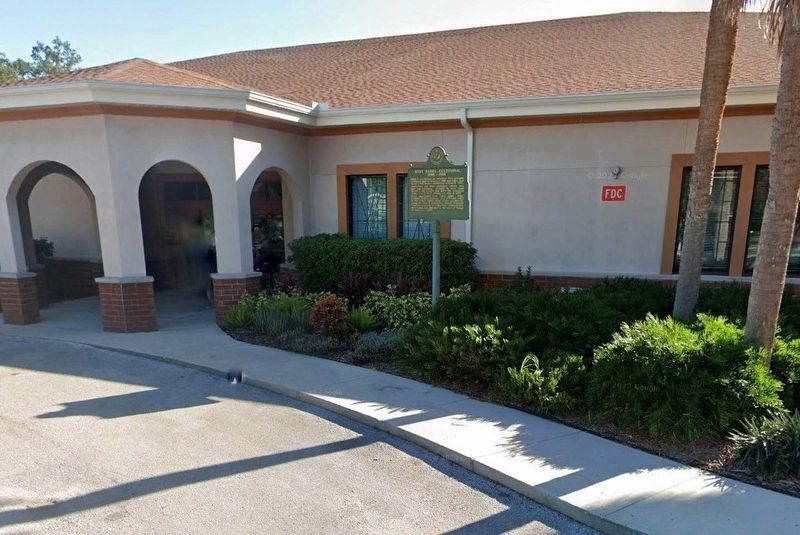
A cigar factory built on this site in June 1892 by Hugh C. Macfarlane brought the first industry to the community of West Tampa. First operated by A. Del Pino and Company, it failed financially. In 1894 the O'Halloran Cigar Company occupied the . . . — — Map (db m46945) HM
Archibald Ross. A native of Scotland. A member of the City Council. "Tampa's popular baker and the poor man's friend." Paved the walk around his brick building on the southeast corner of Franklin and La Fayette Streets with Georgia marble. . . . — — Map (db m15972) HM
Throughout history we have answered
our country's call to arms,
for freedom, for justice,
for self-determination of an ally,
we have served, and sometimes paid
in grim coin the price exacted,
Through no fault of ours,
somehow we . . . — — Map (db m15120) WM
This former grand old resort hotel, a seat of
culture and education, has been the proud
symbol of Tampa since 1891. Erected by The
University of Tampa Class of 1991, on the
occasion of the centennial of the building,
this marker is a . . . — — Map (db m20063) HM
Near this
site, on the northwestern end of MacDill Air Force Base,
lies the final resting place of dozens of Black residents from Port Tampa and the surrounding area. Founded in the early 1900’s, Port Tampa City’s Black Cemetery was located just . . . — — Map (db m308147) HM
On November 18, 1963, John Fitzgerald Kennedy, the 35th President of the United States, arrived in Tampa. The President's day-long visit thrilled the thousands of people who lined his 28 mile motorcade route.
He arrived at MacDill Air Force Base, . . . — — Map (db m157518) HM
On this site, the West Tampa Boys Club was organized around 1923 at the Rosa Valdez Settlement, a Methodist mission. From 1926 until 1944, the club was a major project of the Tampa Rotary Club. Under leadership of E.S. "Pep" Krantz and Charles . . . — — Map (db m214927) HM
Built with a $17,500 grant from industrialist and philanthropist Andrew Carnegie, the West Tampa Free Library opened its doors on January 1, 1914, becoming the first public library in Hillsborough County. Designed by architect John W. Biggar, the . . . — — Map (db m151032) HM
On June 14, 1898, Lt. Col. Theodore Roosevelt
and the First United States Volunteer Cavalry,
known as the Rough Riders, embarked from Port
Tampa for victory in the Spanish-American War.
The Tampa Bay Hotel was used as headquarters
for . . . — — Map (db m20160) HM
John Jackson and Ellen Maher immigrated independently of each other after the great potato famine began in Ireland in the 1840s. They met in St. Augustine, married in 1847, and came to Tampa on their honeymoon. John had intended to go on to Manatee, . . . — — Map (db m200354) HM
Henry B. Plant built this ornate Moorish structure at a cost of $3 million. Opened in 1891, it became the social and cultural center of early Tampa. During the Spanish American War it was headquarters for troops going to Cuba and housed such . . . — — Map (db m20020) HM
In 1899, Colonel Peter O. Knight created Tampa Electric Company to serve the energy needs
of a growing Tampa community. Some 28 employees served 1200 customers with electricity from the region's first power plant, one powered by the water of the . . . — — Map (db m15750) HM
On October 18, 1863, a union task force of 85 soldiers found the “Scottish Chief” and “Kate Dale”, celebrated blockade runners, hidden in a remote anchorage in the Hillsborough River, near this site and set the ships afire. Owner-Skipper James . . . — — Map (db m33675) HM
Salt was an essential commodity during the Civil War because it was required for the preservation of meat and fish. When the Confederate states no longer had access to vital sources of salt in West Virginia and Louisiana, southerners compensated . . . — — Map (db m214934) HM
African-Americans have served valiantly in all of America's wars. Although black soldiers fought and died in previous conflicts, they were not permitted to enlist as army regulars until after the Civil War. Organized into separate infantry and . . . — — Map (db m32837) HM
On the morning of June 9, 1898, the 1st U.S. Volunteer Cavalry Regiment, "The Rough Riders." arrived in this vicinity via an empty coal train originally boarded near the Tampa Bay Hotel (approximately 7 miles to the northeast). That morning. the . . . — — Map (db m254046) HM
Hillsborough County Vietnam Veterans Memorial
Aaron, Eugene Allen PFC Army Tampa • Abney, Daniel Thomas Jr. SP4 Army Tampa • Abrams, Samuel K Jr. SSG Army Tampa • Allen, Edwin Charles PFC Army Tampa • Arnold, Robert SGT USMC Tampa • . . . — — Map (db m197613) WM
From April to June, 1898, Tampa served as port of embarkation for U.S. troops on their way to Cuba. Some 30,000 troops arrived in Tampa and 16,000 embarked from Port Tampa on June 7. The Tampa Bay Hotel was headquarters for the force's leaders . . . — — Map (db m13635) HM
Chartered on September 7, 1891, El Centro Español was the first Latin club organized in Ybor City. As a mutual aid society, it provided early Spanish immigrants with a framework by which they maintained their identity and culture while . . . — — Map (db m31711) HM
In 1886 two cigar factories were completed
at Tampa signaling the founding of the
industry in the area. Pioneer manufacturer
was Vincente Martinez Ybor, a native of
Spain, who had made cigars at Havana and
Key West. Ybor's move to Tampa was . . . — — Map (db m31704) HM
Centro Español de West Tampa has been placed on the National Register of Historic Places by the United States Department of the Interior 1974 — — Map (db m47463) HM
On July 26, 1846, the first Methodist church in Tampa was organized with seventeen founding members. They worshipped in a primitive structure built of driftwood from nearby Fort Brooke. They called it the “Church-by-the-Sea”. This . . . — — Map (db m43141) HM
On January 14, 1941, Col. Clarence Tinker landed a twin-engined B-18 Bomber on the first MacDill Field runway and a new era for Tampa was born. Soon after, the U.S. would enter World War II and MacDill's pilot training would prove to be an important . . . — — Map (db m34109) HM
At midnight, July 18, 1881, two sisters, Marie Augustin, Marie Maurice of the Holy Names of Jesus and Mary, arrived in Tampa from Key West to establish a Catholic school.
“They came empty handed,” the first money was raised from the . . . — — Map (db m38628) HM
The Port Tampa Cemetery was where many African American families of the area laid their loved ones to rest. The segregation-era burial ground was in use by members of the community that did not have the means to use established formal cemeteries. . . . — — Map (db m214931) HM
During the Inchon invasion in Korea, September 15, 1950, Marine 1st Lieutenant Lopez's platoon was engaging the enemy. Exposing himself to hostile fire he attempted to hurl a grenade into the pillbox whose fire was pinning them down. Wounded, he . . . — — Map (db m31703) HM
Spanish immigrants from the province of Asturias formed El Centro Asturiano de Tampa in 1902 as a mutual aid society to meet the recreational, social, educational, and medical needs of its members. In an effort to broaden the concept of . . . — — Map (db m32185) HM
1950's SCCOA Races During the 1950s, the Sports Car Club of America held regular car races at MacDill and many other Air Force bases throughout the country. 1990's Air Shows Air shows at MacDill have brought out huge crowds to witness the . . . — — Map (db m34154) HM
To the 102 unknown soldiers and settlers
reburied here from the old U.S. Army cemetery
at Fort Brooke, Mar. 24, 1981. Rest in eternal
peace.
Through the efforts of the city of
Tampa and Tampa Historical Society. — — Map (db m27497) HM
The Battle of Tampa, also known as the "Yankee Outrage at Tampa", was a minor engagement of the American Civil War fought June 30 - July 1, 1862, between the United States Navy and a Confederate artillery company charged with protecting the port of . . . — — Map (db m197409) HM WM
His was a life of achievements – a great lawyer, pioneer land developer, public servant and a Tampa booster. Had the honor of serving as State's Attorney, Tampa City Attorney, Port Commissioner, and Supt. of Public Works. In 1892, converted 200 . . . — — Map (db m49593) HM
( North face )
This spot was headquarters
for Roosevelt Rough Riders.
Wheeler Cavalry and the
First Florida Troops 1898
( Northeast face )
This war brought the blue
of the cold bleak north and
the gray of the . . . — — Map (db m19979) HM
The first Tampa cigars produced with "Clear Havana" tobacco were rolled at this site in the Sanchez y Haya Co. cigar factory on April 13, 1886. The factory, owned by Ignacio Haya and Serafin Sanchez, was licensed through the state of Florida as . . . — — Map (db m130179) HM
This aircraft was donated by the FedEx corporation and painted to resemble the iconic Piedmont Tampa Bay Pacemaker. After the aircraft’s retirement, it is utilized by our High School students as the only “fully functional Boeing 727 classroom” in . . . — — Map (db m193396) HM
MacDill's First Base Commander • Col. Clarence L. Tinker took command on March 11, 1940 • First Native American to attain the rank of Major General • Killed in action in Pacific Theater during Battle for Midway in 1942 • Tinker AFB . . . — — Map (db m34123) HM
Tampa's Italians have supported a flourishing
club life almost from their first arrival in the
1880's. L'Unione Italiana, the first mutual aid
society, was organized in 1894. Initially located
directly across the street, the club stood . . . — — Map (db m213644) HM
In 1907 William T. Morgan erected this three story cigar factory and soon his Juan De Fuca label attained wide acceptance throughout the country. By 1910, the company had to move to larger quarters to accommodate 1,000 workers. After Morgan . . . — — Map (db m47247) HM
The grateful citizenry of Tampa dedicated this roadway to the memory of George Guida for his commitment to improving the quality of life for all. A business and civic leader, banker and builder of many of our public service buildings, such as Jesuit . . . — — Map (db m214928) HM
Fort Brooke - Tampa, Florida in 1847 & 48 two infantry companies of Florida volunteers restrained the Indians in South Florida while three infantry companies of volunteers went to the Mexican American War.
Dedicated to my great, great . . . — — Map (db m199009) WM
Here lie buried the remains
of a small group of
Native Americans who perished
about 200 years ago.
These remains were discovered
in 1987 during the construction
of the Tampa Convention
Center.
Let us honor the memory
of these and . . . — — Map (db m27496) HM
Las Novedades was founded on this site when Ybor City was a tiny village. Its proprietor was Manuel (Canuto) Menendez. The coffee shop was a favorite rendezvous for the pioneer cigarmakers of Sanchez y Haya Cigar Factory located across the . . . — — Map (db m152237) HM
On July 14, 1939, the Tampa Morning Tribune announced the war department's decision to build the "Southeast Air Base" in Tampa. The land selected was a 6000 acre marshy area known as Catfish Point. As part of President Roosevelt's New Deal Program, . . . — — Map (db m34118) HM
Captain Joseph Fry was born in Tampa (Fort Brooke) June 14, 1826. As a graduate of the U.S. Naval Academy, he served with the Navy throughout the world. When the Civil War broke out, Fry fought with courage and capacity for the South in the . . . — — Map (db m129943) HM
Less than a mile to the north lies Passage Key, marking the southerly entrance into Tampa Bay. Since Ponce de Leon explored this coast in 1513, this island has served to guide ships into the great bay beyond, called by early Spanish explorers . . . — — Map (db m72420) HM
Treasurer of the ill-fated Panfilo de Narvez expedition, was first to write of the discovery of Tampa Bay, April 17, 1528, calling it "Bahia de la Cruz, the best harbor in the world."
After the disastrous trek through Florida the . . . — — Map (db m216412) HM
Entered on the National Register of Historic Places June 7, 1974 Federal Building U.S. Courthouse Downtown Postal Station Tampa, Florida James Knox Taylor Architect 1902 This property significantly contributes to the . . . — — Map (db m33943) HM
Citation:
For conspicuous gallantry and intrepidity at the risk of his life above and beyond the call of duty as a Marine platoon commander of Company A, in action against enemy aggressor forces. With his
platoon Ist Lt. Lopez was . . . — — Map (db m194173) HM WM
(West face)
1861
To the Honor and Courage
of the patriots of the
Confederate States
of America,
This monument is dedicated by
Tampa Chapter,
No.113, U. D. C.,
and the citizens of Tampa.
January 1911.
Memoria . . . — — Map (db m26385) WM
For 104 years this block was the official site of executive and judicial government for Hillsborough County, Florida. The first courthouse, a log building burned by Seminole Indians in 1836, possibly stood here. Subsequent ones were built on this . . . — — Map (db m15730) HM
Within a decade after the famous Wright Brothers' 1903 flight, aviation history was being made in Florida. The first transcontinental flight landed at Jacksonville in 1912, a naval air training center opened at Pensacola in 1913, and the St. . . . — — Map (db m50438) HM
"Knight's Point" is dedicated in memory of Charley Knight, a native Tampan, well-known property appraiser and prominent collector of Native-American artifacts. Knight always had a keen interest in and fond feelings for the 177-acre tract of . . . — — Map (db m216411) HM
At this site, 407 East Street, was the home of John Thomas Lesley, built in 1897. Pioneer settler, soldier, statesman and entrepreneur, Lesley (1835 - 1913) was one of Tampa's greatest early leaders/ A native of Madison County, Florida, he came in . . . — — Map (db m54132) HM
In 1907, Alfred Swann and Eugene Holtsinger constructed the original section of seawall and roadway extending from Swann Avenue to Rome Avenue. This initial section, which was called Bayshore Drive, served Suburb Beautiful, the first residential . . . — — Map (db m44647) HM
This hallowed ground set aside as a town
burial site in 1850 "for whites & slaves alike"
is the resting place for many of Tampa's founding fathers, mayors, and county officers.
A governor of Florida, two Supreme Court
Judges, framers of all . . . — — Map (db m135974) HM
Dedicated to the memory of the 29 Sea Captains and Mariners whose vision and courage chartered a course of development for Tampa Bay — — Map (db m26967) HM
In 1848 a Board of Engineers with Lt. Col. Robert E. Lee, USA as recording officer visited Fort Brooke (Tampa). Aboard the Schooner Phenix they made a survey of Tampa Bay; requested government reservation of the bay keys and erection of defense . . . — — Map (db m216190) HM
The City of Tampa acquired the Cyrus T. Greene property in 1931, which was named in honor of the executive secretary of the Tampa Urban League. By the 1940s, the baseball field created at Cyrus Greene was known as the 22nd Street . . . — — Map (db m151029) HM
front plaque: From this site the St. Petersburg-Tampa Airboat Line, The World's First Scheduled Airline, began regular flights between St. Petersburg and Tampa, January 1, 1914.
This plaque and site dedicated December 4, 1953 by the . . . — — Map (db m50437) HM
At Tampa's Plant Field on April 4, 1919, "Babe" Ruth, playing for the Boston Red Sox against the N.Y. Giants, smacked a
587- foot home run that set a record in a pre-season game. 4,300 screaming fans saw the feat. Famed Evangelist Billy . . . — — Map (db m46601) HM
Emilio Pons, a pioneer Tampa cigar manufacturer, and an outstanding public servant, established the first cigar factory of local origin on this site in 1887.
Here on October 12, 1894, Jose Marti, the Cuban liberator, delivered his last . . . — — Map (db m32828) HM
In 1891 upon the completion of the Tampa Bay Hotel, Henry B. Plant recovered two Civil War cannon from across the Hillsborough River at the site of Old Fort Brooke. With his landscape architect Anton Fiehe, Mr. Plant placed the cannon over a . . . — — Map (db m34084) HM
On Sept. 14, 1896, Sisters of the Holy Names established The Academy of The Holy Names by order of Bishop John Moore. Sisters Mary Emiline and Mary Hubert were the first teachers in this brick school. On Nov. 29, 1896, Fr. William Tyrrell, . . . — — Map (db m47916) HM
During the Spanish-American War in 1898, Port Tampa was the port of embarkation for U.S. Troops going to Cuba to fight An area known as Picnic Island was where the soldiers practiced close order drill and simple maneuvers while tented here. It also . . . — — Map (db m130375) HM
Built circa 1855 by Gen. Jesse Carter for his daughter Josephine. He employed Mrs. Louisa Porter as teacher. The first class included Josephine Carter, Janie Givens, Mary Lesley, Mary Kelly, Eugenia Spencer, Lizzie Spencer and Hayden Porter. Jessie . . . — — Map (db m33902) HM
Francis J. Bellamay, called "the most neglected patriot in American history", wrote the immortal words of the Pledge of Allegiance to the American flag, while an editor on the magazine, Youth Companion, in 1892. He lived in Tampa and worked as . . . — — Map (db m154311) HM
Commemorating the 400th anniversary of the landing of Panfilo de Narvaez, intreped [sic] Spanish Explorer and his four hundred brave companions The first white men to set foot upon the shores of Tampa Bay April 15, 1528. Erected April . . . — — Map (db m33796) HM
As MacDill Field's first runways were being completed in 1941, only 8,500 men were enlisted in the Army Air Corps. But by the end of World War II in 1945, over 2.5 million Americans had joined the newly renamed Army Air Forces. The demands of war . . . — — Map (db m34125) HM
From the late 19th century until the mid 1970s, Central Avenue was the principal business and entertainment district of Tampa's African American community. In 1974, Urban Redevelopment razed all but a few of the buildings and converted the area . . . — — Map (db m94179) HM
William F. Poe Plaza is named in honor of William F. Poe, Sr. in recognition of the many significant improvements he initiated in downtown Tampa during his five years of service as Mayor of Tampa from October 1974 to October 1979.
For many . . . — — Map (db m34188) HM
In 1939, Georgia native Cecil M. Webb founded the Dixie Lily Milling Company. Originally named the Kinchafoonee Milling Company, the company gradually replaced the name with Dixie Lily. The first mill was in Miami but was soon followed by the . . . — — Map (db m267761) HM
Near this site on the shore of the bay, once stood a large Timuquan Temple Mound dating before the time of Christ. It was 50 feet in height with a large level space on top where elaborately decorated temples and residences of Indian chiefs and . . . — — Map (db m33865) HM
On June 3, 1898, when Tampa was a
cluster of old weather beaten houses
floating on an ocean of sand, Teddy
Roosevelt and the Rough Riders
disembarked from their seven train
convoy in Ybor City, five miles from
Tampa City Hall.
They . . . — — Map (db m15569) HM
(side 1)
The City of Tampa established a municipal airport at Drew Field in 1928 on a 160-acre tract leased from farmer, real estate developer and aviation enthusiast John Higley Drew. The City purchased Drew Field in 1934 and added new . . . — — Map (db m150551) HM
History records that the first Jewish services in Tampa were conducted in 1894 by Mr. M. Henry Cohen, Sr., in the old Masonic Temple at the corner of Franklin and Washington Streets. On October 14, 1894, 31 men and women met at Mr. Cohen's home to . . . — — Map (db m70180) HM
Civic leader and historian, Tony Pizzo, was born in the family home at this location on September 22, 1912. Tony's pride in his community inspired him to research and document history that would have been lost without his efforts. His enthusiasm . . . — — Map (db m33055) HM
The historic Harlem Academy, known as "The Mother of African- American Schools," was the first public school erected for African- American children in Tampa.
The first classes were held in 1868 in the Hillsborough County Courthouse. In the . . . — — Map (db m27707) HM
As the base and the City of Tampa progress through the 21st century, they face new challenges in the ever-changing global landscape. Today, over 50 different groups operate from the base and over 13,000 military and civilian personnel are assigned . . . — — Map (db m34153) HM
On September 22, 1912 Anthony P.(Tony) Pizzo was born in the family home on this block, neighboring the family livery stable, and eventually produce store, dating from the 1870's.
Tony's love of his community and his interest in history . . . — — Map (db m129891) HM
All Aboard!
Before railroads came to Pinellas, settlers traveled by foot, buggy, or horseback or by boat. The state's first railroad ended at Cedar Key, nearly 100 miles north of the Pinellas Peninsula. In the 1880s, Russian immigrant Peter . . . — — Map (db m238669) HM
The George Washington Junior High School was formerly located on this site. Along with the local Woodrow Wilson Junior High School, located in the Hyde Park neighborhood, the George Washington Junior High School was among the first junior high . . . — — Map (db m32624) HM
Roland Manteiga chronicled events and politics that shaped Tampa and Ybor city and championed human rights for more than 40 years through his weekly column “As we heard it.” From his private table at La Tropicana Restaurant, where he . . . — — Map (db m49927) HM
Although the F-4 Phantom was used as a fighter jet in Vietnam, it was originally designed as an interceptor for defense of the fleet against air attack. The need for a jet designed as a fighter led to the introduction of the F-16. Between 1979 and . . . — — Map (db m34140) HM
William Benton Henderson was a leading figure in the development of Tampa and Hillsborough County in the late 19th and early 20th centuries. A Georgia native, Henderson arrived in Tampa in 1847 and served as a lieutenant in the Confederate army. . . . — — Map (db m132918) HM
The Scrub, once Tampa's oldest and largest African American neighborhood, traces its history to just after the Civil War, when newly-freed enslaved people built homes in a scrub palmetto thicket just to the northeast of the Town of Tampa. The . . . — — Map (db m229519) HM
In December, 1945, C. Blythe Andrews re-opened the doors of the Florida Sentinel newspaper at 1511 Central Avenue. The original Florida Sentinel was founded in 1919, in Jacksonville, Florida by Mr. Andrews' father, General William W. Andrews. The . . . — — Map (db m20052) HM
It’s May 30, 1539…
Spanish conquistador Hernando de Soto has arrived here in La Florida, Land of Flowers, and stepped ashore –
My men can now offload our nine ships. We have sailed with 500 tons of materials needed for our . . . — — Map (db m126569) HM
Lynching in America
Between 1877 and 1950, thousands of African-Americans were the victims of lynching and racial violence in the United States. Florida had one of the highest per-capita rates of Black victims lynched by white mobs, including . . . — — Map (db m206382) HM
The first citizen of Ybor City was Gavino Gutierrez, Spanish civil engineer.
Gutierrez investigated the area in 1884 as a site for a guava processing plant. The guava plant was never erected, but on the strength of Gutierrez recommendations his . . . — — Map (db m231694) HM