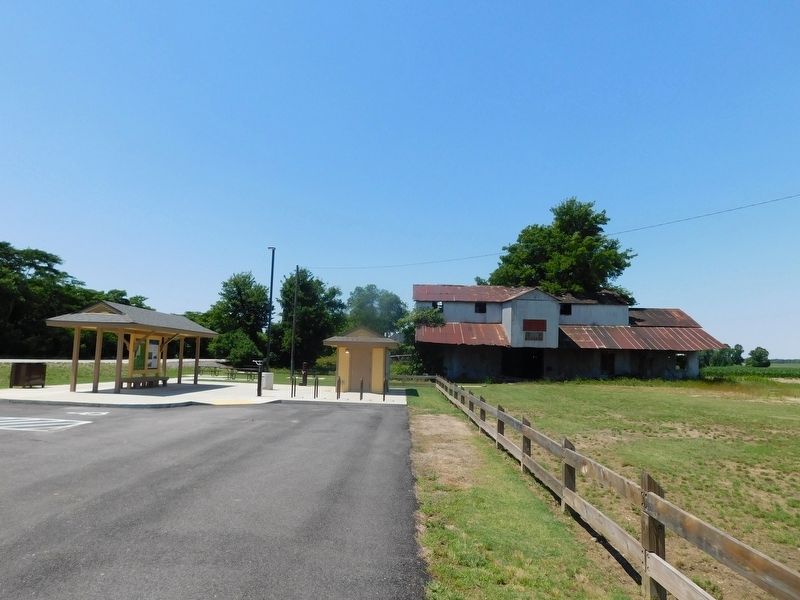
Era Ends, Era Begins
Large-scale farm and businesses were established here during the early 1800s, when people relied heavily on riverboats for transportation. As a formal community, Snow Lake was established with the arrival of the railroad . . . — — Map (db m299922) HM
The first court house in Faulkner County was erected in 1873 on this site, the town of Conway then being known as Conway Station, on the Little Rock and Ft. Smith Railroad. The county was named for “Sandy” Faulkner of “Arkansas Traveler” fame. — — Map (db m229576) HM
The caboose was a home away from home for railroad men, a place as individual as the men themselves. Here the conductor and brakeman could prepare a hot meal, catch up on much needed sleep, wash off the grease and coal dust, or finish daily tasks, . . . — — Map (db m192099) HM
Built in 1885 for the Kansas City, Ft. Scott & Memphis Railroad, Mammoth Spring Depot rapidly became the social hub of the community. Area residents were fascinated with the comings and goings of the massive steam engines and enjoyed the excitement . . . — — Map (db m192097) HM
Brick walkways were a common feature of Victorian era train depots, as were slate roofs and the diamond-shaped panes of the dormer windows. Another interesting feature was the extra-deep eaves, built to shelter passengers and freight from the . . . — — Map (db m192098) HM
You are standing on the support for a bridge across Spring Lake. The bridge provided an important link between the train station and the city of Mammoth Spring. The first bridge, made of wood, was replaced by a steel bridge. The steel bridge was . . . — — Map (db m192168) HM
Organized Dec. 1, 1873 at Port Jervis, N.Y. by Joshua A. Leach and 10 Erie Railroad firemen Membership 69,750 825 lodges in the United States and Canada — — Map (db m265299) HM
Organized Sept. 23, 1883 at Oneonta, N. Y. by 8 brakemen in Delaware & Hudson caboose No. 10 Membership 185,000 1,100 locals in the United States and Canada — — Map (db m265297) HM
For decades, the Missouri-Pacific Railroad Depot was the bustling transportation hub of Hot Springs. On February 24, 1938, legendary pitcher Cy Young received a triumphant reception here upon his return to the Spa City. Young, who won 511 games . . . — — Map (db m262740) HM
The landscape of Hot Springs has gone through many changes since the Native Americans were visiting the springs in the "Valley of the Vapors." From the Spanish and French settlers in the 1500s to the gangsters in the early 1900s, many buildings and . . . — — Map (db m264104) HM
This property has been placed on the National Register of Historic Places by the United States Department of the Interior. Arkansas Historic Preservation Program. Department of Arkansas Heritage. — — Map (db m130032) HM
The railroad reached Malvern in
1870, and the narrow-gauge
Diamond Jo Line from there to
Hot Springs was completed in
1875. The track was changed to
standard gauge in 1889. This, in
effect, brought intercontinental
service to the city. — — Map (db m211166) HM
The original tracks of the
Hot Springs Railway Company
covered almost two miles, and its
operations began in 1875 with two
cars. This was the oldest
continuously operating streetcar
system in Arkansas. By 1893
electrically operated . . . — — Map (db m211154) HM
Organized July 6, 1868 at Amboy, Ill. First Chief Conductor, Thomas J. Wright Membership 13,750 438 Divisions in the United States, Canada and the Panama Canal Zone — — Map (db m265298) HM
After horse racing returned to the spa in the 1930s, traffic along Central Avenue would often be jammed with automobiles and streetcars. The intersection of Ouachita and Central Avenue was the convergence point of the streetcar lines. All Little . . . — — Map (db m264082) HM
Organized Oct. 23, 1894 at Kansas City, Mo. Membership 12,000 275 locals in the United States and Canada SUNA watchword, “The injury of one is the concern of all.” — — Map (db m265338) HM
[east side] Hot Springs, Arkansas is recognized as the birthplace of the United Transportation Union. This monument is placed to commemorate the formation of the union. Members named hereon from the four veteran rail . . . — — Map (db m265300) HM
Created by the Randolph Rose Collection using the Lost Wax Cast Bronze method, these sculptures are titled "All Aboard." The Group Portrays a Train Conductor calling a woman and her daughter to catch a train in the 1920's.
First settled in . . . — — Map (db m246093) HM
This tree is believed to have been planted in 1912 when the railroad station was built. Local residents remember the days when its limbs were so long that they nearly touched the ground. A cannon sat next to this tree prior to World War II but this . . . — — Map (db m161918) HM
The last bag of mail hung on this pole was October 14, 1967 at Ward, Arkansas. This was also the final day of operation for the Railway Post Office in the state. — — Map (db m161919) HM
In 1909, the merchants of Hope paid to have the names of their business imprinted into a sidewalk which led from the old Garland School to Fair Park.
A portion of those squares were removed in 1995 for use in this new sidewalk at the train . . . — — Map (db m161920) HM
March 12, 1999. On this day two Hope natives
visited the Hope Visitor Center and museum.
President William Jefferson Clinton, in town to
dedicate his restored birthplace house, was
escorted through the center by life-long friend
Thomas Franklin . . . — — Map (db m161917) HM
This two man inspection car was built in 1948 by Fairmont Railway Motors. Signalmen especially, relied on this motor car for transportation as they inspected signals, automatic switches and crossing gates.
Known for its light weight and easy . . . — — Map (db m161915) HM
Donated to City of Batesville 1960
This H.K. Porter locomotive 0-4-0 tank
engine was built by H.K. Porter Co.
Pittsburg, Pa. in 1927 weighing 21 tons.
Owners J.C. White Eng. Co. Mex. City, Mex.
Unknown Lbr. Co. in Louisiana
Alcoa in . . . — — Map (db m242388) HM
Much of what we currently know and enjoy
as Walnut Ridge is built upon the work of an
enterprising, 19th Century businessman by the
name of John Rhea. His life, and even his death,
are the stuff of local legend.
John A. Rhea was born in . . . — — Map (db m170301) HM
In 1828 the town of Oakland Grove was founded. By 1861 the name had been changed to Austin, according to a false local legend the once thriving town of over 30 residences was almost selected as the state capitol beginning in 1858 the town was a . . . — — Map (db m116644) HM
Hicks' Station, located on the Memphis & Little Rock Railroad between DeValls Bluff and Huntersville (N Little Rock), guarded the eastern approaches to the capital city. During the Little Rock Campaign, Confederate cavalry used it as a staging area . . . — — Map (db m72142) HM WM
Joseph Taylor Robinson Home - 204 NE Front St. Practiced law in Lonoke - 1893-1912 U.S. Congressman - 1902-1913. Governor of Arkansas - January - March 1913. U.S. Senator - 1913-1937. Lonoke was named for lone oak tree, surveyor's landmark for . . . — — Map (db m65710) HM
The Lonoke Depot has been placed on the National Register of Historic Places by the United States Department of the Interior. Built in 1912, it was an important stop on Arkansas' oldest railroad, the Memphis to Little Rock line. The depot is a . . . — — Map (db m211575) HM
1888 - A group of railroad and timber investors, led by George W. Fouke, built the Texarkana, Shreveport, & Natchez (T.S. & N) Railroad. It extended south from Texarkana to Boggy Creek.
1889 - Led by James Franklin Shaw, the Seventh . . . — — Map (db m173676) HM
This is the site of the Old Broad Street Bridge, also known as the Hickory Street Viaduct. The Arkansas Highway Department designed the Bridge, and the Ottinger Brothers of Hinton, Oklahoma, built it in 1940 for the Texarkana Grade Separation . . . — — Map (db m285028) HM
About a mile south of this point is the natural gap or narrows of the Caddo River, famed in history and legend. A pioneer road through the gap connected Fort Smith with Old Washington and other points, with a toll bridge spanning the river. The . . . — — Map (db m201469) HM
This boxcar and the gifts it carried are a reminder of American support of France during two world wars, and of France's gratitude for that support. Such gestures between peoples deserve a lasting place in our memories.
People to People . . . — — Map (db m107797) HM
After decades of effort, Helena won the bid for a major railroad in 1907. The city of West Helena was platted two years later. The new city's industrial center quickly filled with mills, lumberyards, cooperages and woodenware manufacturers turning . . . — — Map (db m262794) HM
In the 1850s Helena businessmen dreamed of a railroad connecting the city with Little Rock. They drew up plans, but powerbrokers diverted money from the Helena project to a line connecting Memphis and Little Rock. Arkansas's First Railroad . . . — — Map (db m262841) HM
The lumber industry and railroads were inter-dependent. The first could not have developed without the second. The railroads would not have come if not for the industry. Together they made West Helena a boom town. Boom Town Work was abundant . . . — — Map (db m262795) HM
The ink was barely dry on the plan of West Helena before the sounds of construction rang through the new town site. Helena Veneer Company, Ong Chair Company, Upham & Agler, Southwestern Wagon Company, and Dennison Sawmill were all building . . . — — Map (db m262797) HM
Imagine unbroken forests of huge hardwoods — white oak, red gum, sap gum, cottonwood, beech, cypress, hickory, black walnut, poplar, sycamore, catalpa, ash, hackberry, elm — many as much as ten feet in diameter. This was the Arkansas Delta before . . . — — Map (db m262796) HM
Authentic Ore Cart Used in
commercial mining operations
owned By Roscoe Johnston, who
operated The Arkansas Diamond Mine
Tourist Attraction, 1962-1968
Donated By James Taylor
In Memory of Roscoe Johnston — — Map (db m274176) HM
Kirkbride Potts, with help from his wife Pamelia Logan Potts, designed and constructed this large and stately building between 1850 and 1858. He patterned it after the Classical Revival style he knew in his home state of Pennsylvania; however, he . . . — — Map (db m120871) HM
DeValls Bluff was strategically important to both the Union and Confederate armies as a major White River port and as head of the Memphis and Little Rock Railroad. It became a key Union supply depot after its fall 1863 occupation, as well as a . . . — — Map (db m96455) HM
DeValls Bluff’s status as an excellent riverport and the head of the Memphis and Little Rock Railroad made it an important base for both Confederate and Union forces. Hoping to block Federal ships from moving up the White River, Major Gen. Thomas . . . — — Map (db m96666) HM
DEVALL’S BLUFF, ARKANSAS
August 23, 1863.
GENERAL: Having reconnoitered the different routes, I have decided to commence my line of operations at this point, and have moved the depot and hospital here to-day. The site chosen is a . . . — — Map (db m96672) HM
Rising from the Boston Mountains, the White River meanders 720 miles to its junction with the Arkansas River in the southeastern part of the state. The fast-moving water kept the White River from suffering the build-up of silt that made such rivers . . . — — Map (db m96674) HM
The Memphis and Little Rock Railroad was the first railroad to run in Arkansas. It was chartered in 1853, but when the Civil War began, only two sections were complete. One, running from DeValls Bluff to north of Little Rock, was finished in . . . — — Map (db m96454) HM
On the eve of the Civil War, the Memphis to Little Rock Railroad had completed a line between Hopefield across the Mississippi River from Memphis and Madison in eastern Arkansas. A second section between DeValls Bluff and the north side of the . . . — — Map (db m96673) HM
With a swift current and deep channel that allowed deeper-draft vessels to use it reliably as far north as Batesville, the White River was the most important river in Civil War Arkansas and was used extensively by both sides.
The Confederate . . . — — Map (db m96669) HM
DeValls Bluff was ideally situated to be an important location in the Civil War. The riverport was located at a point on the White River that was navigable at all seasons, a distinct advantage over Arkansas River sites that were frequently isolated . . . — — Map (db m96667) HM
The Central Arkansas & Eastern (CA&E) began in 1901 as a short line railroad for transporting timber products from Lonoke County to the Little Rock market. It expanded to Stuttgart and Hazen in 1911 as rice became a major export of the Grand . . . — — Map (db m294945) HM
Dr. William Cogswell Hazen, an early pioneer of what is now Prairie County, was born in 1806 in Charlottesville, Virginia. He spent his early adulthood in Covington, Tennessee as a plantation owner and physician before moving with his family and . . . — — Map (db m294943) HM
Hazen began in the early 1870s as a small refueling station at William Hazen’s place on Arkansas’s oldest railroad line, the Memphis & Little Rock. The settlement grew as the station became a regional transportation hub for agricultural goods, like . . . — — Map (db m294944) HM
Coming of the railroad led to the naming of Jacksonville in 1870 for Nicholas W. "Nick" Jackson (1832 - 1916), a land owner and mule owner who donated the depot site to the Old Cairo & Fulton Railroad with the provision that the new station be named . . . — — Map (db m183518) HM
Near this spot stood the substantial brick home of Alexander George (1812-1877), a wealthy German immigrant active in Little Rock's business, civic, social and political circles. Built during the 1858 to 1859 period, the George House with its . . . — — Map (db m121455) HM
Constructed in 1899, the Choctaw Route Station served as a passenger depot for the Choctaw, Oklahoma and Gulf Railroad Company, before becoming the property of the Rock Island Railroad in 1902.
The station served as a major passenger terminal on . . . — — Map (db m121451) HM
Post-Civil War, railroads became vital to the Arkansas
economy. Point of Rocks was a natural support for
a railroad bridge on the river. In October 1872,
construction began at the Little Rock with several
tons of rock removed from the . . . — — Map (db m116541) HM
[Left marker]
This property
has been placed
on the
National
Register of
Historic Places
by the United States
Department of the
Interior — — Map (db m211488) HM
What we know today as The Heights, known earlier as Pulaski Heights, started as a place called Forest Park, Little Rock's largest private park. The last stop on the trolley line, the park was created by the streetcar company to draw visitors to this . . . — — Map (db m161349) HM
Arkansas's sole Civil War rail line, the Memphis and Little Rock Railroad, ran from DeValls Bluff to what is now North Little Rock. After U.S. troops occupied the capital in 1863, the Union army built warehouses, shops, and other railroad facilities . . . — — Map (db m116260) HM
Businesses flourished on Main Street after the turn of the century. In 1901 the Bank of Waldron and First National Bank both opened on South Main Street. By 1902 the Kansas City Southern Railroad went through Waldron, making it an important . . . — — Map (db m262791) HM
Before automobiles or airplanes, trains were the popular way to travel. At speeds of up to 65 mph (105 km), people traveled faster and farther than ever before. Besides visiting family and friends, trains took people to new and exotic places for . . . — — Map (db m156899) HM
Ordered from the American Car and Foundry Company in 1938, this car is one of the last heavyweight passenger cars built (181,700 pounds). Originally built as a chair car that carried 52 passengers, it was rebuilt in the 1970's to a diner bunk car . . . — — Map (db m164156) HM
Beginning in 1943 a total of 1200 all steel troop sleepers were built by Pullman Standard for the mass transport of military personnel during World War II. The cars sleep 29 soldiers and 1 porter. In 1943 the M.K.T. bought 30 troop sleepers for . . . — — Map (db m164157) HM
Belonged to a family of wealthy coffee merchants. He became interested in financing the completion of the Kansas City Southern Railway. A town on this railway was named for him and he personally selected De Queen.
1897 — — Map (db m121278) HM
In 1866 General Nathan Bedford Forrest, along with about 1,000 workmen, pitched camp in the vicinity of what is now Front Street on land belonging to the Izard and Prewett families. By 1868 they had succeeded in making a cut through Crowley’s Ridge . . . — — Map (db m92609) HM
Thomas Hough founded Augusta in 1848, naming
it after his favorite cousin, Miss Augusta Cald,
of Virginia. For generations it was known as
Chickasaw Crossing. The first settlers came in
1820. It was incorporated in 1861. During the
Civil . . . — — Map (db m116630) HM
With the completion of the Canadian Pacific Railway's southern line through Crowsnest Pass in 1898, underground coal mines were developed at nearby Morrisey, Coal Creek, Homer, and Michel. Fernie served as an
administrative and governmental . . . — — Map (db m288768) HM
This plaque marks the terminus of the first transcontinental passenger train that started in New York City and terminated at Alameda Point Pier on September 6, 1869.
Erected by the U.S. Naval Air Station, Alameda in cooperation with . . . — — Map (db m150959) HM
On September 6, 1869 first Transcontinental
Railroad train linking two great oceans, and
consisting of twelve cars and three locomotives
passed here on way to a wharf terminal west
of here, a location now covered by lagoon
for take-off . . . — — Map (db m150265) HM
In 1918, the City of Alameda invested some of the profits from its Municipal Lighting
Plant in a railroad. The "belt line,” so called because it traveled around, rather than
into a city, ran 1.16 miles along Clement Avenue from Pearl Street . . . — — Map (db m157021) HM
Before the Ice Age waned about 10,000 years ago, this area was part of a wide valley
through which the Sacramento River flowed on its way to the Pacific Ocean near the
Farallon Islands. The river spilled over a waterfall at the Golden Gate . . . — — Map (db m174544) HM
City of Berkeley Landmark
designated in 1978
James Loring Baker was an early Berkeley landowner, developer, and civic leader. He was one of the signers of the incorporation papers for the Town of Berkeley and it was he who delivered them to . . . — — Map (db m54332) HM
Stone and Smith, Architects 1901
Jim Novosel: The Bay Architects 1998
Berkeley’s transit pattern was established in 1876 when Francis Kittredge Shattuck and James L. Barker brought a spur line of the Central Pacific (later Southern Pacific) . . . — — Map (db m52378) HM
City of Berkeley Landmark
designated in 1998
By 1900, downtown Berkeley had developed around Shattuck Avenue, its main street. On this site, owned by John Hinkel, stood a brick livery stable run by John Fitzpatrick, the early operator of the . . . — — Map (db m54346) HM
From 1902 to 1979 the Santa Fe railroad company used this land for both industrial shipping and passenger
service. The railroad tracks that once passed through here were part of a nine mile strip of land that went from
Richmond to Oakland. After . . . — — Map (db m153776) HM
City of Berkeley Landmark
designated in 2001
During the early 20th century, the Santa Fe Railroad provided three-day passenger and freight service between Chicago and the Bay Area. This depot was one of three major rail stations in Berkeley. . . . — — Map (db m53828) HM
This building was originally part of the small commercial district that grew up around Dwight Way Station where Shattuck Avenue commuter trains intersected with the horse-car line that ran up Dwight Way to the California Schools for the Deaf and . . . — — Map (db m29581) HM
From the early 1930's the Santa Fe railroad tracks
ran along Sacramento Street in South Berkeley,
through the heart of the African-American community.
This was unsafe and a barrier to unifying
the Berkeley community.
In 1978 Dr. William B. . . . — — Map (db m171589) HM
South Berkeley was originally settled by Coast
Indians. After Spanish conquest in the 1700s, large
land tracts were held by the Peralta, Ashby and
Harmon families.
Transportation has been a key factor in Lorin's
history. Gov. Stanford . . . — — Map (db m145998) HM
Tassajara Creek Regional Trail
Tassajara Creek/Ridge Trail
(5.54 Miles): This unpaved and paved regional trail extends from the lowlands of Tassajara Creek in Alameda County to the ridgeline above Dougherty Valley in Contra Costa . . . — — Map (db m204577) HM
A 3 foot narrow gauge railroad starting on land owned by Joseph E. Emery, later president and founder of the City of Emeryville.
The line started at 40th and San Pablo, extended through Berkeley and up San Pablo Creek to Bryant (Orinda) 23 . . . — — Map (db m72398) HM
When the first transcontinental railroad was completed in
1869, its route from Sacramento to Long Wharf in Oakland,
on the shore of San Francisco Bay, was circuitous. It went
south to Stockton and then west through Niles Canyon, about 25 miles . . . — — Map (db m239037) HM
In 1877, across the railroad tracks from here, Edward Wiard
built a dance pavilion on top of an ancient shell mound, either
oblivious to, or choosing to ignore, its cultural significance to
the indigenous people. Thus, Shell Mound Park was . . . — — Map (db m239056) HM
You are at the southern end of the Emeryville Greenway, a rails-to-trails project that converted a former interurban passenger and
freight rail line to a pedestrian and bicycle trail across Emeryville.
The Greenway was originally an . . . — — Map (db m238893) HM
Overview of History
California Nursery Historical Park is 20 acres of prime agricultural land. People who inhabited the area included the Muwekma Ohlone, Spanish (Mission San Jose), Mexicans (Rancho Arroyo de la Alameda), and “Californios.” . . . — — Map (db m208723) HM
This railroad station having been located about half a mile west of the old town of Laddsville, on land owned by Wm. M. Mendenhall. Established the location of the town Livermore. The first depot was a freight car that was soon replaced by a . . . — — Map (db m194530) HM
Western history owes the Carter Brothers a great debt, for they were the general contractors for the first six narrow gauge railroads in California. From 1874 to 1902 they built freight, passenger, cable and street cars. Their plant became Newark's . . . — — Map (db m94310) HM
“May God continue the unity of our country as this railroad unites the two great oceans of the world.” The gold spike ceremony at Promontory, Utah in May of 1869 united the tracks of the Central Pacific and Union Pacific Railroads. . . . — — Map (db m143737) HM
Latham Square is actually a triangle, an accidental space created
by the meeting of new and old roads. Broadway did not extend
above 14th Street until the late 1880s, when it was needed to
channel the city's expansion to the north. Telegraph . . . — — Map (db m160466) HM
Moving Shoreline
Oakland's 19-mile shoreline underwent continual change after the Gold Rush, as marsh and tideland was reclaimed for development. The natural shoreline now lies buried under dredged bay sediments and landfill. Here, by the . . . — — Map (db m92753) HM
Imagine crossing the Bay before there
were bridges and trains. Boats were once
the only option.
In 1869, a ferry from a terminal near here finished the journey West for transcontinental railroad passengers.
Starting in 1903, a . . . — — Map (db m160324) HM
On a January morning in 1906, two hundred workmen from Western Pacific Railway and thirty armed “company soldiers” landed on the north training wall and began laying track. Although the City of Oakland had invited this action, it was considered a . . . — — Map (db m72207) HM
It is silent now, but long ago, you would hear the shrill scraping
of iron wheels along a track as a green Interurban electric train
would suddenly appear and pass along the very path on which
you are standing. From 1912 to 1957, the popular . . . — — Map (db m184320) HM
The Sausal Creek Arch Bridge, commonly known as the Leimert Bridge since its completion in 1926, is a graceful example of a fixed arch bridge. George Posey, Alameda County Surveyor and engineer of the Posey Tube connecting Alameda to Oakland, . . . — — Map (db m223950) HM
10689 entries matched your criteria. Entries 301 through 400 are listed above. ⊲ Previous 100 — Next 100 ⊳