On Mason Street at Halleck Street, on the right when traveling west on Mason Street.
Original "Wasteland" Filled
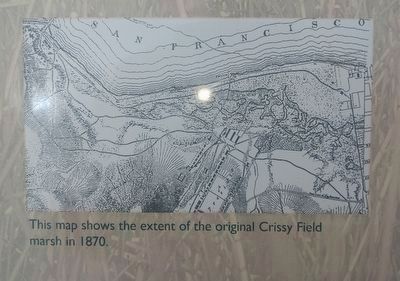
This recreated tidal marsh and lagoon recoup a fragment of a luxuriant 130-acre marsh system that once stretched along this shoreline. Abounding in life, the marsh offered the native Yelamu people an ideal . . . — — Map (db m132412) HM
In 1852 you would have been standing on a bluff overlooking the narrow beach just below that followed the approximate line of King Street. First accurately charted by the U.S. Coast Survey topographical engineers in 1852, the shoreline was named . . . — — Map (db m72544) HM
[Three panels located on the Harford Pier outline the history of Port San Luis.]
Port San Luis - A Gateway Through Time Geology
Bays are formed over thousands of years by erosion. Less resistant rock is weathered away by . . . — — Map (db m249450) HM
Near Soda Lake Road 1 mile south of Simmler Road, on the right when traveling south.
At 3,000 acres, Soda Lake is one of the largest
undisturbed alkali wetlands in the state. It provides
important habitat for migratory birds, such as Black-necked stilts, Avocets, Killdeer and on occasion White
Pelican.
In the late 1800s . . . — — Map (db m196467) HM
Near Soda Lake Road 2.1 miles south of Seven Mile Road, on the right when traveling south.
Physical forces began shaping the Carrizo into a distinct geographic feature about
30 million years ago. As the bordering Temblor and Caliente mountain ranges
were pushed upward, movements along the San Andreas and San Juan faults
caused the . . . — — Map (db m236542) HM
Near Elkhorn Road 4.5 miles south of California Route 58.
Welcome to Wallace Creek. Yes, you are looking at a creek. Wallace Creek may seem insignificant compared to other streams or rivers, after all, on most days of the year, it is bone dry. But it tells an important and exciting story.
As you . . . — — Map (db m262948)
On Coleman Drive 0.3 miles west of Embarcadero, on the right when traveling west.
An important mariner's landfall for over 300 years, chronicled in the diaries of Portola, Fr. Crespi and Costanso in 1769 when they camped near this area on their trek to find Monterey. Sometimes called the "Gibraltar of the Pacific". It is the last . . . — — Map (db m24795) HM
Near Thornton Beach Road west of Skyline Boulevard.
Daly City is usually blanketed with heavy fog and swept by brisk sea breezes from mid-May to mid-September. But while Daly City shivers, the summer fog and sea breezes provide natural air conditioning for the rest of the Bay Area.
The breeze . . . — — Map (db m52114) HM
Near Thornton Beach Road west of Skyline Boulevard.
Here at Thornton Beach, the ground is not as solid as it seems. The ground itself is made up of a semi-consolidate sedimentary rock from here to Mussel Rock. It doesn't hold together well, which makes the coastline very unstable.
Constant . . . — — Map (db m52113) HM
The San Andreas Fault is the largest earthquake fault in North America. It passes through this point and alongside the tip of the small peninsula straight ahead.
In this area, during the 1906 San Francisco earthquake, the west side of the fault . . . — — Map (db m17165) HM
Near Alma Bridge Road, on the right when traveling south.
Watershed: Guadalupe River
Capacity: 6.5 billion gallons
Depth: 130 feet
Length: 2.5 miles
Built: 1952
Lexington Reservoir, named for the historic 1850's town which once stood on the valley's floor, is a significant . . . — — Map (db m55147) HM
On S Akron Road at Severyns Avenue, on the right when traveling east on S Akron Road.
The David Johnston memorial rock is a "bread-crusted" block from the deposit of an andesitic pyroclastic flow (hot avalanche of rocks, ash and gas) that descended the southwest flank of Mount St. Helens between 450 and 500 years ago and extended as . . . — — Map (db m302314) HM
On S. Akron Road at Severyns Avenue on S. Akron Road.
This boulder was collected in the Ross Sea during the 1984 research cruise of the USGS ship S.P. Lee It was dredged at a depth of 2000 meters (6,500 feet) from the flank of Iselin Bank, the northern extension of a wide basement ridge 100 kilometers . . . — — Map (db m302310) HM
Oak trees provide wildlife habitat, scenic beauty, healthy watersheds, recreational opportunities and a link to Morgan Hill’s local historical heritage. Murphy’s Majestic Oak is a representation of the beautiful oak trees found throughout the City . . . — — Map (db m212711) HM
On West 3rd Street near Del Monte Avenue, on the right when traveling west.
Oak woodlands have become California’s signature landscape due to their widespread distribution and unique appearances. These woodlands provide critical wildlife habitat, scenic beauty, healthy watersheds, recreational opportunities, and a link to . . . — — Map (db m212712) HM
Near Penitencia Creek Road, on the left when traveling east.
Founded in 1872 and known as the reservation, Alum Rock Park is the oldest municipal park in California. It was named for a large rock formation believed to contain alum. Even after it was discovered to have been incorrectly identified, the name . . . — — Map (db m92718) HM
The mineral springs located in this area have played an important role in the history and development of the park. Between 1891 and 1902, the Parks Commission began developing the park, highlighting the springs. During this period, over 20 . . . — — Map (db m63781) HM
Near Mystery Spot Road 0.3 miles north of Branciforte Drive.
Originally we wanted to get the level ground below here for a summer home or mountain cabin, but the gentleman we were buying from would not sell the level ground unless
we purchased a strip across the entire south end of his property including . . . — — Map (db m214820) HM
Near Highway 89, on the left when traveling north.
Burney Falls
has been dedicated a
National Natural Landmark.
This site possesses exceptional value as an illustration of the nation's natural heritage and contributes to a better understanding of man's environment. — — Map (db m546) HM
On Lassen Peak Highway (California Route 89), on the right when traveling north.
Our guide [Mr. K.V. Bumpass,] after cautioning us to be careful where we stepped, that the surface was treacherous, suddenly concluded with Virgil that the “descent to Hell was easy” for stepping upon a slight inequality in the ground . . . — — Map (db m237974) HM
Near West Alma Street near Maple Street when traveling south.
Mount Shasta, administered by the Forest Service, United States Department of Agriculture, has been designated a Registered Natural Landmark.
This site possesses exceptional value as an illustration of the nation's natural heritage and . . . — — Map (db m89118) HM
Near County Route 120 near Hill Road (County Route 10), on the left when traveling west.
This was the shoreline of Tule Lake in 1872-73. The Modoc Indians occupying the Stronghold obtained water at this point.
Once nearly 100,000 acres, the lake was drained between 1912 and 1958 to make fertile land available for homesteads. — — Map (db m87914) HM
Near California Route 97, on the left when traveling north.
Dominating the landscape, Mt. Shasta can be seen for 100 miles from certain points drawing hikers, skiers and travelers. Mt. Shasta rises 11,000 fro the base to the summit for a total elevation of 14,162’ above sea level, one of the nation’s largest . . . — — Map (db m69866) HM
The bridges, oil refineries, factories and ports along the East Bay shoreline reflect a commercial history that dates back to the Gold Rush. The Carquinez Strait provided easy passage for ships carrying cargo and people to and from the gold . . . — — Map (db m232404) HM
Major Pierson B. Reading discovered gold on this bar behind this monument in July, 1848. After crossing the Trinity Divide from the North Fork of Cottonwood Creek. His party of three whites, close friend Delaware Indian scout Tom Hill, and sixty . . . — — Map (db m55999) HM
Near North Main Street (California Route 229) at Garden Gulch Street, on the right when traveling north.
In the bend of Rich Gulch near its junction with Ash Hollow five miners worked the winter of 1849-50, with the use of a log hollowed out to make a rocker. The rich pocket yielded five pounds of gold per day. The gulches in this district proved to . . . — — Map (db m112476) HM
Near Big Oak Flat Road (State Highway 120), on the left when traveling east.
In 1859 a wooden suspension flume 2200’ long was constructed across this valley by G.W. Holt and August Conrad as a link in the Golden Rock Ditch system which conveyed the water of the South Fork of the Tuolumne River to the mining areas of . . . — — Map (db m53274) HM
Within this 459-square-mile Hetch Hetchy watershed are 287 miles of trails, including a portion of the Pacific Crest Trail. They offer views of an abundance of flora and fauna, along with breathtaking scenery.
Upstream from the dam to your . . . — — Map (db m1943) HM
The Tuolumne River supplies 85% of the water for 2.4 million people. It originates from pristine spring snowmelt as far upstream as Mt. Lyell at an elevation of 13,114 feet.
The City and County of San Francisco protects the resources entrusted . . . — — Map (db m1942) HM
Known as gateway of Mother Lode and to southern mines, gold first discovered in Tuolumne County west of this point at Woods Creek by James Woods shortly before town was founded by Col. George James, August 8, 1848. Large quantities of gold recovered . . . — — Map (db m2304) HM
1864
In the midst of the
Civil War, President
Abraham Lincoln
signs a law preserving
Yosemite Valley and
making it the nation's
first state park - it later
became a national park.
1890
Preservation . . . — — Map (db m235910) HM
How The Islands Formed -
Linked
to the movement of two great plates of
the earth's crust colliding, the norther
Channel Islands were formed by the
folding and faulting that have taken
place over the past 30 million years.
The islands . . . — — Map (db m253172) HM
“We can see the Dunes and the Crestone Needles from all over our ranch. When we are lost, that’s what we navigate by.”
--local rancher
Whether traveling on foot, by horseback, Model A, or the . . . — — Map (db m71051) HM
"Totally Unique and Unexpected!"
—park visitor
Welcome to the high elevation desert that is Great Sand Dunes! Does this landscape strike you as amazing, bizarre or totally out of place. If so, you’re not . . . — — Map (db m71050) HM
The scale of the Great Sand Dunes can be difficult to judge. The dunes you see from here are only the front lines of a sea of dunes that covers many square miles.
How far do the dunes extend into the distance? The dunes are 8 miles (13km) . . . — — Map (db m104717) HM
Different Life Zones Exist in the Mountains
Imagine climbing the mountain in front of you. You might notice it gets cooler as you ascend. As the temperature drops, moisture in the air condenses, precipitation increases, and creates different . . . — — Map (db m71056) HM
You are about to step into the Great Sand Dunes Wilderness. Its mood changes with the seasons, from the spacious solitude of winter, to spring and summer fun and play. Whatever the season of your visit, this unexpected wilderness offers . . . — — Map (db m71057) HM
Mountains and passes were important in the formation
of the sand dunes.
You are looking at the Sangre de Cristo Mountains. Prevailing southwesterly winds carrying sand across the San Luis Valley were blocked by the mountains.
As the . . . — — Map (db m71055) HM
On Lane 6N 1.2 miles west of State Highway 150, on the left when traveling west.
You are looking across a sandy grassland that is a vital part of the Great Sand Dunes geological system. The sand sheet lies between the dunefield and the sabkha. Its deepest portions may be remnants of an ancient lake system, but the surface is . . . — — Map (db m160700) HM
Near U.S. 285 just north of U.S. 50, on the right when traveling south.
“The Colorado Rockies were once a great barrier to Western travel; then they became a great goal of Western travel.” — William M. Butler, Roof of the Rockies Of the 68 "fourteeners" — 14,000-foot-high mountains — in the continental . . . — — Map (db m281203) HM
Rising Rockies!
The Rocky Mountains started uplifting about 65 million years ago, during what's called the Tertiary Period of the Cenozoic Era.
As they rose, the mountains often fractured along fault lines, which are still visible. About 35 . . . — — Map (db m282827) HM
On State Highway 96 at State Highway 67, on the right when traveling west on State Highway 96.
Located at the merger of the mountains with the plains, today the Wetmore area reveals a remarkable record of the geologic past. Precambrian bedrock makes up the bulk of the Wet Mountains and its fractured and weathered rock serves as an . . . — — Map (db m294998) HM
On G96 Lane at 1550 Road, on the left when traveling west on G96 Lane.
This ancient tree was once part of a grove of native cottonwoods under which the local Ute Indians would camp and hold council prior to 1881. An Indian trail passed nearby. It has been identified as the Ute Council Tree since 1930, when the local . . . — — Map (db m119897) HM
On 17th Street at Arapahoe Street, on the right when traveling south on 17th Street.
Down 17th Street, Longs Peak is visible over the roof of Union Station. Together, they symbolize two bases of Denver's economy. Since its founding in 1858, Denver has taken advantage of its location for freight and passenger transportation. . . . — — Map (db m135104) HM
On 17th Street at Glenarm Place, on the left when traveling south on 17th Street.
Long’s Peak, visible at the end of 17th Street, is 14,255 feet in elevation.
The National Forest Service lists 54 peaks over 14,000 feet in elevation within the state of Colorado. Mt. Elbert at 14,433 feet it the highest peak in the Rocky . . . — — Map (db m135531) HM
On Wilcox Street close to 3rd Street, on the right when traveling south.
A geologic phenomenon known as a “glowing avalanche” formed Castle Rock and the other buttes of Douglas County 36.7 million years ago. A volcanic eruption near Mount Princeton, about 95 miles southwest of here, spewed a frothy, gleaming cloud of . . . — — Map (db m46142) HM
On Southbound Rest Area (Interstate 25 at milepost 171), in the median.
This mountain, 14,110 feet above the sea and the most celebrated peak in America, is named for the explorer, Capt. Zubulon M. Pike, who saw it first in 1806. He attempted to climb it, failed and reported it unclimbable. Ascended in 1820 by Dr. . . . — — Map (db m4846) HM
On Roxborough Drive 4.5 miles south of Watertown Road, on the right when traveling east.
Looking at the habitats of Roxborough, it's easy to understand how geology shapes the landscape that supports plants and animals. It's what's underneath that makes the difference in what's on top. I can see so many differences here - oak brush, . . . — — Map (db m289369) HM
Near Paint Mine Road 1.5 miles east of North Calhan Highway.
Imagine standing here in a tropical hardwood forest 55 million years ago. The forest and ancient soils were later covered by white sandstone of uplifted and later eroded Pikes Peak Granite. The sandstone is known as the Dawson Arkose Formation. Its . . . — — Map (db m135458) HM
The Rocky Mountains are the longest chain of mountains in the world. They divide the United States watershed between the Atlantic and Pacific Oceans. Colorado has 53 peaks over 14,000 feet. One inch on the Horizon equals about 38 miles. — — Map (db m4838)
Anthony Bott, one of the founders of
Colorado City, quarried Dakota Sandstone
from the east face of the hogback (highest
ridge) in the 1870s and 1880s. These were
simple but significant operations for
supplying community needs. Vertical . . . — — Map (db m283032) HM
Pikes Peak
You are at 13,380 feet, 4,078 meters
Feeling Spacey? In the United States you can not get much closer to outer space than this! Are you dizzy and short of breath? No wonder, you are 2.5 miles (4 kilometers) above sea level! There is 40% . . . — — Map (db m45815) HM
Has been designated a Registered National Historic Landmark under the provisions of the Historic Sites Act of August 21, 1935 this site possesses exceptional value in commemorating and illustrating the history of the United States. US Department of . . . — — Map (db m45816) HM
On Pike's Peak Highway, on the left when traveling south.
Passage from prairie to high plains
If you had been standing on this spot for the last 10,000 years, you would have seen the history of Colorado progress below you. This ancient route through the Rocky Mountains is named for Colorado’s Ute . . . — — Map (db m45761) HM
In 1879, General William Jackson Palmer, the founder of Colorado Springs, convinced his friend, Charles Elliot Perkins to purchase land in Garden of the Gods. Perkins eventually bought a total of 480 spectacular acres surrounding the Gateway Rocks, . . . — — Map (db m135547) HM
In 1879, General William Jackson Palmer, founder of Colorado Springs, convinced his friend Charles Elliot Perkins to purchase land in Garden of the Gods. Perkins eventually bought a total of 480 spectacular acres surrounding the Gateway Rocks, . . . — — Map (db m135646) HM
On Gateway Road, on the right when traveling east.
The beauty of Garden of the Gods Park, with its dramatic red rock formations framing Pikes Peak, serves as a magnificent eastern gateway to Colorado’s Rocky Mountains. The park’s towering red sandstone rocks have long been recognized as a landmark. . . . — — Map (db m45983) HM
On Garden Drive, on the left when traveling north.
Around 300 million years ago, the Ancestral Rockies once stood here. Over time, the forces of wind and water eroded the magnificent peaks into swift streams full of sediments. These sediments were eventually pressed and cemented into solid rock. The . . . — — Map (db m45979) HM
Near Garden Drive, on the right when traveling west.
Given to
the City of Colorado Springs
in 1909
by the children
of
Charles Elliott Perkins
In fulfilment of his wish
that it be kept forever
free to the public — — Map (db m135023) HM
This rock formation, called Sentinel Rock, is a geologic treasure. It is composed of two types of rock - a fine sandstone and a gravelly conglomerate. The various layers in this rock were deposited 275 million years ago. During that time, ancient . . . — — Map (db m135022) HM
On Manitou Avenue (Business U.S. 24) at El Paso Boulevard, on the right when traveling west on Manitou Avenue.
The world's most famous mountain was discovered by Zebulon M. Pike, an army officer, November 13th, 1806. At the time he discovered this peak, which now fittingly bears his name, he made the statement that it could never be ascended by . . . — — Map (db m288471) HM
Near Manitou Avenue (Business U.S. 24) at Navajo Avenue, on the right when traveling west.
Navajo Spring was often mentioned in written accounts by early explorers. To American Indians, it was sacred.
The natural water and gases erupting from the Earth were impressive to behold. This spring was especially meaningful to the . . . — — Map (db m250653) HM
On Washington Avenue at El Paso Boulevard, on the left when traveling north on Washington Avenue.
Julia Archibald Holmes was the first Anglo woman to climb Pikes Peak. She camped near Manitou Springs as a member of the Lawrence Party with her husband and brother in 1858.
Upon seeing the springs for the first time, Julia wrote:
...we . . . — — Map (db m250618) HM
On County Road 3A 4.5 miles south of U.S. 24, on the right when traveling south.
Lt. Zubulon M. Pike and his men, who traveled through this area in November and December 1806, were the first American explorers to view the Arkansas River Canyon now known as the Royal Gorge. A small party from the Maj. Stephen H. Long . . . — — Map (db m34858) HM
From Vision to Reality
Glenwood Canyon has been a critical link in the nation's ground transportation network ever since the completion of the Denver & Rio Grande Railroad in 1887. Later, Taylor State Road, a continuous wagon road between . . . — — Map (db m120263) HM
On East 6th Street at North River Street, on the right when traveling west on East 6th Street.
The Vision
The year was 1886. Walter Devereux, a wealthy silver mining venture capitalist from Aspen, turned his vision downvalley to Glenwood Springs to develop the next world
class resort. The area's climate, rich land, rivers and free . . . — — Map (db m120130) HM
Near Interstate 70 Frontage Road at milepost 119 east of No Name Lane (County Road 129).
In 1905, Colorado state senator Edward T. Taylor said, "I hope that someday our road will be a portion of a grand boulevard stretching across the nation." Taylor referred to the 12.5-mile gorge known as Glenwood Canyon. Today, the canyon road is the . . . — — Map (db m120136) HM
Near Interstate 70 Frontage Road at milepost 119 east of No Name Lane (County Road 129).
Glenwood Canyon inspired the finest hour in American rail travel. During World War II a railroad official rode through here in the cab of a diesel freight locomotive. The view from the panoramic windshield so impressed him that he began steps to rig . . . — — Map (db m120140) HM
The Dillon Pinnacles are one example of many spires found within Curecanti. Pinnacles are a product of erosion. Wind, rain, and ice are carving away at the landscape. This process happens everywhere, so why does the rock here form pinnacle shapes? . . . — — Map (db m158868) HM
On Silver Thread Scenic Byway (State Highway 149 at milepost 76.8), 4 miles north of 8th Street, on the right when traveling north.
Twenty million years ago this entire region was geologically active as massive volcanoes changed the face of the landscape. If you were here 23 million years ago, you would be standing on the northern edge of what is now called the Lake . . . — — Map (db m292667) HM
On Interstate 25 at milepost 59, 0.3 miles north of County Road 103, on the right when traveling north.
Here, in the shadow of the Spanish Peaks and the Wet Mountains, stands El Huerfano - "the orphan." This stark and lonely volcanic outcrop, named in the late 1700s by an unknown Spanish trader, had for centuries guided earlier Hispanos and . . . — — Map (db m97717) HM
Clear Creek is one of the most popular and historic waterways of the Front Range. The Clear Creek watershed covers approximately 1550 square kilometers (600 square miles), includes five counties, and more than thirteen communities. From the . . . — — Map (db m49896) HM
On Washington Avenue Bridge, on the right when traveling north.
The history of Golden reflects the history of Clear Creek. Eons ago, this creek, then a raging river, coursed its way through the mountains, cutting out the canyon and leaving behind fertile soil where an abundance of plants provided food for wild . . . — — Map (db m49908) HM
This is part of the Morrison Formation accumulated around 150 million
years ago. Monsoonal (seasonal) rains caused flooding which dotted the terrain
with small lakes, ponds, and braided streams. These served as watering holes
in the drier times. . . . — — Map (db m125152) HM
Mountain-building processes generate massive pressures in
the earth’s crust. Such pressures cause the rock layers to tilt, buckle,
or fold and sometimes to break or crack. In addition to the obvious tilting of rocks
along the Dakota Hogback, . . . — — Map (db m125154) HM
Near Hog Back Road (State Highway 93) near West Alameda Parkway.
The high mountains west of here are the beginning of the Rocky Mountains.
They are made up of resistant Precambrian granite and gneiss. The prominent red rocks
in Red Rocks Park are the Fountain Formation, a series of sandstones and . . . — — Map (db m125055) HM
A volcano erupted hundreds of miles from here and ash from the volcano
blanketed this area, which was a swampy environment. Subsequent burial,
compaction, and chemical alteration led to this four inch white to rusty orange
colored claystone . . . — — Map (db m125321) HM
•Colorado’s geologic history dates back nearly two billion years. Several mountain ranges have been uplifted and eroded away before the rise of today’s Rocky Mountains. The landscape you see in front of you has undergone many dramatic changes. This . . . — — Map (db m46438) HM
•This diagram illustrates the features you can see from here. North and South table Mountains are remnants of ancient lava flows now separated and eroded by Clear Creek. The Dakota Hogbacks on the left and right sides of the image were one . . . — — Map (db m46439) HM
You are looking out over the edges of tilted and eroded layers of sandstone and shale that lie upon much older rocks in the mountains behind you. If the eroded layers were restored to where you stand they would be more than two miles thick. The . . . — — Map (db m57932) HM
On U.S. 550 0.2 miles north of Academy Drive, on the right when traveling north.
Even though this land was Ute territory, the upper Animas River Valley was first settled by prospectors in the spring of 1860. Charles Baker, returning from the mines north of Silverton, established "Old Animas City" and built the first bridge . . . — — Map (db m177468) HM
On Trail Ridge Road (U.S. 34) 17.1 miles north of Western Road (County Road 49), on the right when traveling north.
The "great divide" separates drainage to the Atlantic
from drainage to the Pacific. It traverses America from
Alaska almost to Cape Horn.
Atlantic Ocean
«« drainage
Cache La Poudre Creek
drains into the Platte River
which flows to . . . — — Map (db m89106) HM
On Trail Ridge Road (U.S. 34) near Old Fall River Road.
The cirque before you was the birthplace of many glaciers. Several times during the last two million years, snow hundreds of feet deep accumulated at the top of this valley. The tremendous weight of the compacted snow and ice caused the mass to move . . . — — Map (db m264264) HM
On Nevada Avenue at North Animas Street, on the right when traveling south on Nevada Avenue.
Panel 1
Welcome to Colorado
Colorado's vast plains, rugged mountains and grand plateaus, so magnificent in their beauty and variety seem at times to overshadow the state's history and people. But look closely. The . . . — — Map (db m97739) HM
The rocks that make up this landscape formed in environments that are very similar to ones we can observe on the earth's surface today as well as ones that occur beneath the surface where tectonic plates collide to form mountain ranges.
Kayenta . . . — — Map (db m159711) HM
While this might look like a glacial U-shaped valley, it is not. It is a canyon formed by flowing water. The story is one of different rocks responding to erosion in different ways.
Hanging Canyon
Notice how the profile of this canyon . . . — — Map (db m159762) HM
Take the short stroll to a spectacular and unique viewpoint to discover more about the Monument's geology and high flying birds.
Bird Habitat
The airspace above the protected canyons is the domain for a diverse variety of birds.
The Oldest . . . — — Map (db m159709) HM
Erosion produces unusual shapes on the landscape. As the protective Kayenta Formation layers erode from the ridge before you, the softer Wingate Formation beneath it is exposed and responds in a unique way. Early visitors throught these shapes . . . — — Map (db m159759) HM
On U.S. 160 0.2 miles County Road 402, on the left when traveling west.
Water! Every drop has a destiny via the continent’s backbone: the Continental Divide.
With a foot on each side of the bronze line below, you are symbolically straddling the spine of the Western Hemisphere. In North America the Divide follows . . . — — Map (db m71660)
Over a billion years ago, molten rock was squeezed into fissures forming the light-colored bands which thread Black Canyon's otherwise dark walls. You are standing on one of these bands. As the hot fluid slowly cooled and hardened, minerals formed . . . — — Map (db m158993) HM
At 2300 feet, Painted Wall is the highest cliff in Colorado. If the Empire State Building stood on the canyon floor, it would reach slightly more than halfway to the top of the cliff.
The patterns that inspired the name Painted Wall were created . . . — — Map (db m159001) HM
Near Chipeta Road north of U.S. 550, on the right when traveling north.
It took bold men to ride into a bold land—a land of raging rivers,
burning deserts, towering mountains, and rugged canyons.
The land of the Southwest through which Dominguez and
Escalante travelled in 1776 was awesome in beauty and . . . — — Map (db m120226) HM
You are standing at the Ouray Fault, the first step in the formation of Box Cañon Falls. Millions of years ago a deep crack in the earth caused the harder rocks to move upward, while the soft sedimentary rocks to the north moved downward. As you . . . — — Map (db m191376) HM
The Continental Divide is the topographic line that separates the Pacific and Atlantic Ocean drainages. The Divide in North America runs down the spine of the Rocky Mountains between Alaska and Mexico over the highest points between the drainages. . . . — — Map (db m152921) HM
In front of you is one of the largest fossils in the park, a massive petrified redwood stump. The Big Stump is all that remains of a redwood tree that may have been more than 230 feet (70 meters) tall and 500-1,000 years old when the lahar buried . . . — — Map (db m240556) HM
Explosive volcanic eruptions, a quiet freshwater lake, towering redwoods. A picture of this valley 35 million years ago is revealed by studying the rocks that are here today. — — Map (db m93087) HM
Florissant Fossil Beds National Monument safeguards a buried treasure: one of the world's richest fossil deposits. Look around. This 6,000 acre open space belongs to all of us—and to future generations. But what if instead of a public resource, it . . . — — Map (db m240551) HM
On U.S. 85 0.3 miles south of County Road 126, on the right when traveling south.
On these widespread plains blown clean by the wind and rains large herds of buffalo roamed and gained in number. Then the warriors of Indian tribes hunted them for food and skins. Later white men came to trap beaver in the prairie channels and the . . . — — Map (db m119615) HM
Near Noble Avenue north of Crown Street, on the left when traveling north.
Status: Threatened
Formerly an endangered species due to poaching, their population has increased thanks to environmental awareness programs at zoos like Connecticut's Beardsley Zoo.