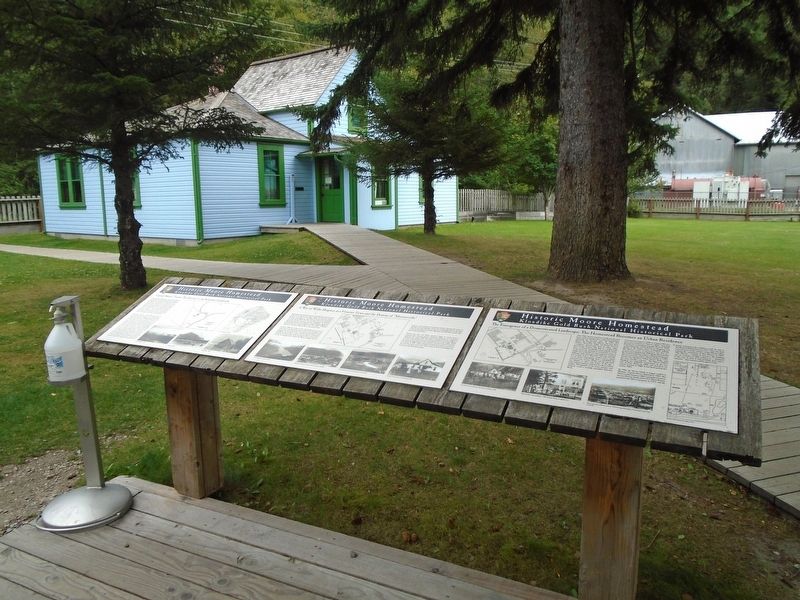
In June 1887, Captain William Moore and Native guide, Skookum Jim Mason (Keish), scouted the relatively unknown Tlingit route through the coastal mountains to what became known as the White Pass leading to the Canadian interior. . . . — — Map (db m257782) HM
During April 1942, the sleepy little town of Skagway was startled awake by the sudden arrival of thousands of American troops.
Alaska was thrown into the spotlight in June 1942 after the Japanese bombed Dutch Harbor and invaded . . . — — Map (db m257835) HM
During April 1942, the sleepy little town of Skagway was startled awake by the sudden arrival of thousands of American troops.
Alaska was thrown into the spotlight in June 1942 after the Japanese bombed Dutch Harbor and invaded . . . — — Map (db m257889) HM
Building Alaska's highways was, and is, no easy feat. The Alaska Road Commission (ARC) was one of the first groups to battle Alaska's tough working conditions.
Trail to Road
ARC crews blazed a 10-foot-wide dog team and pack horse . . . — — Map (db m255747) HM
The original ARC garage, which
this building resembles, housed
graders and other road
machinery in winter and
functioned as a maintenance
shop in summer. — — Map (db m255745) HM
COMMUNICATION
In 1900, it took a year for the Army to send a message from Interior Alaska to Washington D.C. and receive an answer. To speed communications, the U.S. Signal Corp[s], a branch of the Army, built the Washington to . . . — — Map (db m255857) HM
Rebel truckers took the law into their own hands when a ferry toll was imposed.
Weigh and Pay
The federally-built Alaska Railroad was losing money, in part because it was cheaper to truck freight to Fairbanks on the Richardson Highway. . . . — — Map (db m255808) HM
This highway was constructed during World War II as a military supply route for interior Alaska Military and Airfields in 1942. 7 Army regiments and 42 Contractors and Public Roads Administrators working from Delta Junction South and Dawson Creek . . . — — Map (db m59840) HM
The Sullivan Roadhouse was originally located 18 miles southwest of the city of Delta Junction, at the midpoint of the Donnelly Washburn Winter Cut [O]ff. The cut off shortened the trip by 35 miles, more than a day's travel at that time.
The . . . — — Map (db m255659) HM
The Valdez-Fairbanks Trail was ten feet wide and
crossed 386 miles of steep mountain passes, rivers
and muskeg.
[Trail map highlighting Sullivan Roadhouse location] — — Map (db m255653) HM
The Taylor Highway leads through some of the earliest and richest gold mining country in Alaska to the City of Eagle on the Yukon River. Gold was discovered by Franklin in 1886 and the old town of Forty Mile was located on the Yukon River at the . . . — — Map (db m49596) HM
Across the Puerco River, the tracks of the Burlington Northern Santa Fe Railroad stretch for miles to the east and to the west. With no landforms or forests to block your view, you can see very long trains from beginning to end. More than 60 . . . — — Map (db m119934) HM
U.S. Route 66 (US 66 or Route 66), also known as the Will Rogers Highway, the Main Street of America or the Mother Road, was one of the original highways within the U.S. Highway System. US 66 was established on Nov. 11, 1926, with road signs erected . . . — — Map (db m184319) HM
Petrified Forest is the only National Park in the country with a portion of Historic Route 66 within its boundaries. You are currently standing where the Mother Road used to be, with the line of telephone poles paralleling its alignment through the . . . — — Map (db m163277) HM
As a traveler to this spot, you are in good company. The Painted Desert offers a rich story of travelers, traders, and migrants passing near this location through the centuries. This natural travel corridor skirts the Rocky Mountains and other . . . — — Map (db m255985) HM
You are standing near old Route 66. The line of the roadbed and the telephone poles in front of you mark the path of the famous "Main Street of America" as it passed through Petrified Forest National Park. From Chicago to Los Angeles, this heavily . . . — — Map (db m68904) HM
You have made a good decision to exit the interstate and visit Petrified Forest National Park. Beyond lies a 28 mile (45 km) road through the heart of the park, showcasing the Painted Desert, the world's largest and most colorful concentration of . . . — — Map (db m255927) HM
The oldest continuously operated Ford dealership west of the Mississippi began in the west building in 1910. A pathfinding auto trip blazed the first "ocean to ocean highway" through here. — — Map (db m36379) HM
This 10 foot high, 5 ton statue cast by St. Louis sculptor August Leimbach is one of 12 identical monuments to the bold spirit of the pioneers erected in 1928-29 along the National Old Trails Road from Maryland to California. — — Map (db m36380) HM
Front of obelisk
Road Constructed by
Prison Labor 1913-14
Board of Control
Geo. W.P. Hunt Governor
C. Callaghan Auditor
U.R. Osburn Member
R.E. Sims Supt of Prison
Lamar Orb
State Engineer
Right side of obelisk . . . — — Map (db m48552) HM
The Road Below
We started through Apache Pass, over awful roads, up hill and down. We had to tie the wagon wheels with ropes and then in some places, the men had to stand on the wheels to keep them from turning over. Every man who could . . . — — Map (db m101004) HM
In 1857, the government awarded John Butterfield a contract to carry mail by stagecoach between St. Louis and San Francisco. The 2,800-mile route was to be traversed within 25 days. A year later, as the stagecoaches prepared to roll, Butterfiled . . . — — Map (db m100817) HM
The Apache Pass Stage Station was built of stone in July 1858. Within its 6-8 foot-high walls were a kitchen-dining room, sleeping rooms, a storage room for feed and weapons, and a mule corral with portholes in every stall. The stage stopped here . . . — — Map (db m100814) HM
Dedicated to the
Engineering Achievements of
Percy Jones, Jr.
1888 –
Chief locating engineer who by sheer genius personally located more miles of Arizona highways than any other person. His college training in mining and geology . . . — — Map (db m37899) HM
Dedicated to the
Engineering Achievements of
Percy Jones, Jr.
1888 –
Chief locating engineer who by sheer genius personally located more miles of Arizona highways than any other person. His college training in mining and geology . . . — — Map (db m37900) HM
This 1881 double adobe was the site of Garet & Page's Wagon Shop. To your left was the charcoal yard. Charcoal was a primary source of heat for both forges and homes in the early 1880's. This block was part of "Hop Town", the heart of Tombstone's . . . — — Map (db m249782) HM
At 1:00 p.m. on April 21st, 1907, the "Million Dollar Stope" was created when the Good Enough Stope caved in dropping a horse and wagon 75' into a gaping hole. The driver had climbed down to see why his horse had stumbled only to find himself . . . — — Map (db m131088) HM
Wells Fargo had several locations in Tombstone. They were the major carrier of mail, bullion and payroll in the early years. While they hired agents and shotgun messengers, they contracted with local stage coach lines to carry express cargo. . . . — — Map (db m249815) HM
Railroad Avenue became the Commercial center for the growth of Willcox and the Sulpher Springs Valley from the time of the construction of the Southern Pacific Railroad through the area in 1880. — — Map (db m28174) HM
In 1857 Congress authorized Navy Lieutenant Edward F. Beale to survey a wagon road along the 35th parallel from Fort Defiance, New Mexico Territory, to the Colorado River. A secondary mission was to test the feasibility of using camels in the . . . — — Map (db m33348) HM
From 1857-60, Lt. Edward F. Beale and a crew of 100 men completed the first federal highway in the southwest from Fort Smith, Ark. to Los Angeles, Calif. at a cost of $200,000. The wagon road was used extensively by immigrants en route to . . . — — Map (db m33346) HM
Maker - Silas Overpack Wheelwright, Manslee, MI
c. 1900
Also known as Michigan High Wheels, Big Wheels, or Skid Wheels, these wheels were the workhouse of the forest. The large wheel here made it easy to transport logs over rough . . . — — Map (db m263150) HM
Beneath the inverted, forked ponderosa entryway awaits an adventure in pioneer history, country-western legends and ghost stories - one of northern Arizona's liveliest landmarks since 1931.
Recognized by Hampton Hotels Save-A-Landmark . . . — — Map (db m192855) HM
This trail follows the south side of historic Route 66 from downtown Flagstaff to the east side of town. In the mid 1990s the City removed a series of Billboards from the strip or land between Route 66 and the BNSF railroad tracks, and replaced it . . . — — Map (db m263060) HM
During the summer of 1947, the Arizona Highway Department constructed a 6.5 mile cut-off alignment of Route 66 through Flagstaff. This re-alignment shifted Route 66 away from the older Camp Townsend- Winona Road/U.S. Highway 89 alignment that . . . — — Map (db m263116) HM
Heading west, Route 66 helped determine Flagstaff's urban form by creating the long commercial corridor that provided travelers with motels, auto repair, gas, entertainment and food. The buildings along Route 66 that remain today are a living museum . . . — — Map (db m263117) HM
This 1945 Model H International Farmall, purchased by the Zanzucchi Family after World War II, was used to plow the "Fields" at the Flagstaff Dairy. The Flagstaff Dairy operated from 1904 thru 1979 and was located 3 miles west of Flagstaff on Old . . . — — Map (db m178779) HM
This trail follows the south side of historic Route 66 from downtown Flagstaff to the east side of town. In the mid 1990s the City removed a series of Billboards from the strip or land between Route 66 and the BNSF railroad tracks, and replaced it . . . — — Map (db m263109) HM
Directly behind you, looking down into Hermit Canyon, you can see part of Hermit Trail and the remains of Hermit Camp. In 1911-12 the Santa Fe Railroad built both trail and camp to serve a blossoming tourist trade. Why did Santa Fe build here at . . . — — Map (db m156999) HM
Each year thousands of hikers enter Grand Canyon on the Bright Angel Trail. They follow a tradition - and a trail route - established by prehistoric people. For centuries humans have used this route for two key reasons: water and access. Water . . . — — Map (db m39563) HM
You are standing on a section of the original Hermit Road, constructed in 1911-1913. It was a road ahead of its time, offering sweeping vistas and gentle grades, at a cost of $250,000 — an unheard of sum for such a short road. It was built for . . . — — Map (db m157147) HM
"No language can fully describe, no artist paint the beauty, grandeur, immensity and sublimity of this most wonderful production of Nature's great architect. [Grand Canyon] must be seen to be appreciated."
C.O. Hall, Grand . . . — — Map (db m39659) HM
On the inner plateau, Hermit Camp has been built.... A skilled Chef is in charge of the dining room, where excellent meals are provided. It is camping out ‘deluxe.’ —1916 Hermit Camp postcard Deep in the canyon are faint signs of . . . — — Map (db m156994) HM
Today, most visitors will travel the Hermit Road by shuttle, but in 1912 when the road first opened, you would have traveled by horse or buggy. The Santa Fe Railway and U.S. Forest Service built the buggy road so early visitors had a choice in . . . — — Map (db m157166) HM
Constructed in 1928, the Kaibab Trail Suspension Bridge was the only crossing of the Colorado River in a distance of 754 miles from Moab, Utah to Needles, California. Built in a remove location with incredibly difficult access through rugged . . . — — Map (db m173929) HM
The mule barn and the nearby livery stable were two of the most important buildings in the original Grand Canyon Village. In the early 1900's, when all travel within the village was by horse-drawn carriage, these huge barns were the center of all . . . — — Map (db m39585) HM
Behind you is the Bright Angel mule corral, where each morning mules greet riders and another adventure begins. Mules have carried people into Grand Canyon since sightseeers first visited here in the 1890s. For many people - including those who . . . — — Map (db m205170) HM
Allow about 30 minutes to tour Tusayan Ruin. The 0.1 mile loop trail through the main ruin is paved and wheelchair-accessible; the side loop to a prehistoric farming site is not. Signs along the way explain the site's features. An interpretive . . . — — Map (db m39633) HM
Under the direction of General George Crook this trail was built in the early 1870's. Starting at Fort Whipple, it winds down to Fort Verde then eastward across the Mogollon Rim to Fort Apache covering 200 miles. It was used as a supply route by . . . — — Map (db m67419) HM
Under the direction of General George Crook this trail was built in the early 1870's. Starting at Fort Whipple, it winds down to Fort Verde then eastward across the Mogollon Rim to Fort Apache covering 200 miles. It was used as a supply route by . . . — — Map (db m67420) HM
Segments of centuries-old Indian trails between St. George and Long Valley were used by Mormon pioneers in 1864 to settle Long Valley and its resettlement in 1871 following Indian conflicts. The trail
divided at the area of this marker; the . . . — — Map (db m131299) HM
John D. Lee settled here in Dec. 1872 and established ferry service thirteen months later. After her husband's death, Warren M. Johnson ran the oar-driven ferry for Emma Lee, 1875 to 1879, when the Church of Jesus Christ of Latter-Day Saints . . . — — Map (db m41997) HM
Navajo Bridge
has been placed on the
National Register
of Historic Places
By the United States
Department of the Interior
August 31, 1981 — — Map (db m94885) HM
There are three markers on this end of the Navajo Bridge.(Marker on left:)
National Historical Civil
Engineering Landmark
American
Society of
Engineers
1852
Designated by the American Society of Civil Engineers . . . — — Map (db m94887) HM
This Erection Toggle Screw was used in the construction of the historic Navajo Bridge to maintain bridge vertical elevations and as a means of lowering bridge sections in place. — — Map (db m38469) HM
"This is one of the wonders of the world! People will come from all quarters of the globe and will pay great sums of money to gaze on what we behold." - Edwin Dilworth "Dee" Woolley
A visionary entrepreneur, "Uncle Dee" . . . — — Map (db m258210) HM
Dwellings for ferry customers and operators
Only a ruin remains of the small stone cabin available to
travelers staying overnight. The ruin with two stone fireplaces
was home to Ferryman Frank Johnson, son of a previous
ferryman. . . . — — Map (db m291064) HM
Throughout the 1800 and 1900s, Lees Ferry was backdrop to a mix of Westward expansion dreams and failed schemes. Because of its stragic location along the Colorado River, unlikely groups overlapped on these shores. Miners, traders, US government . . . — — Map (db m291037) HM
Rough, angled rock ledge on opposite river bank
Until 1899, many pioneers crossed the river near the
present-day boat dock, necessitating a harrowing
wagon ride either up or down the unforgiving rock ledge
known as "Lee's Backbone." . . . — — Map (db m291060) HM
Rough mule trail for hauling Charles H. Spencer's gold mining supplies
Built 1910
Spencer's mining machinery needed fuel. As the rest of the miners hauled equipment to Lees Ferry, two men spent the fall of 1910 building a trail up this . . . — — Map (db m291041) HM
Carl Richards constructed this building in 1947 as his blacksmith shop. At the time, auto garage work was just a sideline. Richards is known as Sedona's first 'Fire Chief' because he kept the town's first fire truck in his garage. If there was a . . . — — Map (db m78744) HM
L.E. "Dad" Hart established Sedona's first real store in this building in 1926. The general store sold Oak Creek fruit and tourist supplies and was considered modern with gravity-drained gas pumps and the first commercial power in town. When the . . . — — Map (db m33202) HM
In 1926, the Old Trails Highway was officially designated U.S. Highway 66, and it became the "Main Street of America." In 1984, Williams was the last Route 66 town in America to be bypassed by the interstate highway system. Built in 1907, this . . . — — Map (db m33375) HM
1925 - Williams had two car camps to service travellers along Route 66 and those going to the Grand Canyon. A car camp consisted of cabins that served as both a garage and sleeping quarters.
1936 - An early gas station on Route 66 after a . . . — — Map (db m193234) HM
A Route 66 icon since the 1940's. Meteor City Trading Post is home to the "World's Longest Map of Route 66."
Recognized by Hampton Hotels Save-A-Landmark program as a site worth seeing — — Map (db m194738) HM
This pass was used by Kearny's Army of the West in a march to California in 1846. Guided by Kit Carson it was described in a journal of the trip as "Carson's Old Trail”. The pass led around the impassable canyon on the Gila River where . . . — — Map (db m28045) HM
This historic mail trail is dedicated to the memory of the mail riders named below and unknown mail carriers that braved weather, rough terrain and the Verde River to deliver mail 52 miles from Camp Verde to Payson, Arizona from 1884 to 1914.
. . . — — Map (db m67417) HM
Veteran of the Civil War and for twenty years a leader of Scouts for the U.S. Army in Arizona Indian troubles. Was killed on this spot February 19th, 1907 by a rolling rock during construction of the Tonto Road. His body is buried in the cemetery at . . . — — Map (db m34114) HM
In Memory Of
Horatio Harris Merrill
Born January 3, 1837
And his daughter
Eliza Ann Merrill
Born July 27, 1881
Who, while traveling by team and wagon from Pima, Arizona to Clifton, Arizona, were . . . — — Map (db m36243) HM
"Riches from the Earth"
Imagine traveling this winding dirt road during the 1920s. The Byway takes you on a journey back through time when people relied on the land for their survival. As you enjoy the harsh beauty of the countryside, reflect . . . — — Map (db m172280) HM
This was a stage stop between Ehrenberg and Wickenburg and points east. Travelers in the 1870's and 80's made their first stop here on eastward journeys from the Colorado River. "No grass, but good water," an early desert guide indicated . . . — — Map (db m7004) HM
"The Apache Trail combines the grandeur of the Alps, the Glory of the Rockies, the magnificence of the Grand Canyon and then adds an indefinable something that none of the others have. To me, it is the most awe-inspiring and most sublimely . . . — — Map (db m34066) HM
This property is listed in the
National Register
of Historic Places
By the United States Department of the Interior
Listed
April 6, 2006
Ed and Bessie Morcomb and their son Den acquired this property in 1935, as an 18-hole . . . — — Map (db m30495) HM
Once you enter the Museum, you will see how Sun City became the "Community That Changed A Nation." With that amazing statement comes another first for Sun City that seldom is recognized.
If you GOOGLE first golf car community in the country you . . . — — Map (db m292140) HM
Golf cars quickly became part of the way of life in the newly formed active adult community of Sun City. The state of Arizona was baffled by it all; it was just a unique problem not faced before.
The Motor Vehicle Division (MVD) watched in horror . . . — — Map (db m292142) HM
Sitting on the eastern slope of the Black Mountains, is the site of Cool Springs. An important life saving water source for the desert native tribes of Mohave and Haulapai Indians. In the 1850's Lieutenant Ned Beale and his camel brigade used this . . . — — Map (db m271274) HM
The Running Hare is a manifestation of Donald Gialanella's creative imagination and his talents as an internationally acclaimed artist specializing in the design and fabrication of public art. While an artist-in-residence at the Arthub he became . . . — — Map (db m280588) HM
The Powerhouse, Arizona's oldest known reinforced concrete industrial building, generated electricity from 1909 to 1938. After serving as a substation and later a recycling center, it was renovated to its current use and condition in 1997 by the . . . — — Map (db m193159) HM
Surveyed by Lt. Edward F. Beale 1857 - 1858. Followed by railroad survey, 1858 – 1859. Route of Atlantic and Pacific Railroad built across Arizona 1882 – 1883. Tracks reached Kingman, spring, 1883. U. S. Highway 66 closely follows . . . — — Map (db m29357) HM
The “Wish You Were Here” mural was designed by artist JC Amberlyn in cooperation with the Powerhouse Visitor Center as a partnership with Arizona@Work Mohave County. It was completed by four young local artists working under Amberlyn’s . . . — — Map (db m281583) HM
The Old Spanish Trail, the main trade route between Santa Fe and Los Angeles, passed this way beginning in 1829. At the end of the Mexican-American War this portion of the route evolved into what was variously known as the Salt Lake Road, the . . . — — Map (db m78535) HM
This turn of the century gold mining camp was on the original road through the Black Mountains and eventually became Route 66. Burrows came with the miners and still roam the streets today.
Get you Kicks on Route 66 in Arizona. — — Map (db m188974) HM
The Changing Decades
In the decades between the 1930s and 1950s, travellers along Historic Route 66 changed markedly … along with their hopes and dreams, their vehicles and accommodations, and their perspective of the Black Mountains.
. . . — — Map (db m288513) HM
This monument marks a segment of an early road across northern Arizona following the 35th parallel-transcontinental survey. The route evolved from several pathfinding expeditions: Lt. Amiel W. Whipple's 1853-54 railroad survey; Lt. Edward F. Beale's . . . — — Map (db m236476) HM
Opened in 1949, tourists were drawn to stop and see what "here it is" was all about. Their marketing campaign placed mileage signs along the highway counting down the distance to the oversized jackrabbit. — — Map (db m192859) HM
US Route 66: The Mother Road
In 1926, the section of the transcontinental National Old Trails Highway that passed through downtown Winslow on Second Street became part of US Route 66, which ran from Chicago to Los Angeles. The highway was . . . — — Map (db m239369) HM
The Little Colorado River and its tributaries supplied a vital water source to the area's earliest inhabitants and travelers. The watershed sustained the nearby Homol'ovi villages of the Ancestral Puebloans. A passable ford across the river allowed . . . — — Map (db m209669) HM
This monument marks a segment of an early road across northern Arizona following the 35th parallel-transcontinental survey. The route evolved from several pathfinding expeditions: Lt. Amiel W. Whipple's 1853-54 railroad survey; Lt. Edward F. Beale's . . . — — Map (db m236470) HM
Mary Colter's masterpiece, La Posada was one of the last great railroad hotels and known as one of the fanciest on Route 66.
Recognized by Hampton Hotels Save-A-Landmark program as a site worth seeing — — Map (db m192857) HM
This area was dedicated on September 11, 1999 as a tribute to the memorable song of the 1970's that made Winslow, Arizona a town to sing about on famous Route 66. — — Map (db m36329) HM
This crossing, first noted early in the 1850s in journals and maps of explorers along the 35th parallel, is the only convergence of major travel routes on the Little Colorado River. It lies on the trail used by Mormon immigrants journeying from Utah . . . — — Map (db m32722) HM
Dedicated to the Honorable Carl Hayden, United States Senator and to the Honorable Frank R. Goodman, former State Highway Engineer. Both being good roads advocates who by their close application and untiring efforts contributed much to the . . . — — Map (db m291083) HM
Tourist attractions are vital to Winslow's economic and cultural life. Residents and visitors alike enjoy local historic sites, artist galleries, and annual events, as well as outdoor recreation at Homolovi State Park and McHood Park at Clear . . . — — Map (db m239395) HM
For early travelers the road through this canyon was one of the most dangerous in Arizona. Indians attacked lone riders and wagon trains along this route from Tucson to Old Camp Grant on the San Pedro River. Despite the canyon's name, very little . . . — — Map (db m48999) HM
In 1862, Union soldiers took possession of a former Confederate camp located in what is now Armory Park neighborhood. The camp, originally named Military Plaza, was reactivated in 1866 as Camp Lowell. During its occupation, soldiers traveled between . . . — — Map (db m69704) HM
11736 entries matched your criteria. Entries 201 through 300 are listed above. ⊲ Previous 100 — Next 100 ⊳