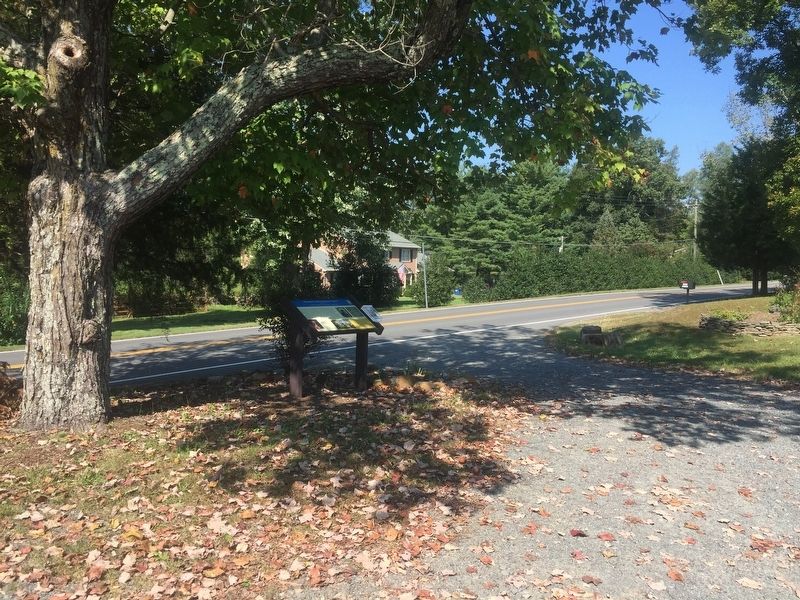
Loudoun County experienced continuous Union and Confederate activity during the war. Carter's Mill Road, in front of you, provided access to the agricultural abundance of Oatlands and other farms south and east of here, where the use of slave . . . — — Map (db m124387) HM
Bristoe Station served as an ideal location for a large encampment, as it was near a fresh water source and close to the vital Orange & Alexandria Railroad. This place was an encampment more than a battlefield.
From August through November . . . — — Map (db m289719) HM
You are looking at the site of 'Union Town,' a bustling community established after the U.S. Army occupied Suffolk in 1862. In the months that followed thousands of formerly enslaved people self-emancipated and gathered here to craft a new life. . . . — — Map (db m267248) HM
"The War That Ended Slavery"
Abolitionist Frederick Douglass, from his 1881 Storer College Commencement speech
"I want to free all the negroes in this [slave] state ... if the citizens interfere with me I must only burn . . . — — Map (db m143940) HM
Twenty-two Kentucky courthouses were burned during Civil War, nineteen in last fifteen months: twelve by Confederates, eight by guerrillas, two by Union accident. See map on reverse side.
Jan. 4, 1865, the courthouse at Owensboro, occupied by . . . — — Map (db m119800) HM
Commanding 2nd Brigade
3rd Division 17th Corps
April 13 - May 15 1863
Commanding District
Northeast Lousiana
June 7 - July 4 1863
Lt. Col. 30th Ill. Inf. Aug. 28 1861
Colonel May 1 1862
Brig. Gen. U.S. Vols. Nov. 29 . . . — — Map (db m239688) HM
Lawyer and Businessman
Charles Cruft was born in Terre Haute, Indiana, in 1826 and graduated from Wabash College in 1842. He taught school and worked at a bank before reading law and being admitted to the bar in 1848. An excellent . . . — — Map (db m210652) HM
On June 7, 1863, black troops fought a vicious battle to defend the Union supply base at Milliken’s Bend, 15 miles northwest of here. Their victory proved black troops could fight well and helped ensure that the siege at Vicksburg would end in Union . . . — — Map (db m84474) HM
General Butler to Governor Hicks
Off Annapolis, April 22, 1861
"Have I your excellency's permission...to land my men, to supply their wants, and to relieve them from the extreme and unhealthy confinement of a transport vessel not fit to . . . — — Map (db m114563) HM
Divided loyalties and ironies tore at Marylanders’ hearts throughout the Civil War: enslaved African-Americans and free United States Colored Troops; spies and smugglers; civilians imprisoned without trial to protect freedom; neighbors and . . . — — Map (db m168144) HM
Imagine the now-quiet fields south of Rt. 231 full of activity that signified a revolutionary shift in American society. Shouted commands and gunfire filled the air as Black men, some formerly enslaved, learned to march and fire their weapons as . . . — — Map (db m274120) HM
Divided loyalties and ironies tore at Marylanders’ hearts throughout the Civil War: enslaved African-Americans and free United States Colored Troops; spies and smugglers; civilians imprisoned without trial to protect freedom; neighbors and families . . . — — Map (db m922) HM
You are looking at a rare survivor—a building that embodies the radical social change brought on by the Civil War. In 1882, 28 African American veterans of the United States Colored Troops (USCT) chartered the Charles Sumner Post #25, Grand Army . . . — — Map (db m199235) HM
I will bear true faith and allegiance to the United States of America.
—from the volunteer enlistment form of Felix Battles, August 8, 1864
Felix Battles was 20 years old when he enlisted. He was born into slavery near Memphis, . . . — — Map (db m231429) HM
On July 4, 1864, a small brigade of
Confederate cavalry under the command
of Col. Robert C. Wood attacked a
Union force composed of the Mississippi
Marine Brigade and two regiments of
United States Colored Troops on an
expedition from . . . — — Map (db m117953) HM
After John Brown’s raid on Harpers Ferry, Virginia, in 1859, new militia companies were formed in the South. Businessman William W. McDowell, whose wife acquired this house from her father’s and brother’s estates, raised a company called the . . . — — Map (db m75524) HM
George Avery, a 19-year-old enslaved blacksmith, joined Co. D, 40th United States Colored Troops, in Greeneville, Tennessee, in 1865. According to local tradition, his master, Confederate Maj. William W. McDowell, sent Avery to enlist for a post-war . . . — — Map (db m75527) HM
The city of Wilmington was captured on February 22, 1865. Union troops continued to occupy Fort Fisher and Federal Point under the Union military occupation policy known as General Order Number 8, issued on February 27, 1865.
Postwar occupation . . . — — Map (db m278936) HM
A Final Resting Place Before the mid-20th century, cemeteries were often part of institutional settings such as prisons, workhouses, poor farms, and public hospitals. When a patient died at a state mental hospital, the body was usually returned . . . — — Map (db m233380) HM
About the Art
Monumental Stories is a dedication to the History, Heritage, and Honor of the African American community of Gettysburg, PA, and the United States Colored Troops (USCT).
The art is designed to communicate an everlasting . . . — — Map (db m67395) HM WM
Below the hill to your front and concealed by thick brush, Confederate troops under the command of Maj. Gen. Nathan Bedford Forrest constructed five artillery positions to deploy guns against the Union supply depot at Johnsonville. On November 3, . . . — — Map (db m146438) HM
In November 1863, Federal troops occupied Kingston Springs to serve as headquarters for the supervisors of the U.S. Military Railroad Construction Corps. They oversaw the construction of this section of the Nashville and Northwestern Railroad. . . . — — Map (db m69365) HM
Capt. Jacob C. “Jake” Bennett, a native Kentuckian and noted Confederate partisan ranger, is buried in Donaldson Cemetery (four miles north of here). During the war, bushwhackers and guerrillas on both sides raided the sparsely populated borderlands . . . — — Map (db m112197) HM
"The sharp points of frozen mud rendered it difficult, and even painful, for Hood's brave bare-footed men to maneuver. Why Thomas did not capture Hood's whole army seemed strange to us." — Private W.J. Worsham, 19th Tennessee, . . . — — Map (db m178446) HM
Johnsonville was a major Federal supply depot on the Tennessee River at the western terminus of the Nashville and Northwestern Railroad, completed in May 1864. Col. Charles R. Thompson commanded the 2,000-man garrison here. The 12th, 13th, and 100th . . . — — Map (db m74390) HM
Before the Civil War, 75 enslaved people toiled at Rippavilla, and many of them worked the fields in front of you. That changed after the January 1, 1863, Emancipation Proclamation. While the decree freed slaves only in areas not under Federal . . . — — Map (db m209551) HM
A Town Built by Stolen Labor
Slavery existed at Port Royal from the moment the Town was established. Port Royal’s economy was built on the sale and trade of tobacco, which was made possible on the backs of the enslaved. This stolen labor came . . . — — Map (db m314617) HM
Before the Civil War, hundreds of enslaved African Americans in Port Royal and on surrounding plantations and farms toiled so that the Red River port could flourish as a center for tobacco inspection, storage, and shipment. Accordingly, like most . . . — — Map (db m313360) HM
Securing the Capital
On May 24, 1861, Gen. Winfield Scott ordered eleven regiments of Union troops from Washington, D.C., across the Potomac River, where they captured Arlington and Alexandria.
After their defeat in July at Manassas, . . . — — Map (db m92113) HM
Fort Ethan Allen witnessed the dramatic social change brought on by the war. In late 1865, the 107th United States Colored Troops (USCT) garrisoned Fort Ethan Allen. Two companies, C and H, roughly 200 men, drilled on the parade ground and manned . . . — — Map (db m283749) HM
Patients at Point of Rocks Hospital were under the care of two pioneer women in the field of medicine, Clara Barton and Harriet Dame. At a time when most women were not allowed to be near the fighting, these women saw the war close up at field . . . — — Map (db m109378) HM
In April of 1864, Lt. Gen. Ulysses S. Grant met with Maj. Gen. Benjamin F. Butler and approved his plan for attacking Richmond by moving an army up the James River. Grant decided that while the Army of the Potomac moved against Robert E. Lee and the . . . — — Map (db m271156) HM
In the years after the Civil War, African Americans across the country commemorated fallen Union soldiers with Decoration Day, a precursor to modern Memorial Day celebration.
Following the creation of the Fredericksburg National Cemetery . . . — — Map (db m242243) HM
Prior to the Civil War, Dr. Eppes commanded his slaves to not get drunk, steal, commit adultery, damage property, nor attack him, the overseers, or each other. The enslaved people resisted by stealing, feigning illness, breaking tools, and at . . . — — Map (db m149560) HM
During the Civil War this church served as a signal station for both the Confederacy and the Union. On May 5, 1864 Col. Samuel A. Duncan's brigade of United States Colored Troops (4th, 5th, and 6th U.S.C.T.) occupied City Point and this signal . . . — — Map (db m149544) HM
After the Union 9th Corps advanced, General John W. Turner's men from the 10th Corps moved into the Poor Creek bottom behind the Union picket line. This line came down the hill in front of you, crossed upstream (to the right) and up the ridge behind . . . — — Map (db m266871) HM
Shiloh Baptist Church was started in 1863 by former slave and lay minister, John Carey; and Reverend Jeremiah Asher from Shiloh Baptist Church in Philadelphia, Pennsylvania. The church sewed the residents of Slabtown, a community established by . . . — — Map (db m90962) HM
Shiloh Baptist Church was started in 1863 by former slave and lay minister, John Carey; and Reverend Jeremiah Asher from Shiloh Baptist Church in Philadelphia, Pennsylvania. The church served the residents of Slabtown, a community established by the . . . — — Map (db m302785) HM
Martin Robison Delany was born in Charlestown, Virginia (now Charles Town, West Virginia) on May 6, 1812. His mother, Patti Peace was a free black woman. She married an enslaved man from Berkeley County named Samuel Delany. They had five children . . . — — Map (db m132450) HM
Captain Albert D. Wright
Eustis
Captain Wright entered the Union Army on August 15, 1862, where he was mustered in as a sergeant in Company A, 149th Pennsylvania Volunteer Infantry. On April 20, 1864 he was transferred to the 43rd United . . . — — Map (db m247085) HM WM
Divided loyalties and ironies tore at Marylander’s hearts throughout the Civil War: enslaved African-Americans and free United States Colored Troops; spies and smugglers; civilians imprisoned without trial to protect freedom; neighbors and families . . . — — Map (db m1104) HM
To The
Union Defence Committee
of the
Town of Rye
Who Pledged Their Honor
To Sustain the Government
And Ensure a Successful Outcome
of the
War of the Rebellion — — Map (db m38718) HM
At about 3 P.M. on February 20, 1865, Col. Elias Wright's brigade of 2,000 United States Colored Troops (USCT) charged down Federal Point Road into a storm of musketry and artillery fire from 1,200 Confederates sheltering behind earthworks . . . — — Map (db m284126) HM
In 1868 the "Little Bethel" AME Church was built as a permanent place of worship for free yet segregated Native and Black Americans. Here they worshiped "Almighty God." The diverse congregation included Monroe County's Veterans of the United . . . — — Map (db m217042) HM WM
The construction of Johnsonville's Upper Redoubt - called Fort Johnson during the Civil War - is shrouded in mystery. A redoubt is an earthwork enclosed on all sides. The overall configuration may be square, polygonal, or circular. There is . . . — — Map (db m177359) HM
A garrison is a contingent of military personnel stationed at a strategic location for defensive purposes. Federal troops at Johnsonville were responsible for protecting the supply depot and guarding the Nashville and Northwestern Railroad. Between . . . — — Map (db m177278) HM
The three brick cabins in the field before you are tangible connections to the enslaved people of Rappahannock County before and during the Civil War. Many slaves escaped to Union lines here and elsewhere, and some former bondsmen served in the . . . — — Map (db m173050) HM
“The Union soldiers would put out the fires and push into the city within hours of the Confederates passing over the bridges. Among the first Union soldiers to put down their muskets and pick up fire hoses and axes would be several . . . — — Map (db m41840) HM
George Washington Williams was born in 1849 in Bedford, Pennsylvania. At age 14, he enlisted in the Union Army to fight in the Civil War and received a medical discharge in 1868. In 1874, he became the first African American to graduate from the . . . — — Map (db m25125) HM
Battery C sat directly above Helena and was the key to the city's defenses. The small earthen battery manned by the 33rd Missouri held two artillery pieces. A series of infantry trenches in front of the battery defended the approach. Union engineers . . . — — Map (db m107956) HM
When the American Civil War began, African Americans saw the war as an opportunity to end slavery in the United States. However, fighting for freedom was not yet possible.
Since 1792, US law prohibited African Americans from serving in the . . . — — Map (db m265713) HM
The first African American to win an Academy Award for her stellar performance in Gone With the Wind
Journey to Kansas A former slave, Henry McDaniel fought in the Civil War with the 122nd United States Colored Troops. Although he . . . — — Map (db m223493) HM
While Kentucky slaves were not freed by the Emancipation Proclamation in January 1863, which only affected the enslaved community under Confederate control, Union military policy in Kentucky did provide opportunities for slaves to liberate . . . — — Map (db m291002) HM
President Abraham Lincoln and Congress resisted the enlistment of African Americans into the military during the early stages of the Civil War despite intense pressure from abolitionists. This changed in July 1862, when Congress passed the Second . . . — — Map (db m169974) HM
The Thirteenth Amendment to the Constitution, enacted on December 18, 1865, abolished slavery within the United States. Immediately before the ratification of this amendment, slavery remained legal only in Kentucky and Delaware. Elsewhere, slaves . . . — — Map (db m169975) HM
Fall of Port Hudson In May 1863, Union Gen. Nathaniel Banks landed 30,000 soldiers at Bayou Sara north of Port Hudson. A force of 7,500 men commanded by Confederate Gen. Franklin Gardner held the Mississippi River stronghold. General Banks' . . . — — Map (db m129210) HM
Black men responded to the call for military service long before enactment of the 1863 Enrollment Act which first included Blacks in the draft. Despite
segregation and discrimination, these service members fought with courage and valor, many paying . . . — — Map (db m219766) HM WM
In Memory of Queen Anne's County Veterans Who Gave All in Defense of Freedom
Revolutionary War
William Adair 1780 • William Alexander 1777 • Nathaniel Bateman 1781 • Alexander Beck 1779 • Michael Clancy 1779 • James Clift . . . — — Map (db m244985) WM
Military service was a definitive step for African Americans toward obtaining full rights of citizenship during the century after the Civil War.
How were The Hill Community residents connected to national and world events?
After . . . — — Map (db m302835) HM
The American Civil War began in 1861, the same year that
construction on Windsor was completed. Confederate soldiers
used the mansion's cupola as an observatory to monitor the Union
Navy's movements on the Mississippi River. The mansion's . . . — — Map (db m290968) HM
The plaque pictured at left has been placed in Sunset Hills Cemetery in remembrance of eight Union cavalry soldiers who died in action and are buried here.
In central Missouri in the summer of 1864, bands of Southern partisan cavalry roamed the . . . — — Map (db m252367) HM
Henry Charles, Private, Co.F., 55th Massachusetts Volunteer Infantry was born on April 24, 1844 or 1845. He served in the sister regiment to the 54 Mass., immortalized in the movie “Glory.” Henry was discharged on August 29, 1865. Henry died on . . . — — Map (db m271522) HM WM
The Russell Family
On April 15, 1841, Ann and Gerrit Smith arranged to purchase the freedom of Harriet Sims Russell and her family. Harriet had been a slave of Ann’s family in Maryland. The Smith’s hired James C. Fuller, a Quaker . . . — — Map (db m271784) HM
Near this location stood the settlement of African American families known as
“The Lett Settlement.” The Lett Settlement was a self-sustaining community of mixed race families, including the Caliman, Guy,
and Lett families. The . . . — — Map (db m135923) HM
Leaders, Stewards and Advocates
1873 - 1913
East State Street
By 1873, Bethel AME Church served three elements of the city’s Black population; those free before the Civil War, those emancipated and placed in Bethel’s care by the . . . — — Map (db m85932) HM
With the outbreak of the Civil War, Tennessee allied with the South in June 1861, making Nashville a Confederate capital. Unable to defend the city after the fall of Ft. Donelson, Nashville was surrendered to the Federal army in February 1862. . . . — — Map (db m256526) HM
Thirteen African American veterans of the Civil War are interred nearby at the Cuffeytown Historic Cemetery. They served in the 5th, 10th, and 36th United States Colored Troops infantry regiments organized in 1863 and 1864, after the Emancipation . . . — — Map (db m48917) HM
On August 10, 1864, Colonel Alonzo Alden, who commanded the 169th N.Y. Infantry, brought his regiment here and took command of all the troops working at "Dutch Gap Canal." Those troops were his regiment, the 16th NY Heavy Artillery, several . . . — — Map (db m278806) HM
(left panel)
Fort Brady
Visiting Richmond National Battlefield Park
The concentration of Civil War resources found in the Richmond area is unparalleled. The National Park Service manages 13 sites, giving visitors an . . . — — Map (db m180911) HM
(left panel)
Fort Gilmer
Visiting Richmond National Battlefield Park
The concentration of Civil War resources found in the Richmond area is unparalleled. The National Park Service manages 13 sites, giving visitors an . . . — — Map (db m37244) HM
(left panel)
Fort Harrison
Visiting Richmond National Battlefield Park
The concentration of Civil War resources found in the Richmond area is unparalleled. The National Park Service manages 13 sites, giving visitors an . . . — — Map (db m35191) HM
(Side 1)
Fort Norfolk
First Series Fort 1794
On 28 March 1794, President George Washington approved funding for the fortication of 19 coastal harbors in the United States, stretching from Portland, Maine to Savannah, Georgia. . . . — — Map (db m200212) HM
Throughout the period of slavery in Virginia, enslaved people sought freedom through acts of resistance, self-liberation, and rebellion. At the start of the Civil War, enslaved people sought to aid United States troops at Fort Monroe. On January . . . — — Map (db m256292) HM
“Trinity School founder Mary Fletcher Wells
and the American Missionary Association
forged the path for reconstruction in Limestone
County's African American population in an
approach based on the belief that education
and religion . . . — — Map (db m158194) HM
Freedmen Fill Two Regiments
Within days of Lorenzo Thomas' speech in
Helena on April 6, 1863, enough Freedmen
enlisted to fill a regiment—1,000 men. Many
were already in Helena. Others came in . . . — — Map (db m108014) HM
Pointer Descendants in the Civil War and Today
At least four generations of the Harris family — direct descendants of George Pointer — were born and raised here. They maintained a thriving homestead along Broad Branch Road at a time . . . — — Map (db m259730) HM
Marker middle
Winter Quarters
Winter Quarters, the country home of Haller and Julia Nutt, is the only plantation home along Lake Saint Joseph that survived the Vicksburg campaign. The Nutts were Union sympathizers who . . . — — Map (db m90405) HM
Near this spot, a vibrant African American neighborhood existed prior to the construction of the Frostburg State University campus.
The name and spirit of Brownsville emerged in the late 19th century largely due to the courage and dedication . . . — — Map (db m199904) HM
Southwest quadrant:
Section 2 lot 7 Edward Wade (1802-1866) was born in Massachusetts and moved as a boy with his large family to Ashtabula. In 1832, he married Sarah Atkins, daughter of a prominent abolitionist, Josiah Atkins, who was . . . — — Map (db m297142) HM
Prelude to Gettysburg
One of the great debates of our Country's history and legacy is what scholars call "the two Civil Wars": the first a matter of campaigns, generals, and troop movements and the second focusing on the ways that the great . . . — — Map (db m11746) HM
One of the great debates of our Country's history and legacy is what scholars call "the two Civil Wars": the first a matter of campaigns, generals, and troop movements and the second focusing on the ways that the great conflict affected the daily . . . — — Map (db m167853) HM
The Greatest Sacrifice
Chambersburg
The price of war is devastation. Franklin County paid the price when its county seat, Chambersburg, was burned to the ground in 1864. Invaded in 1862, 1863, and 1864 by Confederate forces, Franklin . . . — — Map (db m201757) HM
The bloodiest war in all of American history.
A war that pitted brother against brother
and father against son.
Total casualties - 624,515
Union - 364,511 • Confederate - 260,004
Merrimac [illustration]
"A house divided against . . . — — Map (db m215263) HM WM
On November 11, 1864, Union General W.T. Sherman would telegraph his Chief of Staff saying: "I would like to have Foster break the Charleston and Savannah Railroad about Pocotaligo about the 1st of December." It was his intention to cut off . . . — — Map (db m244739) HM
During much of the 19th century, those who lived in the city came from all walks of life. Nashville's population was comprised of a combination of independent business owners, slaveholders, poor whites, Irish an german immigrants, free Blacks, and . . . — — Map (db m205371) HM
The Major General William E. Potts Veterans Memorial Plaza
Named in honor of
Columbia native
M. G. William E. "Billy" Potts, USA
1936-2004
For his service to community, state and nation
Military Attache, Turkey . . . — — Map (db m314389) WM
To the North was the Confederate Fort Gilmer, attacked but not captured, Sept. 29, 1864. Southward, earthworks centering around Fort Harrison extended to James River. These protected Chaffin's Bluff which, with Drewry's Bluff opposite it, guarded . . . — — Map (db m257563) HM
On May 28, 1891, this plot was set aside by the Oak Ridge Cemetery Board of Managers for the burial of Civil War Union Army veterans who did not have family plots elsewhere. The Grand Army of the Republic Stephenson Post #30 dedicated the memorial . . . — — Map (db m229603) HM WM
Grant's March Map included
Winter Quarters
Winter Quarters, the country home of Haller and Julia
Nutt, is the only plantation home along Lake Saint Joseph
that survived the Vicksburg campaign. The Nutts were
Union sympathizers . . . — — Map (db m60239) HM
Vale-Himes Park
The ground you are now standing on is the Cumberland County Historical Society's Pocket Park. A one-story building that served as a barber shop existed on this site before 1909. Over the years, the building on this . . . — — Map (db m217332) HM
African Americans established "The Fort," a community that continued here after the Civil War (1861-1864) for nearly a century into the Civil Rights Era of the 1960s. The place received its name from The Fort's location around the remnants of . . . — — Map (db m149722) HM
While there were no large-scale military actions, several dozen skirmishes and many troop movements occurred here. As a gateway to the northern Shenandoah Valley, the county was a major thoroughfare for both Union and Confederate forces on a . . . — — Map (db m171306) HM
(Front ) This Civil War fort, named for Gen. Joshua Blackwood Howell (1806-1864), was built by the U.S.
Army to defend Hilton Head Island and the nearby freedmen’s village of Mitchelville from potential Confederate
raids or . . . — — Map (db m49841) HM
295 entries matched your criteria. Entries 201 through 295 are listed above. ⊲ Previous 100
Thin black lines indicate changes in relevance. Between each pair of lines entries are ordered geographically but all have the same relevance.
* Inflectional forms of words are their plurals, singulars, and possessives as well as gramatical tenses and similar variations.