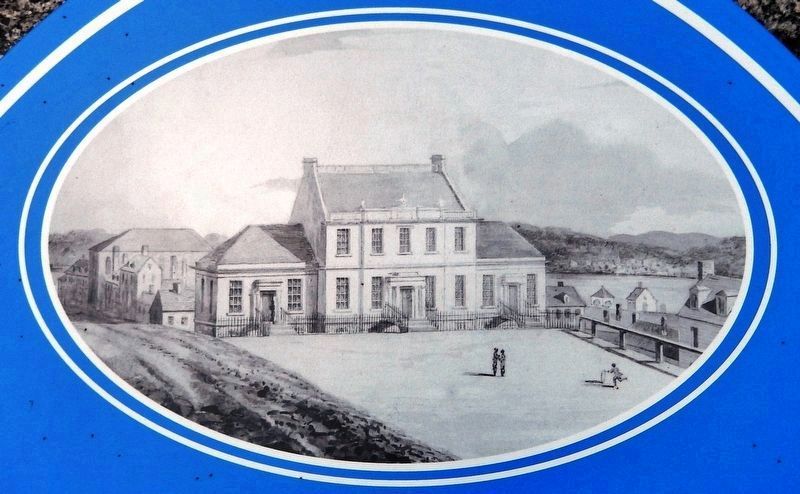
The year is 1821. You are looking south in the Grand Parade towards Saint Paul's, the oldest Anglican church in Canada. Turn and face north: the fine building you see is not City Hall, but "old" Dalhousie College.
In a long, often acrimonious, . . . — — Map (db m139592) HM
English
Built about 1819 by John Black, successful merchant and Executive Councillor (1813-23), this house is a notable example of the finest Halifax residences of its day - the first important era of stone construction in the town. James . . . — — Map (db m77657) HM
Erected
by the
Commissioners
of the
Public Gardens
in commemoration
of the services
of our
Citizen Soldiers
in the
South African
Campaign
1899~1902 — — Map (db m112796) WM
The corps was formed in Nova Scotia and elsewhere across Canada in 1937, on the instigation of the Canadian Government, to find employment for worthy older veterans.
Its organization was patterned along military lines of the British Corps of . . . — — Map (db m77805) HM
English
These gravestones were all carved by hand, using chisels and wooden mallets. Many of the old slate stones were quarried and carved around Massachusetts Bay, and shipped to Halifax before the American Revolution. By the 1770s local . . . — — Map (db m77782) HM
English:
This building, erected in 1860, provides a rare and early example of a full cast iron facade in Canada. Used in construction since the 1770s, cast iron had become a popular decorative material by the mid-19th century . . . — — Map (db m139596) HM
Dedicated to the original Irish
settlers of 1749 and to the
contributions of the Irish
community to Halifax, to
Nova Scotia and to Canada
Tíolactha do na hÉireannaigh a
bhain fúthu í Halifax sa bhliain
1749 is mar aitheantas da . . . — — Map (db m113130) HM
The history of Kuowage’jk (Citadel Hill and Kjipuktuk (Halifax) does not begin with European settlements. These places form part of the larger Indigenous landscape of Mi’kma’ki, which dates back more than 10,000 years.
The Mi’k’maq, along with . . . — — Map (db m260157) HM
D-Day and the
Battle of Normandy
6 June-21 August 1944
After months of elaborate planning, the largest seaborne invasion in modern history commenced on 6 June 1944 (D-Day) to liberate northwestern Europe from German . . . — — Map (db m139666) HM
This plaque is dedicated to the memory of
Edmund Burke
distinguished scholar, missionary pastor, and prelate, having served for sixteen years, he was elected as Bishop of Sion and first Vicar Apostolic of Nova Scotia on July 4, 1817. He . . . — — Map (db m77747) HM
The Halifax Citadel was once the headquarters for a massive array of coastal defenses that made Halifax one of the most heavily defended ports in North America. Five of those fortifications are now national historic sites and together are known as . . . — — Map (db m259732) HM
Read it Here
Project Bookmark Canada
places stories and poems in the exact Canadian locations where literary scenes are set.
This bookmark was unveiled in December 2017, by the Estate of Hugh MacLennan, McGill University, as part of the . . . — — Map (db m260371) HM
English:
Born in Halifax, Newton had his first art lessons in Boston from his uncle Gilbert Stuart, painter of the George Washington portraits. Leaving for Europe in 1815 he settled in London and entered the Royal Academy Schools . . . — — Map (db m139597) HM
On this site in 1802 was erected the school building which became the forerunner of Saint Mary’s University.
Edmund Burke, newly appointed as Roman Catholic Vicar General in Nova Scotia, had the two-storey structure built in the hope of . . . — — Map (db m77719) HM
English
Built to defend against a land-based attack, the Halifax Citadel was the fourth in a series of forts to occupy this hill, The star-shaped fortress, completed in 1856, was the centerpiece of the extensive system of fortifications . . . — — Map (db m78258) HM
English:
The Halifax City Hall, erected between 1887 and 1890, is the
largest and one of the oldest municipal buildings in Nova Scotia.
Designed by a local architect, Edward Elliot, its elegant facade
features an attractive and . . . — — Map (db m139509) HM
Open for viewing daily, 10:00am to 5:00PM
Come visit the ship, on the waterfront,
behind the Maritime Museum Of The Atlantic
HMCS Sackville is the last of 267 Flower Class Corvettes
built for the Allied Navies during WWII.
Of . . . — — Map (db m112799) HM
English
Major General Ross sailed to North America in the summer of 1814 from the Peninsular War against France to command the British army on the east coast of the United States, opening a second front to relieve the pressure on the . . . — — Map (db m77877) HM
On your left near this spot lie the remains of … / À votre gauche, près d’ici se trouvent les restes de ….
Mr. / M. John Samwell
Midshipman / Aspirant de marine • 1797-1813
Mr. / M. William Stevens
Boatswain / Maître de . . . — — Map (db m77897) HM
This land was set aside as a common burial ground outside the stockade of the new fortified town of Halifax
First grave dug June 21, 1749
Granted to St. Paul’s Church June 17, 1793
Closed to burials August 18, 1844
Welsford-Parker Monument . . . — — Map (db m77743) HM
English
The Old Burying Ground, which contains more than 1,200 head and footstones, constitutes a unique concentration of gravestone art. A rich variety of styles, poignant images and carving skill is reflected in these old stones. The . . . — — Map (db m77784) HM
English
Author of the first Canadian novel of French expression, L’influence du’ livre (1837), written in Saint-Jean-Port-Joli, Philippe-Ignace-Françoise Aubert de Gaspé was born in Quebec City on April 8th, 1814. He worked from 1840 . . . — — Map (db m77825) HM
This plaque is dedicated to the memory of
Pierre Maillard
who served as missionary to the Micmac Indians in this country for over thirty years, who succeeded in reconciling the Micmac to British rule, who celebrated the first mass and opened . . . — — Map (db m77723) HM
English
Province House is an architectural monument and the setting for signifiant events in Canadian political life. Begun in 1811 and opened in 1819 as the seat of government for Nova Scotia, it is one of the finest Palladian-style . . . — — Map (db m77858) HM
Hurricane Juan struck Halifax on September 29, 2003, devastating the Halifax Public Gardens. A volunteer-led foundation was formed to raise funds and restore the Gardens and historic Horticultural Hall.
This fountain and plaza were dedicated on . . . — — Map (db m112821) HM
Erected
by the people of
Nova Scotia
in honor
of those who served
and in memory of
those who fell in the
South African Campaign
1898 - 1902 — — Map (db m77859) WM
English
St. Mary’s holds a central position in the history of Roman Catholicism in Nova Scotia. Begun in 1820, the church demonstrated the enhanced ecclesiastical status of the province, which acquired its own Bishop in 1818, and witnessed . . . — — Map (db m77721) HM
English:
Completed in 1750, St. Paul’s was the first church outside Great Britain to be designated as an Anglican cathedral. Between 1787 and 1864 it served as the cathedral church of the See of Nova Scotia. For 96 years St. . . . — — Map (db m139686) HM
The Acadians on George Island
Georges Island National Historic Site, the small island that lies in Halifax harbor, is a culturally significant site to the Acadian community.
The Acadians are descendants of French colonists who arrived in what is . . . — — Map (db m259737) HM
[English]
The Bailey Bridge was developed in Britain and used to great advantage by the Allied forces’ military engineers in the 1939-1945 World War. These Bailey panels were erected overlooking the Royal . . . — — Map (db m269427) HM
The hands on the north clock face in the City Hall tower, opposite on Duke Street, are permanently fixed at 9:04:35 the exact moment of the wartime Halifax Explosion the morning of 6 December 1917.
The clock face, a replica of the City Hall . . . — — Map (db m139510) HM
This has been the central gathering place of our people since the founding of Halifax in 1749.
Saint Paul’s Church was established by Royal Charter in our founding year, becoming the first church in the city and the oldest Protestant church in . . . — — Map (db m139593) HM
English:
The Halifax Court House was designed in 1858 by the Toronto architectural firm of William Thomas and Sons and since its completion in 1863 has housed both county and provincial courts. The building’s importance is . . . — — Map (db m139600) HM
From where you are standing, you can see Ground Zero for the Halifax Explosion, the largest man-made explosion prior to the first atomic bomb. On December 6, 1917, as the First World War raged around the globe, the Norwegian relief ship Imo . . . — — Map (db m259705) HM
The Jamaican Maroons
The "Maroon Bastion" stood near this location from about 1796 to 1828
The Jamaican Maroons were descendants of enslaved Africans who had escaped to form free communities in the mountainous interior of the . . . — — Map (db m259709) HM
English
In this common burial ground lie many of the first citizens of Halifax, their descendants and men of the British Army and the Royal Navy who were stationed here. First opened in 1749, the year Halifax was founded, it was used until . . . — — Map (db m77783) HM
The property on which this Church stands was acquired by the Society of Methodists in 1793 for use as a burial ground. A church structure was built on part of the site in 1852 but was destroyed by fire in 1868. The present Church building was . . . — — Map (db m307800) HM
Halifax has been the scene of many "firsts" in Canada. These eighteen acres, comprising one of Canada's most attractive Victorian public gardens, derived from an earlier site, part of the original Common, chosen for the Gardens in 1841, the year . . . — — Map (db m112715) HM
The place where you are standing is known as the Saluting Battery. Here the custom of saluting naval ships with cannon fire was carried out by British forces in the 19th century. For much of the 20th century, the famous Noon gun was also . . . — — Map (db m260364) HM
This marker is composed of five plaques on the same mounting. The marker stands on north wall of the Citadel overlooking Halifax Harbor. The markers are presented left to right.
The Halifax Explosion / L’explosion d’Halifax . . . — — Map (db m78257) HM
English This monument was erected in 1860 in memory of Major A.F. Welsford and Captain W.B.C.A. Parker. These two Halifax men both perished during the Crimean War. In September of 1855 they participated in the assault on the Great Redan, part . . . — — Map (db m77744) HM
Studio Notman Studio, 1897
[Historic photo of the fountain unveiling]
—————————————
Erected by the Garden Commissioners
in commemoration of Queen Victoria's . . . — — Map (db m112947) HM
The Halifax Public Gardens is one of the finest surviving examples of Victorian Gardens in North America. It was established in 1874 by the amalgamation of two older gardens, the Nova Scotia Horticultural Society Garden (laid out in 1837) and an . . . — — Map (db m112791) HM
This marker may be conveniently divided into three section; left, center and right. The center sections is presented first.Center sectionEnglish
We are not Americans because of the service men like the sailors and . . . — — Map (db m78073) HM
English:
Born in Halifax and called to the bar in 1840, Henry represented Antigonish in the Nova Scotia Assembly as a Liberal (1841-57), and as a Conservative (1857-67). An ardent advocate of Confederation, he attended the . . . — — Map (db m139598) HM
English:
The buildings on the north end of Granville Street were designed by the firm of William Thomas and Sons after a fire had razed the block in 1859. Erected in the Italianate Style for prosperous merchants, the structures . . . — — Map (db m139599) HM
Women in Canada and Newfoundland significantly contributed to Allied victory. Whereas women were military nurses during the First World War, more than 50,000 were now serving in uniform as
non-combatants in all three armed services . . . — — Map (db m139663) HM
English:
A gifted lawyer, legislator, and judge, this Father of Confederation helped pave the way for Nova Scotia's reluctant entry into the new Dominion. He was a member of this colony's legislature and served as solicitor . . . — — Map (db m140961) HM
English
Before the voyages that brought him world fame as Captain Cook, this British Royal Navy officier complied navigational charts for the coasts of Quebec and Nova Scotia. While based in Halifax from 1758 to 1762, he learned . . . — — Map (db m77953) HM
This marker is composed exclusively pictures and their captions. There is a left side and a right side to the marker. Captions are presented left to right, then top to bottom. Click on the marker image to enlarge it. Left side
• . . . — — Map (db m77955) HM
Charles Morris was Nova Scotia’s Chief Surveyor and one of he first residents of Halifax.
In 1750, on order from the founder of Halifax, Edward Cornwallis, Morris began surveying the entire peninsula, laying out new suburbs and 240 acres of . . . — — Map (db m77647) HM
Dedicated 30 April 2006
Dedicated to the men and women of the
Canadian armed forces who left from
these shores and participated in the
liberation of the Netherlands
during World War II. We remember the over 5700 who paid the . . . — — Map (db m202799) HM WM
France and Canada share a long history. Theirs is a story of enduring friendship.
It began 400 years ago, in Nova Scotia, the birthplace of Acadie, with the arrival of the first French settlers and of Samuel de Champlain at Port-Royal in 1605. . . . — — Map (db m77622) HM
Constructed between 1799 and 1805 under the superintendence
of architect-builder Isaac Hildrith, this is one of the oldest
official residences in Canada. The combination of building
material, craftsmanship, scale and style made it an . . . — — Map (db m289901) HM
English:
In September, 1814, a British military and naval expedition from Halifax, under Lieutenant General Sir John Coape Sherbrooke and Rear Admiral Edward Griffith, occupied the portion of Maine between the Penobscot and St. . . . — — Map (db m140379) HM
National Historic
Civil Engineering Site
Ocean Terminals
1912-1928
A tribute to the civil engineers
and contractors who designed and built these
ocean terminals Canadian Society for
Civil Engineering June 1998
Site historique . . . — — Map (db m139330) HM
English
Celebrating Canada’s Immigrants
In the 1940s and 1950s, Canada opened its doors wide to European immigrants. With haunting wartime memories still fresh in their minds, men, women and children from diverse countries and . . . — — Map (db m77876) HM
English
When the Canadian immigration complex known as Pier 21 closed its doors in March of 1971, it marked the end of a more than forty-year saga of human hope, vision, courage and resilience. From its opening on the Halifax . . . — — Map (db m77616) HM
There are three plaques on this monument.
Pier 21 / Le Quai 21 English
This site witnessed the arrival of approximately one million immigrants, who have enriched the cultural mosaic of Canada. Opened in 1928, Pier 21 served . . . — — Map (db m77718) HM
Kamień z polski dla upamietnienia
emigrantów z ziem polskich
przybyłych do Kanady.
Ten kraj stał sie ich nowa ojczyzna.
A stone from Poland in honour of emigrants from Polish lands who contributed to . . . — — Map (db m202797) HM
Prince Valiant in the Days of King Arthur is celebrated as one of the world’s first action-adventure newspaper strips. It was created in 1937 by Nova Scotian artist Harold Rudolf Foster.
Foster was born hereabouts on Lower Water Street in . . . — — Map (db m205790) HM
Born in Cape Breton to Jewish immigrant parents who had fled Czarist Russia, Ruth Goldbloom was a legendary community volunteer, leader, and fundraiser. When she learned that Pier 21, then a shed on Halifax’s waterfront, had been the . . . — — Map (db m205789) HM
English: Samuel Cunard was born in Halifax, Nova Scotia on November 21, 1787. He was the eldest son of Abraham and Margaret Cunard, United Empire Loyalists who emigrated from Philadelphia (Germantown) to Nova Scotia in 1783. His . . . — — Map (db m139200) HM
This memorial was erected
by the
Atlantic Chief and Petty Officies Association
to commemorate the
Ships and Men of the Royal Canadian Navy
who failed to return through enemy action,
stress of weather and accidents during
The Battle of . . . — — Map (db m77646) WM
English: Born in Halifax of Loyalist parentage, Cunard founded in the maritime provinces a commercial empire embracing banking, lumber, land, coal and, especially, shipping. Involved in transatlantic steam navigation from its early . . . — — Map (db m139202) HM
During the First and Second World Wars, thousands of merchant ships and their naval escorts assembled in the harbour below you before proceeding across the Atlantic to Britain. Braving a swarm of German U-boats, many did not make it. Few . . . — — Map (db m260367) HM
English
For five days beginning on July 20, 2000, Halifax harbour and waterfront was like no other place - wet or dry - on earth. The city was the sole Canadian host of the largest gathering ever of the world’s Tall Ships - majestic . . . — — Map (db m77741) HM
Thousands of women and children volunteered during the
Second World War. They provided nursing care, respite,
entertainment and meals. They knitted and quilted, made
clothing, collected salvage, aided war brides and their
children when they . . . — — Map (db m205669) HM WM
English:
A native of Kings County, Chase made his fortune as a shipper of potatoes and apples, warehouse developer and speculator in Annapolis Valley fruits. Active in the Nova Scotia Fruit Grower’s Association, he initiated apple . . . — — Map (db m141002) HM
Hometown Hero
Born in Dartmouth (with roots in Cherry Brook), Allan Bundy broke down racial barriers by becoming the first black combat pilot in the Royal Canadian Air Force. He tried to enlist in 1939, with the outbreak of the war . . . — — Map (db m259858) HM
Hometown Heroes
The Battle of the Atlantic was Canada's longest campaign. Our Navy and Air Force escorted massive convoys of supply and troop ships from Halifax to Europe, battling German U-boats. Several thousand Canadian . . . — — Map (db m259855) HM
Hometown Heroes
Although the Allies had achieved victory in Europe two months earlier, on 18 July 1945 the war came to Halifax. The Bedford magazine caught fire and ignited a series of blazes and explosions lasting into the next . . . — — Map (db m259849) HM
The sailor statue represents those valiant young Canadians who served in both war and peace is symbolic of the thousands of sailors who were instrumental in the victory at sea and a fitting acknowledgement to those who continue to maintain the peace. — — Map (db m77597) WM
Hometown Hero
Charles Doucette was a Mi’knaw soldier from Maupeltu First Nation (Membertou). He was part of the Allied offensive that began on the beaches of Normandy on D-Day, 6 June 1944. Tragically, the next day, Doucette and 17 . . . — — Map (db m259847) HM
Oceanographer, Veteran, Hydrographer, Home
Le CCS Acadia: oce`anographe, ancient combattant, hydrographe, chez-soi
Canadian Government Ship (CGS) Acadia during sea trials shortly after her launch in 1913. MMA, MP28.36.35
Le navire du . . . — — Map (db m259859) HM
The ship in dry dock at Halifax Shipyard, 2010.
Sacrificial anodes, which corrode more quickly than the hull, are mounted below the waterline. MMA
French:
Le Xavier en Cale se`che au chattier naval d’Halifax en 2010. Des anodes . . . — — Map (db m259860) HM
English:
An ambitious seaman from Liverpool, N.S., and sometime privateer, Enos Collins was reputed to be the richest man in British North America when he died. His fortune, amassed through shrewd investments in mercantile, . . . — — Map (db m139664) HM
Hometown Heroes
Halifax was transformed in wartime. Military personnel in the city increased from 2,000 in 1939 to nearly 100,000 by 1945. Entertainment was needed to keep our servicemen and women in good spirits. This included . . . — — Map (db m259846) HM
English
The Island was first fortified when the British founded Halifax in 1749. During the period of the Acadian Deportation, 1755 to 1762, the island was sometimes a detention camp for Acadians prior to being shipped to other British . . . — — Map (db m77619) HM
Hometown Hero
Gertrude Ritchie served with the Royal Canadian Air Force Women's Division as a clerk and equipment assistant. When women were authorized to serve non-combat roles in the Army and Air Force, many Nova Scotian women . . . — — Map (db m259853) HM
La regione del Veneto Alla Provincia di Novara Scozia in occasoine del quinto centenario dell arrivo in Canada di Giovanni Caboto
Halifax 23 Augusto, 1997
The Veneto Region
To the Province of Nova Scotia on . . . — — Map (db m139853) HM
English From the founding of Halifax in 1749 until the early twentieth century, this portion of the waterfront was associated with men and events in the civic and commercial life of the city. These seven typical warehouses and offices, . . . — — Map (db m77826) HM
The Cable Wharf was purpose built in 1913 by the Western Union Telegraph Company and measures 108 x 17 metres (355 x 54 feet). It is where the company’s cable ships, Minia, Lord Kelvin and Cyrus Field docked and underwent minor . . . — — Map (db m77595) HM
Hometown Heroes
A native of Bedford, Harry DeWolf was a decorated Canadian naval officer. In 1943-44, he commanded the destroyer HMCS Haida, earning a fighting reputation and sinking nine German ships. After the war, DeWolf rose to . . . — — Map (db m259852) HM
Hometown Hero
Born in Halifax, Harry Foster was a Major General with the Canadian Army. He led with distinction, landing troops at Juno Beach on D-Day in 1944 and liberating the Belgian city of Bruges later that year. After the . . . — — Map (db m259854) HM
Just inland from this place, Chebucto Landing, 2,576 first permanent settlers of Halifax came ashore from thirteen small ships in June 1749. Here, you are at the shore of one of the great natural harbours of the world, the focus of Halifax's . . . — — Map (db m113185) HM
Hometown Heroes
Juno Beach is one of Canada's most significant military achievements. As part of the Allied invasion of Normandy on D-Day, 6 June 1944, Canadian forces stormed the 10km beach code-named "Juno."
Despite heavy German . . . — — Map (db m259851) HM
This monument is a universal symbol of a proud, strong and globally united Lebanese
community. The statue honours the early Lebanese settlers who, 130 years ago,
established a presence in this country, sewing the bonds of loyalty, faith, . . . — — Map (db m139674) HM
Hometown Hero
Born in Middleton, Mona Parsons was an actress and nurse before moving to Holland with her Dutch husband in 1937. When the Nazis invaded, she joined the Dutch resistance, rescuing airmen until captured a year later. . . . — — Map (db m259845) HM
This square is named in honour of Chief Judge Nathan Green (1913-1982). Judge Green, a distinguished member of the legal community and an outstanding citizen of Halifax, graduated from Dalhousie Law School in 1936 and was appointed the first . . . — — Map (db m307919) HM
English: The Port of Halifax is one of the world’s finest natural harbours. Ice-free year-round, its main channel depth of over 18 metres (60 feet) offers shippers some of the deepest and most navigable waters along the North American . . . — — Map (db m140099) HM
Hometown Heroes
Halifax's waterfront was a site of joy in 1945 as Canadians started arriving home from the war. The Queen Elizabeth, a luxury liner turned troopship, outran German U-boats to carry 750,000 troops back and forth . . . — — Map (db m259843) HM
In honour of the 100th Anniversary of Rotary International, Rotary Clubs of Halifax are pleased to join Waterfront Development Corporation limited in creating this performance platform and lookoff as a gift to the people of the Halifax . . . — — Map (db m139326) HM
A native son and a great Nova Scotian, he received his early training in this city and became a highly regarded merchant, humanitarian and ship owner. All this was a prelude to his most successful venture, the founding of the British and North . . . — — Map (db m77879) HM
531 entries matched your criteria. Entries 201 through 300 are listed above. ⊲ Previous 100 — Next 100 ⊳