[Side A:]
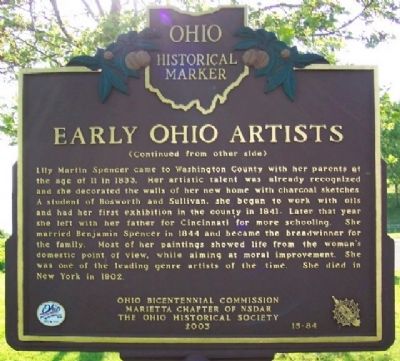
Born in Massachusetts in 1805, Sala Bosworth spent all but nineteen years of his eighty-five years in Washington County. After studying at the Philadelphia Academy of Fine Arts, he returned to the county to paint many full size . . . — — Map (db m20127) HM
Site of
Fort Greene-Ville
»»««
The largest pioneer fort
in Ohio, built in 1793, by
General Anthony Wayne.
Here, August 5, 1795, the
Treaty was signed by which
much of present Ohio was
opened to White . . . — — Map (db m19878) HM
Ohio Stadium, built between August 1921 and October 1922, received immediate acclaim for its innovative architectural features. Its reinforced concrete construction, double-deck seating, and open-ended horseshoe design were so imaginative that . . . — — Map (db m221018) HM
Camp Hutchins-Warren's Civil War Training Camp.
After the outbreak of the Civil War in the spring of 1861, the U.S. War Department commissioned Ohio Senator B.F. Wade of Jefferson and local Congressman John Hutchins of Warren to supervise . . . — — Map (db m288735) HM
Through the forest to the east may still be seen the original trail of Hull’s army in June 1812, enroute to Detroit. Some of the corduroy timbers are still buried along the route. — — Map (db m283557) HM
Side A: The Ohio River
The Ohio River begins at the confluence of the Allegheny and Monongahela rivers in Pittsburgh, Pennsylvania, and flows 981 miles to join the Mississippi River at Cairo, Illinois. The Iroquois called the river "Oyo" or . . . — — Map (db m28497) HM
(Front):The 61st Ohio Infantry ———On arriving from Emmittsburg about one o'clock p.m., July 1st 1863, was deployed as skirmish line in advance of its Brigade and moved towards Oak Hill. Later it supported as section of . . . — — Map (db m11132) HM
Inscription on stone monument:
14th Ohio Infantry
2nd Brigade, 3rd Division, 14th Army Corps.
Text on bronze plaque:
This regiment, Lieutenant Colonel Henry D. Kingsbury commanding, engaged the enemy . . . — — Map (db m65612) HM WM
A part of the Virginia Military District, Ripley was founded in 1812 by Colonel James Poage, a veteran of the Revolutionary War. Originally named Staunton, after Poage’s home town in Virginia, the village comprised 1,000 acres along the Ohio river. . . . — — Map (db m272717) HM
When visitors see mature forests, tall grass prairie meadows, or high- quality wetlands at Ohio's state nature preserves, they are seeing the Ohio that European colonists experienced when they arrived in the 1780s.
Because of extensive field . . . — — Map (db m280894) HM
The Ohio School for the Deaf was established in 1829 by an act of the Ohio Legislature. Although the fifth school for the deaf in the country, it was the first school to be 100% funded by the state. The school first opened in a small rented building . . . — — Map (db m12869) HM
Fort Laurens Continental Outpost of the Ohio Frontier. During the American Revolution, Fort Laurens became the only Continental military fort in what would later be Ohio. Continental army troops and militia, led by General . . . — — Map (db m225417) HM
Site of
Fort Jefferson
The most advanced post
established by General St. Clair
on his campaign
against the Northwestern
Indian Tribes in 1791. — — Map (db m256973) HM
Abatis and Camp
»»««
General Wayne’s Army in
1794 and General Winchester’s
Army in 1812 encamped on
this spot.
Here also was the western
end of Gen. Winchester’s Abatis. — — Map (db m136580) HM
Ohio and Erie Canal in Groveport
The Ohio and Erie Canal was Ohio's solution to the lack of a reliable and fast transportation system to move goods to outside markets. The canal opened in the then unplatted village of Groveport on September 25, . . . — — Map (db m12659) HM
The purpose of the Ohio Military Hall of Fame is to recognize those Ohio individuals who served in the United States military and distinguished themselves by displaying extraordinary heroism in action against an enemy of the United States while . . . — — Map (db m12683) HM
The Ohio Country. In the 1700s, the region west of the Appalachian Mountains and north of the Ohio and Allegheny Rivers was called the Ohio Country. Both Native American nations and Europeans settlers vied for this region's rich game and . . . — — Map (db m285821) HM
7/8 mile west – site of
Fort Necessity
Erected in 1812 by Hull’s
army on its march north-
ward from Fort McArthur,
when incessant rains and
mud made further advance
impossible. — — Map (db m136824) HM
Girty's Island
»»««
Named for George Girty,
renegade brother of Simon Girty.
This was his hiding place
between various treach-
erous expeditions. — — Map (db m136576) HM
Charloe
»»««
From this point, known as
the “Upper Delaware Town,”
Wayne destroyed the Indians'
abundant crops, which
skirted the Auglaize all
the way to Fort Defiance. — — Map (db m136582) HM
1000 feet east – site of
Fort Brown
Erected in the War of
1812 by a contingent
of Harrison’s army and
commanded by Colonel Brown. — — Map (db m136590) HM
Fort St. Clair
One mile west
Erected in 1791-92, by order
of General James Wilkinson.
Here, on November 6th, 1792,
Major John Adair's Kentucky
Volunteers were attacked by
Little Turtle. — — Map (db m138808) HM
3 miles east – site of
Fort Jennings
Built by Colonel William Jennings
in 1812, as one of the
posts along General Harrison’s
march to the confluence of
the Auglaize and the Maumee. — — Map (db m136591) HM
Designed by architect Levi T. Scofield, the Ohio State Reformatory opened its doors in 1896 as a facility to rehabilitate young male offenders through hard work and education. A self-sufficient institution with its own power plant and working farm, . . . — — Map (db m20683) HM
Indian Gantlet and Race Course
»»««
From the present State Street
to the railroad bridge was
a famous Indian race track
and gantlet run by captives.
James Whittaker ran it so
well that he was adopted and
given . . . — — Map (db m31692) HM
Burning of Crawford
»»««
One-half mile northeast,
June 11, 1782, the Indians
burned Colonel William Crawford
at the stake, in revenge for
massacre of the Christian
Moravian Indians by William-
son's earlier . . . — — Map (db m20362) HM
The Ohio State Highway Patrol (OSHP) was created by Ohio House Bill 270 in 1933. More than 5,000 applications to join the newly formed Division were trimmed and approximately 125 individuals-between the ages of 24 and 40 years were admitted into . . . — — Map (db m281188) HM
The Ohio Standard Baseline (OSB) was a geodetic baseline that provided highly accurate measurements of the earth and made possible extremely fine calibrations of surveying equipment. Several such baselines were established in Europe and South . . . — — Map (db m284777) HM
The Ohio-Erie Canal 1825-1913
Seeking an alternate transportation route to distant markets, many farmers and manufacturers in Ohio wanted to connect the Ohio River to Lake Erie with a canal. Beginning in Cleveland the Ohio-Erie Canal ran south, . . . — — Map (db m15190) HM
Pontiac Birthplace
»»««
Here, in 1712, was born the
Great Indian chief who in-
cited Pontiac’s Conspiracy.
He federated the tribes and
with the aid of the French
threatened British suprem-
acy. Killed in Illinois . . . — — Map (db m28350) HM
Chesapeake & Ohio Canal. Commenced at Georgetown. July 4th 1828. Chief Engineer Benjamin Wright.
Chesapeake & Ohio Canal Company, 1850. President James M. Coale. Directors William A. Bradley, Henry Daingerfield, Wm. Cost Johnson, John . . . — — Map (db m118) HM
Brigadier General Albert G. Jenkins of Virginia, with 350 Confederate cavalrymen, crossed the Ohio River near this point on September 3, 1862 and advanced to Racine. After occupying the town for a few hours and after seizing a dozen horses, the . . . — — Map (db m143872) HM
The greatest engineering achievement in Ohio during the pre-railroad era, the Ohio & Erie Canal traversed nearly six miles of Warwick Township. Completed in 1830, the canal brought prosperity to the village of Trenton (now Tuscarawas) and to . . . — — Map (db m294) HM
Text from the front side of the Monument:
17th Ohio Infantry,
Lieutenant Colonel Durbin Ward Commanding.
Connell's Brigade, Brannan's Division.
14th Army Corps.
Text from the back side of the Monument: . . . — — Map (db m76351) HM WM
1755 - Simon Kenton - 1836
»»««
In Oakland Cemetery, one
mile east,is the grave and
monument of Simon Kenton,
pioneer, soldier, Indian scout.
Also, "The Indian Hunter,"
by J.Q.A.Ward, noted sculptor
and native of . . . — — Map (db m44106) HM
Lock and Dam 10, completed in 1915, was part of a slack-water navigation system built for the Ohio River. The site included a brick powerhouse and two lockkeeper houses. The lock and dam was replaced when Pike Island Dam was completed in 1965. The . . . — — Map (db m44147) HM
[South side of marker]:
Zanesfield
»»««
Once a Wyandot village and
home of Chief Tarhe, whose
daughter, Myeerah, Isaac Zane
married here about 1776, and thus
established the home of the first
white man . . . — — Map (db m19801) HM
Was it an Inside Job?
Entering the prison gates, the captured Confederate
officers were immediately stripped, washed, shaved,
and taken to their section of the prison. The men
were treated much like the other inmates rather
than . . . — — Map (db m108372) HM
From the island opposite, Samuel Brady, one of Washington's scouts, sent from Fort Pitt, watched the Indians. On the second trip he was captured but escaped from his burning pyre. — — Map (db m20568) HM
Founded by Presbyterians in 1822, and, after several changes of administration, abandoned in 1834.
These missions were important factors in the winning of the west. — — Map (db m228820) HM
Falls of the Ohio Fossil Beds
has been designated a
National Natural Landmark
This site possesses exceptional value as an illustration of the nation's natural heritage and contributes to a better understanding of the . . . — — Map (db m291783) HM
The Great War
2018 marks the centennial end of the Great War (1914-1918), known later as World War I.
The United States entered the war in April 1917 with the first troops arriving in Europe during the late fall of 1917. By the end of . . . — — Map (db m139835) HM
On this site stood the Main Gatehouse of the Anna Dean Farm, estate of Barberton town founder and industrialist Ohio C. Barber. The Anna Dean Farm was not only a lavish estate but also a farming showcase built to promote and develop scientific . . . — — Map (db m43734) HM
(Front):Ohio 71st Infantry commanded by Col. Rodney Mason Stuart's (2d) Brigade Sherman's (5th) Division Army of the Tennessee. (Back): This Regiment formed line of battle here at 11 a.m., April 6, 1862, but was soon driven back to . . . — — Map (db m22559) HM
Erected by the Seventh Ohio Regimental Association in honor of the officers and soldiers of that regiment who fought in the battle of Cedar Mountain Virginia August 9, 1862 many of whom are buried in unknown graves in this cemetery Killed 37 . . . — — Map (db m13451) HM
Front
Ohio
Ninety Sixth Infantry,
Lieut. Col. Albert H. Brown
Col. Joseph W. Vance.
1st Brig.10th Div.,13th Corps.
Rear
This regiment was ordered to remain at
Perkins' Landing, Louisiana, when . . . — — Map (db m104260) WM
Ohio City. Ohio City was originally part of Brooklyn Township, which was founded by Richard Lord and Josiah Barber in 1818. The township population increased rapidly with the completion of the Ohio Canal in 1832. The “City of Ohio” became an . . . — — Map (db m296347) HM
The Ohio River, the southeast border of Gallia County, played a significant role in the development of Gallipolis and Gallia County. One of the state's first thoroughfares, this waterway enabled pioneers to settle in what was known as the Northwest . . . — — Map (db m312390) HM
Centennial Oak. The Newbury Woman Suffrage Political Club, headquartered at Union Chapel, planted the Centennial Oak on July 4, 1876. The White Oak (Quercus alba) was chosen for its endurance, longevity, and beauty. The picnic and planting . . . — — Map (db m309439) HM
Ironton's Role on the Ohio Ironton was a prominent port at one time and many boats docked here to take on iron ore, coal and other products. There were also many great steamboats built in Ironton. Many of these photos were taken by Thornton . . . — — Map (db m310294) HM
Columbus Feeder Canal
Col. Nathaniel McLean removed the first earth for the Columbus Feeder Canal not far from this site, April 27, 1827. The earth was wheeled away by Ralph Osborn and Henry Brown, auditor and treasurer of the state, amid . . . — — Map (db m88254) HM
(Front Inscription): OHIO 11th Infantry Commanded by Lieut. Col. Augustus H. Coleman (Killed) Maj. Lyman Jackson Crook's (2nd) Brigade Kanawha Division Ninth Army Corps Army of the Potomac (Rear Inscription):
This Regiment . . . — — Map (db m6785) HM
(Front Inscription):OHIO 12th Infantry Commanded by Col. Carr B. White Hugh Ewings (1st) Brigade Kanawha Division Ninth Army Corps Army of the Potomac (Rear Inscription):
This Regiment advanced to this place on the afternoon of . . . — — Map (db m7116) HM
OHIO 28th Infantry Commanded by Lieut. Col. Gottfried Becker Crooks (2d) Brigade Kanawha Division Ninth Army Corps
Army of the Potomac (Rear of Monument): This Regiment was conducted by Gen. Crook on a reconnaissance above the Bridge . . . — — Map (db m155756) HM
(Front of Monument): 36th Infantry commanded by Lieut. Col. Melvin Clarke (Killed) Crook's (2d) Brigade Kanawha Division Ninth Army Corps Army of the Potomac Ohio (Rear of Monument): This Regiment advanced near the Bridge over . . . — — Map (db m6518) HM
(Front):Arriving about noon July 1, 1863, this battery Capt. Lewis Heckman Commanding went into position here in reserve when the 11th Corps began to retire, it engaged the enemy with great gallantry. After severe loss it was withdrawn. . . . — — Map (db m11040) HM
Winding 981 miles to Cairo, Illinois from its Pittsburgh, Pennsylvania head, the Ohio has been an important force in America’s history and its economy. Pioneers made it the highroad to western expansion after the American Revolution. The Ohio . . . — — Map (db m114727) HM
(West Side): Dedicated to the memory of the gallant 126th Reg't O.V.I. commanded by Colonel Benjamin F. Smith and Lieut. Colonel Aaron W. Ebright 2nd Brigade 3rd Division 6th Army Corps. Army of the Potomac (North Side):Ohio's . . . — — Map (db m10314) HM
Front of monument
1st, Ohio Infantry.
Baldwin’s Brigade,
Johnson’s Division
20th Army Corps.
Rear of monument
This Regiment, Lieut. Col. Bassett Langdon commanding, on the 19th Sept. 1863, at 12:00 M. advanced with . . . — — Map (db m100684) HM WM
Inscription on the front of stone monument:
31st
Ohio Infantry,
1st Brigade,
3rd Division,
14th Army Corps.
Text on bronze plaque on backside of monument:
31st Regiment
Ohio . . . — — Map (db m65617) HM WM
About 60 leaders of Ohio hospitals gathered at the
Hotel Breakers on August 25, 1915 to form the Ohio
Hospital Association (OHA), the nation’s first state
hospital association. Established 15 years after the
American Hospital Association, the . . . — — Map (db m142165) HM
The purpose of the Ohio Military Hall of Fame is to recognize those Ohio individuals who served in the United State Military and distinguished themselves by displaying extraordinary heroism in action against an enemy of the United States while . . . — — Map (db m35426) HM
Side A
Zoar Town Hall
The Society of Separatists of Zoar built the Zoar Town Hall in 1887 when the village was formally incorporated. Established in 1817 by German religious dissidents, Zoar became one of the most successful . . . — — Map (db m81578) HM
On January 26, 1838, the Ohio General Assembly passed an act “providing for the erection of a new statehouse.” Construction of the Greek revival, 184 – by 304 – foot structure began in the Spring of 1839, and on July 4 of . . . — — Map (db m131034) HM
Colonel Charles Young’s Historic Ride to Washington. In 1918, Charles Young made a desperate attempt to convince the U.S. Army that he was fit for duty. The Army’s highest-ranking Black officer, he had been medically retired and not given a . . . — — Map (db m304744) HM