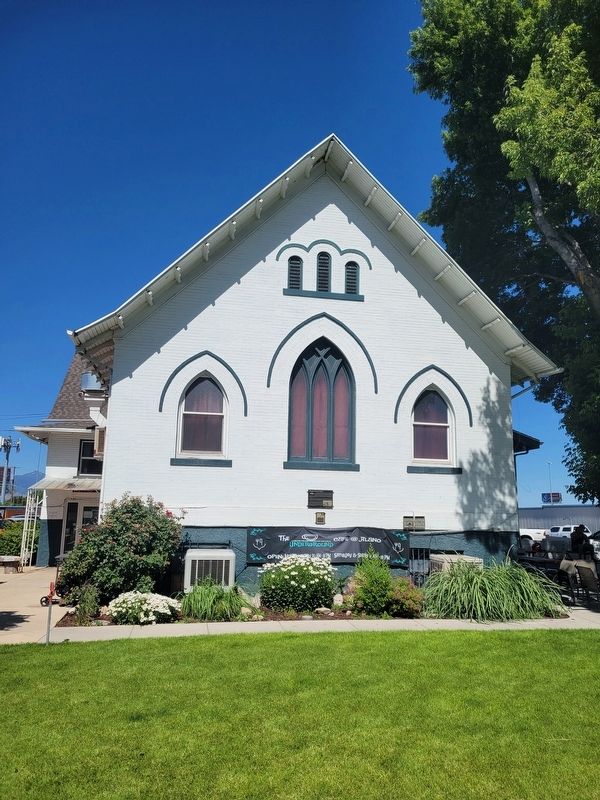
On Commerce Drive, on the left when traveling north.
Swiss Immigrant, Christian Berger and his family, came to Utah in the John Ross Mormon Pioneer Company in 1860. Berger homesteaded 160 acres west of State Street between Poplar Street and 48th South. After living two years in a dugout, the family . . . — — Map (db m249475) HM
Near 5300 South, on the right when traveling west.
The pony express epoch began simultaneously April 3, 1860 with riders starting at St. Joseph, Missouri, and San Francisco, California. It was a 1966 mile journey and reduced the time of transmitting news across the country from approximately 21 to . . . — — Map (db m124033) HM
As early as 1845 Brigham Young advised the Saints to store grain. December 14, 1876 Bishop Joseph S. Rawlins asked the sisters living in this vicinity to store wheat. February 8, 1877 the first donations were received. A temporary bin was built . . . — — Map (db m246474) HM
Near South 1500 West north of West 12800 South, on the right when traveling north.
In 1886, the Riverton Branch of the Church of Jesus Christ of Latter-day Saints purchased choice land for a tithing yard from Samuel L. Howard Sr., located between 12400 and 12600 South, one mile northeast of this park. Members brought one tenth of . . . — — Map (db m291073) HM
On East Evergreen Avenue, on the right when traveling south.
The pioneers of East Millcreek built the log schoolhouse in 1854 on bench land above a creek, later named Millcreek. Drinking water was carried up the hill from the creek. Logs were brought from the nearby canyons, and members of the community . . . — — Map (db m273352) HM
This monument was erected July 23, 1933, and marks the last camp site of the first company of Mormon Pioneers, under the leadership of President Brigham Young, before entering the Salt Lake Valley, July 24, 1847. — — Map (db m41379) HM
Near Frontage Road (Interstate 80 at milepost 101), on the right when traveling west.
On July 27, 1847, an exploring party of pioneers bathed near historic Black Rock. In 1851, the first recorded Fourth of July celebration was held here; 150 vehicles and 60 horsemen arrived from Salt Lake City. A huge, homemade flag was unfurled. . . . — — Map (db m254734) HM
On North Canyon Road, on the left when traveling south.
This monument marks the site of the Crismon Mill, the first grist mill built in the Territory of Utah. Built by Charles Crismon in the fall of 1847 this mill ground the wheat brought across the plains by the pioneers of 1847.
Vilate Kimball . . . — — Map (db m245948) HM
On West 2nd North at West Temple, on the right when traveling east on West 2nd North.
The parent school or the University of Deseret, established November 11, 1850 in the home of John Pack, was located on this corner. Forty students enrolled the first year. Produce, lumber, etc. were taken for tuition and sold by Mr. Pack. Cyrus W. . . . — — Map (db m223394) HM
On North Main Street north of North Temple Street, on the right when traveling north.
Heber C. Kimball, pioneer of 1847 and first counselor to Brigham Young, was allotted the land adjacent to this monument upon which to build homes for his family, the majority of whom arrived in 1848. He and Newel K. Whitney dedicated a plot of . . . — — Map (db m132484) HM
On Columbus Street at 300 North, on the left when traveling south on Columbus Street.
From 1847 to 1869 approximately 86,000 persons, mainly converts to the Church of Jesus Christ of Latter-day Saints, left their established homes to build anew in the valleys of the Rocky Mountains. About 6,000 were buried along the way. . . . — — Map (db m35212) HM
Constructed in 1864-65 at 120 East 1st South, this red sandstone building served for nearly 30 years, 1866-1894, as the seat of government. Here the Territorial Legislature met and passed laws establishing free public schools, made appropriations . . . — — Map (db m34994) HM
On Columbus Street at North Main Street, on the left when traveling north on Columbus Street.
Erected by the Daughters of Utah Pioneers and the State of Utah as a replica of the Salt Lake Theater. Dedicated July 23, 1950, as a Hall in which to preserve the names, portraits, histories, manuscripts, relics and other evidences of . . . — — Map (db m35252) HM
On 300 North at East Capital Boulevard, on the right when traveling east on 300 North.
The 18th Ward of the Church of Jesus Christ of Latter-day Saints, one of the original nineteen ecclesiastical wards of Salt Lake Valley, was organized Feb. 14, 1849. Early congregations consisted of families of Brigham Young, Heber C. Kimball, and . . . — — Map (db m35670) HM
On Columbia Street at 300 North, on the right when traveling north on Columbia Street.
"I want to say to every man, the Constitution of the United States, as framed by our fathers, was dictated, was revealed, was put into their hearts by the Almighty who dwells in the heavens; and I tell you in the name of Jesus Christ it is as good . . . — — Map (db m132154) HM
On Main Street north of North 3rd Street, on the right when traveling north.
Early migration to Utah and its settlement by the Mormons were added by stalwart friends. Typical of these was Col. Thomas L. Kane of the U.S. Army. A cultured and courageous man, devoted to truth and justice. In financial, political, and civil . . . — — Map (db m223417) HM
July 26, 1847, President Brigham Young and others descended Ensign Peak and located Sulphur Springs. Thomas Bullock wrote: "About 1½ miles north of the Temple Block is a sulphur spring which I dug out and made into a beautiful place." A bathhouse 15 . . . — — Map (db m124915) HM
Built in 1852 by Isaac Chase, a native of New York State who came to Utah in September 1847. His daughter Louisa drove the ox team across the plains which brought the mill stones and mill irons which were used in the manufacture of flour. In 1854, . . . — — Map (db m35131) HM
On East 900 South, on the right when traveling east.
The original five acre plot, located in the Big Field Survey, was assigned to Isaac Chase, a pioneer of 1847. A spring of clear water made it a verdant spot. Later he purchased three other tracts and planted seeds of locust trees around his home and . . . — — Map (db m35127) HM
On University Boulevard at State Street, on the right when traveling east on University Boulevard.
This ten-acre block served as camping grounds for immigrant trains.
The vanguard of the first band of pioneers pitched their tent here July 23,
1847, at which time their leader Orson Pratt dedicated the land. Later it became
the focal point for . . . — — Map (db m143213) HM
This home was erected 1853-1854 by Isaac Chase who with his wife Phebe and their family came to Utah in 1847. Originally it had eight rooms, including a large kitchen with a built-in dutch oven. The adobes were made on the church farm and the small . . . — — Map (db m35129) HM
On South 600 East south of East Broadway / E 300 S, in the median.
The street to the north was originally Emmigration Road – the only approach from the east. Over this road the pioneers of 1847 and subsequent years entered the valley of the Great Salt Sea. They found growing near this site a lone cedar and . . . — — Map (db m35125) HM
On 400 West at South Temple Street, on the right when traveling south on 400 West.
As western settlement increased, the need for an overland railroad was voiced by various groups, including Utah pioneers who petitioned Congress, Mar. 1852. The Enabling Act of 1862 authorized construction. First rails laid by Central Pacific in . . . — — Map (db m35805) HM
The Kennedy Ditch was an early pioneer irrigation canal taken out of Parley's Canyon stream near
17th East. The construction was achieved as a cooperative work project, and the new channel named after its first Watermaster, Charles Kennedy, a Utah . . . — — Map (db m273646) HM
Near this spot once stood a wall built of stone from Red Butte Canyon. Decision to thus enclose University of Deseret now University of Utah campus was made, March 13, 1850, same day present site recommended by Brigham Young and committee was . . . — — Map (db m239748) HM
On July 22, 1847, the main body of the Mormon Pioneer Company, along with a few of the Mormon Battalion sick detachment and some of the Mississippi Saints, camped near this location. After leaving Emigration Canyon, the group traveled in a . . . — — Map (db m273649) HM
On 300 West at 400 South, on the right when traveling south on 300 West.
On this ten acre square during the years 1847-1849 stood the first fort, historic Mormon bastion, sometimes called the "Plymouth Rock of the West." Homes were erected of logs or adobe, side by side, with the rear walls forming a protective . . . — — Map (db m35280) HM
On South 700 East (Utah Route 71) at East Nibley View Court, on the right when traveling south on South 700 East.
In the early 1860's George and Mary B. Calder built one of the first amusement parks on this spot. They cleared the land with oxen, planted grass and trees and converted a natural spring of water into a lake for boating. It was spanned by a . . . — — Map (db m40229) HM
On East 2100 South, on the left when traveling west.
After World War II the growth of the city to the south and east made it imperative to
construct a large prison facility in a more isolated area. In 1951 all the old penitentiary buildings were demolished and the inmates transferred to the "Point of . . . — — Map (db m273639) HM
Anderson Tower was built in 1884 by Robert R. Anderson (1848-1935) a pioneer of 1867, and one of the original settlers on the north bench of Salt Lake City. The tower was patterned after similar towers Mr. Anderson had seen in Scotland as a young . . . — — Map (db m124173) HM
On A Street East north of Second Avenue, on the right when traveling south.
Brigham Young's Garden Wall was built in the 1850s as a protection
and a "make work" project.
The wall was eight feet high and thirty inches thick at the base. The
wall receded to about twelve inches at the top. Using the surrounding . . . — — Map (db m245950) HM
This marker stands 90 ft. north of the gate to Lindsey's Gardens. First playground in Utah. In 1865 Mark Lindsey and wife Bithiah Savill Lindsey, handcart pioneers of 1859, homesteaded a quarter-section; built a home, dance hall, museum, lunch . . . — — Map (db m263160) HM
On D Street at 2nd Avenue, on the right when traveling north on D Street.
On this site in 1857, the Twentieth Ward or Twentieth District School was erected, John Toone builder. The one large room served for school, church and recreation. In 1860 a two-story addition was constructed. Pupils came from all parts of Salt Lake . . . — — Map (db m43559) HM
On Hempstead Road at Mario Capecchi Road, on the left when traveling east on Hempstead Road.
Founded Oct. 22, 1862 by Brevet Major General Patrick Edward Connor and U.S. Volunteers ordered to defend western mail routes. Quartered first in tents and dugouts. Soon stone buildings were erected, some of which are standing. Named Camp Douglas by . . . — — Map (db m223087) HM
On Herbert Avenue, on the right when traveling west.
In 1867 Paul A. Schettler, an ardent supporter of the silk industry in Utah, acquired this land and planted five acres in mulberry trees, the leaves of which were used to feed silk worms. He built two cocooneries near this location. Elizabeth Von . . . — — Map (db m176751) HM
On South 3100 East south of Granite Woods Lane, on the left when traveling south.
In the 1860's, a town named Granite was located at the mouth of Little Cottonwood Canyon by ore miners of Alta, Silverton, and Tannersville. Its desertion began as the mines closed about 1882. The surrounding country had been settled by Latter-day . . . — — Map (db m37468) HM
On 9000 South (State Highway 209), on the right when traveling east.
The Mingo Smelter was the largest single producer in Utah of metals such as gold, silver, and lead. When it began in 1873, it was known as the Mountain Chief Smelter and was renamed the Mingo smelter in 1876 when it was expanded. By 1881 it produced . . . — — Map (db m35765) HM
In 1871, Utah Southern Railroad from Salt Lake was finished and station built here. Wasatch & Jordan Valley Line ran east to Granite Quarry to bring to this junction, huge rocks for constructing S.L. Temple. Later, a narrow-gauge, completely covered . . . — — Map (db m222696) HM
Rufus Forbush buried his wife Polly Clark, at this spot on 22 August 1851. In 1852, after several victims of a black smallpox epidemic had been buried here, he contributed the land for use as a pioneer cemetery and many of the prominent early . . . — — Map (db m272817) HM
On South 1055 West, on the right when traveling south.
In 1859, George A. Smith sold his Mexican Land Grant to Alexander Beckstead, who, with others, settled ½ mile to the south. They dug a five mile ditch from Jordan River, in operation since completed in 1863. Adobe Community House built, 1864. . . . — — Map (db m34679) HM
On South Redwood Road (Utah Route 68) 0.1 miles north of Conifer Way, on the right when traveling north.
Upon the advice of Brigham Young, the first settlers west of the Jordan River built English Fort in 1853 for protection from Indians. Thick walls of rock and adobe with one gate surrounded the two acres of land. Adobe partitions separated the . . . — — Map (db m137520) HM
Early pioneers displayed determination of spirit and purpose, even death, disaster, or
elements of nature could not drive them away. About 1853, on a small knoll just
south of Wight's Fort, an Indian baby was buried. The first West Jordan pioneer . . . — — Map (db m302989) HM
On 3500 South (Utah Route 171) west of 4000 West, on the right when traveling east.
When Joseph Harker crossed Jordan River at 3300 South in 1848, he luckily found springs. By 1870 pioneers had sparsely settled the Granger area. School was held in homes until 1882 when the 16 x 24 foot West Granger was built at 3500 South and 4000 . . . — — Map (db m231232) HM
First settlers to arrive in this community in 1849 built homes dug wells, and made canals from Jordan River. The soil's rich yield prompted Judge Elias Smith to name the area Granger. Churches and schools were situated in various places. In 1884 . . . — — Map (db m254634) HM
On 6000 West at Brook Hollow Drive, on the right when traveling north on 6000 West.
Homesteaders and settlers came in the 1870's to the area 4700 South to 7200 West, north to the Great Salt Lake, northeast along it's shore and the Davis County line to 4800 West and south to 4700 South. This area became Hunter Precinct in 1880 from . . . — — Map (db m35101) HM
On South Main Street, on the left when traveling north.
A canal was surveyed from Johnson Creek on Blue Mountain to White Mesa; in 1902-3 lots were staked for homes. Two years later Albert R. Lyman and Family pitched first tent and settled one block west of this site. In 1907 a tent school was . . . — — Map (db m95062) HM
On Utah Route 276, on the right when traveling east.
In 1879 the L.D.S. church sent missionary families to San Juan Country to make settlement and better relations with the Indians. These pioneers led by Silas S. Smith and Platte D. Lyman came through the Hole in the Rock. The company consisted of 83 . . . — — Map (db m173731) HM
On South Main Street, on the right when traveling north.
March 12, 1887 Frederick I. Jones, Farley R. Butt, Charles E. Walton and George A. Adams came here to start the L.D.S. Blue Mountain Mission. After their families arrived they camped at Verdure the first summer. In 1888 the families of M. Peterson, . . . — — Map (db m95124) HM
Near U.S. 191 at milepost 110.4, on the right when traveling north.
Kane Springs, San Juan County, was a major water stop along the historic Spanish Trail, in use from 1829 to 1848. Large trade caravans halted here and drank from the abundant spring waters. In autumn months, pack trains carried woolen textiles and . . . — — Map (db m95080) HM
On U.S. 191 at milepost 65.5, on the right when traveling north.
The oldest Mormon settlement in the Blue Mountain Region was first known as South Montezuma. Later the name was changed to Verdure after the lush green growth along the stream bed. Verdure was settled by men of the Blue Mountain Mission March 11, . . . — — Map (db m95065) HM
On U.S. 89 at Center Street, on the left when traveling north on U.S. 89.
Axtell, originally called Willow Creek, is a wide-spread, productive farming community located on the boundary of Sanpete and Sevier Counties. It is a living monument to the rugged characteristics of the pioneers who came to this valley. Axtell was . . . — — Map (db m74902) HM
On South Main Street 0.1 miles north of 300 South Street, on the left when traveling north.
Gunnison settlers began farming the land to the south in the early 1860's, each claiming his acreage under "Squatter's Rights" and later paying a filing fee of $1.25. Water was obtained from the Sanpitch River and fresh mountain springs. By 1877 . . . — — Map (db m74903) HM
On South Main Street 0.1 miles north of 300 South Street, on the left when traveling north.
In the Early 80's Centerfield was known as "The Field" or "South Gunnison". The thirty families living there erected a public building in 1882 made of red pine logs with a slab roof covered with clay. A stone fireplace furnished the heat while the . . . — — Map (db m74905) HM
On Pioneer Cemetery Road 0.9 miles north of U.S. 89, on the right when traveling north.
In 1854, Ephraim's first settlers erected a one and one half acre stone fort for housing and protection against Indian attacks. A cemetery was not included in their plans. The first pioneer to die was Mr. Manwaring. Permission had been granted to . . . — — Map (db m75027) HM
On North Main Street south of 100 North Street, on the right when traveling north.
President Brigham Young, in 1876, gave the Relief Society sisters an assignment to store wheat for a time of need. This historic, oolite limestone building was constructed as a granary in response to this concept. Pioneer women and children followed . . . — — Map (db m74995) HM
On East 100 North at North 300 East, on the right when traveling east on East 100 North.
In 1852 Isaac Behunin and family came to Pine Creek. By 1854 seventy-seven families had arrived. Branch L.D.S. Church organized, Rueben W. Allred was presiding elder. Reddick N. Allred captain of militia. Ft. Ephraim incorporated as a city 1868, . . . — — Map (db m75022) HM
Near West 100 North Street west of North Main Street, on the left when traveling west.
The Indian War years of 1865-72 brought bitter hardships to Sanpete and other central Utah areas. Different bands of Indians stealthily attacked settlers from their mountain hideouts, then fled to safety. Twenty-seven settlements were evacuated; two . . . — — Map (db m276825) HM
On South Main Street at 50 South Street, on the right when traveling south on South Main Street.
Near this spot on Tuesday, October 17, 1865, Black Hawk, a Ute chief, led his warriors out of Cottonwood Canyon foraging for cattle. They stole the entire Ephraim herd. Settlers who were working in the fields were massacred and lie buried in one . . . — — Map (db m74951) HM
On East 100 North Street east of North Main Street, on the right when traveling east.
Near this spot February 7, 1854, twenty-five men organized in military order, began the construction of a small fort for protection from the Indians. The walls, made of rock were seven feet high, almost two feet thick, and formed the outer wall of . . . — — Map (db m74998) HM
On Cemetery Road 0.4 miles north of West 100 North Street, on the right when traveling north.
This sacred plot, laid out by Joseph Gaston Garlick, was first used in 1860. Three small children, Maria Terry, Henry Weeks Sanderson, Jr., and Lucy Jones were the first buried here. Later, John Givens, his wife, Eliza, and their son and three small . . . — — Map (db m75061) HM
On South State Street north of East 100 South Street, on the right when traveling north.
In 1859, a small group from Mt. Pleasant laid out a townsite here called North Bend. Later the name was changed to Fairview. During the winter rock was quarried and hauled to build a fort, and in 1860 walls of three sides were finished; the other . . . — — Map (db m235293) HM
On S 100 E Street at E 100 S Street, on the right when traveling north on S 100 E Street.
In 1861 Joseph Bartholomew, James Mellor and others settled here and diverted the warm creek for irrigation purposes. A branch of the Church of Jesus Christ of Latter-day Saints was organized in 1862 with Branch Young as President. The name of the . . . — — Map (db m74909) HM
On North Main Street, on the left when traveling north.
Official outlet of ZCMI (Zion's Co-operative Mercantile Institution), "America's First Department Store". This building housed the Fayette Merc. from circa 1890s to 1986. Until 1960 it was part of the ZCMI co-operative system which served more than . . . — — Map (db m74910) HM
On South State Street at Center Street, on the right when traveling south on South State Street.
After Albert Petty surveyed this site in 1859, pioneers came, built homes, erected a meeting house of logs cut by William Gibson and Asbury Parks. In 1861, Bishop Robert L. Johnson opened first store and hotel. Polly Johnson was first Relief Society . . . — — Map (db m75193) HM
On South State Street south of Center Street, on the right when traveling south.
This monument replaces one previously erected north of town near the site of this historical event. Over the years the original marker was weather-eroded and vandalized.
Lewis Lund an eighteen year-old herdsman, along with Jasper Robertson, Swen . . . — — Map (db m75191) HM
On West Center Street at 300 West Street, on the left when traveling west on West Center Street.
This location, later called Fountain Green, was a favorite camping place for travelers. Sept. 30, 1853, James Nelson, Wm. Luke, Wm. Reed and Thos. Clark, while camping here with their ox teams, were killed by Indians. Under direction of Brigham . . . — — Map (db m75228) HM
On North Main Street north of 200 North Street, on the left when traveling north.
Gunnison was settled in 1859. As a precinct it was granted weekly U.S. Mail service in 1862. The Black Hawk War began in 1865. In 1867 a bastion was erected 362 feet southeast of here. It was used by Colonel Byron Pace and 1500 militia men to . . . — — Map (db m74907) HM
On West 300 North east of North 100 West, on the right when traveling west.
This pioneer cabin, one of the first erected in Manti, was built inside the log fort, about 1853 by Nathaniel S. Beach. He later moved it to 104 West 2nd North where it was purchased by William and Johannah Richey, as a home for their family. At one . . . — — Map (db m74949) HM
On East 500 North Street (U.S. 89) at North 100 East Street, on the left when traveling north on East 500 North Street.
Under direction of Bishop Isaac Morley 224 pioneers arrived in this vicinity Nov. 22, 1849. In response to an invitation from Indian Chief Walker to President Brigham Young. Their first homes were dugouts in the south side of Temple Hill. That . . . — — Map (db m44489) HM
On South 200 West Street at West 100 South Street, on the right when traveling south on South 200 West Street.
Erected in 1865 on order of General D.H. Wells to protect the settlers during the Black Hawk War. The fort covered the present City Hall Block and westward with 12 ft. rock walls supporting cabins along the inside. The bastion stood on the Lincoln . . . — — Map (db m75190) HM
On South State Street south of 100 South Street, on the right when traveling south.
On Sept. 7, 1872, the final peace treaty of the Utah Black Hawk Indian War was signed at the home of Bishop Seeley by General Henry A. Morrow, Orson Hyde, Amasa Tucker, Fredrick Olson, Reddick Allred and William S. Seeley. Representing the Indians . . . — — Map (db m75172) HM
On North State Street north of Main Street, on the right when traveling north.
Mt. Pleasant, a small town nestled at the foot of the mountains in Sanpete County near the geographic center of Utah, was settled early in 1859. During June the men kept busy tending their crops and building a fort, twenty-six rods by twenty-six . . . — — Map (db m75169) HM
On North Main Street at West 100 North, on the left when traveling north on North Main Street.
This spring was long used by Indians and early scouts as a camp site. James Allred, directed by Brigham Young on March 22, 1852 led his sons and their families here to build their homes. In 1853 a large colony of Scandinavian emigrants joined them. . . . — — Map (db m75059) HM
On North 100 East north of East 200 North, on the right when traveling north.
The pioneers of Spring City established a cemetery at this location in 1857. It is in the shape of the State of Utah. The earliest known burial was that of Newton Devine Allred in 1857. Three men who were casualties of the Black Hawk War, James . . . — — Map (db m150177) HM
On South Main Street at West 100 South, on the left when traveling north on South Main Street.
In 1859, this area was resettled permanently by families of James Allred, Wm. Black, James Ellis, a large Danish colony of gifted craftsmen and stonemasons, and others. They surveyed the land, raised abundant crops, and became known as the . . . — — Map (db m75044) HM
On South Main Street at 100 South Street, on the left when traveling north on South Main Street.
In 1873, Daniel B. Funk purchased the winter camp grounds of the Sanpitch Indians situated in Arropeen Valley, one mile east of Sterling, Utah. With the help of President Brigham Young, he obtained from Chief Arropeen a deed to the valley. Here he . . . — — Map (db m74917) HM
On West Center Street 0.5 miles west of Main Street, on the right when traveling west.
In this cemetery are the remains of many of the settlers of the town of Pettyville. In 1873, George Petty led fifteen families from the town of Manti to an area located two miles west of Sterling. They built a settlement and named it after Mr. . . . — — Map (db m74920) HM
On Main Street at Center Street, on the left when traveling north on Main Street.
First Walker War casualty, Peter Ludvigson, was killed by Indians in 1865, three miles south of Sterling. Wm. D. and Daniel B. Funk located on Six-Mile Creek in 1872; dug irrigation ditches for farming. Families came later. A Manti branch of Church . . . — — Map (db m74919) HM
On State Street north of East 100 North, on the right when traveling north.
In 1854, at Fort Ephraim, an Indian Tabiona, gave Pres. Brigham Young a black rock, saying “Heap burn.” Two Welsh coal miners, John Rees and John Price, were sent with the Indian to located the coal vein, which was found in Coal Canyon . . . — — Map (db m150180) HM
On Main Street at Center Street, on the left when traveling south on Main Street.
In the spring of 1871, Harry Dalton, James Powell, and their families traveled across Sevier Valley to Omni Point at the base of Cove Mountain. In early fall that same year, the Edward Killick Roberts and John Gleave families moved from Glenwood . . . — — Map (db m307634) HM
On South Main Street at West 100 South, on the right when traveling north on South Main Street.
While riding through the Aurora valley, George T. Holdaway, J. Alma Holdaway and Elliott Newell of Provo, Utah, noticed fertile soil and an abundance of water and decided to begin a settlement here. They traveled home and encouraged others to join . . . — — Map (db m74856) HM
On Utah Route 24 0.3 miles north of Route 62, on the left when traveling north.
June 15, 1873 Brigham Young called Albert K. Thurber and George W. Bean, Indian interpreters, WM. B. Pace, William Jex and others to explore Grass Valley for settlement and make peace with the Indians. Chief Tabioonah accompanied the party and acted . . . — — Map (db m142661) HM
On East 200 North at Center Street, on the right when traveling west on East 200 North.
Elsinore, named for a town in Denmark, was settled in 1874-75 by families of James C. Jensen, Charles H. Nielson, Lars Hansen, Niels Erickson, Hans Nielsen, William and Vigo Smith; Thomas C. Jensen and sons: (Jens Ivor, Christian J., Niels Peter), . . . — — Map (db m74807) HM
On Utah Route 119 at Route 263, on the right when traveling east on Utah Route 119.
On October 2, 1874, the Latter-day Saints living in this locality organized a modern order of Enoch called the United Order, established under counsel and instruction of Brigham Young. Families placed their land, cattle, sheep, machinery and all . . . — — Map (db m74844) HM
On Main Street at Center Street, on the right when traveling south on Main Street.
This building has two markers on the east wall of the building.
ZCMI Co-Op Building
1878-1930
Official outlet of ZCMI (Zion's Co-operative Mercantile Institution), "America's First Department Store". This building housed the . . . — — Map (db m74846) HM
On North 100 East, on the left when traveling north.
Jericho settlement was begun in 1864. That spring, Charles Green, John Pine, Daniel Brown, and a Mr. Hill arrived from Sanpete. The valley had fertile soil and water from the Sevier River, but the site was abandoned in 1865 because of Indian . . . — — Map (db m74801) HM
On North Main Street, on the left when traveling north.
During the winter of 1866-1867, William Cordingly built a small log cabin in the settlement of Alma, and by early spring the house was ready for his family. Indian troubles forced some of the original settlers to abandon their homes and leave this . . . — — Map (db m74804) HM
On West 200 North at North 100 West, on the right when traveling west on West 200 North.
Pioneers and Families who lived in
Fort Alma (later Monroe) 1864-1867
Major Allred, Parley Allred, Wiley Allred, Andrew Anderson, Israel Bale, Benjamin Barney, Walter Barney, Joseph Besswick, George Blacket, John W. Bohman, Thomas Broadbent, . . . — — Map (db m74806) HM
On West Main Street at North Center Street, on the right when traveling west on West Main Street.
The town of Redmond established in 1875 with John Johnson as the first Bishop and Mayor, received its name from the three red mounds that form part of the grey hills to the west of town. The Redmond Town Hall has been a landmark in Redmond for many . . . — — Map (db m74861) HM
On South 200 West, on the right when traveling north.
On this spot of ground, in 1873, an adobe building, the first recreation center in Richfield, was erected by Pioneers Austin M., Alonzo L. and Albert Farnsworth. Accepted into the United Order in 1874. Acquired by the LDS Church in 1877 for all . . . — — Map (db m74819) HM
On West 100 South 0.2 miles west of South Main Street, on the right when traveling west.
Near this spot in 1865 a rock fort was built as a protection from Indians. It was a cooperative project. Each man who owned a city lot built one rod of the wall which was 3 l/2 feet at base, 12 feet high, 1 foot at top. There were portholes at . . . — — Map (db m74820) HM
On East 300 North, on the right when traveling west.
The first ten pioneers who arrived here January 6, 1864, were Capt. Albert Lewis, Robert W. Glenn, Christian O. Hansen, Hans O. Hansen, Nelson Higgins, August Nelson, George Oglevie, Eskild C. Peterson, Andrew Poulson, and Jorgen Smith. Followed by . . . — — Map (db m74840) HM
On South 100 East just north of East 100 South, on the right when traveling north.
Erection of the first L.D.S. Church in Salina was commenced in 1864 when rocks were hauled from a quarry two miles away. Soren Neilson, a stonecutter, supervised the work. When the structure was built to the square, the people used it as a fort. . . . — — Map (db m74860) HM
On South State Street at Interstate 70, on the right when traveling south on South State Street.
During the winter of 1864 a small band of Indians near Gunnison contracted smallpox and blamed the settlers. In April 1865 the Utes and Whites met at Manti to solve the difficulties but failed. Elijah B. Ward and James P. Anderson were killed by . . . — — Map (db m74857) HM
On South 100 East at East 100 North, on the right when traveling north on South 100 East.
Work on the Fort began in 1865. The Fort was 214 feet square, on ground purchased from Christian Sorenson. The walls were 10 feet high, and 2 feet thick, with bastions 10 feet square at the four corners, with port holes in walls and bastions. Inside . . . — — Map (db m74859) HM
On Utah Route 24 0.1 miles north of Center Street, on the left when traveling north.
On April 5, 1868, a company of twenty three men under the leadership of Frederick Olson of Spring City were on their way to Monroe with the intention of resettling that locality. When at Cedar Ridge near Rocky Ford, now within the limits of . . . — — Map (db m74855) HM
On S. Hoytsville Road at E 1100 S Road, on the right when traveling north on S. Hoytsville Road.
This monument is near the site of the old fort, 300 ft. so. west of here. It was on old Emigrant Trail. Route also used by Overland Stage and part of Johnston's Army going east in 1861, to participate in the Civil War. The fort was built during the . . . — — Map (db m67624) HM
On S. Main Street at W 100 S Street ( Route 280), on the right when traveling south on S. Main Street.
First public building in Summit County, built in 1865, originally used as county building, meeting house and amusement hall, later, as school house dedicated by President Brigham Young in the fall of 1868. Summit Stake was organized in this building . . . — — Map (db m67611) HM
On Hoytsville Road, on the right when traveling north.
Summit stake was organized July 9, 1877, William W. Cluff, George G. Snyder, Alma E. Eldridge, Presidency. In 1879 ground was broken for a tabernacle, Thomas L. Allen, Architect and builder. Plans approved by Truman O. Angell, Church Architect. . . . — — Map (db m276060) HM
On Hoytsville Road 0.3 miles north of Old Lincoln Highway, on the left when traveling north.
In 1861, Aaron Daniels built a stage coach station here to change horses and as an overnight stop for the Overland coach from the east to Salt Lake City. Gilmer and Salsbury operated the line until 1870. In 1869, Kimball Brothers, stage between Echo . . . — — Map (db m67622) HM
546 entries matched your criteria. Entries 301 through 400 are listed above. ⊲ Previous 100 — Next 100 ⊳