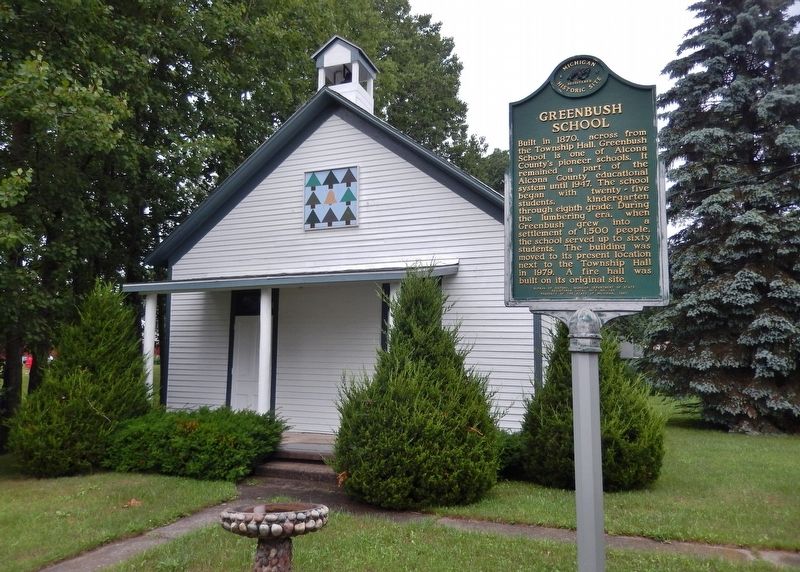
Built in 1870, across from the township hall, Greenbush School is one of Alcona County’s pioneer schools. It remained a part of the Alcona County educational system until 1947. The school began with twenty-five students, kindergarten through . . . — — Map (db m121967) HM
The first issue of the Alcona County Review was published on April 27, 1877 by publisher James K. Fairchild. Nine publishers and 140 years later, the Review is the oldest continuously run business in Alcona County. Throughout all of . . . — — Map (db m121971) HM
In the mid-1800s the first white settlers came to what is now Alcona County. As the population grew, schools became part of nearly every settlement or logging camp. The first school was built in 1860. In 1869, Alcona County was established but . . . — — Map (db m277850) HM
This bell marks the site of the beloved red brick schoolhouse on the hill. Proud alumni and loyal friends dedicate this memorial to those who taught and learned from morning ring to closing toll. The bell symbolizes love, laughter and learning of . . . — — Map (db m154630) HM
In 1883, Russell Alger formed the Detroit, Bay City and Alpena Railroad. In 1895 it was combined with the Alpena and Northern to form the Detroit and Mackinaw Rail Company. In 1900 depot sites were selected at Greenbush and Harrisville. Scheduled . . . — — Map (db m121975) HM
In September 1846, fisherman Simeon M. Holden and his boat's crew, Robert McMullen and William Hill, were driven by a northwest gale from their fishing ground at Thunder Bay Island and made land at the High Banks of AuSable, now called Springport. . . . — — Map (db m277372) HM
Erected by the Women's Civic League of Harrisville in memory of our boys who
sacrificed their lives in the Great World War.
Percy Anderson •
John E. Armstrong •
Delbert Atchison •
Harvey G. Alexander •
Asa Baird •
Ernest R. Berry . . . — — Map (db m277399) WM
This anchor windlass was mounted on the forward deck of large sailing vessels to raise their heavy anchors. It was mounted in a strong frame and used a rachet device to rotate the shaft to lift and recover
the anchors and lines. — — Map (db m277857) HM
Built in 1907 of Norway pine, the Bailey School is one of the few remaining one-room, log schoolhouses still standing in Michigan. It was built at the site of
the C.A. Johnson Logging Camp west of Mikado for the children of the logging crews, and . . . — — Map (db m277568) HM
The history of the Great Lakes is dominated by tales of majestic schooners and gigantic freighters battling storms. Working in the shadows of these larger ships, thousands of small workboats tolled in every corner of the Great Lakes. They
were . . . — — Map (db m277671) HM
(On Left)
The Capstan is an apparatus which
is mounted on thenforedeck of a ship to raise anchors and handle other heavy loads. This one was operated by hand using bars inserted in the holes at the top.
Damage suggests this one failed under . . . — — Map (db m277965) HM
Get Into Your Sanctuary
Sanctuary Sentinels
As the nation's population and economy rapidly expanded throughout the 19th century, so did the shipping traffic on the Great Lakes. Violent storms, thick fog, shifting sandbars, rocky . . . — — Map (db m277968) HM
According to the Detroit Tribune, the tug Loretta "was always considered an unlucky boat, having been in dry dock every season since coming out." On the morning of October 7, 1836, the Loretta was awaiting repairs at Black River when a . . . — — Map (db m277860) HM
On August 29, 1880, the sidewheel passenger vessel Marine City steamed across Lake Huron. While just off Sturgeon Point, passengers and crew noticed smoke
coming from the engine room. In very little time, the fire engulfed the ship. As thick . . . — — Map (db m277836) HM
After stopping for a load of shingles at Alcona the ship caught fire three miles off shore from Sturgeon Point. The fateful day was Aug. 29, 1880.
The tugs Vulcan and Grayling came to the rescue. Approx. 100 passengers, 41 crewmen leaped into . . . — — Map (db m277845) HM
This tug caught fire at the dock of the Alger Smith lumber mill in Black River, Mi., circa 1890. It was pushed away from the dock where it sank. — — Map (db m277854) HM
This is a gasoline powered fishing boat typical of many used on the great lakes in the first half of the 20th century. Fishing for lake trout, white fish and other species was a major industry from the early 19th century until the sea lamprey, an . . . — — Map (db m277606) HM
Circa 1845, William Hill established a fishery at this place,
which was called The Cove. He had five fishing boats and a
lodging house. The settlement became the village of Alcona.
In the 1860s and 1870s, Johnston, Haynes & Company built
a saw . . . — — Map (db m233580) HM
William Hill established a fishing
station in this area. known as "the
Cove." circa 1853. Early residents
were fishermen who netted the once
abundant schools of herring.
whitefish and perch. Johnson, Haynes
and Co. began lumbering the . . . — — Map (db m233566) HM
This bell was originally mounted in
the Watchtower from which the Coast Guardsmen at Sturgeon Point maintained a dawn-to-dusk lookout for vessels in trouble out on the Lake. If a vessel in distress was spotted the man on duty would ring the bell to . . . — — Map (db m277674) HM
Shipbuilding forever changed with the transition from wooden hulls to those built of iron and steel. The first iron-hulled freighter on the Great Lakes, the Onoko, debuted in 1881. At 287 feet long, she was a giant of her day. Just five years . . . — — Map (db m122196) HM
Located on the Government Square, City Hall remains one of Alpena’s most prominent structures. In 1904 when the city council chose to construct the building of Bedford (Indiana) limestone rather than local limestone or concrete from Alpena’s . . . — — Map (db m121900) HM
"Alpena has blazed a new trail in construction," architect William H. Kuni of Detroit declared at the opening of the Alpena County Courthouse on October 21, 1935. Calling it "the first monolithic building erected in a cold climate," Kuni designed . . . — — Map (db m66795) HM
At the time of the U.S. Civil War, thousands of sailing ships worked the Great Lakes. Despite their impressive numbers, these sailing vessels struggled hardly able to keep pace with the enormous demands for bulk cargos generated by America's . . . — — Map (db m122215) HM
Launched in 1891, the Grecian symbolizes an era of unprecedented industrial growth and dramatic changes in technology. Newspapers heralded the steamer and her five sister ships as “fast steel flyers.” A marvel of efficiency at . . . — — Map (db m126625) HM
Soon after white settlers came to
the area in 1856, J.K. Miller held
religious gatherings at the home
of Daniel and Sarah Carter. These
meetings evolved into the First
Congregational Church, which was
organized on March 2, 1862, with
the . . . — — Map (db m233605) HM
In 1874, the 60-foot wooden harbor tug E.H. Miller began a 45-year career operating out of Alpena, escorting vessels on the Thunder Bay River and assisting those in distress. The tug was not without her own share of mishaps. In her first . . . — — Map (db m122200) HM
The maritime professionals who sail the ships on the Great Lakes are celebrating the 100th anniversary of their fraternal organization, the I. S. M. A. whose purpose is stated in the Association's constitution, "The purpose of this association's . . . — — Map (db m121889) HM
In 1916 the Monarch
Milling Company, a grist
and flour mill, began
operations in this
building, which was
constructed in 1914. By
1920 it was known as the
Alpena Flour Mills,
producing “Leader” and
“Velvo” brand flour. The
mill closed in . . . — — Map (db m233604) HM
The screw steamer or "propeller" first appeared on the Great Lakes in the 1840s. These vessels featured wooden hulls and shallow bottoms like early sidewheelers, but their steam engines powered one or more screw propellers at the stern of the ship . . . — — Map (db m121898) HM
For centuries explorers and scientists have researched the Great Lakes. As a vital transportation link to the Midwest and one of the largest sources of fresh water on the planet. Such important resources warranted scientific, charting and survey . . . — — Map (db m122199) HM
Life on the frontier Great Lakes was dangerous when the sidewheeler Vermilion went into service in 1838. In 1842, the 151-foot steamer burned to the waterline, killing several people. A year later, with immigration booming and the economy . . . — — Map (db m122429) HM
Sailing ships first appeared on the Great Lakes when French explorer Rene Robert Cavalier, Sieur de La Salle built the Griffon in 1679. By 1870, over two thousand sailing ships plied the Great Lakes. Most of these sailing ships were . . . — — Map (db m122194) HM
In 1861 Bishop Frederic Baraga (1797-1868) trod through snow and icy waters from Sault Ste. Marie to Alpena where he founded a Catholic church. However, it was not until 1866 that Father Patrick Murray became the first resident pastor of the church . . . — — Map (db m121899) HM
Steam power first appeared on the Great Lakes in 1818. The earliest "steamers" were expensive to build and operate. Constructed of wood, the vessels had shallow bottoms and were powered by large sidewheels.
For a time, these "sidewheelers" . . . — — Map (db m121957) HM
In 1856 Daniel Carter, who came to
the Thunder Bay region seeking pine
lands, brought his wife, Sarah, and
daughter Mary to the town of Fremont,
present-day Alpena. They were Alpena’s
first permanent settlers. Daniel participated in the . . . — — Map (db m233610) HM
In November of 1856, George N. Fletcher assisted a survey crew in laying the footprint for the city of Alpena. Appreciative of the area's dense forest and the Thunder Bay River's ability to help transport raw materials, finished products, and fuel, . . . — — Map (db m122228) HM
The Civil War created an insatiable demand for copper. At a time when Michigan's Upper Peninsula produced the majority of America's supply, vessels like the Pewabic played a critical role in the war effort. On a typical trip between lakes . . . — — Map (db m121896) HM
Located across the river from where you are standing is an area known historically as Alpena's Third Ward. The first dwellings there were erected in 1858 or '59 at the river's edge, while the majority of the land remained woods and swampland. The . . . — — Map (db m121894) HM
From the time of Alpena's inception it was divided by the Thunder Bay River, although most of the community was centered on the south side. A wooden scow served as a ferry, connecting Second Avenue on the south side with Dock Street on the north; it . . . — — Map (db m121890) HM
The first known fishing camp near Alpena was established on Thunder Bay Island in 1835. By the 1840s, both Thunder Bay Island and nearby Sugar Island served as a base for the area's fishing fleet, comprised entirely of sailing vessels. In 1846, . . . — — Map (db m121897) HM
From 1858 to 1926, Thunder Bay served as a major center of the Great Lakes lumber trade. Schooners and steamers shipped lumber around the Great Lakes and to eastern cities. Beginning in 1845, Thunder Bay Island also served as a "wooding," or fueling . . . — — Map (db m121895) HM
Like other "canallers," the schooner E.B. Allen squeezed through the canals and locks of the Great Lakes. Crews tried to maximize the payload, and thus profits, using every inch of cargo space.
The heavy traffic of thousands of sail and . . . — — Map (db m122198) HM
“By the Treaty of Saginaw, made at Saginaw [Saquina] September 24, 1819, by General Lewis Cass, Governor of the Northwest Territory, on the part of the United States, and the Chippewa Nations, Thunder Bay River became a part of the boundary of the . . . — — Map (db m182328) HM
U.S.S. Maine, destroyed in Havana harbor February 15th 1898. This tablet cast from metal recovered from the U.S.S. Maine.
(on the shield) ☆ Patriotism ☆ Devotion ☆
— — Map (db m233608) WM
Shipping on the Great Lakes has always been seasonal. The poor visibility, heavy seas and ice that came each year with the gales of November prompted ship owners and captains in the 1800s to "lay up" their ships. Every winter ice choked docks and . . . — — Map (db m121892) HM
Portland cement, so-called because
it resembles in color stone from
the Isle of Portland, in the British
Isles, was first produced in the
United States in 1871, in Michigan
in 1896. Because of Alpena’s location
in the midst of immense . . . — — Map (db m233611) HM
Launched in 1891, the steel-hulled Grecian was built during an era of unprecedented
industrial growth and dramatic change in shipbuilding technology. Good steel flexes
but doesn’t break upon impact. However in June 1908, when the . . . — — Map (db m236369) HM
Built for speed, the 236-foot steam package freighter Montana
initially carried all types of freight. A typical trip found the
Montana carrying a diverse cargo of 6,000 barrels of flour, 40
tons of copper, 250,000 shingles, 100 . . . — — Map (db m236026) HM
On Saturday night, November 19, 1966, the Nordmeer was traveling to
Chicago from Hamburg, Germany, with a cargo of 990 coils of steel
destined for Milwaukee. It was the ocean-going vessel’s first freshwater
voyage. The night was clear. . . . — — Map (db m236019) HM
My name is Abby O’Bryan, I am a Girl Scout with Troop 1033 in Alpena.
I proposed the original idea of a dog park to a member of the City Council and
began the planning process. During the initial stages, I met many others with
common interests . . . — — Map (db m236519) HM
Thomas Stafford was born in Wexford, Ireland in 1842. After originally immigrating to Canada,
Stafford moved to Alpena where he married Elizabeth McDougall. The couple raised nine children
in Alpena, with many descendants still living in the area . . . — — Map (db m236518) HM
Shipwreck Alley.
For more than 12,000 years, people have traveled on the Great Lakes. From Native American dugout canoes to wooden sailing craft and steel freighters, thousands of ships have made millions of voyages on the Inland Seas. The . . . — — Map (db m236835) HM
What is this
NOAA
building?
This building houses
equipment that records Lake
Huron water levels, wind
speed and direction, air and
water temperature,
barometric pressure, and
relative humidity. It was
installed in 2006.
NOAA’s . . . — — Map (db m235924) HM
Since Alpena’s inception, the Thunder Bay River has bisected the city. Initially, a wooden
scow, pulled back and forth across the river with a rope, served as a ferry and connected
Second Avenue on the south side with Dock Street on the north. In . . . — — Map (db m235868) HM
Located across the river from where you are standing is an area
known historically as Alpena’s Third Ward. The first dwellings
were erected in 1858 or ’59 at the river’s edge, while the majority
of the land remained woods and swampland. In 1867, . . . — — Map (db m235736) HM
Shipping on the Great Lakes has always been seasonal. Poor
visibility, heavy seas and ice that arrive each year with the gales
of November prompted 19th-century ship owners and captains
to “lay up” their ships and take them out of active service . . . — — Map (db m235671) HM
E. P. Austin • Vincent Agius, Jr. • Philip B Emerson • Jack R. Sanborn • David K. Bruning • Ned A. Heath • Rodney Chapman • Gene P. Fussey • Phillip A. Elliott • Bruce E. Hahn • Thomas P. Smith • Donald J. Woloszyk • Frederick J. Wozniak • Luther A. . . . — — Map (db m235658) WM
This sculpture series represents the history of industry in Alpena and the surrounding region of Northeast Michigan. It is dedicated to
the people who made livelihoods for themselves, their families and their communities throughout time.
While . . . — — Map (db m235657) HM
In the summer of 1879
five Norwegian families
settled what became the
village of Leer. They and
those who followed came
to Michigan seeking to
own their own land. Many
of the men worked in area
lumber camps and Alpena’s
mills until they . . . — — Map (db m233696) HM
In Memory Of
Bruce E Hahn
Sgt E5 U.S. Army
Vietnam
July 13th 1948 - May 6th 1970
In Memory Of
Roger P. Briunski
Sgt E5 U.S. Army
Persian Gulf
April 30th 1966 - Feb. 27th 1991 — — Map (db m165334) WM
This churchlike white frame structure with its graceful cupola was built in 1890 as the second Arenac County Courthouse. The first courthouse on this site burned the previous year. Omer had been a part of Bay
County until Arenac was organized in . . . — — Map (db m70969) HM
In 1868 the Williams Township Board of Health authorized a township burial ground and voted to purchase land for that purpose. In 1871 the board purchased five acres previously designated for school purposes from the state of Michigan for twenty . . . — — Map (db m163589) HM
When Bay City's sawmills opened in 1885, mill owners notified workers that wages would be 12 to 25 percent lower than in 1884. On July 6, 1885, Bay City millhands began to walk off the job. Their slogan, "Ten Hours or No Sawdust," represented their . . . — — Map (db m162453) HM
Aaliyah was born in Brooklyn, New York, in 1979 but moved with her family to Detroit when she was very young. She first gained recognition at the age of ten when she appeared on Star Search. After signing with Jive and Blackground Records, she . . . — — Map (db m255458) HM
Abraham Lincoln Dedicated to the Grand Army of the Republic and The Women Who Served Daughters of Union Veterans of Civil War 1861-1865
Lincoln’s Address Delivered at the dedication of the cemetery at Gettysburg, November 19, 1863.
. . . — — Map (db m131778) HM WM
This scene depicts artist W.E. Wright's vision of Bay City in 1882 as seen looking south from the Third Street Bridge. Mr. Wright depicts a busy port town with vessels of all size and function from tugs and barges to schooners and large . . . — — Map (db m255478) HM
After being housed in various buildings since 1869, the east-side branch library found a permanent home thanks to the Carnegie Corporation, local leaders William Clements, James E. Davidson, and Charles R. Wells, and the government and citizens of . . . — — Map (db m198353) HM
In memory of Bay County Veterans who died in war that we may live in peace
Civil
Adams, Hiram • Armstrong, Thomas • Baldwin, Martin M. • Bartlett, Irwin C. • Beach, John W. • Beebe, Franklin H. • Birney, Fitzhugh • Blodgett, Jerome • . . . — — Map (db m257049) WM
One of the first attempts in America to produce beet sugar was made in Michigan at White Pigeon late in the 1830's. The venture did not succeed though the future governor John Barry went to Europe seeking to learn its production methods. In 1888 Dr. . . . — — Map (db m180634) HM
Bob Segar's first national success came after the Bob Seger System signed with Capitol Records and "Ramblin' Gamblin' Man" became a hit single in 1968. It took eight more years of hard work, but Seger finally established himself as a major rock . . . — — Map (db m255475) HM
Center Avenue presents one of the most spectacular displays of late nineteenth and early twentieth century residential architecture in Michigan. Between 1870 and 1940 Bay City's prominent citizens favored Center Avenue as "the" place to live. Early . . . — — Map (db m33961) HM
Center Avenue presents one of the most spectacular displays of late nineteenth and early twentieth century residential architecture in Michigan. Between 1870 and 1940 Bay City´s prominent citizens favored Center Avenue as "the" place to live. Early . . . — — Map (db m161001) HM
Charles came to Bay City in 1864 from Ithaca, NY, to work for sawmill owners Henry Sage and John McGraw, eventually buying the Bay City Dredging Co. His home's architecture is Shavian Manorial, a Queen Anne/Tudor Revival style named after the . . . — — Map (db m33909) HM
Before the advent of the World Wide Web, indeed even before the advent of telephones and automobiles, it was the railroad that kept us connected. Communities to communities. Businesses to customers. People to one another. Americans to their . . . — — Map (db m131789) HM
Fan-fare produced noise that could confuse earlier types of passive acoustic homing torpedoes. When towed behind the ship and energized, fan-fare could make a torpedo its noise target rather than the Edison. — — Map (db m256579) HM
Side 1
In 1848, James G. Birney and his wife led Bay City's earliest Presbyterian services in a schoolhouse. Birney, an elder in the church, twice ran unsuccessfully for president on the antislavery ticket. The Reverend Lucius Root organized . . . — — Map (db m33696) HM
The introduction of chicory into Bay County, at the beginning of the twentieth century brought a ___ industry into the area and provided the farmers with a profitable cash crop. Chicory was a popular beverage in Europe at the time. The chicory root, . . . — — Map (db m180656) HM
Frankenlust
One of four colonies in Michigan settled by people from Franconia, Germany, Frankenlust was founded by Pastor Ferdinand Sievers and fourteen immigrants who established Saint Paul Evangelical Lutheran Church in June 1848. On July . . . — — Map (db m138097) HM
George began as a laborer in his father James' lumber business, eventually managing what became Shearer Brothers when his brother James B. joined the firm. The lumber, real estate and insurance company operated out of the Shearer Brothers Block . . . — — Map (db m131779) HM
A tribute to Gold Star Families and Relatives who sacrificed a Loved One for our Freedom.
Family - Patriot - Homeland - Sacrifice
Michigan Gold Star Families Memorial Monument
The monument is in tribute to and honors Michigan families . . . — — Map (db m255470) WM
The Bay County Independence Park Boat Launch Facility is located upon a former industrial area that has been impacted by petroleum and other chemicals, and is listed by the Michigan Department of Environmental Quality as a site of environmental . . . — — Map (db m256588) HM
This 9-inch Dahlgren Cannon is a true replica of those in place at Battery Park from the early 1900s to 1942. The originals were part of the arsenal aboard the USS Hartford, the flagship of Rear Admiral David G. Farragut. During the Civil . . . — — Map (db m182351) HM
(Side 1)
In 1926 the Bay City Chamber of Commerce recognized the economic benefits that could be derived from a local airport. That year the chamber decided to build one and dedicate it to Bay City men killed during World War I. The . . . — — Map (db m180636) HM
This plaque is issued by the Historical Society of Michigan in recognition of Keit’s Florist founded in 1856 for more than 100 years of continuous operation in service to the people of Michigan and for contributing to the economic growth and . . . — — Map (db m131787) HM
Madonna became known as the 'Queen of Pop' after moving to New York, signing with Sire Records, and releasing a string of hit singles, albums, and music videos. Her works, which incorporate social, political, sexual, and religious themes, have . . . — — Map (db m255457) HM
The Mark 46 torpedo is the backbone of the United States Navy's lightweight anti-submarine warfare torpedo inventory and is the NATO standard. These aerial torpedoes are designed to attack high-performance submarines. In 1989, an improvement program . . . — — Map (db m256583) HM
A medicine wheel is an ancient symbol respected by Native American people of North and South America to teach the interconnectedness of life. In the Native American tradition, a medicine wheel is a circle divided into four sections, each . . . — — Map (db m275561) HM
The Midland Street Commercial District comprises fifty buildings in a four-block area that was the business hub of West Bay City. Prior to 1830 the area was occupied by Sauk and Chippewa Indians. In response to depleted eastern timberlands resulting . . . — — Map (db m163221) HM
The ships motor whaleboat can be launched rapidly when the ship is moving slowly ahead (forward) or stopped. Two of the many uses of the ship's boat was to rescue a downed aviator or men swept overboard, and transport of the crew ashore. (liberty) . . . — — Map (db m256585) HM
Spend some time wandering around Bay City and you'll notice a few names appearing time and time again...on buildings, streets and parks. Some identify the person responsible without a hint of their accomplishments. Others reflect the early . . . — — Map (db m182354) HM
Established in 1847, the Ogaukawning Indian Mission, the first church in present-day Bay County, served Chippewa Indians at the nearby Kawkawlin settlement. First ministered by Methodist missionaries, it soon came under Indian trusteeship and still . . . — — Map (db m182297) HM
This boulder is erected
to the memory of
O-Ge-Ma Ke-Ga-To
Chief Speaker of the Chippewas
Born about 1794,; elected chief, 1815;
spoke at treaty, 1819; spoke before
Congress, 1837; died, 1840
First buried on property now known . . . — — Map (db m180642) HM
656 entries matched your criteria. The first 100 are listed above. Next 100 ⊳