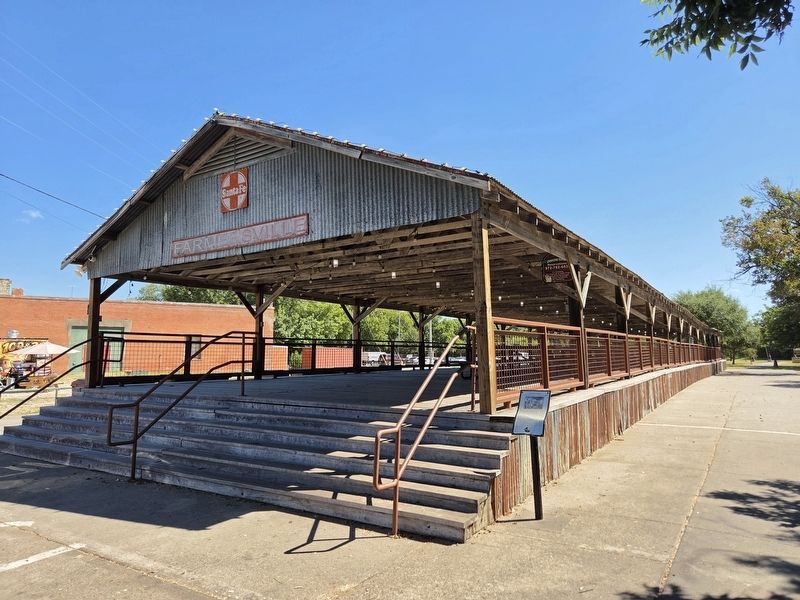
This historic Onion Shed, restored in 2002, was one of several onion sheds in Farmersville, built by the railroads for the packing and shipping of the Collin County Sweets. In 1925 local farmers began planting onion crops, and by 1935 Farmersville . . . — — Map (db m309846) HM
A pioneer leader of North Texas and signer of the Texas Declaration of Independence, Collin McKinney was born in New Jersey, a son of Scottish immigrant parents. In 1780 the family moved to Kentucky and in 1824 McKinney migrated across the Red River . . . — — Map (db m194697) HM
Texas patriot and statesman One of committee of five that wrote the Texas Declaration of Independence, one of its fifty-nine signers, March 2, 1836. Served in House of Representatives, Republic of Texas. In recognition of his distinguished service . . . — — Map (db m171045) HM
On March 11, 1848, Ebenezer Allen, former Republic of Texas Attorney General, obtained a charter for the Galveston and Red River Railway. Track construction began in early 1856, and the company was renamed Houston & Texas Central (H&TC) Railway . . . — — Map (db m220383) HM
Born in Wilson County, Tennessee, George Washington Smith came to Texas in 1834 with his wife Elizabeth Briggs. He fought in the Texas War for Independence (1835-36) as a private in Capt. Clendennin’s Company 1st Regiment Artillery. In the Mexican . . . — — Map (db m163227) HM
Herring Hogge Cemetery on South Murphy road and Skyline was established in the 1870's and contains the graves of the Herring, Hogge, and McAmis families who were among the earliest settlers in Collin County. Daniel Herring (1812-1882) was born in . . . — — Map (db m246104) HM
In 1840 and 1842, Texas pioneers McBain Jamison and Jeremiah Muncey settled near this site. They were part of the post-Texas revolution wave of settlers. As with much of the West during that era, Texas was a wild and often savage place. While . . . — — Map (db m295818) HM
During its brief existence, the Congress of the Republic of Texas made significant efforts to plan for the inevitable increase in settlement. One of those efforts was the establishment of the Central National Road, designed to connect the Red River . . . — — Map (db m246080) HM
Designed by F.E. Ruffini, architect of numerous public buildings in Texas in the late 19th century, this High Victorian Italianate structure served as the Collin County prison for 99 years. Completed in 1880, it was modified in 1938 with funds . . . — — Map (db m142823) HM
Fertile land and plentiful water drew settlers to this area from as early as the 1840s. This part of Collin County was well populated by 1876 when the Houston and Texas Central Railroad built a water supply stop on Cottonwood Creek near this site. . . . — — Map (db m220381) HM
On March 2, 1836, members of the Convention of 1836 signed the Texas Declaration of Independence at Washington-on-the-Brazos, declaring Texas independent from Mexico. Of the 59 signers, five were from Red River County, more than from any of the . . . — — Map (db m96900) HM
Farmersville is one of the oldest towns in Collin County. It has historic ties to the antebellum (pre-Civil War) era of Texas and the pioneer settlement of Sugar Hill (1.5 mi. NE), founded by John Yeary. The center of settlement soon shifted to . . . — — Map (db m163056) HM
James Newton Rayzor was born December 10, 1858 in Lockport, Kentucky. He immigrated to Texas in the fall of 1866 with his family and settled in Collin County. In 1871, the family moved to Cooke County where Rayzor later taught school at Prairie . . . — — Map (db m178608) HM
James Anderson and his wife, Elizabeth Caroline Barnard, natives of Buncombe County, North Carolina, married there in 1821 The couple had 15 children. Anderson was a farmer and in 1835 migrated to Missouri. He joined the Mercer Colony and migrated . . . — — Map (db m203268) HM
Allen was platted by surveyor Theodore Kosse in 1876 for the Houston & Texas Central Railway, formerly known as the Galveston-Red River Railway. It was named for former Texas Attorney General and railroad promoter Ebenezer Allen. Nearby Cottonwood . . . — — Map (db m310145) HM
Among the stock brought to Texas by Jones, Greene and Middleton M. Perry, sons-in-law of Thomas McKee Ellis, was a yearly colt, nondescript in appearance except for lines which suggested to the two farmers and stockmen that he might develop into a . . . — — Map (db m300535) HM
In the 1850s, North Texas attracted settlers from border states like Kentucky with the promise of inexpensive land for farming and stock raising. One such man was Dr. William Dixon Lair (1814-1887), a pioneer physician, former Kentucky state . . . — — Map (db m309928) HM
James Calvin Rhea (1837-1925) came to Texas from Tennessee in 1855. He and his brother, W.A. Rhea, built a gristmill in the Collin County community that became known as Rhea Mills. Built about 1890 by John W. Hamilton, this home features Eastlake . . . — — Map (db m167835) HM
This vernacular style house was built c. 1868 by James Waller Thomas, an early civic leader in Collin County, for his family of 13. Originally a one-room residence, the house has not been substantially modified since 1902. It reflects the modest . . . — — Map (db m170536) HM
Fixing Up Farmland
In 1950, Plano had 2,126 residents. The city's population began to grow when new companies opened plants in Plano. In 1958, the North Central Expressway was completed. With business booming for Texas Instruments in . . . — — Map (db m264893) HM
Brothers Jacob, George Washington, Joseph and Thomas Jefferson Routh, and their sister Elizabeth Routh Thomas, were cousins of the Vance Family which held the original land grant that encompassed this site. Jacob Routh (1818-1879), a Baptist . . . — — Map (db m228147) HM
A native of Maryland, Charles C. Stibbens came to Texas about 1835. He served in the Army during the Texas Revolution, participating in the Battle of San Jacinto. He settled in Anderson County soon after the war and worked as a farmer and . . . — — Map (db m246072) HM
William Myers (b.1753) and his wife Flora moved from Virginia to Kentucky, where the last of their ten children, David Myers, was born. David married fellow Kentuckian Letitia Reddish (1801-1885) in 1820. They moved to Indiana in 1829 and to . . . — — Map (db m145910) HM
A minister in the Primitive Baptist Church, the Rev. Henry Hurley came to Texas in 1844. His years in the state were spent organizing frontier churches and helping pioneers settle in new communities. He established churches in Hunt, Fannin and . . . — — Map (db m248536) HM
Screech Owls are the most common owls in Texas. These small, nocturnal birds are well adapted to suburban parks. Screech Owls are 6.3”-9.8” long with an 18.9”-24” wingspan at maturity, yet can eat over 1,000 mice a year. The owls are a great . . . — — Map (db m310153) HM
Elisha and Margaret Ann (Mannon) Chambers came to Texas from Indiana in 1847. Their infant son Lewis Cass Chambers died in 1853 and they donated the land on which he was interred for a cemetery and school. This site was once at the crossroads of a . . . — — Map (db m194598) HM
Samuel D. Rude
Born 1865 in Farmersville, Collin County, Texas. The son of I.J. and Sarah Alexander Rude. Married Sarah Pyeatt in 1888, to which union was born five children - Hester, Lela, Ike, Myrtle and Dorothy.
Homesteaded N.E. of . . . — — Map (db m289126) HM
In 1824, Hiram Brinlee (1807-1885) and his brother George traveled with the Collin McKinney family from Kentucky to Texas. On that wagon train was Elizabeth McKinney (1813-1889), niece and ward of Collin McKinney, who later signed the Texas . . . — — Map (db m263785) HM
Organized as the Melissa Baptist Church of Christ on Oct. 18, 1884, this congregation began with 22 charter members. Levi Dunn served as first pastor. The fellowship met once a month until 1898, when services began to be held twice monthly. Weekly . . . — — Map (db m194603) HM
This cemetery has been the primary burial ground for members of the Melissa community for generations. Its origin can be traced to the pioneer Sherley/Shirley family, although the specific date of its founding is unknown.
The oldest graves in . . . — — Map (db m194601) HM
The first schoolhouse to serve the residents of Melissa was constructed on land acquired in 1882 by trustees James Graves, John Gibson and George Fitzhugh, pioneer area settlers. Since the deed stated the property was to be used "Forever . . . — — Map (db m194671) HM
Worshiped in 1831 at McKinney's Landing, where the McKinney family and a small group of neighbors met together for informal services. During the winter of 1841-1842, a traveling preacher from Illinois, G. Gates, organized the congregation into a . . . — — Map (db m286697) HM
Originated 1849 as a settlement on the Jefferson-McKinney road, and near Republic of Texas National road. Named by pioneers for their chief occupation. After 1854, the Yearys and their neighbors of Sugar Hill (2 mi. NE) began relocating here. Dr. . . . — — Map (db m162995) HM
This historic onion shed, restored in 2002, was one of several onion sheds in Farmersville, built by the railroads for the packing and shipping of the Collin County Sweets. In 1925 local farmers began planting onion crops, and by 1935 Farmersville . . . — — Map (db m309841) HM
Pioneer home of T.J. Campbell. Built in Lebanon Tx. on Preston Road, 1869. Moved to Frisco to be on railroad and mail line, 1902.
Constructed of lumber hauled by wagon train from Jefferson. Has cypress siding and windows. Gingerbread added . . . — — Map (db m191450) HM
John (Jack) and Polly McGarrah and family came to this site from Tennessee in 1842. The third settler in present Collin County, McGarrah opened a trading post to barter for hides and furs. While in the act of building a family fort, he and his men . . . — — Map (db m162268) HM
Joseph Wilson Baines (1846-1906), son of Minister-Editor-Baylor University President George W. Baines, settled in Collin County in 1867. He taught school and in 1869 married Ruth Huffman, daughter of a physician of the Peters Colony. Baines read . . . — — Map (db m177567) HM
Two Steps Forward...
During the Reconstruction Era that followed the Civil War, the African American residents of Plano experienced segregation and racism. In 1898, a small group of white men who called themselves the White Caps tried to . . . — — Map (db m264711) HM
Plain Potential
The Republic of Texas gained its independence from Mexico in 1836. However, the population was so low that by 1841 the Texas Congress provided land to immigration agents. W.S. Peters was granted contracts for North Central . . . — — Map (db m264704) HM
"Gone to Texas" was the popular slogan for settlers during the 1830s who immigrated from numerous countries and states to the newly formed Republic of Texas (1836-1846). Although the Republic of Texas struggled, the desire for vast amounts of cheap . . . — — Map (db m285487) HM
Settlers traveling to this area of Texas after it opened for settlement as part of the Peters Colony found free land, clear spring water and plenty of timber. Those who decided to stay named it Lebanon and began to establish homes and farms. On . . . — — Map (db m191472) HM
Born in Louisiana; in 1850 came to Texas, where his father, Rev. Geo. W. Baines, founded a church newspaper and was president of Baylor University. Served in the Williamson Cadets, in Civil War.
Lived in Collin County, 1867-1882. Married . . . — — Map (db m305380) HM
Liberty Christian Church (Disciples of Christ), one of the earliest Christian churches in Texas, was founded in northern Collin County by pioneer settlers Collin McKinney and J.B. Wilmeth in 1846. In 1854 a Christian seminary was established by . . . — — Map (db m194694) HM
Designed by architect J. H. Suttle, the 1911 McKinney Post Office is a characteristic and well-preserved example of an Italianate post office. The tile roof, ornamental columns, eaves and window configuration are common to the American post office . . . — — Map (db m164620) HM
According to the late Collin County Historian, Capt. Roy F. Hall, the two-room log cabin that once belonged to Republic of Texas colonist Thomas Jefferson McDonald is contained (in whole or in part) in the cottage behind this marker underneath two . . . — — Map (db m309723) HM
Built between 1897 and 1908 for the family of Judge Harvey Louis "H.L." (1861-1956) and Emma (Umphrees) Davis (d. 1949), this Transitional style residence features Prairie-style influences with a Sullivanesque frieze and Classical detailing with . . . — — Map (db m167884) HM
Entrepreneur Francis Emerson (1815-1905) founded a McKinney banking firm in 1869, which developed into the First National Bank in 1882. First National bought this site in 1912 and built this classical revival style building. Glazed bricks and . . . — — Map (db m173777) HM
This house was built in 1915 by George W. and Lula Fox. George Fox, the descendant of one of Collin County's pioneer families, was a local realtor and county official. Prominent local citizens Gibson and Goldie Caldwell purchased the house in . . . — — Map (db m170541) HM
John M. Martin (b. 1859), a member of an early Collin county family, was a local architect and builder who erected this house for himself about 1880. The structure exhibits elements of the Queen Anne style, including asymmetrical massing, wall . . . — — Map (db m170535) HM
Warren Tully Beverly (1857-1903) was a native of Collin County, attending Spring Creek School and Plano Institute. He studied law in the office of Joseph W. Baines, grandfather of Lyndon Baines Johnson. Beverly served as county attorney and later . . . — — Map (db m167889) HM
A surgeon in the Confederate Army, Dr. Joseph E. Dulaney (d. 1877) came to McKinney after the Civil War (1861-65) and married Lucy Ann Field (1844-1941), daughter of Collin County pioneers. In 1875 he built this Victorian home with its numerous . . . — — Map (db m164656) HM
North Carolina-born William B. Largent (1840-1896) came to Collin county with his parents in 1854. He later prospered as a livestock trader and lumber merchant. In 1876 he hauled building materials overland from Jefferson to erect this Victorian . . . — — Map (db m170546) HM
This cemetery served settlers of what was known as the McMinn community. Both the community and cemetery are named for John W. and Evaline McMinn, who settled in this area in 1849. They donated land for the cemetery in 1894, although the oldest . . . — — Map (db m264429) HM
In 1836 Dr. Daniel Rowlett (1786-1848), a Kentuckian, came to Texas with his wife and six other families. Rowlett, a physician, lawyer, surveyor, and politician, settled near present Bonham. He located much of his large 1838 land grant in the . . . — — Map (db m212321) HM
The largest of the thirteen cemeteries in the Plano area, Rowlett Creek Cemetery has more than 1250 gravesites and remains active. Ancestors of President Lyndon Baines Johnson are buried here amidst the gravesites of many early pioneers and their . . . — — Map (db m212324) HM
Known as the Broadway of America and one of the nation’s earliest transcontinental highways, the Bankhead highway was created through the Federal Aid Road Act of 1916. The roadway extended from Washington, D.C., to San Diego, California, by way of . . . — — Map (db m255645) HM
In the aftermath of the Civil War, plans were enacted for the Reconstruction of the Union with the creation of the Freedmen's Bureau in 1865, and the passages of the Civil Rights Act of 1866 and the Reconstruction Act of 1867. Texas would not . . . — — Map (db m282770) HM
This cemetery, which dates to the mid-19th century, is on land donated by early settler John Coffman (1804-1880). His son, George W. Coffman (1840-1913), owned and operated a homestead one mile west of this site. The oldest marked grave dates to . . . — — Map (db m72897) HM
The site of the former town of Frankford consists of the three-acre wagon yard, five-acre Frankford Church area and three-acre cemetery. The town of Frankford grew around Indian Springs after W.C. McKamy and his family moved to Texas in 1852. They . . . — — Map (db m93072) HM
Collin County was formed in 1846 and its only town, Buckner, was automatically selected as the county seat. To comply with state law, an election was held to relocate the county seat to the center of the county. Only eleven people participated due . . . — — Map (db m167861) HM
Built in the 1860s, the structure originally stood across the street from the site. It was sold in 1868 to Armistead Joshua Taylor (1840-1888), a cabinet maker. He married Tabatha Jane Scott, daughter of Collin County pioneer Preston Scott. The . . . — — Map (db m164671) HM
William Claiborne Parker, known to his friends as “Uncle Billy,” was the namesake of Parker Road and the community of Parker, Texas. Born June 6, 1836, in Mississippi, he was the oldest son of John W. Parker who journeyed to Collin County before . . . — — Map (db m309860) HM
In 1845, before Collin County was formed, Sam Young, a pioneer from Illinois, bought land in the Jacob Baccus survey. He established the Young Cemetery in 1847 when his first wife, Patience Cornell Young, died. Hers is the oldest marked grave in the . . . — — Map (db m264637) HM
Named indirectly for Simon Bolivar, South American statesman, general and patriot. It might have been called "New Prospect," but for a mug of rum. When town was founded in 1852, a man who had settled here from Bolivar, Tenn., wanted to name the . . . — — Map (db m194005) HM
Jeremiah H. Wilson, his wife, Elizabeth (Wilhite), and their three sons moved from Missouri to Texas in 1845, first settling in Collin County. Elizabeth's untimely death in 1853 left Jeremiah with seven children. Later marrying Melinda Flowers, he . . . — — Map (db m269127) HM
Collin County native Marvin E. Blackburn came to Junction in 1902 to serve as County Attorney, and he remained to practice law and serve as District Judge and four terms as a state legislator. He and his wife, Retta Ann (Daugherty), reared 11 . . . — — Map (db m235221) HM
Illustrious Texas Ranger for whom this county is named. Born in Kentucky; came to Texas 1876; became rancher-trail driver. Served in Texas Rangers 1882-1906. By order of the Governor, aided in preventing Fitzsimmons-Maher world title prize fight, . . . — — Map (db m288991) HM
Born near town of Paint Lick, Kentucky. Came to Collin County, Texas, 1858. Joined Confederate army at McKinney, October, 1861, as private in Army of Tennessee.
Served in five divisions. Was in Battle of Chickamauga; hurt at Murfreesboro, . . . — — Map (db m95975) HM
It has been said that the farmer’s barn was the most important structure on the farmstead, even more important than his own house. Barns served to store crops and protect animals, all essential to early settler’s survival.
The earliest barns . . . — — Map (db m310164) HM
The earliest citizens of Anna were determined that their children should have the best educational opportunities possible. Founded in 1883 with a population of twenty, Anna was named for the daughter of a Houston & Texas Central Railroad official. . . . — — Map (db m194695) HM
Located in northeast Collin County and positioned between Desert and Pilot Grove Creeks, Blue Ridge was named for its hilltop location and the blue-flowering grass in the area. From a distance, the grass looked like a blue haze. Pioneers began to . . . — — Map (db m185635) HM
In 1866 Moses and Mary Jane Hubbard and their daughter Alla moved from Missouri to Collin County, where Hubbard was a successful doctor, farmer, and one of the largest landholders in the area. Concerned with the inadequacy of the local school, the . . . — — Map (db m194794) HM
Established in 1905, Chambersville Methodist Church has served this community for more than 100 years. From Chambersville's founding in 1847 until the church's organization, residents attended non denominational services in various locations. J.M. . . . — — Map (db m194599) HM
Kentucky native John Miles Cope, who settled in Collin County in 1848 with his parents and brother, helped organize the Copeville community (originally known as Black Spot) in the 1850s on land in the Willis Roberts and Hezekiah Walters surveys. . . . — — Map (db m164610) HM
This two-story house was originally built in 1895 by Nannie Chambers Crozier in Lebanon, a community near the present-day intersection of Preston Road and John Hickman Parkway. The house’s foundation is made of bois d’arc tree stumps. Its . . . — — Map (db m309769) HM
In 1847, the Rogers brothers traveled 14 weeks from their home in Bethel, Tenn., to Texas. Settling along Panther Creek, they named their new home Bethel, which became a popular campground for pioneers and known for its brush arbors. Brush arbors . . . — — Map (db m309913) HM
John Abston (1761-1856), a soldier in the American Revolution, was a native of Virginia. In the 1830s Abston and his family moved to Missouri. In 1853 he moved to Collin County, Texas, with the family of his son Jesse. Following Jesse's death that . . . — — Map (db m164617) HM
Edward Bradley, his wife Nancy, and their family came to this area from Kentucky in the 1840s as members of the Peters Colony. They built a log home of a branch of Wilson's Creek in the southwest part of present McKinney. A hillside near the . . . — — Map (db m170531) HM
Elisha and Margaret (Peggy) Ann Mannon Chambers immigrated to Texas in 1847 with their seven children. Elisha took up two headrights in Collin and Dallas counties, donating a piece of his homestead for the creation of a cemetery and a school in . . . — — Map (db m307870) HM
This financial institution was organized on March 13, 1883, by a number of McKinney's prominent citizens and businessmen. Among those financial pioneers were James W. Throckmorton, who had served as governor of Texas in 1866 and 1867; G.A. Foote, . . . — — Map (db m167859) HM
Located in south central Collin County, Wylie and Nickelville began as settlements on the west side of the east fork of the Trinity River. Pioneers began arriving in the area in the early 1850s, attracted by the plentiful water supply from the . . . — — Map (db m164633) HM
The City of Josephine began as a gift when the St. Louis Southwestern Railway began construction in the area in 1887. Jesse Hubbard donated four acres of land for the construction of a new town to be named after his daughter. The prior settlement of . . . — — Map (db m246086) HM
Augustus M. Wilson was a self-made man who lived in Collin County nearly his whole life, giving his fortune away to needy community members. He was born in 1845 in Tennessee and moved with his parents and six siblings to Collin County in 1849. He . . . — — Map (db m246068) HM
All that remains of the Highland community is this corner post from Uncle Charlie Wysong's blacksmith shop and Highland Cemetery. From 1851-1884, the Wysong blacksmith shop was located on the Wysong's "Old Highland Farm", a "Texas Century Farm". . . . — — Map (db m194677) HM
In 1855, William Orenduff (1807-1892) and his wife, Mary E. Orenduff (1808-1859), traveled by wagon train from Breckinridge County, Kentucky, and settled in an area of Collin County later called the Trinity community, due to its proximity to the . . . — — Map (db m264341) HM
Among the earliest graveyards in Collin County, this cemetery traces its beginnings to 1852 when Dr. Lillie was buried on land belonging to his uncle William Forman. A Kentucky native, Forman came to Texas about 1850 and bought 640 acres in 1851 . . . — — Map (db m245918) HM
This site was the homeplace of one of Melissa’s leading citizens, John H. Mallow (1860-1953), and wife Dollie Rattan Mallow (1862-1946).
A lifelong resident of Collin County, he was a farmer, raised and sold registered pedigreed Poland-China . . . — — Map (db m309722) HM
Settlement in Collin County grew substantially from 1840-1860, and although citizens were mostly farmers, the majority of farms were small, and cotton harvest was of little significance. There was little incentive for farmers to plant cotton since . . . — — Map (db m309862) HM
The Trail Boss was responsible for leading the cattle drive to market. A hard delivered by contract drovers typically
consisted of as many as 3,000 head of cattle and employed
about eleven persons.
Most days were uneventful. Drudgery was . . . — — Map (db m214281) HM
In 1887 Rev. J. M. Hayder founded a school of higher learning in Northeast Collin County known as Seven Points College. The surrounding community was also called Seven Points. Five years later, in 1892, the school was sold to J. P. Rosser, and . . . — — Map (db m309836) HM
Thin black lines indicate changes in relevance. Between each pair of lines entries are ordered geographically but all have the same relevance.
* Inflectional forms of words are their plurals, singulars, and possessives as well as gramatical tenses and similar variations.