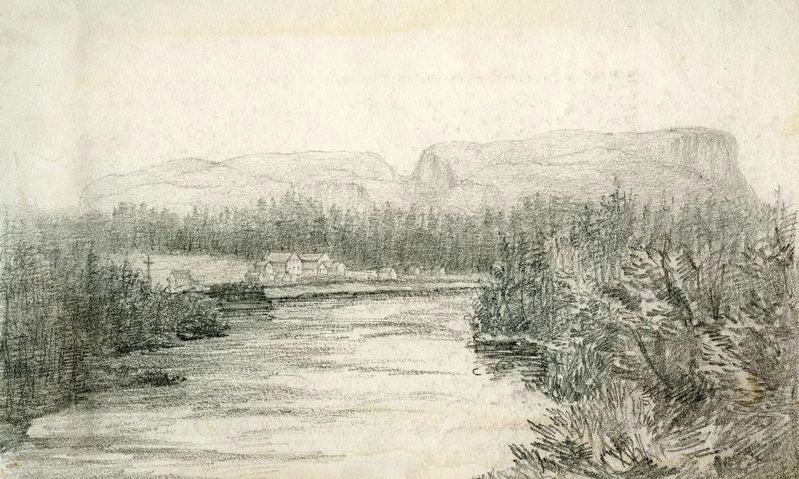
In 1849 two priests of the Society of Jesus, Father Jean-Pierre Choné and Father Nicholas Frémiot, established the Mission of the Immaculate Conception on the Kaministiquia River. From there the Jesuits travelled the north shore of Lake Superior on . . . — — Map (db m199599) HM
[English] The mouth of the Pic River has been a center of native trade and settlement for thousands of years. It was a strategic location in the region's water transportation network because it offered access to . . . — — Map (db m255197) HM
This chain of rivers, lakes and portages linking the St. Lawrence system with the waterways of the prairies had been known to the Indians for centuries when Jacques de Noyon first travelled it in 1688. After 1800, when the boundary settlement had . . . — — Map (db m106543) HM
This portage around Kakabeka Falls formed a link in the historic Kaministiquia canoe route connecting Lake Superior with Lake of the Woods and the West. First recorded in 1688 by the French explorer Jacques de Noyon, it was later abandoned in . . . — — Map (db m106547) HM
[top marker]Erected by the Corporation of the Township of Oliver in permanent commemoration of the Centennial of Confederation in Canada in 1967. Construction was made possible through the co-operation of the Province of . . . — — Map (db m255499) HM
The Oliver Agricultural Society was formed in 1890 and held the first Murillo Fair in October 1891. The first executive was Robert McKenzie — President, Owen Duross — Secretary/Treasurer. Our Agricultural Fair has been held on this location for 100 . . . — — Map (db m255497) HM
In the late 1860s the need to develop a local agricultural base to serve the growing population of the Thunder Bay region became apparent, and when the 1873 survey of Oliver Township indicated that it contained good agricultural land, attention . . . — — Map (db m255550) HM
[English] A solitary path The Nipigon River is the traditional gateway from Lake Superior to the fur rich Arctic watershed. By 1885, the area was dramatically altered when the Canadian Pacific Railway finished the "Nipigon gap" . . . — — Map (db m244764) HM
The first church in Nipigon, St. Mary the Virgin, was built in 1888, under the guidance of Reverend Robert Renison. Local people contributed about $250 toward construction, and tourists and visitors donated as well. Its solid log foundation has . . . — — Map (db m244509) HM
Look around. What appears to be a natural stream is actually the result of careful planning and bio-engineering. Clearwater Creek was home to a spawning run of Lake Superior coaster brook trout and flowed into the Nipigon River just north of . . . — — Map (db m244597) HM
After considerable negotiations for an appropriate site, school trustees settled on this location for the new building, known as The Consolidated School. It was completed in 1923 at a cost of $35,000. By 1925, the school included high school . . . — — Map (db m244520) HM
In 1920, a group of Nipigon residents formed the Consumers Co-op store to try to control rising food and clothing prices. For the sum of five dollars, an individual could buy one share in the co-op. The store opened in 1926, and served the . . . — — Map (db m222197) HM
The Hudson’s Bay Company had the contract for postal service in Nipigon until 1916 when Alice Barker, a schoolteacher from Rossport, became postmistress. At that time, the post office was moved into a 315 square foot frame building on this site. . . . — — Map (db m244529) HM
The Hudson’s Bay Company sold this property to the Diocese of Algoma, Church of England in 1908 for the sum of two dollars so that a house could be built for the Anglican minister. Using balloon construction with British Columbia fir and nine-foot . . . — — Map (db m244544) HM
In the early 1890's, a meeting was called to organize school for the local children. Businessman William McKirdy was elected the chairman of the board. By 1893, the first school in Nipigon was built on a double plot purchased for $250 from the . . . — — Map (db m244546) HM
This house built in French Provincial style using a post and beam construction may well be the oldest residence in Nipigon. All the ceilings, walls, and floors are made with tongue-and-groove hardwood. The original insulation was birch bark and . . . — — Map (db m222201) HM
This log home was originally built to be a hay barn by Arvu Paju on Maatas Road about 1920. It was purchased by the Robert Fraser family, and hauled to town in 1924. Robert converted the barn into a home for his family. A blacksmith by trade, he . . . — — Map (db m244570) HM
With the arrival of the Canadian Pacific Railway in 1885, trading and commerce began to shift away from the river to the railway due to increased efficiency and cost competitiveness. By 1898, Hudson Bay Company replaced the river post with a new . . . — — Map (db m222220) HM
Although this structure looks like a typical office building, it began its history as the Nipigon Presbyterian Church in 1899. William McKirdy built the wooden pews, and his wife Georgina played the organ, taught Sunday school and formed a Ladies . . . — — Map (db m244589) HM
This plaque was erected to commemorate the many humanitarian gifts made for the benefit of the citizens of Nipigon by John Salo, who was born in Finland and came to Canada in 1905, taking up residence here one year later. Following his retirement . . . — — Map (db m244598) HM
Under the modern exterior of this building is the oldest log home still standing in Nipigon. Built in 1887, it changed hands a number of times before 1925, when William and Georgina McKirdy took possession. William, the owner of the first . . . — — Map (db m244593) HM
The shop where high school students buy corsages for their dates in 2002 is the very building that housed those on the wrong side of the law at the beginning of the last century. When the Township of Nipigon became incorporated in 1909, the . . . — — Map (db m222199) HM
[English] Indigenous peoples who hunted and traded here thousands of years ago developed a water route by which they could travel from Lake Superior to James Bay via Lake Nipigon and the Albany River. Archaeologists . . . — — Map (db m255199) HM
Nipigon Historical Museum Nipigon’s first museum was built in 1904 as an engineering office building for the Canadian Northern Railroad. Dr. Herman Bryan, the first doctor in town, arrived in 1905 to look after the railway workers and took up . . . — — Map (db m244600) HM
In 1925, Arvo Paju built the Nipigon Service Garage, the first garage in town. It was also the Imperial Esso Service Station and the General Motors Dealership. In the early 1930s, Charles and Frank Gerlach bought the business. It stayed in their . . . — — Map (db m244599) HM
The first permanent trading post in the area was established by Claude Greysolon in 1678 near the location of the present railway bridge. Some 180 years later, the Hudson's Bay Company built Red Rock Post to keep independent fur traders from . . . — — Map (db m244596) HM
This site has a rich history with many successful businesses owned by such well-known people as Hogan, the Revillon Brothers, Sanderson, Gentile and Defazzio, Zechner and Everett. The Revillon Brothers Limited established one of the first stores . . . — — Map (db m222219) HM
Situated on this large corner lot with beautifully landscaped gardens, this home was originally a three-story hotel and boarding house called the Skandia House. Built in 1909 by the Olsen Brothers, the cement blocks used in the construction were . . . — — Map (db m244595) HM
This Jesuit mission, initially called OPOO-GAN-ASIN (Pipestone) was established in 1852 and the first Mass was celebrated on February 29 in the Hudson’s Bay Company barn. Located on an old fur trade route, the Lake Helen area has often been the . . . — — Map (db m255339) HM
Located right on the old Trans Canada highway is the Nipigon Cafe, an outstanding example of classic art moderne and a fixture on the scene since the 1930s. Sandy and Lilly Kuorikoski, the original proprietors operated a garage at this location . . . — — Map (db m222196) HM
The Nipigon Inn has been a fixture on the main street for more years than anyone can remember. It is unclear what year the hotel was constructed, but early photos show that the original inn may have been built in the early part of the 20th century. . . . — — Map (db m222221) HM
Men, machines, water and wood came together in 1900 but it was 1938 before any company was able to drive the entire length of the Nipigon River. From 14,000 cords then to as much as 400,000 cords later, pulp wood has journeyed downstream to the . . . — — Map (db m222198) HM
The Old Nipigon CP railway station, built in 1929, existed on mid-Front St. It was demolished in Oct. 1982 despite a valiant effort to save it by a local committee. ‘Racing the train’ July 16, ‘92 — — Map (db m222200) HM
Here is the site of the Ovilio Hotel. For 59 years, descendants of the Gentile Family kept the establishment going originally began by Dominic and Maria Gentile in the early 1920s. The establishment first started with the construction of living . . . — — Map (db m222218) HM
This property has been a resting place for travelers for more than one hundred years. The Taylor House, a large wood frame rooming house, was built on this site circa 1890. It was later known as the “Travellers and Tourists House.” Pete Prete . . . — — Map (db m244738) HM
History: In 1915 Dr. Cook caught the world record brook trout, 14 lbs. 8 oz. (6.58 Kg) in the Nipigon River. Today, anglers still travel to Nipigon from around the world to fish for trophy brook trout. Brook trout from 5 lbs. to 8 lbs. are . . . — — Map (db m244594) HM
This turbine runner was from generating unit #2 at Cameron Falls Generating Station. The generating unit #2 was placed in service on December 20th 1920, and remains in service today. In 1988, the turbine runner was replaced with a new stainless . . . — — Map (db m244571) HM
This picturesque little church dates back to 1906 when it was the first Catholic Church in Nipigon. The main body of the church seats about 70 people and a small gallery holds about 15 more. Its original location was the southwest corner of Second . . . — — Map (db m244792) HM
In 1950, archaeological investigations in this area uncovered a site which had been used as a workshop camp by a group of the earliest known people in this part of the Upper Great Lakes basin. Called Aqua-Plano Indians because they migrated from . . . — — Map (db m261869) HM
In 1924, Sibley Township was set aside for settlement by Danish homesteaders. Eager to take advantage of the opportunity to own land, many Danish immigrants underwent great trials to clear land and build houses in the region. One of the newcomers' . . . — — Map (db m261796) HM
In 1897, Sir Sandford Fleming was knighted for his proposal outlining a worldwide uniform system for reckoning time. Fleming’s concept of Standard Time brought him immediate international recognition. A brilliant energetic innovator, Fleming’s many . . . — — Map (db m237384) HM
In the early days lakes and rivers took the place of roads. The dotted green line shows part of the first Highway across Canada. This was a very renowned canoe route used by the Indians, celebrated explorers, traders, and missionaries. It was first . . . — — Map (db m237391) HM
In 1937, the original CNR station, was a converted rail car, which was situated on the right hand side of the track heading out of town and about 50 to 100 feet down the tracks, west of the road. It was on the opposite side of the tracks from where . . . — — Map (db m262641) HM
The CPR station was once active 24 hours per day with tons of freight and express handled. Products were shipped to and from the paper mill here. Incoming and outgoing telegrams were handled by the agent in the early years, as well as the mail . . . — — Map (db m262646) HM
The Red Rock Fish and Game Club was one of the first clubs organized in Red Rock. The club's first meeting was held on March 21, 1947 in the schoolroom of the Inn, with 25 men present. The original clubhouse was an old donated building given to the . . . — — Map (db m262656) HM
In 1948, the Red Rock Athletic and Recreation Council constructed a road to the shore of the bay establishing a beach and picnic grounds. The Fish and Game Club was not far from the beach area. In 1967, a Centennial Park Project was spearheaded by . . . — — Map (db m262658) HM
Red Rock’s future as a pulp and paper town began with the Lake Sulphite Pulp Company’s purchase of property in 1936. The Company started construction of the mill and bunkhouses, completed 20 houses near the mill site, and constructed the Red Rock . . . — — Map (db m262653) HM
History: In 1915 Dr. Cook caught the world record brook trout, 14 lbs. 8 oz. (6.58 Kg) in the Nipigon River. Today, anglers still travel to Nipigon from around the world to fish for trophy brook trout. Brook trout from 5 lbs. to 8 lbs. are . . . — — Map (db m272894) HM
During the Second World War, the federal government forcibly evacuated Canadians of Japanese ancestry from the coast of British Columbia. In the spring of 1942, several hundred young men were sent to Ontario to help build the Trans-Canada Highway. . . . — — Map (db m107384) HM
Arthur Birch • Christopher Christopher • Willard C. Daniels • Walter Davidson • Charles L. Edmunds • William E. Farley • Clen Hulme • Alexander L. McKenzie • Sidney Marple • Clifford Pope • Frederick T. Riley • Stanley C. Reed • Ambrose St. Jean • . . . — — Map (db m195907) WM
This community, originally known as Isbester's Landing, was named in 1885 after Collingwood G. Schreiber. Born at Bradwell Lodge, near Colchester, England, Schreiber emigrated to Canada West in 1852. His training in England as a civil engineer . . . — — Map (db m107382) HM
Off this shore lies Silver Islet, once a barren rock, measuring about eighty feet in diameter, where silver was discovered in 1868 by Thomas Macfarlane. The claim was purchased in 1870 by a company headed by A.H. Sibley, and one of the partners, . . . — — Map (db m261875) HM
Near here in 1882, Daunais made his first important discovery, the Rabbit Mountain Silver Mine. One of the best-known prospectors and mining promoters of his day, he was born at St. Ours, Quebec, and came to this region about 1870. Among other . . . — — Map (db m261697) HM
About 20,000 years ago Ontario was covered by a great glacier, the fourth glaciation in this region within the past million years. The meltwaters from these gigantic ice-sheets filled the Lake Superior basin and progressively developed new drainage . . . — — Map (db m107567) HM
Thunder Bay’s annual 10-Mile Road Race in May is one of the oldest foot races in Canada. First run in 1910 through the streets of Fort William and Port Arthur, it effectively linked the two rival cities. Created to encourage “healthy and clean . . . — — Map (db m244243) HM
The Court Street Fire Hall, built in 1906, was designed by Port Arthur Architect, Thomas Hanley. The brick two-storey structure was designed for horse-drawn fire wagons with access provided by four round-arched wooden doors. A one-storey tower at . . . — — Map (db m227985) HM
This Edwardian-style building was designed by Robert E. Mason, and constructed by Michael Braden in 1910 as a court house and police station combined. The placement of the two pilasters on the façade creates the impression that four columns exist . . . — — Map (db m227965) HM
Origin Stories The rock, the water, the oral traditions of the First Nations: Each tells its own tale about the origins of this shoreline site, but all speak of a place that is ancient. Geologists talk in terms of glaciers. The first . . . — — Map (db m227996) HM
Constructed in 1912 by Seaman and Penniman, this single span bridge was designed by Joachim Antonisen to harmonize with the beauty and grandeur of the landscape. Featuring arch ribs and open spandrels, its unadorned functionalism and use of . . . — — Map (db m195890) HM
The dynamic "Minister of Everything", Massachusetts-born Clarence Decatur Howe immigrated to Canada in 1908 and established an engineering firm in Port Arthur in 1916. Elected to the House of Commons in 1935, he was a dominate figure in Liberal . . . — — Map (db m107352) HM
"Can Car" was the main plant of Canada's largest aircraft manufacturer during the Second World War. Here, workers built 1,451 of the reliable Hawker Hurricanes that won renown in the battle of Britain and 835 Curtiss Helldivers, significantly . . . — — Map (db m106692) HM
Thunder Bay’s Stone Frigate Her Majesty's Canadian Ship Griffon was launched modestly, in a leased garage a few blocks from this waterfront with its White Ensign flying from a tree trunk felled in the bush. But from the start, . . . — — Map (db m227989) HM
Joining rail and water transportation, this station, which was built in 1905 at Port Arthur and which formed the end of the line from Winnipeg, was designed in what was commonly called the Canadian Railway style by Winnipeg architect, R.B. Pratt. . . . — — Map (db m227999) HM
Designed by Robert J. Edwards, the school was erected in 1884. In 1901, an eight-room classroom structure, designed by C.W. Wheeler, was added. The two-storey brick structure has a symmetrical facade and the straightforward design is ornamented . . . — — Map (db m195889) HM
Thunder Bay's current city hall had two predecessors. The first (visible at right) was built in 1893. It housed Fort William's civic offices and served as a venue for community events and entertainments. It also accommodated Fort William's . . . — — Map (db m244242) HM
This celebrated Canadian army nurse and public health authority was born in Port Arthur. In 1909 "Beth" Smellie became night supervisor at McKellar General Hospital. Joining the Royal Canadian Army Medical Corps in 1915, she served in France and . . . — — Map (db m106976) HM
Tree Planted by The Honourable Lynn McLeod and Jack Adderly in 1990 to commemorate the 100 millionth tree planted by Abitibi-Price Inc. in Ontario — — Map (db m243999) HM
This square was named in 1936 for Prince Arthur, Duke of Connaught, third son of Queen Victoria. He was serving in Canada with his regiment in 1870, when Colonel Wolseley named Prince Arthur's Landing (later Port Arthur) in his honour. Created Duke . . . — — Map (db m107067) HM
At least 9,000 years old, the Cummins site is one of the most significant of several Palaeo-Indian archaeological sites that form the Lakehead Complex. Many of these early seasonal camps were located on the shoreline of ancient Lake Minong, at a . . . — — Map (db m106858) HM
Elsie MacGill made remarkable contributions to aeronautical engineering by introducing mass-production techniques for the Hawker Hurricane built here during the Second World War and later by developing international air-worthiness regulations. . . . — — Map (db m106696) HM
A small fort was established near here in 1717 by a French officer, Zacharie Robutel de la Nouë. First of a projected series of bases en route to the "Western Sea", it replaced a structure built in 1679 by Daniel Greysolon, Sieur Dulhut, on another . . . — — Map (db m106760) HM
In aboriginal times the Kaministikwia river was an important link between the Great Lakes and the northwest, and from the late 17th century French posts here at its mouth served as bases for the penetration of the interior. Between 1804 and 1821 . . . — — Map (db m106755) HM
When the boundary settlement of 1783 placed its major inland depot, Grand Portage, in U.S. territory, the North West Company was forced to seek a new site on British soil. Following the reopening of the Kaministikwia route a new post, later named . . . — — Map (db m106757) HM
It was here on June 11, 1923, that the General Assembly of The Presbyterian Church in Canada, after two days of vigorous debate, voted decisively in favour of the Presbyterians uniting with the Methodists and the Congregationalists to form the . . . — — Map (db m227975) HM
This historic stone was embossed with the letters C.P.R. in 1907 for display under the peak of the roof of the Canadian Pacific Railway Station at Port Arthur. Commonly called Tyndall stone, it is dolomitic limestone weighing 1500 pounds and comes . . . — — Map (db m228000) HM
The fountain was a gift to the City of Port Arthur from Mrs. Madge Hogarth in honour of her husband Major General D. M. Hogarth, an early industrialist, sportsman, soldier and politician. Originally from Luton Hoo Mansion, Hitchen, Hertfordshire, . . . — — Map (db m244244) HM
A.L. McGovern • R.H. Clarke • C. Vincent • B. Clavet • J. Jeffs • J. Heffernan • J. Morrison • C. King • J. Bougie • W. Jeffs • E. J. McCartney • J. Audray • H. Nadon • M. Sauve • P.J. Moriarty • R. Taylor • J. Deagle • A. Pariseau • W. Malott • N. . . . — — Map (db m244104) WM
Cathedrals, Pyramids and Hospitals Canada's famous photographer Yousuf Karsh called them cathedrals. Europe's most influential architects compared them to the pyramids. At one time, there were 29 grain elevators on this waterfront. . . . — — Map (db m227991) HM
A Joint Venture of the Peng You Taiji Quan Association and The City of Thunder Bay: Martial Arts Capital of Canada Taiji (or Tai Chi) an ancient Chinese martial art — a form of wushu — is performed with slow, carefully controlled movements . . . — — Map (db m243796) HM
In response to a brief from Lakehead educators and business representatives outlining northwestern Ontario's need for an institution of higher education, a provincial Order-in-Council established the Lakehead Technical Institute in 1946. Two years . . . — — Map (db m106857) HM
Live theatre has been part of life at the Lakehead since the 1800s. Many amateur companies performed dramas, comedies and even full-fledged operas. In addition, professional troupes made regular stops here, nurturing a wide audience base. The . . . — — Map (db m243798) HM
Paddling to the Depot Bark peeled from a birch tree felled in spring. Cedar branches, tamarack roots, spruce pitch, and charcoal. From those materials, the first mariners of Lake Superior — the ancestors of the present-day First . . . — — Map (db m227995) HM
[English] On Thunder Bay just north of Fort William, engineer Simon Dawson established the eastern terminus of the Canadian government's proposed land and water route connecting Lake Superior and the Red River, for . . . — — Map (db m199597) HM
For many decades, lake commerce was the life's blood of the community and the focus of much business activity. Port Arthur and Fort William, which joined in 1970 to become Thunder Bay, once fought over who had the better harbour. But things changed . . . — — Map (db m243799) HM
Erected in commemoration of the men and women of this city who died on the field of honour in war that Canada might maintain her heritage of freedom 1914-1918 1939-1945 1950-1953 — — Map (db m244241) WM
Designed by Henry Simpson of Toronto with George H. Otto, general contractor, this structure was built in 1909 with classrooms being added in 1925, 1954, and a new gymnasium in 1972. The original design has medieval and Flemish architectural . . . — — Map (db m195886) HM
The First Highway to the West Continents and oceans, geography and history, the Great Lakes and the inland waterways: they all meet here, on this waterfront, at the mouth of a river called the Kaministiquia. The name has been . . . — — Map (db m227997) HM
[English] On November 18, 1929, Finnish-Canadians Viljo Rosvall and Janne Voutilainen left the Port Arthur-area for Onion Lake, 20 kilometres upstream from here, to recruit bushworkers for a strike. Their bodies were . . . — — Map (db m261000) HM
Born in Scotland, Dawson emigrated to Canada as a young man and began his career as a civil engineer. In 1857 as a member of a Canadian government expedition, he surveyed a line of road from the Lakehead to Fort Garry and in 1858-59 further . . . — — Map (db m106859) HM
Born in Chelsea, Illinois, Van Horne, after a brilliant career with a number of railway companies in the mid-western United States, accepted the position of general manager of the Canadian Pacific Railway in 1881. Construction of this pioneer . . . — — Map (db m107350) HM
"Dreams are made if people only try. I believe in miracles... I have to... Because somewhere the hurting must stop." Terry Fox inspired this nation with his dream - his MARATHON OF HOPE - a cross-Canada run to raise money for cancer research. . . . — — Map (db m107355) HM
While in remission from cancer, Terry Fox set out to run across Canada in 1980 to raise money for cancer research. Despite having lost his right leg to the disease, this determined athlete ran 5,373 kilometres - nearly a marathon a day for 143 . . . — — Map (db m107354) HM
This boulder composed of 15 tonnes of massive copper, zinc, and lead ore with gold and silver values was discovered in Aldina Twp. west of Thunder Bay by local prospector Dan Calvert. It symbolizes the significance of the mining industry to the . . . — — Map (db m244000) HM
In 1812, the Earl of Selkirk settled dispossessed Scottish highlanders on Red River valley lands granted by the Hudson's Bay Company. The HBC's rival in the fur trade, the North West Company, feared the new colony would block its trade and . . . — — Map (db m106761) HM
This Armoury is dedicated to the memory of Major Christopher Patrick John O'Kelly, VC, MC of the 52nd (New Ontario) Battalion, Canadian Expeditionary Force. The then Captain O’Kelly was awarded the Victoria Cross for his actions at the Battle of . . . — — Map (db m227998) HM WM
[original] The “Saga of the Stone” began and ended with the efforts of Thunder Bay pioneer and park founder Sterling Lysnes. His efforts brought the Larvikite Stone from Norway to Thunder Bay to celebrate the contribution of . . . — — Map (db m272700) HM
The “new” Ottawa House was rebuilt on this site in 1888, after fire had destroyed two wooden hotels built earlier in the decade. A major addition was made in 1901, with the architectural detailing carefully matched. The façade features ornate . . . — — Map (db m227961) HM
114 entries matched your criteria. The first 100 are listed above. The final 14 ⊳